What is a Pipe Shoe? Its Types and Functions Explained
In my 20 years of managing piping stress analysis and field installations, I have seen simple support failures shut down entire process units. One of the most common culprits is the incorrect specification or installation of a pipe shoe. When process fluids run at extreme temperatures, pipes expand and contract dynamically. Without a robust shoe to elevate the pipe and transfer these loads safely to the structural steel, your insulation tears, moisture ingress causes corrosion under insulation (CUI), and localized stress concentrations can lead to catastrophic pipe wall failure.
Understanding how to select, design, and inspect these components is not just a theoretical exercise; it is a fundamental requirement for plant reliability. Whether you are dealing with cryogenic liquefied natural gas (LNG) lines or superheated steam systems, the humble shoe acts as the primary interface between your dynamic piping system and your static civil structures.
- Learn the primary mechanical functions of a pipe shoe in industrial piping networks.
- Identify the differences between welded, clamped, and insulated shoe designs.
- Understand the stress distribution and thermal expansion calculations required for proper support selection.
- Access field-proven inspection checklists to prevent common installation errors.
Complete Course on
Piping Engineering
Check Now
Key Features
- 125+ Hours Content
- 500+ Recorded Lectures
- 20+ Years Exp.
- Lifetime Access
Coverage
- Codes & Standards
- Layouts & Design
- Material Eng.
- Stress Analysis
Understanding the Core Functions of a Pipe Shoe
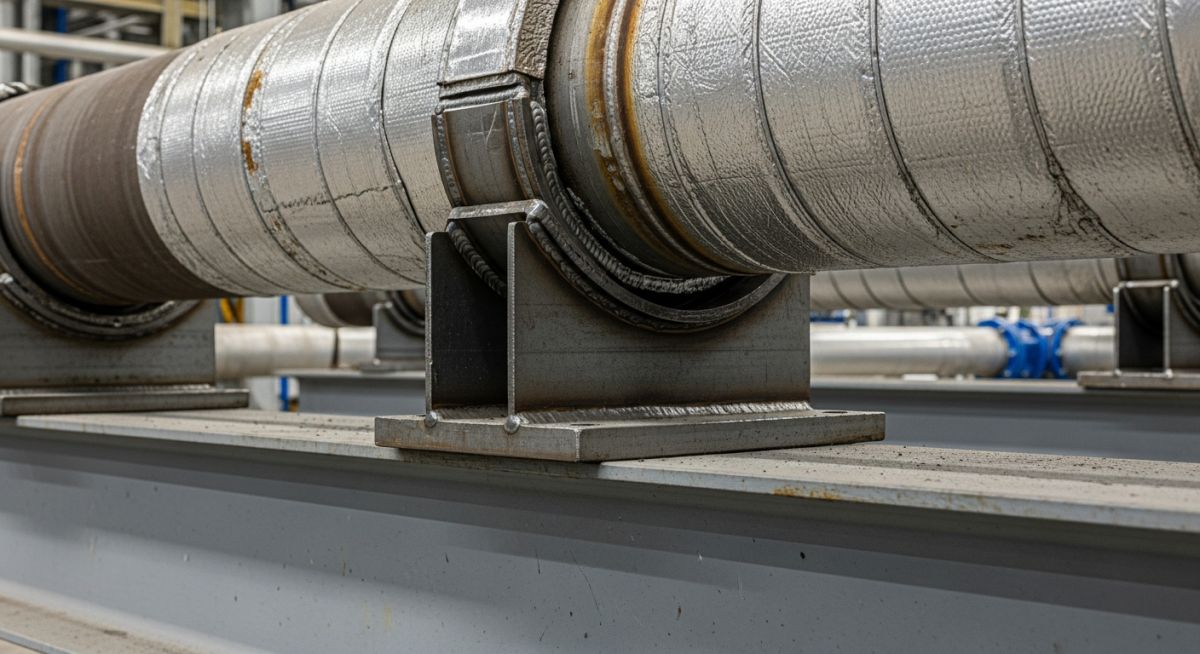
To appreciate why we use these supports, we must look at the physics of a running pipeline. When a pipe rests directly on a structural beam, several problems arise. First, if the pipe is insulated, the weight of the pipe will crush the insulation material at the contact point, destroying its thermal efficiency. Second, as the pipe expands axially due to thermal changes, direct contact with structural steel causes severe frictional wear on the pipe wall.
By utilizing a pipe shoe, we elevate the pipe centerline. This elevation provides sufficient clearance for the insulation cladding to remain completely intact. The shoe, rather than the pipe wall, absorbs the frictional wear as it slides across the supporting steel. This sliding action is governed by the coefficient of friction between the shoe base and the support beam, which we often optimize using low-friction slide plates made of Teflon (PTFE) or graphite.
Thermal Expansion and Stress Calculations
In piping stress analysis, we calculate the thermal expansion of the pipe to determine the required length of the shoe. If a shoe is too short, it can slide off the supporting steel beam during thermal expansion, causing a catastrophic drop of the line. The expansion is calculated using the following formula:
Where:
– dL is the thermal expansion (change in length) in millimeters.
– L is the length of the pipe run between anchors in meters.
– alpha is the mean coefficient of thermal expansion of the pipe material (obtained from ASME B31.3 Appendix C) in millimeters per meter per degree Celsius.
– dT is the difference between the operating temperature and the ambient installation temperature in degrees Celsius.
The minimum length of the pipe shoe must always exceed the calculated thermal expansion (dL) plus the width of the supporting beam, along with a safety margin of at least 50 millimeters on either side to prevent the shoe from falling off the support.
Selecting the Right Pipe Shoe for Piping Systems
Industrial piping systems utilize several distinct types of shoes, each engineered for specific operating envelopes. The most common designs include:
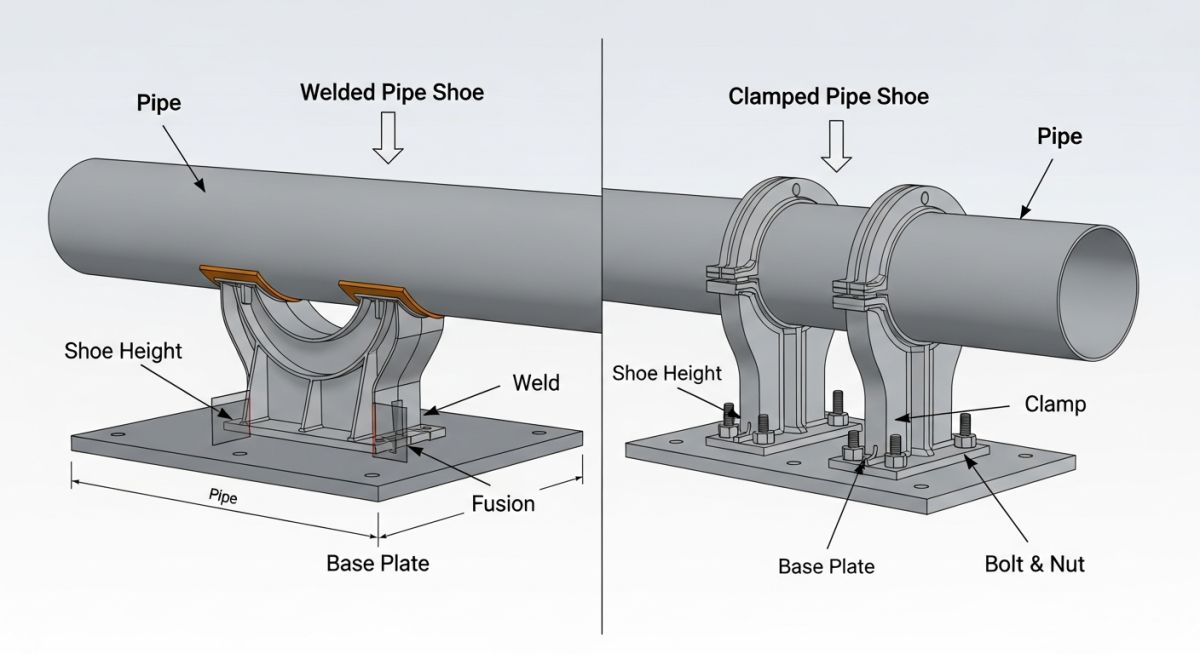
- Welded Pipe Shoes: These are fabricated from structural T-sections or welded plates and are welded directly to the pipe wall. They are highly robust and cost-effective but are limited to non-insulated lines or systems where the pipe and shoe materials are identical.
- Clamped Pipe Shoes: These utilize a bolted clamp arrangement around the pipe. They are ideal for systems where welding is restricted, such as in-service lines, or when supporting dissimilar materials like alloy steel or plastic-lined pipes.
- Insulated Pipe Shoes: Designed specifically for hot or cold service. Hot insulated shoes use high-density calcium silicate or microporous insulation blocks inside a metal housing to prevent heat loss. Cold (cryogenic) shoes use high-density polyurethane foam (HDPUF) or cellular glass to prevent thermal bridging and ice formation.
The table below outlines the standard dimensions and maximum allowable vertical load ratings for typical welded and clamped carbon steel pipe shoes, based on standard industry practices and MSS SP-58 guidelines.
| Nominal Pipe Size (NPS) | Standard Shoe Height (mm) | Standard Shoe Length (mm) | Max Vertical Load (kN) | Max Axial Load (kN) |
|---|---|---|---|---|
| 2″ to 3″ | 100 | 150 / 300 | 4.5 | 1.5 |
| 4″ to 6″ | 100 / 150 | 300 / 450 | 12.0 | 4.0 |
| 8″ to 12″ | 100 / 150 | 300 / 450 | 28.0 | 9.5 |
| 14″ to 18″ | 150 | 450 / 600 | 45.0 | 15.0 |
| 20″ to 24″ | 150 | 450 / 600 | 70.0 | 22.0 |
This matrix maps specific process conditions to the recommended shoe type, material selection, and applicable design codes.
| Process Service | Temperature Range | Recommended Shoe Type | Material Specification | Design Code Reference |
|---|---|---|---|---|
| Steam / Hot Utility | 120C to 400C | Pre-insulated Hot Shoe | ASTM A36 / Calcium Silicate | ASME B31.3 / MSS SP-58 |
| Cryogenic / LNG | -196C to -29C | Cold Shoe (Cold Box) | Stainless Steel / HDPUF | ASME B31.3 / BS 3974 |
| Corrosive Chemical | Ambient to 100C | Clamped Shoe with Liner | 316L SS / PTFE Liner | ASME B31.3 |
| High Vibration Gas | Ambient | Welded Shoe with Guide | ASTM A106 Gr. B / A36 | ASME B31.3 / API RP 520 |
Field Inspection Checklist for Pipe Shoe Installation
During construction and pre-commissioning, QA/QC inspectors must verify that every pipe shoe is installed exactly according to the piping isometric drawings and support standards. A single misplaced shoe can lock a line, causing high stress and eventual flange leakage.
-
Material Compatibility: Verify that the shoe material matches the pipe material or that a proper isolation pad/liner is installed to prevent galvanic corrosion. -
Weld Quality: Ensure all seal welds on welded shoes are continuous to prevent water entrapment and subsequent corrosion under insulation (CUI). -
Offset Alignment: Confirm that the shoe is offset in the cold position if significant thermal expansion is expected, ensuring it centers on the beam when hot. -
Slide Plate Clearance: Check that PTFE or graphite slide plates are clean, free of weld spatter, and properly aligned with the shoe base. -
Bolting Torque: For clamped shoes, verify that clamp bolts are torqued to the specified engineering values to prevent slippage without crushing the pipe.
Field Case Study: Real-World Application
A petrochemical plant experienced recurring piping vibration and insulation tearing on a 12-inch high-pressure steam line operating at 350 degrees Celsius. The original design utilized standard welded carbon steel shoes resting directly on structural steel beams. Over time, the high friction coefficient (approximately 0.4) caused the shoes to bind on the beams. This binding locked the thermal expansion, transferring massive forces back to the vessel nozzles and causing localized buckling on the pipe wall near the shoe welds.
As the lead consultant, I recommended replacing the rigid welded shoes with clamped pipe shoes equipped with integrated PTFE slide plates. We installed matching stainless steel slide plates on the structural steel beams. This modification reduced the sliding coefficient of friction from 0.4 to less than 0.08.
During the next turnaround, the modifications were executed. The pipeline now expands smoothly without binding, nozzle stresses have dropped by 70%, and the insulation remains completely intact, eliminating the risk of CUI.
Direct Recommendation: Always perform a formal friction force check in your stress analysis software (such as Caesar II) for lines larger than 8 inches operating above 200 degrees Celsius. If the friction loads on the structural steel are excessive, immediately specify low-friction slide plates rather than standard steel-on-steel shoes.
Frequently Asked Engineering Questions
What is the standard height of a pipe shoe?
When should I use a clamped pipe shoe instead of a welded one?
How do you prevent galvanic corrosion on pipe shoes?
What design codes govern the fabrication of pipe shoes?
Why are cryogenic pipe shoes made of different materials?
How do you calculate the required length of a pipe shoe?
===

📚 Recommended Resources: pipe shoe
Read these Guides
- 📄 Introduction to FRP Pipes: Properties, Applications, Specifications, Codes, Joining & More
- 📄 What is a Pipe Anchor? Comprehensive Engineering Guide to Design, Types, and Functions
- 📄 What is a Pipe Wear Pad? Functions, Sizing, and Code Differences
- 📄 Ultimate Guide to U-Bolt Pipe Support: Types, ASME Installation, and Field Applications