Geotechnical Borehole Engineering: From Subsurface Investigation to Foundation Design
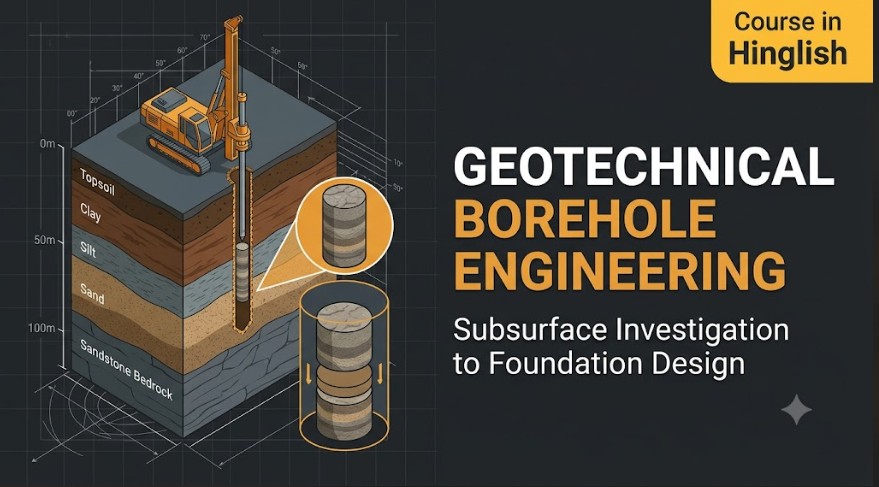
About Course
Every safe and stable structure begins below the ground — with a thorough understanding of the subsurface. This course takes you through the complete geotechnical investigation process, using borehole engineering as the backbone, and builds up to real, foundation-level engineering decisions.
Starting from establishing a subsurface baseline and correlating borehole coordinates, the course walks through the mechanics of Standard Penetration Test (SPT), interpreting overburden conditions, evaluating rock mass quality through core recovery and RQD (Rock Quality Designation), and understanding key rock strength and stiffness parameters like UCS (Unconfined Compressive Strength), Young’s Modulus (E), and triaxial testing. The course then moves into hydrogeology and environmental durability considerations, before finally integrating all this geotechnical data to guide foundation path selection.
This course is designed for engineers, geologists, and construction professionals who want to move beyond textbook theory and understand how geotechnical data from boreholes actually translates into real foundation design decisions on a project site.
The course is delivered in Hinglish (Hindi + English), so core technical terminology — SPT, RQD, UCS, triaxial testing, hydrogeology, overburden, foundation selection — stays in English exactly as used in real geotechnical reports and site documentation, while explanations are delivered in conversational Hindi for easier understanding.
By the end of this course, you’ll be able to read and interpret borehole logs, assess rock mass quality, understand key geotechnical strength parameters, evaluate groundwater and environmental risks, and connect all of this data to make informed foundation design decisions.
Course Content
Geotechnical Borehole Investigation & Foundation Engineering
-
Geotech Introduction
11:00 -
The Subsurface Baseline & Coordinate Correlation
21:00 -
Deciphering the Overburden & The Mechanics of SPT
12:00 -
Rock Mass Quality Core Recovery & RQD Aesthetics
22:00 -
Rock Strength & Stiffness Parameters UCS, E, & Triaxial Aesthetics
15:00 -
Hydrogeology & Environmental Durability
15:00 -
Geotechnical Integration & Foundation Path Selection
11:00 -
In Situ Geotechnical Investigations (All Tests)
14:00 -
Details of Getech Tests
22:00
Earn a certificate
Add this certificate to your resume to demonstrate your skills & increase your chances of getting noticed.
Student Ratings & Reviews
