Pressure Relief Valve (PRV): Definition, Types, Working, Sizing, Codes and Standards
In my 20+ years of piping engineering experience across EPC and site projects, I’ve seen one component repeatedly making the difference between safe operation and catastrophic failure — the Pressure Relief Valve (PRV). Whether it’s a refinery flare system or a compressor discharge line, a wrongly selected or poorly located PRV can lead to severe safety incidents, equipment damage, or even shutdowns.
In this detailed guide, I’ll walk you through the working, types, sizing, location guidelines, and applicable codes for Pressure Relief Valves — not just theoretically, but with practical insights from real field challenges I’ve personally encountered.
✅ Key Takeaways
- Pressure Relief Valves (PRVs) protect equipment from overpressure conditions.
- Proper selection depends on backpressure, service type, and system design.
- Incorrect sizing is one of the most common causes of PRV failure.
- Standards like API 520, API 521, and ASME Section VIII govern PRV design.
- Improper installation location can delay pressure relief and create hazards.
A Pressure Relief Valve (PRV) is a safety device designed to automatically release excess pressure from a system when it exceeds a preset limit, preventing equipment failure. It operates by opening at a specific pressure and closing once normal conditions are restored, ensuring safe operation of piping systems and pressure vessels.
Interactive Engineering Quiz
Q1: In a high backpressure compressor discharge system, which Pressure Relief Valve (PRV) type is most suitable?
Complete Course on
Piping Engineering
Check Now
Key Features
- 125+ Hours Content
- 500+ Recorded Lectures
- 20+ Years Exp.
- Lifetime Access
Coverage
- Codes & Standards
- Layouts & Design
- Material Eng.
- Stress Analysis
What are Relief Events in Pressure Relief Valve (PRV) Design?
In my field experience across refinery and steel plant projects (similar to JSPL environments), the most critical aspect often overlooked is identifying the correct relief event. A Pressure Relief Valve (PRV) is only as reliable as the scenario it is designed for.
- Blocked outlet condition
- Thermal expansion in liquid-filled systems
- External fire exposure (fire case)
- Control valve failure (fail-open)
- Utility failure (cooling water loss)
Potential Lines of Defense Against Relief Events
Relief valves are the last line of defense. Before relying on PRVs, engineering design includes multiple protective layers:
- Process control systems (DCS/PLC)
- Alarm systems (operator response)
- Shutdown systems (ESD)
- Pressure Relief Systems (PRV/PSV)
What is a Pressure Relief System?
A relief system is not just a valve — it includes inlet piping, PRV, outlet piping, discharge headers, and flare systems. Design must comply with API 521.
Why Use a Relief System?
- Prevent explosion due to overpressure
- Protect costly equipment
- Ensure regulatory compliance
Code Requirements for PRV Design
PRV design shall follow ASME Section VIII along with API 520.
Pressure Accumulation Limits
- Single PRV: Max 10% of MAWP
- Multiple PRVs: Up to 16% allowed
- Fire case: Up to 21% allowed
Locating Pressure Relief Valves (PRV)
Improper location is one of the most common mistakes I’ve seen during site audits. The PRV must be installed:
- Directly on top of pressure vessel nozzle
- As close as possible to protected equipment
- Without isolation valves (unless approved)
Types of Pressure Relief Valves (PRV)
Based on system design and operating conditions, PRVs are classified into:
- Conventional PRV
- Balanced Bellows PRV
- Pilot-Operated PRV
- Power Actuated PRV
Conventional Pressure Relief Valve
Most commonly used PRV, suitable for low backpressure applications.
Advantages
- Simple design
- Low cost
Disadvantages
- Affected by backpressure
Working of a Pressure Relief Valve (PRV)
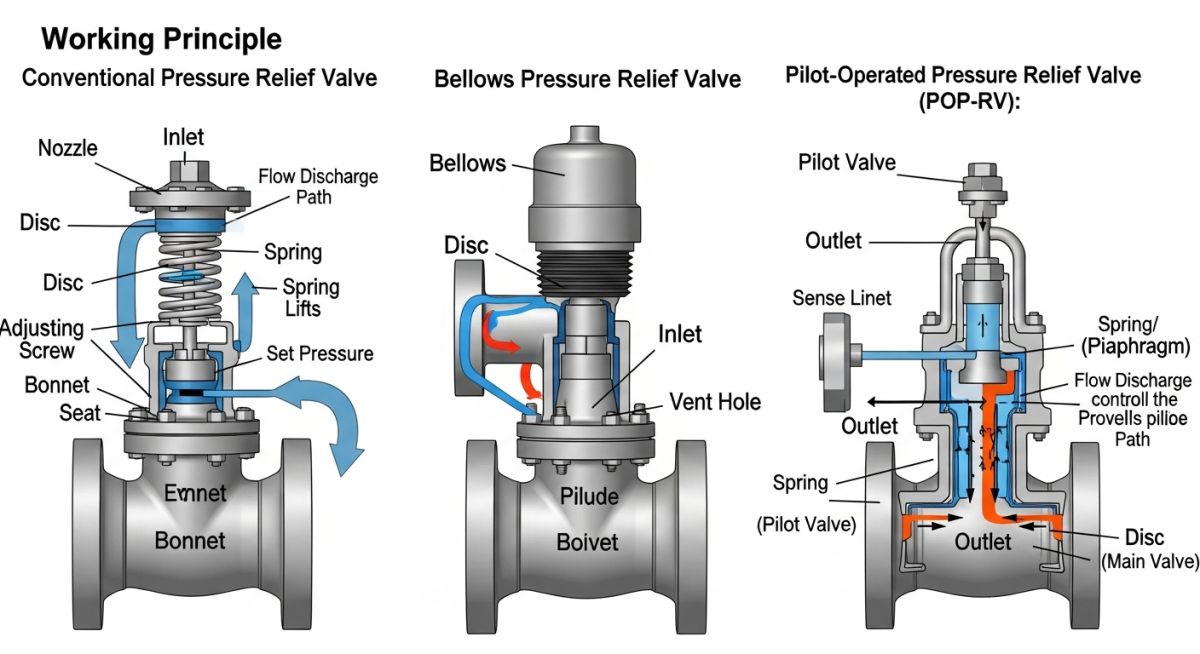
PRV operates using spring force balancing system pressure. When pressure exceeds set limit, valve lifts and discharges fluid.
| Parameter | Value / Requirement | Standard |
|---|---|---|
| Max Accumulation | 10% | ASME Section VIII |
| Backpressure Limit | Typically <10% for conventional valves | API 520 |
| Sizing Criteria | Mass flow & relieving conditions | API 520 |
| Relief System Design | Flare, headers, knockout drum | API 521 |
| Valve Dimensions | Standard orifice sizes | API 526 |
Field Case Study: Real-World Application
During a steel plant expansion project (similar to JSPL-type configuration), a compressor discharge system experienced frequent Pressure Relief Valve (PRV) failures. The installed valve was a conventional PRV, while the system had significant built-up backpressure due to a long flare header.
Result: Continuous chattering, seat damage, and repeated shutdowns.
We replaced the conventional valve with a balanced bellows type PRV as recommended in https://www.api.org/products-and-services/standards/important-standards-announcements/api-520API 520. Additionally, inlet piping was optimized to reduce pressure drop.
✅ Result: Zero chattering, stable operation, and improved plant reliability.
Engineering Recommendation: Always evaluate backpressure and dynamic flow conditions during PRV selection. Never rely solely on datasheets — simulate real operating scenarios wherever possible.
Pressure Relief Valve Sizing Basics
PRV sizing is governed by relieving flow rates and thermodynamic properties. As per https://www.api.org/products-and-services/standards/important-standards-announcements/api-520API 520, the general sizing equation for gas/vapor service is:
- A = Required orifice area
- W = Mass flow rate
- T = Relieving temperature
- P = Set pressure
- K factors = Correction factors
Relief Valve Chattering – Causes & Prevention
- Oversized PRV
- High built-up backpressure
- Improper spring selection
- Poor inlet piping design
Chattering drastically reduces valve life and can lead to catastrophic seat leakage.
Difference Between PSV and PRV
| Parameter | PRV | PSV |
|---|---|---|
| Function | Gradual opening | Pop action (instant) |
| Application | Liquids & gases | Gases/steam |
| Operation | Modulating | Snap acting |
