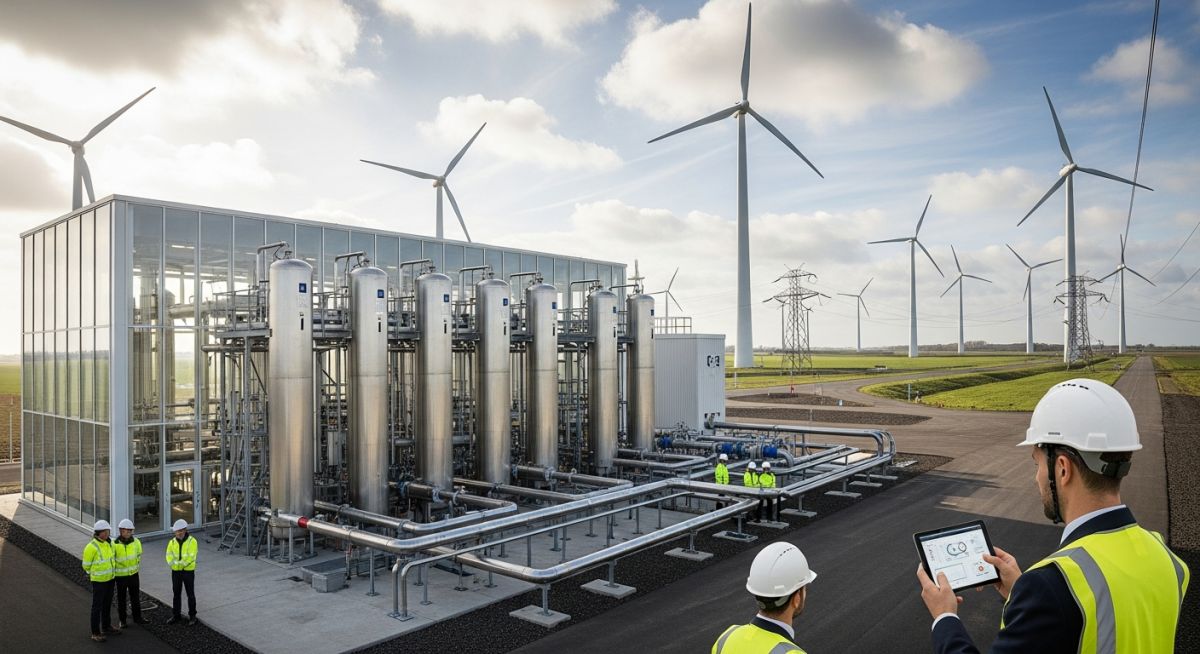
RFNBO Compliance Checklist for Green Hydrogen Projects
In my two decades of piping and process engineering, I have seen few regulatory frameworks as transformative—or as technically demanding—as the RFNBO requirements. Achieving compliance is not merely a paperwork exercise; it requires a fundamental integration of electrical grid data, electrolyzer operational logic, and rigorous greenhouse gas (GHG) accounting. If your project fails to align with the delegated acts regarding temporal correlation or additionality, your hydrogen output will not qualify for subsidies or carbon-intensity credits, effectively rendering the business case obsolete.
Key Compliance Takeaways
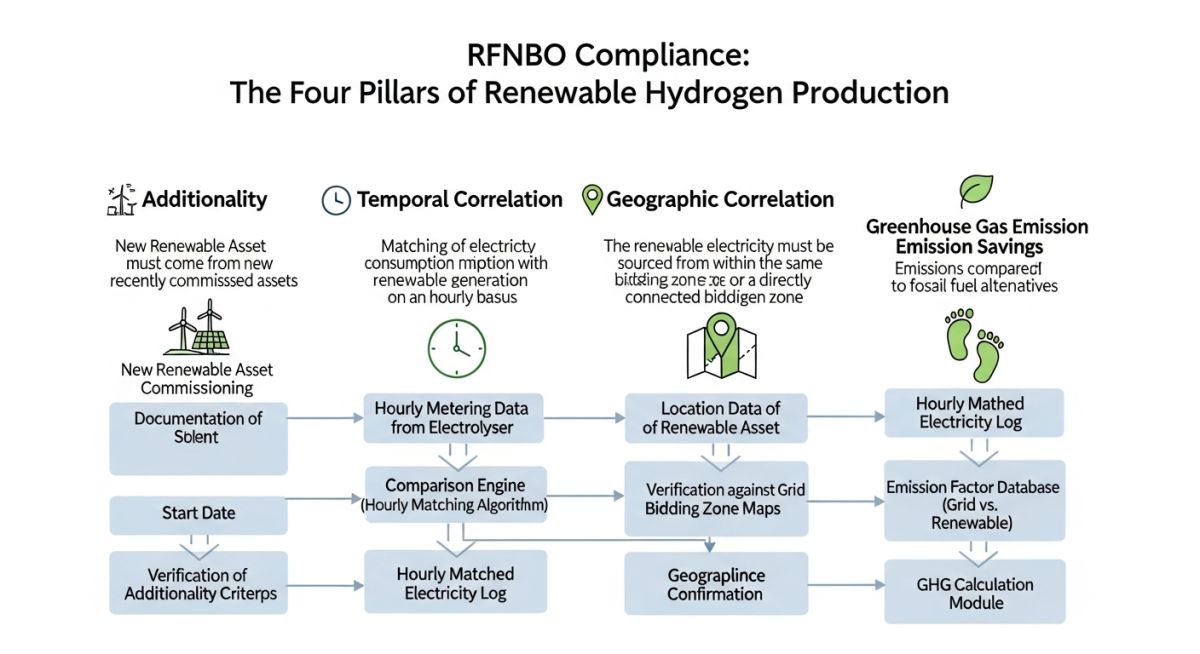
- Temporal Correlation: Transitioning from monthly to hourly matching by 2030 is mandatory.
- Additionality: Renewable assets must be commissioned no more than 36 months prior to the electrolyzer.
- Geographical Correlation: Power must be sourced from the same bidding zone or interconnected zone.
- GHG Thresholds: Lifecycle emissions must be at least 70% lower than the fossil fuel comparator (94g CO2e/MJ).
Technical Deep-Dive: RFNBO Compliance Requirements
To achieve RFNBO compliance, engineers must design the facility’s power supply architecture to satisfy the “additionality” principle. This means the electricity used for electrolysis must come from new, non-subsidized renewable installations. From a design perspective, this requires a direct line connection or a Power Purchase Agreement (PPA) that explicitly tracks the generation profile of the renewable asset against the electrolyzer’s load profile.
Temporal Correlation and Grid Integration
The most significant technical challenge is the temporal correlation requirement. Initially, projects may match renewable generation on a monthly basis, but this window tightens significantly. By 2030, hourly matching becomes the standard. This forces us to implement sophisticated Energy Management Systems (EMS) that can throttle electrolyzer output based on real-time grid signals and renewable generation availability.
GHG Accounting and Lifecycle Analysis
The GHG accounting methodology follows the ISO 14067 standard for product carbon footprinting. We must calculate the total emissions from the upstream renewable energy production, the electrolysis process (including auxiliary cooling and compression), and the transport/storage phases. The threshold of 3.38 kg CO2e per kg of H2 is the hard limit for most industrial applications.
When calculating the emissions, we must include the “embedded” carbon of the electrolyzer stack itself. For PEM (Proton Exchange Membrane) electrolyzers, the use of noble metals like iridium and platinum significantly impacts the lifecycle assessment (LCA). Engineers must ensure that the stack replacement frequency is factored into the 20-year project lifecycle model to maintain compliance with the 70% reduction target.
Advantages
- Market Access: Guarantees eligibility for EU-wide green hydrogen subsidies and carbon credits.
- Future-Proofing: Aligns infrastructure with long-term EU decarbonization trajectories and RED III mandates.
- Investor Confidence: Provides a transparent, auditable framework that reduces regulatory risk for project financing.
- Operational Efficiency: Encourages the integration of advanced EMS and battery storage to optimize power usage.
Disadvantages
- High CAPEX: Requires investment in dedicated renewable assets or complex PPA structures.
- Operational Complexity: Hourly temporal matching necessitates high-frequency data logging and automated control systems.
- Supply Chain Constraints: Sourcing “additional” renewable power in saturated bidding zones can be physically impossible.
- Regulatory Volatility: Evolving definitions of “additionality” can threaten the viability of projects already in the FEED stage.
Green Steel Manufacturing
Direct reduction of iron ore using green hydrogen requires massive, continuous supply volumes that must meet strict RFNBO criteria to qualify as “green steel.” Engineers must design large-scale electrolyzer arrays that utilize dedicated wind or solar farms to ensure the hydrogen produced maintains a low carbon intensity throughout the entire smelting process.
Ammonia Synthesis for Fertilizers
The Haber-Bosch process is a primary candidate for RFNBO-compliant hydrogen, replacing steam methane reforming (SMR) to significantly reduce the carbon footprint of global food production. By integrating electrolyzers directly into existing ammonia plants, operators can leverage existing infrastructure while transitioning to renewable feedstocks that satisfy the 70% emission reduction threshold.
Heavy-Duty Maritime Transport
Green hydrogen converted into liquid ammonia or methanol serves as a carbon-neutral fuel for shipping, where RFNBO compliance is essential for accessing green shipping corridors. The technical challenge lies in the bunkering infrastructure, which must maintain the chain of custody for the renewable energy certificates (RECs) from the point of electrolysis to the vessel’s fuel tank.
Achieving compliance with Renewable Fuels of Non-Biological Origin (RFNBO) mandates requires rigorous adherence to specific technical thresholds. These parameters define the boundary between conventional hydrogen production and certified green hydrogen suitable for EU market entry under the Renewable Energy Directive (RED II/III).
The following table outlines the critical performance metrics that project developers must monitor during the operational phase. These values are not merely operational targets but legal requirements for greenhouse gas (GHG) emission savings calculations, which must demonstrate at least a 70% reduction compared to the fossil fuel comparator of 94 grams of carbon dioxide equivalent per megajoule.
| Parameter | Unit | Compliance Threshold |
|---|---|---|
| GHG Emission Savings | Percentage | Minimum 70% |
| Additionality (PPA) | Years | Max 36 months post-commissioning |
| Temporal Correlation | Hourly | Mandatory from 2030 |
| Geographical Correlation | Bidding Zone | Same or interconnected zone |
Developers must ensure that their SCADA systems are configured to log these parameters with high temporal resolution. Failure to maintain granular data logs often results in audit failure during the certification process, as auditors require verifiable proof of renewable energy matching for every hour of electrolyzer operation.
The regulatory landscape for green hydrogen is complex, involving multiple overlapping standards and technical definitions. This matrix maps the core entities involved in RFNBO compliance, providing a clear reference for project engineers and compliance officers navigating the EU Delegated Acts.
Understanding these relationships is vital for establishing a robust compliance framework. Each entity listed below plays a distinct role in the lifecycle of a hydrogen project, from the initial power purchase agreement (PPA) negotiation to the final verification of the carbon intensity of the produced hydrogen.
| Entity/Concept | Acronym | Standard Reference |
|---|---|---|
| Renewable Energy Directive | RED II/III | EU 2018/2001 |
| Power Purchase Agreement | PPA | Delegated Act 2023/1184 |
| Guarantees of Origin | GO | ISO 14067 |
| Carbon Intensity | CI | RED II Annex V |
By aligning project documentation with these specific standards, developers can streamline the certification process. It is recommended that all project documentation, including technical specifications and energy procurement contracts, explicitly reference these regulatory frameworks to minimize ambiguity during third-party audits.
RFNBO Compliance Verification: This checklist provides a structured approach to validating your green hydrogen project against the stringent requirements of the EU Delegated Acts. Use this to ensure all technical, operational, and administrative components are audit-ready.
- Additionality Validation: Confirm the renewable energy installation was commissioned no more than 36 months before the electrolyzer.
- Temporal Correlation: Verify that the electrolyzer operation is matched with renewable generation on an hourly basis (or monthly until 2030).
- Geographical Matching: Ensure the renewable source and the electrolyzer are located within the same bidding zone or interconnected zones.
- GHG Calculation Audit: Perform a full lifecycle assessment (LCA) using the JRC methodology to confirm the 70% emission reduction threshold.
- Data Integrity: Implement a secure, tamper-proof data logging system for all energy inputs and hydrogen outputs.
Site verification requires a multi-disciplinary team. I recommend conducting a pre-audit simulation six months before the official certification date. This allows for the identification of data gaps in your energy procurement records or electrolyzer efficiency logs. Ensure that all PPA contracts contain the necessary clauses regarding the transfer of renewable attributes, as these are frequently scrutinized by auditors. Documentation must be maintained for a minimum of five years to satisfy regulatory retention policies.
The Challenge: Temporal Mismatch in Northern Europe
A 50MW electrolyzer project faced significant compliance hurdles due to a lack of hourly matching between wind farm output and electrolyzer demand.
- Inconsistent PPA data logs failing to align with hourly production cycles.
- Grid congestion leading to curtailment that was not properly accounted for in the GHG balance.
- Lack of clear documentation regarding the “additionality” of the wind assets.
- Auditor rejection of the initial carbon intensity report due to missing temporal data.
The Outcome: Successful Certification via Digital Integration
The project team successfully achieved compliance by implementing an automated energy management system that synchronized PPA data with electrolyzer operation.
- Achieved 98% data accuracy for hourly renewable energy matching.
- Successfully passed the third-party audit for RED II compliance.
- Reduced administrative overhead by 40% through automated reporting.
- Secured long-term off-take agreements based on certified green hydrogen status.
My recommendation for similar projects is to prioritize the integration of digital monitoring tools from the design phase. Do not rely on manual data entry for compliance reporting, as the complexity of hourly matching makes human error inevitable. Invest in robust, API-driven connections between your energy meters and your compliance reporting software.
Frequently Asked Engineering Questions
What defines additionality for RFNBO?
- The renewable installation must be commissioned no more than 36 months before the electrolyzer.
- It must not have received operating aid, ensuring the project is economically driven by the hydrogen demand.
- This requirement prevents the “cannibalization” of existing renewable capacity, which would otherwise increase the carbon intensity of the general grid.
How is temporal correlation calculated?
- Currently, monthly matching is permitted, but this transitions to hourly matching by 2030.
- The goal is to ensure that the electrolyzer only consumes electricity when the renewable source is actively generating.
- This requires high-resolution metering and sophisticated energy management software to track the energy balance in real-time.
What is the geographical correlation rule?
- The renewable installation must be located in the same bidding zone as the electrolyzer.
- If located in a different zone, the price in the renewable zone must be equal to or higher than the price in the electrolyzer zone.
- This prevents the use of renewable energy from regions where it is already highly utilized, maintaining the integrity of the green hydrogen claim.
Are there exceptions for grid-connected projects?
- Direct lines to renewable assets are the most straightforward path to compliance.
- Grid-connected projects must use Guarantees of Origin (GOs) to track the renewable nature of the electricity.
- The project must demonstrate that the grid electricity used does not exceed the average carbon intensity of the grid during non-renewable periods.
How is GHG intensity calculated?
- It accounts for the entire lifecycle, including electricity production, water treatment, and compression.
- The threshold is a 70% reduction compared to the fossil fuel comparator of 94 grams of carbon dioxide equivalent per megajoule.
- Engineers must use verified emission factors for all inputs, including grid electricity during periods of non-renewable supply.
What documentation is required for audits?
- Copies of all Power Purchase Agreements (PPAs) and proof of renewable energy attribute transfer.
- Hourly or monthly energy consumption logs from the electrolyzer.
- Certificates of origin for all renewable energy inputs.
- A detailed lifecycle assessment report signed by a qualified third-party verifier.
Complete Course on
Piping Engineering
Check Now
Key Features
- 125+ Hours Content
- 500+ Recorded Lectures
- 20+ Years Exp.
- Lifetime Access
Coverage
- Codes & Standards
- Layouts & Design
- Material Eng.
- Stress Analysis
