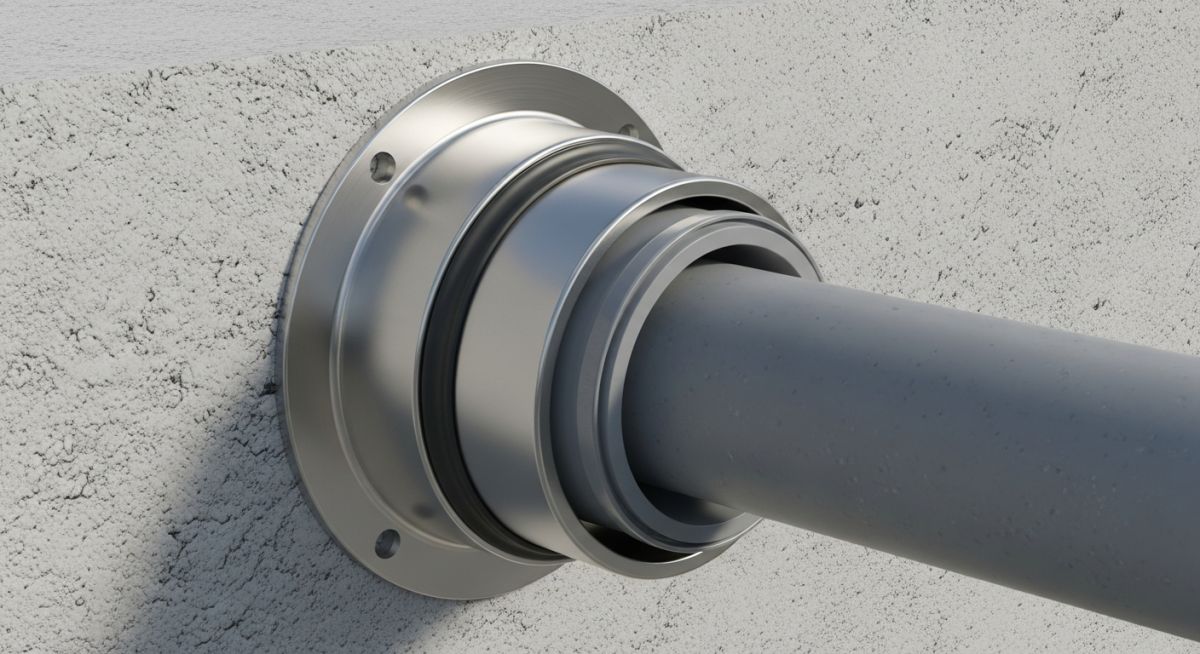
What is a Pipe Sleeve and How Does It Protect Piping?
In my 20+ years of managing piping installations across petrochemical plants and high-rise commercial facilities, I have seen minor oversights lead to catastrophic failures. One of the most common omissions is the humble pipe sleeve. When a carrier pipe passes directly through a concrete wall or floor slab without this protective barrier, it is subjected to immense shear stresses, chemical degradation from concrete contact, and restricted thermal movement.
I recall a project in 2014 where a high-pressure steam line ruptured because it was cast directly into a concrete foundation; the thermal expansion had nowhere to go, causing localized stress concentration that exceeded the material’s yield strength. A properly specified pipe sleeve would have prevented this entire disaster.
Key Engineering Takeaways
- Sleeves isolate carrier pipes from structural loads and concrete-induced chemical corrosion.
- They provide the necessary annular space for thermal expansion and acoustic insulation.
- Properly sealed sleeves maintain fire ratings and prevent hazardous fluid or gas migration.
Why Use a Pipe Sleeve in Piping?
When designing piping systems under ASME B31.3, we must account for external forces acting on the pipe. Without a sleeve, the weight of a settling concrete wall rests directly on the pipe wall, inducing high bending moments and shear stresses.
Sleeve Internal Diameter (ID) Calculation
To ensure adequate clearance for thermal expansion and insulation, the minimum internal diameter of the sleeve is calculated using the following formula:
For example, if a carrier pipe has an outer diameter (OD) of 114.3 mm (4-inch nominal) with 50 mm of calcium silicate insulation, and we require a minimum radial clearance of 25 mm for movement, the minimum sleeve ID is:
114.3 + 2*(50) + 2*(25) = 264.3 mm.
In this scenario, we would select a standard 12-inch schedule 40 pipe sleeve (ID of approximately 304.8 mm) to safely accommodate the assembly.
Material Selection Criteria
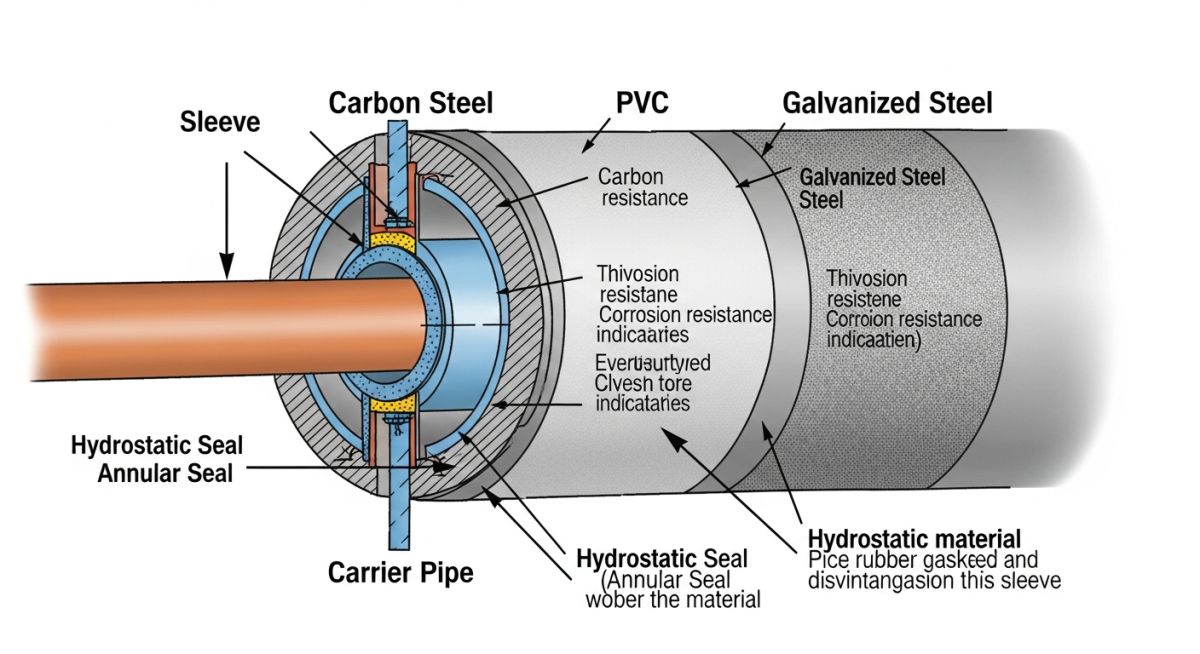
Sleeve materials must be compatible with both the surrounding structure and the operating environment. Carbon steel sleeves are standard for concrete walls due to their structural strength, while PVC and HDPE sleeves are preferred in corrosive environments or non-load-bearing partitions. For fire-rated assemblies, steel sleeves are mandatory to comply with NFPA 101 life safety codes.
The table below outlines the standard sizing relationships between carrier pipes and protective sleeves to ensure compliance with standard engineering practices and International Plumbing Code (IPC) guidelines.
| Nominal Carrier Size (inches) | Carrier OD (mm) | Recommended Sleeve Size (inches) | Sleeve ID (mm) | Radial Clearance (mm) |
|---|---|---|---|---|
| 2.0 | 60.3 | 4.0 | 102.3 | 21.0 |
| 4.0 | 114.3 | 6.0 | 154.1 | 19.9 |
| 6.0 | 168.3 | 8.0 | 202.7 | 17.2 |
| 8.0 | 219.1 | 10.0 | 254.5 | 17.7 |
| Sleeve Material | Applicable Standard | Max Temp Limit (°C) | Primary Application |
|---|---|---|---|
| Carbon Steel (Galvanized) | ASTM A53 / ASTM A123 | 400 | Load-bearing concrete walls, fire-rated barriers |
| Schedule 40 PVC | ASTM D1785 | 60 | Non-fire rated wet areas, chemical drainage lines |
| Stainless Steel (316L) | ASTM A312 | 650 | Corrosive process environments, cleanrooms |
How to Inspect a Pipe Sleeve on Site
During my field audits, I frequently find sleeves that are misaligned or completely filled with concrete slurry. This checklist ensures your installation meets rigorous industrial standards before the concrete pour and after final pipe routing.
Pre-Pour and Post-Installation Verification Items
-
Sleeve Alignment: Verify that the sleeve is perpendicular to the wall face and securely tied to the rebar matrix to prevent displacement during concrete pouring.
-
Sleeve Extension: Ensure the sleeve extends a minimum of 50 mm (2 inches) above finished floor levels to prevent floor wash water from cascading to lower levels.
-
Annular Space Clearance: Confirm that the carrier pipe is centered within the sleeve, leaving uniform clearance around the entire circumference.
-
Seal Integrity: Check that the modular mechanical seal (e.g., Link-Seal) or firestop sealant is installed tightly and matches the rating of the wall assembly per ASTM E814.
Field Case Study: Real-World Application
The Problem: High-Pressure Steam Line Failure
At a chemical processing plant in Texas, a 6-inch high-pressure steam line (operating at 180°C) passed through a 300 mm thick concrete shear wall. The original contractor failed to install a pipe sleeve, casting the carrier pipe directly into the concrete. Within six months of commissioning, the concrete wall cracked severely, and the pipe developed a circumferential crack at the wall interface due to restricted thermal expansion and high shear stress.
The Outcome: Retrofit and Stress Mitigation
My team was called in to remediate the system. We core-drilled a 300 mm opening around the failed pipe, removed the damaged section, and installed a heavy-wall galvanized carbon steel sleeve. We sealed the annular space using a high-temperature modular mechanical seal. Finite element analysis (FEA) post-remediation showed that local stress levels at the wall penetration dropped by 78%, completely eliminating the risk of future fatigue failures.
This case highlights why we must never compromise on sleeve installations. The cost of retrofitting a sleeve after a failure is often fifty times higher than installing it correctly during the initial construction phase.
Frequently Asked Engineering Questions
What is the difference between a pipe sleeve and a pipe casing?
Is a pipe sleeve required for all wall penetrations?
How do you seal the gap between a pipe and a sleeve?
Can PVC sleeves be used in fire-rated walls?
What is the standard extension height of a floor sleeve?
How does thermal expansion affect sleeve design?
===
Complete Course on
Piping Engineering
Check Now
Key Features
- 125+ Hours Content
- 500+ Recorded Lectures
- 20+ Years Exp.
- Lifetime Access
Coverage
- Codes & Standards
- Layouts & Design
- Material Eng.
- Stress Analysis