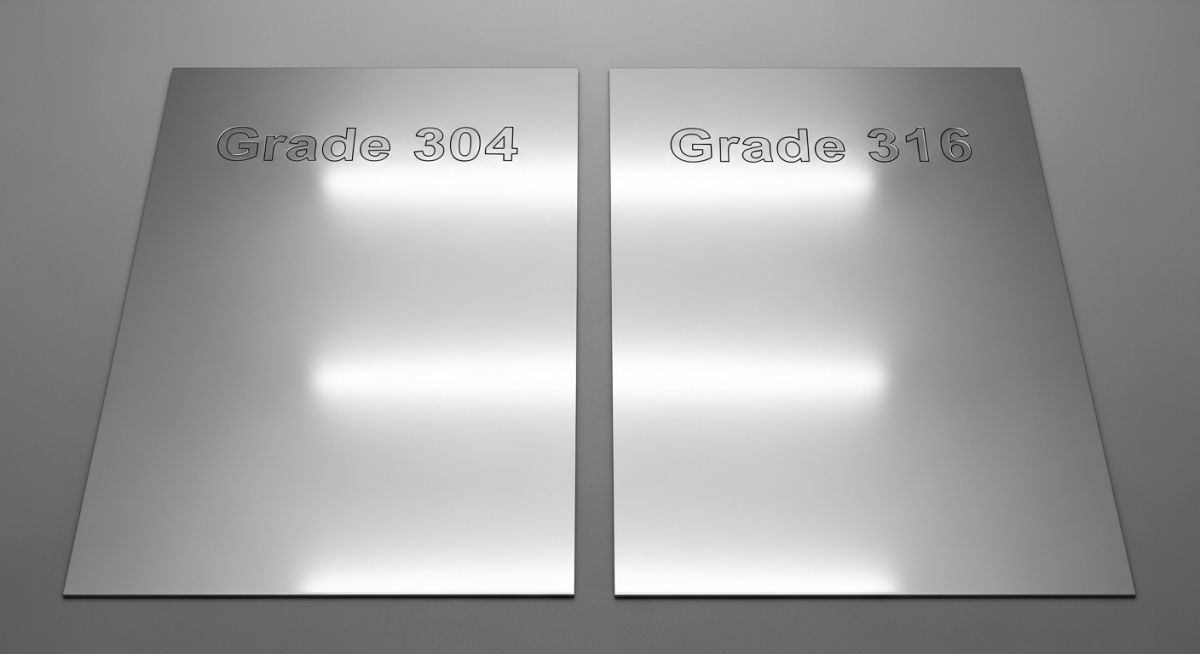
304 vs 316 Stainless Steel: Engineering Guide to Material Selection
In my 20+ years of piping engineering, I have seen millions of dollars wasted because of a single digit in a material specification sheet. Choosing between Grade 304 and Grade 316 is not just a matter of cost; it is a decision that dictates the operational lifespan of your entire piping network. I have stood on offshore platforms where Grade 304 piping failed within months due to stress corrosion cracking, and I have managed food processing plants where Grade 304 performed flawlessly for decades at a fraction of the cost of 316. Understanding the metallurgical nuances between these two workhorses of the industry is what separates a reliable, code-compliant design from an environmental and financial disaster.
Key Engineering Takeaways
- Molybdenum Addition: Grade 316 contains 2% to 3% molybdenum, providing superior resistance to localized chloride attack.
- Cost Differential: Grade 316 typically carries a 30% to 50% cost premium over Grade 304 due to alloying elements.
- Temperature Limits: Both grades offer excellent cryogenic properties, but sensitization must be managed above 425 degrees Celsius.
- Code Compliance: Material selection must align with pressure design requirements of ASME B31.3 and ASTM A240.
How to Choose 304 vs 316 Stainless Steel
Alloy Performance Metrics: Selecting between these grades requires evaluating the operating temperature, chloride concentration, and mechanical stress limits defined by ASTM A240 and ASME Section VIII.
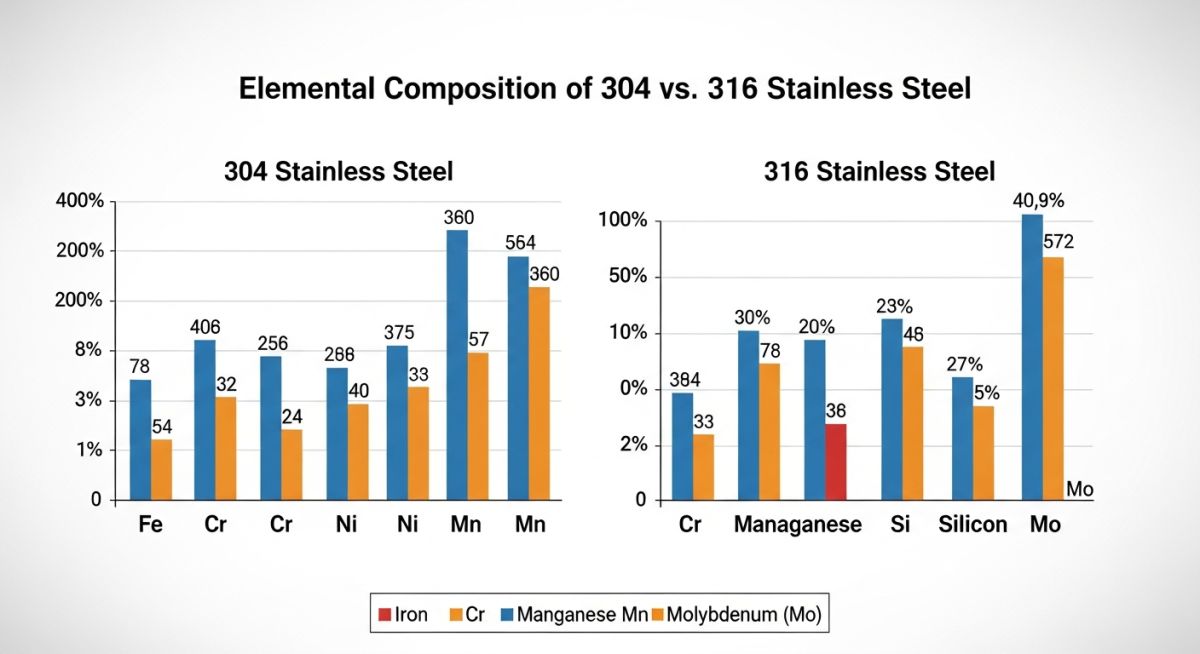
To truly understand why these alloys behave differently, we must look at their chemical makeup. Grade 304, often referred to as 18/8 stainless steel, contains approximately 18% chromium and 8% nickel. Grade 316, on the other hand, contains roughly 16% chromium, 10% nickel, and 2% to 3% molybdenum. This small addition of molybdenum is the game-changer.
Let us look at the Pitting Resistance Equivalent Number (PREN), which is a predictive measurement of an alloy’s resistance to localized pitting corrosion. The formula is written as:
For a standard Grade 304 stainless steel with 18% Chromium and 0% Molybdenum, the PREN is approximately 18 to 20. For Grade 316 with 16% Chromium and 2.5% Molybdenum, the PREN jumps to 23 to 25. In my experience, any environment with chloride levels exceeding 150 parts per million (ppm) demands a PREN of at least 23, making Grade 316 the minimum acceptable choice.
Another critical factor is sensitization. When these steels are heated to temperatures between 425 and 860 degrees Celsius, chromium carbides precipitate at the grain boundaries. This depletes the adjacent areas of chromium, leaving them vulnerable to intergranular corrosion. To combat this, we specify low-carbon variants: 304L and 316L, where the carbon content is restricted to a maximum of 0.03%.
From a mechanical design perspective, both materials exhibit similar yield and tensile strengths at ambient temperatures. However, when designing pressure vessels under ASME Section VIII Division 1, the allowable design stresses diverge at elevated temperatures. Grade 316 retains slightly better creep strength and tensile properties at temperatures exceeding 500 degrees Celsius compared to Grade 304.
Comparing Properties of 304 vs 316 Stainless Steel
Material Property Standards: Mechanical limits for tensile strength, yield strength, and elongation are governed by ASTM A240 to ensure structural integrity under pressure.
| Mechanical Property | Grade 304 (UNS S30400) | Grade 316 (UNS S31600) | Governing Code |
|---|---|---|---|
| Tensile Strength, Min (MPa) | 515 | 515 | ASTM A240 |
| Yield Strength, 0.2% Offset, Min (MPa) | 205 | 205 | ASTM A240 |
| Elongation in 50mm, Min (%) | 40 | 40 | ASTM A240 |
| Hardness, Max (Brinell / Rockwell B) | 201 HBW / 92 HRB | 217 HBW / 95 HRB | ASTM A240 |
| Density (g/cm³) | 8.00 | 8.00 | Physical Constant |
| Thermal Conductivity at 100°C (W/m·K) | 16.2 | 15.0 | Physical Constant |
| Entity / Acronym | Technical Definition | Grade 304 Application | Grade 316 Application | Governing Standard |
|---|---|---|---|---|
| PREN | Pitting Resistance Equivalent Number measuring localized corrosion resistance. | Low-risk environments (PREN 18-20). | High-risk chloride environments (PREN 23-25). | ASTM G48 |
| UNS S30400 / S31600 | Unified Numbering System designation for metal alloys. | Standard 18-8 stainless steel components. | Molybdenum-bearing stainless steel components. | SAE HS-1086 |
| SCC | Stress Corrosion Cracking caused by combined tensile stress and corrosive environment. | Highly susceptible in hot chloride environments. | Moderately resistant; preferred for mild chloride exposure. | ASME B31.3 |
| Sensitization | Precipitation of chromium carbides at grain boundaries during welding. | Mitigated by using Grade 304L (low carbon). | Mitigated by using Grade 316L (low carbon). | ASTM A262 |
Site Verification Checklist for Stainless Alloys
Material Verification Protocols: Field inspection requires positive material identification and mill test report verification to prevent accidental grade substitution in corrosive piping systems.
In my experience, material mix-ups during construction are the leading cause of early-life piping failures. Use this checklist on-site to ensure your materials match your design specifications.
Quality Assurance Field Steps
-
Verify Mill Test Reports (MTRs): Ensure chemical composition matches ASTM A240 limits, specifically checking the molybdenum content (2.0% minimum for Grade 316).
-
Perform Positive Material Identification (PMI): Use handheld XRF analyzers on 100% of incoming piping components to confirm the presence of molybdenum before installation.
-
Inspect Material Markings: Confirm continuous line marking on pipes showing ASTM specification, grade (e.g., WP316L vs WP304L), heat number, and manufacturer logo.
-
Check Welding Consumables: Ensure ER308L is used for Grade 304 welding and ER316L is used for Grade 316 welding to maintain corrosion resistance across weld joints.
-
Post-Weld Cleaning Inspection: Verify that all weld joints have undergone pickling and passivation to restore the protective chromium oxide passive layer.
Field Case Study: Real-World Application
The Problem: Catastrophic Pitting in Coastal Chemical Piping
During a routine shutdown inspection at a coastal chemical processing facility, I discovered severe localized pitting and pinhole leaks in a process water line. The line was operating at 65 degrees Celsius with a chloride concentration of approximately 280 ppm. The original design specification called for Grade 316L stainless steel. However, metallurgical analysis of the failed pipe spool revealed that a Grade 304L spool had been accidentally substituted during a fast-track maintenance turnaround 14 months prior. The lack of molybdenum in the 304L spool led to rapid breakdown of the passive layer, resulting in localized pitting rates exceeding 2.5 mm per year.
The Outcome: Remediation and Quality Control Implementation
We immediately isolated the affected section and replaced the compromised piping with fully certified Grade 316L stainless steel. To prevent future material mix-ups, I implemented a mandatory Positive Material Identification (PMI) protocol for all incoming warehouse stock and field-fabricated spools. Over the next eight years of continuous operation, the replacement Grade 316L piping showed zero signs of pitting or crevice corrosion, validating the material selection and highlighting the critical role of molybdenum in chloride-bearing process streams.
My recommendation for any operating plant is simple: never rely solely on paper mill test reports. Implement a robust field PMI program. The cost of a handheld XRF analyzer is negligible compared to the cost of an unscheduled shutdown caused by a single incorrect piping spool.
Frequently Asked Engineering Questions
Why does Grade 316 perform better than Grade 304 in marine environments?
Can I weld Grade 304 to Grade 316 stainless steel?
What is the difference between 316 and 316L stainless steel?
How does temperature affect the choice between 304 and 316?
Is Grade 316 magnetic?
How do I clean and maintain these stainless steel grades?
Complete Course on
Piping Engineering
Check Now
Key Features
- 125+ Hours Content
- 500+ Recorded Lectures
- 20+ Years Exp.
- Lifetime Access
Coverage
- Codes & Standards
- Layouts & Design
- Material Eng.
- Stress Analysis