Guide to Types of Metals and Their Classification Systems
In my 20-plus years of managing piping systems and structural builds, I have seen millions of dollars lost simply because a team misidentified a material grade. Choosing between carbon steel, low-alloy steel, or a nickel-based superalloy is not just a design choice; it is a safety-critical decision governed by strict codes. When I review piping specifications for high-pressure, high-temperature refinery units, I rely on a deep understanding of metallurgy to prevent catastrophic failures like graphitization or stress corrosion cracking.
This guide breaks down the fundamental metallurgical concepts that every engineer, inspector, and project manager must master. We will explore how chemical compositions alter mechanical properties, how crystalline structures dictate low-temperature toughness, and how international standards bodies organize these materials.
Key Engineering Takeaways
- Ferrous metals derive their strength from iron-carbon crystalline structures, governed primarily by ASME Section II.
- Non-ferrous alloys like copper, nickel, and titanium offer superior corrosion resistance and cryogenic stability.
- Proper material identification prevents galvanic corrosion and high-temperature creep in process piping.
Analyzing Types of Metals and Their Classification
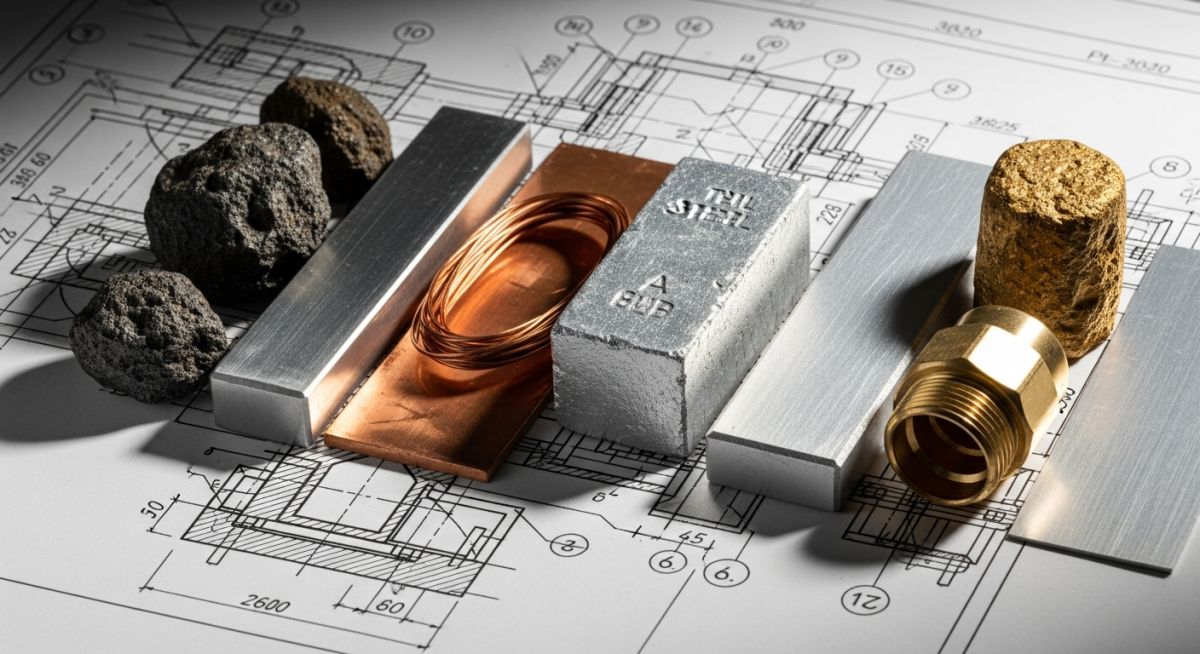
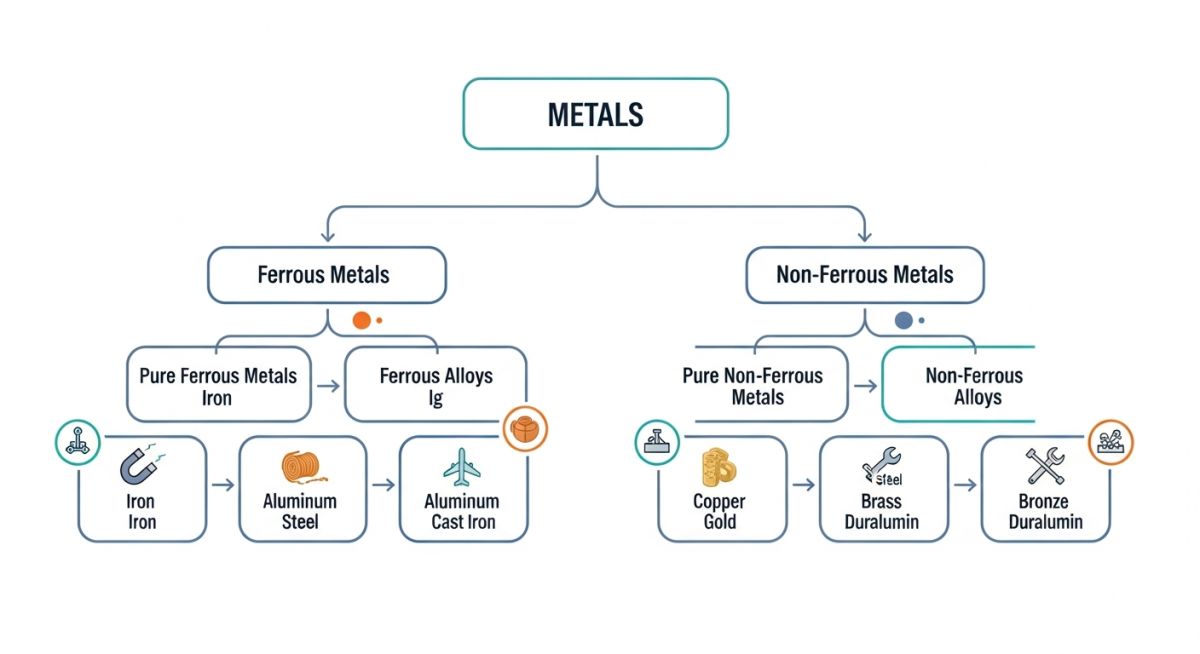
To design safe industrial systems, we must first look at how metals are structured at the atomic level. Metals are broadly divided into two primary families: ferrous and non-ferrous. Ferrous metals contain iron as the primary element, while non-ferrous metals do not. This distinction is critical because the presence of iron fundamentally changes how a material reacts to heat, moisture, and mechanical stress.
Understanding Ferrous and Non-Ferrous Alloys
Ferrous alloys, such as carbon steel, low-alloy steel, and stainless steel, are the workhorses of industrial piping. Their mechanical properties are highly tunable through heat treatment and the addition of alloying elements like chromium, nickel, and molybdenum. However, they are susceptible to oxidation and low-temperature embrittlement.
Non-ferrous alloys, including copper, nickel, aluminum, and titanium, are selected when specific physical properties are required. For instance, nickel alloys like Monel or Inconel are indispensable in highly corrosive acid services, while aluminum is favored in cryogenic applications due to its face-centered cubic (FCC) crystal structure, which does not undergo a ductile-to-brittle transition at sub-zero temperatures.
In my experience, substituting carbon steel for low-alloy steel (like 1.25Cr-0.5Mo) in high-temperature service above 427 degrees Celsius (800 degrees Fahrenheit) leads to rapid graphitization. This microstructural degradation causes sudden, catastrophic pipe ruptures. Always verify material test reports (MTRs) before welding.
Weldability and the Carbon Equivalent Formula
When fabricating piping systems, weldability is a primary concern. For carbon and low-alloy steels, we calculate the Carbon Equivalent (CE) to assess the risk of cold cracking in the heat-affected zone (HAZ). The widely accepted formula developed by the International Institute of Welding (IIW) is:
Where each chemical symbol represents the weight percentage of that element in the alloy. In my practice, if the calculated CE exceeds 0.43, I mandate preheating of the joint prior to welding and specify post-weld heat treatment (PWHT) in accordance with ASME Section VIII and ASME B31.3. This step is necessary to temper the martensitic phases and drive out residual hydrogen, preventing delayed hydrogen-induced cracking.
Mechanical Properties of Common Engineering Alloys
The table below outlines the mechanical properties of widely used metallic alloys in industrial piping and structural applications. These values are standardized by ASTM International and are critical for performing stress analysis.
| Metal Group | Common Grade | Tensile Strength (MPa) | Yield Strength (MPa) | Elongation (%) | Primary Application |
|---|---|---|---|---|---|
| Carbon Steel | ASTM A106 Grade B | 415 | 240 | 30 | Medium-pressure utility piping |
| Low Alloy Steel | ASTM A335 Grade P11 | 415 | 205 | 30 | High-temperature steam lines |
| Stainless Steel | ASTM A312 TP316 | 515 | 205 | 35 | Corrosive chemical process lines |
| Nickel Alloy | ASTM B165 (Monel 400) | 480 | 195 | 35 | Hydrofluoric acid service |
To streamline material procurement and engineering design, this matrix maps the core technical entities, Unified Numbering System (UNS) designations, and corresponding ASME specifications.
| Material Class | UNS Designation | ASME Specification | Key Alloying Elements | Critical Temp Limit |
|---|---|---|---|---|
| Carbon Steel | UNS K03006 | ASME SA-106 | Carbon, Manganese, Silicon | 427°C (800°F) |
| Low Alloy Steel | UNS K11597 | ASME SA-335 P11 | 1.25% Chromium, 0.5% Molybdenum | 565°C (1050°F) |
| Austenitic Stainless | UNS S31600 | ASME SA-312 TP316 | 16% Chromium, 10% Nickel, 2% Molybdenum | 815°C (1500°F) |
| Nickel Alloy | UNS N04400 | ASME SB-165 | 63% Nickel, 28% Copper | 480°C (900°F) |
Selecting Types of Metals and Their Classification Rules
Before any metallic component is welded or installed in a process facility, it must undergo a rigorous field verification process. In my experience, relying solely on paper records is a recipe for disaster. Use this checklist to ensure complete compliance on your job site.
Field Material Verification Checklist
-
Verify Material Test Reports (MTRs): Cross-reference the heat number stamped on the metal component with the certified MTR to confirm chemical composition and mechanical properties.
-
Perform Positive Material Identification (PMI): Use handheld X-ray fluorescence (XRF) or optical emission spectroscopy (OES) analyzers to verify alloy composition on high-alloy and stainless steel components.
-
Inspect Dimensional Tolerances: Measure wall thickness, outer diameter, and ovality to ensure compliance with ASME B36.10M for carbon steel or ASME B36.19M for stainless steel.
-
Check Hardness Limits: For sour service applications (NACE MR0175/ISO 15156), verify that the base metal and weld heat-affected zones do not exceed 22 Rockwell C (HRC) or 248 Vickers (HV).
-
Assess Surface Condition: Inspect for pitting, scale, laminations, or mechanical damage that could act as stress concentrators or initiate localized corrosion.
Field Case Study: Real-World Application
In industrial environments, selecting the wrong metal classification can lead to rapid, catastrophic failures. The following case study highlights the importance of matching material selection to the specific chemical and thermal environment of the process.
During a turnaround at a Gulf Coast refinery, our inspection team discovered micro-cracking in a 10-inch carbon steel piping system handling rich amine. The original design specified standard carbon steel without post-weld heat treatment (PWHT). The combination of residual tensile stresses from welding and exposure to alkaline amine solutions triggered severe amine stress corrosion cracking (ASCC).
I recommended replacing the damaged piping with ASTM A106 Grade B carbon steel, but with a mandatory requirement for post-weld heat treatment (PWHT) at 621 degrees Celsius (1150 degrees Fahrenheit) for one hour per inch of thickness, in strict compliance with NACE SP0472. This thermal treatment relieved the residual stresses and reduced the heat-affected zone (HAZ) hardness to below 200 Brinell (HBW), completely eliminating the cracking mechanism.
This case highlights that even when the correct base metal classification (carbon steel) is selected, the fabrication process and heat treatment must be carefully controlled to match the specific service conditions. Always consult NACE and API standards when dealing with corrosive process fluids.
Frequently Asked Engineering Questions
What is the difference between carbon steel and low-alloy steel?
Why does stainless steel resist corrosion compared to carbon steel?
What is the significance of the UNS numbering system?
How does temperature affect the mechanical properties of metals?
What is galvanic corrosion and how can it be prevented?
Why is post-weld heat treatment (PWHT) required for some metals?
Complete Course on
Piping Engineering
Check Now
Key Features
- 125+ Hours Content
- 500+ Recorded Lectures
- 20+ Years Exp.
- Lifetime Access
Coverage
- Codes & Standards
- Layouts & Design
- Material Eng.
- Stress Analysis