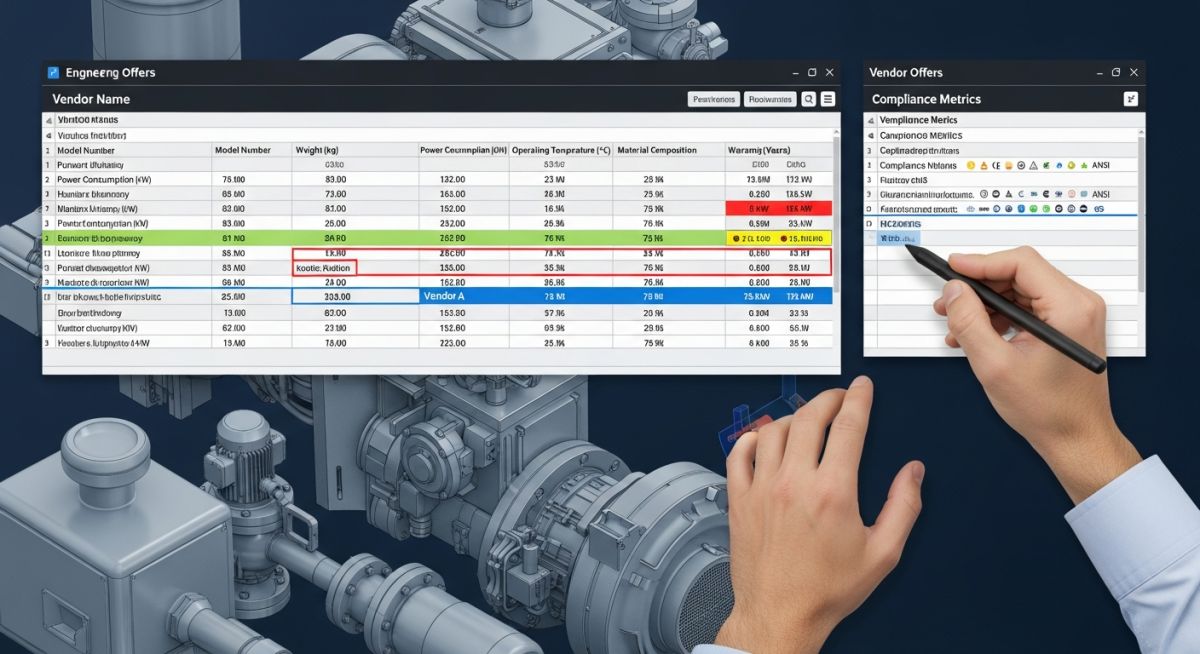
How to Master Technical Bid Evaluation for Complex Engineering Procurement
In my 20 years of managing piping and static equipment packages, I have seen projects fall apart not because of poor construction, but because of flawed procurement decisions. A vendor promises the world on a datasheet, but when the actual engineering drawings arrive, you find out they skimped on corrosion allowance or used non-standard nozzle configurations. That is where a rigorous technical bid evaluation saves your project.
I have learned that treating this process as a mere paper-stamping exercise is a recipe for disaster. We must dive deep into the metallurgy, pressure ratings, and design calculations. This guide outlines the exact methodology I use to establish technical bid evaluation criteria and systematically review vendor offers for complex engineering procurement projects.
Key Takeaways
- Understand how to align vendor proposals with international standards like ASME B31.3 and API 610.
- Learn to perform independent verification calculations to catch vendor design shortcuts.
- Establish a clear, un-biased scoring matrix to compare competing technical offers.
- Identify hidden costs in vendor scopes, such as testing, inspection, and spare parts.
Establishing a Robust Technical Bid Evaluation Framework
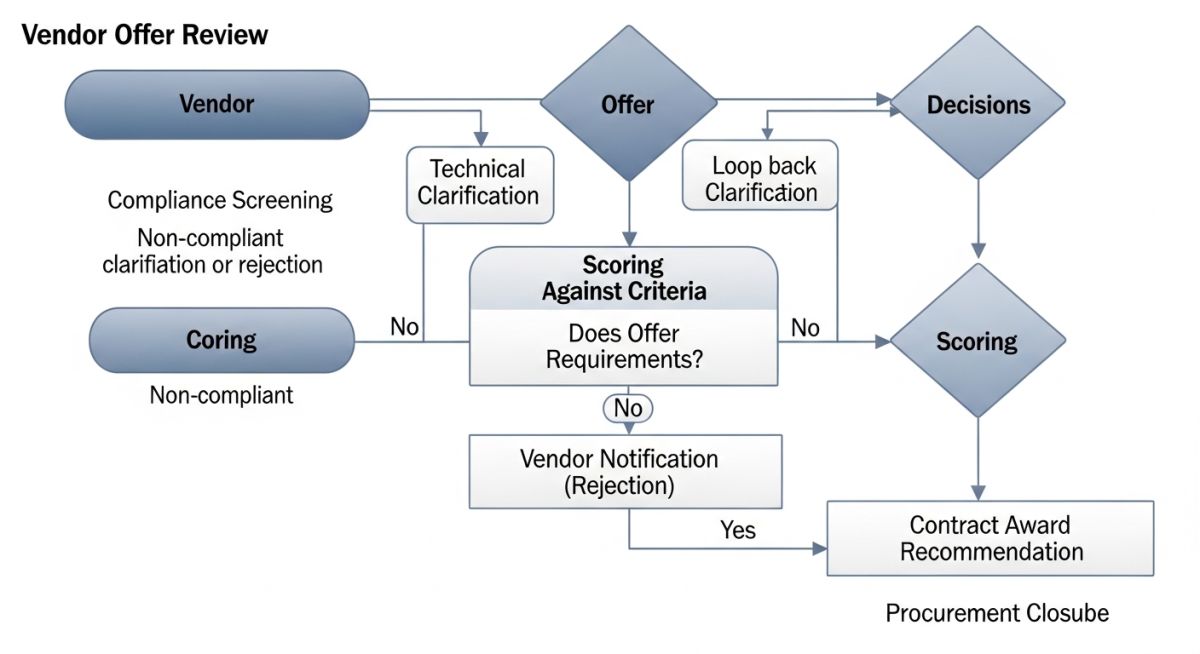
When evaluating vendor offers, you cannot rely solely on the vendor’s compliance statement. Many vendors tick the “comply” box while burying critical deviations in the fine print of their clarifications. To prevent this, we must establish a rigid framework that forces vendors to prove compliance through calculations and material test reports.
Verifying Wall Thickness and Pressure Containment
Let us look at a real-world verification calculation. Suppose a vendor submits a bid for a high-pressure piping spool. The design parameters are:
- Design Gauge Pressure (P): 10.5 MPa
- Design Temperature: 300 degrees Celsius
- Outside Diameter of Pipe (D): 323.8 mm (12.75 inches)
- Material: ASTM A106 Grade B
- Corrosion Allowance (c): 3.0 mm
We must verify the minimum wall thickness using the ASME B31.3 pressure design formula:
Where:
P = 10.5 MPa (Design Pressure)
D = 323.8 mm (Outside Diameter)
S = 138 MPa (Allowable Stress for ASTM A106 Gr. B at 300C per Table A-1)
E = 1.0 (Quality Factor for Seamless Pipe)
W = 1.0 (Weld Joint Strength Reduction Factor)
Y = 0.4 (Coefficient from Table 304.1.1 for ferritic steels)
Calculation:
t = (10.5 * 323.8) / (2 * (138 * 1.0 * 1.0 + 10.5 * 0.4))
t = 3399.9 / (2 * (138 + 4.2))
t = 3399.9 / 284.4
t = 11.95 mm
Now, we add the corrosion allowance (c) to find the minimum required thickness ™:
Accounting for the standard 12.5% manufacturing mill tolerance, the nominal thickness (tnom) required is:
The nearest standard schedule is Schedule 80, which has a nominal wall thickness of 17.48 mm. If a vendor proposes Schedule 40 (10.31 mm nominal) or Schedule 60 (14.27 mm nominal) claiming their “proprietary design” is sufficient, you must technically reject their offer. This calculation is a non-negotiable gatekeeper.
Material Compatibility and Corrosion Resistance
Another critical aspect of the evaluation is material verification. Vendors often try to substitute specified alloys with cheaper alternatives. For example, substituting 316L stainless steel with 316 stainless steel might seem minor, but in low-carbon applications, this substitution can lead to sensitization and intergranular corrosion during welding. Your evaluation must cross-reference the vendor’s material datasheets with the project’s piping material specifications (PMS).
Standardizing Vendor Compliance Review Parameters
To ensure a fair and transparent evaluation, I use a standardized set of parameters for every equipment class. The table below outlines the typical verification parameters for static and rotating equipment packages.
| Equipment Class | Critical Parameter | Code Reference | Verification Method |
|---|---|---|---|
| Pressure Vessels | Shell & Head Thickness | ASME Sec VIII Div 1 | Independent UG-27/UG-32 calculations |
| Centrifugal Pumps | NPSH Margin (NPSHa vs NPSHr) | API 610 | Review of performance curves & test plans |
| Piping Components | Flange Pressure-Temp Ratings | ASME B16.5 | Cross-reference material group tables |
| Control Valves | Flow Coefficient (Cv) & Noise | ISA-75.01.01 | Sizing verification under worst-case flow |
Technical Mapping & Specifications Matrix
This matrix maps the core technical entities, structural acronyms, and physical parameters that must be verified during the vendor offer review.
| Acronym / Entity | Technical Definition | Physical Parameter | Standard Reference |
|---|---|---|---|
| TBE | Technical Bid Evaluation | Compliance Score (%) | Project Quality Plan |
| MDMT | Minimum Design Metal Temperature | Temperature (degrees C) | ASME Sec VIII UCS-66 |
| NACE | National Association of Corrosion Engineers | Hardness Limit (HRC) | NACE MR0175 / ISO 15156 |
| NDE | Non-Destructive Examination | Radiography / UT Extent (%) | ASME Section V |
Executing the Technical Bid Evaluation for Critical Equipment
Before you sign off on any technical bid evaluation, you must run through a rigorous checklist. This is not a generic checklist; it is a highly technical validation protocol designed to catch the most common vendor omissions.
Vendor Offer Review Checklist
Field Case Study: Real-World Application
The Problem: The Low-Bid Piping Package Trap
During a major refinery expansion project, the procurement team was leaning toward a low-cost overseas vendor for a critical high-pressure, high-temperature piping package. The vendor’s bid was 25% lower than the nearest competitor. However, during my technical bid evaluation, I noticed they had omitted the mandatory post-weld heat treatment (PWHT) for the 2.25Cr-1Mo alloy steel piping, claiming it was unnecessary for wall thicknesses under 16 mm.
I immediately flagged this deviation. According to ASME B31.3 Table 331.1.1, PWHT is mandatory for this material grade regardless of thickness to prevent hydrogen-induced cracking in sour service. We forced the vendor to include PWHT in their scope, which increased their price by 15%. Even with the price increase, they remained competitive, but we successfully prevented a catastrophic piping failure during commissioning.
This case study highlights why the technical bid evaluation must be independent of commercial pressures. If we had accepted the low bid without a thorough technical review, the cost of field failures and project delays would have far exceeded the initial savings.
Frequently Asked Engineering Questions
What is the difference between a Technical Bid Evaluation (TBE) and a Commercial Bid Evaluation (CBE)?
How do you handle vendor deviations from project specifications?
Why is NPSH verification critical during pump bid evaluations?
What role does NACE MR0175 play in material evaluation?
How do you evaluate vendor-designed structural supports?
What is the significance of the EN 10204 3.2 certification?
===FAQ_BLOCK===
Complete Course on
Piping Engineering
Check Now
Key Features
- 125+ Hours Content
- 500+ Recorded Lectures
- 20+ Years Exp.
- Lifetime Access
Coverage
- Codes & Standards
- Layouts & Design
- Material Eng.
- Stress Analysis


