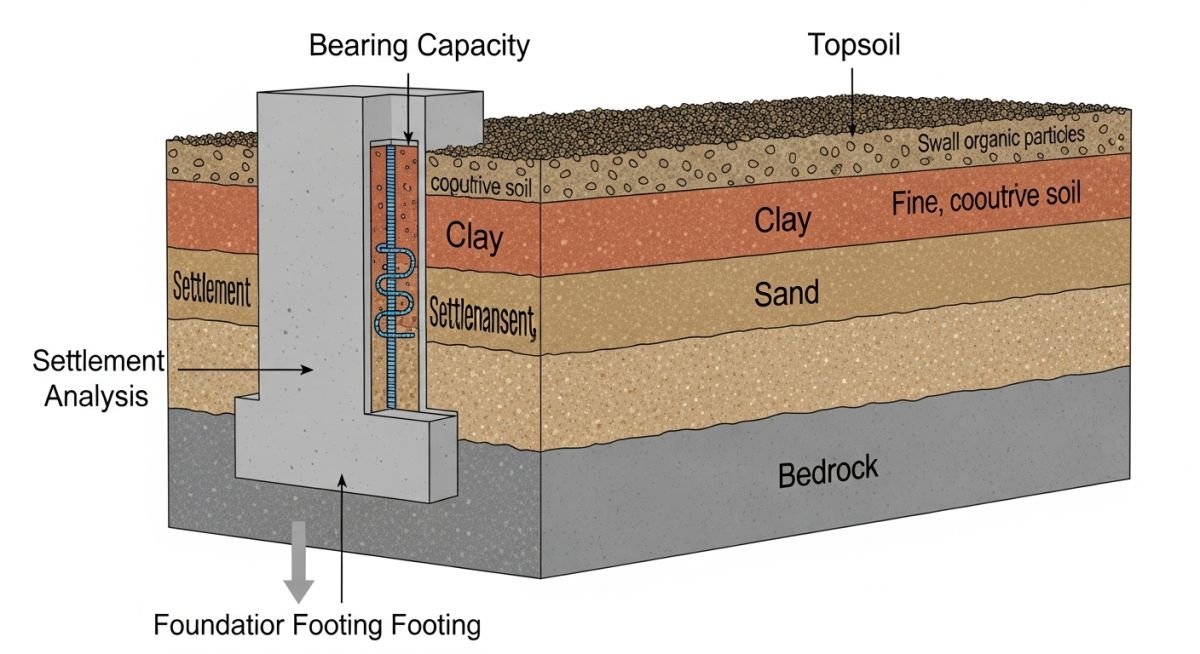
Common Soil Types and Their Engineering Properties
In my two decades of field experience, I have learned that the foundation is only as reliable as the soil supporting it. Whether you are designing a heavy-duty pipe rack or a massive storage tank, understanding the specific behavior of local soil strata is the difference between a project that stands for fifty years and one that suffers from differential settlement within the first season.
This guide breaks down the fundamental mechanics of various soil types, from high-plasticity clays to well-graded gravels. We will examine how these materials respond to moisture, load, and vibration, providing you with the technical baseline needed for accurate site investigation and foundation design.
Key Takeaways for Site Engineers:
- Master the Unified Soil Classification System (USCS) to predict load-bearing capacity.
- Identify high-risk expansive soils that threaten structural alignment.
- Apply moisture-density relationships to optimize site preparation and compaction.
- Utilize standard penetration test (SPT) data to correlate soil properties with allowable bearing pressure.
Understanding Common Soil Types and Their Engineering Properties
Soil Classification Mechanics: The rigorous categorization of soil particles based on grain size distribution and plasticity index, which dictates the shear strength and permeability characteristics essential for geotechnical stability.
When I evaluate a site, I start by looking at the grain size distribution. Coarse-grained soils like gravel (GW, GP) and sand (SW, SP) provide excellent drainage and high shear strength, making them ideal for shallow foundations. Conversely, fine-grained soils like silt (ML) and clay (CL, CH) introduce complexities related to consolidation and moisture sensitivity.
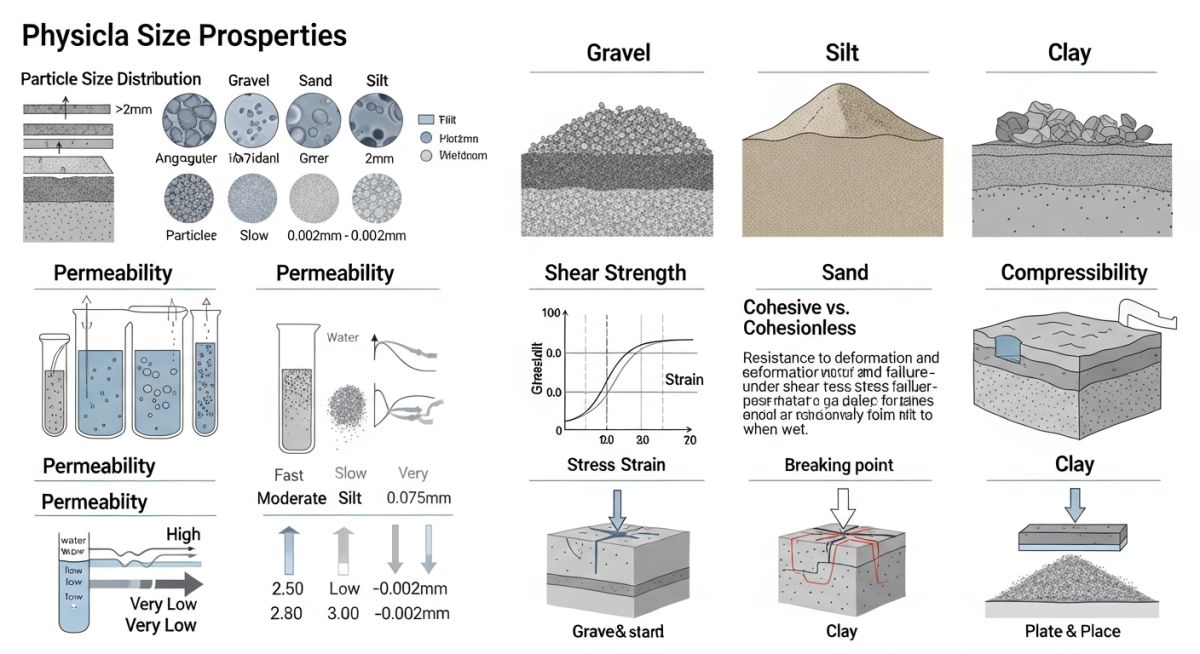
Shear Strength and Consolidation Parameters
The shear strength of soil is defined by the Mohr-Coulomb failure criterion: tau = c + sigma * tan(phi). In this equation, ‘c’ represents cohesion and ‘phi’ represents the angle of internal friction. For granular soils, ‘c’ is typically zero, meaning strength is derived entirely from inter-particle friction. In clays, ‘c’ is the dominant factor, but it is highly dependent on the degree of saturation.
Field Warning: The Consolidation Risk
Fine-grained soils, particularly organic silts and high-plasticity clays, are prone to long-term settlement. When a structural load is applied, the pore water pressure increases, and as this water dissipates over time, the soil volume decreases. This process, known as primary consolidation, can lead to significant differential settlement if not accounted for during the initial design phase using ASTM D2435.
Expansive Soil Behavior
Expansive soils, often containing montmorillonite clay minerals, present a unique challenge. These soils undergo significant volume changes with fluctuations in moisture content. I have seen foundations heave by several inches during wet seasons, causing catastrophic damage to piping systems and structural steel connections.
To mitigate this, we often specify soil replacement or chemical stabilization using lime or fly ash. The goal is to reduce the Plasticity Index (PI) of the soil to a manageable level, typically below 15, to ensure the foundation remains stable regardless of the water table elevation.
Geotechnical Material Performance: The comparative analysis of soil types based on their structural load-bearing capacity, drainage efficiency, and long-term settlement risks in industrial foundation applications.
Advantages of Granular Soils
- High internal friction angle provides superior bearing capacity.
- Excellent drainage characteristics prevent pore water pressure buildup.
- Minimal long-term consolidation settlement under static loads.
- High suitability for mechanical compaction to reach 95% Modified Proctor density.
- Predictable behavior under dynamic loading from rotating equipment.
Disadvantages of Fine-Grained Soils
- High susceptibility to volume change in expansive clay types.
- Low permeability leads to slow dissipation of excess pore pressure.
- Significant risk of long-term primary and secondary consolidation.
- Reduced shear strength when saturated, leading to potential slope instability.
- Requires complex stabilization techniques to achieve required bearing capacity.
Industrial Foundation Engineering: The practical implementation of soil mechanics principles to support heavy infrastructure, ensuring structural alignment and operational safety across diverse geological environments.
Heavy Storage Tank Foundations
Large-scale storage tanks require uniform settlement to prevent shell buckling and piping stress. We utilize granular fill pads to distribute the massive vertical loads evenly across the underlying soil strata, minimizing the risk of tilting.
Pipe Rack and Structural Steel Supports
For pipe racks, differential settlement is the primary enemy of flange integrity. By analyzing the soil’s modulus of subgrade reaction, we design shallow spread footings that maintain structural alignment even in variable soil conditions.
Subsurface Drainage and Trenching
In areas with high silt content, trench stability is critical for underground piping installation. We implement shoring and dewatering strategies based on the soil’s permeability coefficient to prevent trench collapse and ensure worker safety.
Expansive Soil Stabilization for Pavements
Industrial access roads often cross expansive clay zones that threaten pavement longevity. We apply lime-stabilization techniques to chemically alter the clay structure, significantly reducing the swell potential and ensuring a stable subgrade for heavy vehicle traffic.
When evaluating site conditions, engineers must rely on standardized classification systems to predict how soil will behave under structural loads. The table below summarizes the critical engineering properties for primary soil types, focusing on permeability, shear strength, and compressibility characteristics that dictate foundation selection.
These values are derived from ASTM D2487 standards, which provide the framework for the Unified Soil Classification System (USCS). Understanding these parameters is essential for calculating bearing capacity and settlement potential during the preliminary design phase of any civil infrastructure project.
| Soil Type | Permeability | Shear Strength | Compressibility |
|---|---|---|---|
| Gravel (GW/GP) | High | Excellent | Negligible |
| Sand (SW/SP) | High to Medium | Good | Low |
| Silt (ML/MH) | Low | Fair to Poor | Medium |
| Clay (CL/CH) | Very Low | Variable | High |
Note that these classifications assume a saturated or near-saturated state. In practice, site-specific laboratory testing, such as triaxial shear tests or consolidation tests, must always supersede generalized table values to ensure safety factors meet ASCE requirements.
The following matrix maps essential geotechnical entities to their corresponding regulatory standards and physical performance indicators. This mapping is vital for project managers and structural engineers to maintain consistency across site investigation reports and design documentation.
By aligning soil mechanics terminology with specific ISO and ASTM standards, we reduce the risk of misinterpretation during the transition from geotechnical analysis to structural foundation detailing.
| Entity | Standard | Key Parameter |
|---|---|---|
| Atterberg Limits | ASTM D4318 | Plasticity Index |
| Standard Penetration | ASTM D1586 | N-Value |
| Consolidation | ASTM D2435 | Compression Index |
Always verify that the testing laboratory is accredited for the specific standard referenced. Discrepancies in testing methodology often lead to significant errors in settlement predictions, particularly in highly compressible clay deposits.
Effective site investigation requires a systematic approach to data collection and verification. Before finalizing any foundation design, I ensure that the following checklist is completed to mitigate geotechnical risks associated with soil variability and environmental factors.
-
☐
Confirm borehole spacing meets ASCE guidelines for the specific structure footprint. -
☐
Verify groundwater table depth during seasonal high-water periods to assess liquefaction potential. -
☐
Perform laboratory classification tests on representative samples from every distinct soil stratum identified. -
☐
Check for organic content levels, as high concentrations significantly reduce bearing capacity and increase settlement. -
☐
Validate that the soil shear strength parameters used in calculations account for long-term consolidation effects.
These checkpoints serve as the final line of defense against foundation failure. In my experience, skipping the verification of groundwater fluctuations is the most common cause of post-construction structural distress. Always document the date and method of sampling for every borehole to ensure traceability in the event of future site audits or forensic investigations.
The Problem: Unexpected Differential Settlement
A mid-rise commercial structure experienced significant cracking due to unforeseen settlement in a localized lens of soft, organic-rich clay.
- Inadequate borehole density failed to detect the thin, highly compressible clay layer.
- Groundwater table elevation was higher than historical records indicated.
- Structural loads were concentrated on a shallow mat foundation without deep soil improvement.
The Outcome: Successful Remediation and Stabilization
We implemented a targeted remediation strategy that successfully halted further settlement and restored structural integrity.
- Installed micro-piles to transfer structural loads to a deeper, competent bearing stratum.
- Implemented a dewatering system to manage the high water table during the repair phase.
- Achieved a 95% reduction in settlement rates within six months of project completion.
This case highlights the necessity of comprehensive site investigation. I recommend that for any project involving complex soil profiles, engineers should mandate at least one deep boring that penetrates well into the competent bedrock or dense soil layer, regardless of the initial shallow soil findings.
Frequently Asked Engineering Questions
How do Atterberg Limits influence foundation design?
- Classify the soil’s potential for expansion or shrinkage when moisture content changes.
- Estimate the shear strength of the soil in its remolded state.
- Determine the suitability of the soil for use as structural fill or subgrade material.
What is the significance of the N-value in SPT?
- Relative density of granular soils like sand and gravel.
- Consistency of cohesive soils like clay and silt.
- Empirical correlation to internal friction angles and allowable bearing capacity.
Why is soil permeability a concern for foundations?
- Slow drainage in clay can lead to excess pore water pressure, reducing effective stress.
- High permeability can lead to piping or erosion issues if hydraulic gradients are not managed.
How do we identify expansive soils on site?
- High plasticity indices in Atterberg limit testing.
- Presence of montmorillonite or other swelling clay minerals.
- Visible surface cracking during dry seasons and heaving during wet seasons.
- Laboratory swell tests that measure vertical strain under specific surcharge pressures.
What is the role of organic soils in construction?
- High water content and fibrous structure.
- Significant secondary compression (creep) over time.
- Potential for chemical degradation, which can affect foundation materials.
In most cases, these soils must be excavated and replaced with engineered fill or bypassed using deep foundation systems.
How does groundwater affect soil bearing capacity?
- Bearing capacity equations must be adjusted using submerged unit weights.
- High water tables can trigger liquefaction in loose, saturated sands during seismic events.
- Dewatering during construction is often required to maintain stability and prevent base heave.
Complete Course on
Piping Engineering
Check Now
Key Features
- 125+ Hours Content
- 500+ Recorded Lectures
- 20+ Years Exp.
- Lifetime Access
Coverage
- Codes & Standards
- Layouts & Design
- Material Eng.
- Stress Analysis
