
Scaffolding Definition: Types, Parts, Design, Materials, and Hazards
In my 20 years of managing piping and structural engineering projects, I have seen scaffolding treated as an afterthought. This is a dangerous mistake. Scaffolding is a highly engineered temporary structure. When a scaffold fails, the consequences are catastrophic. I want to share the technical realities of scaffolding design, material selection, and safety protocols that keep sites safe.
Whether you are erecting a simple tower or a complex cantilevered system, understanding the structural mechanics is non-negotiable. We must look beyond the basic definition and analyze the load paths, component interactions, and safety margins required by international codes.
Key Engineering Takeaways
- Understand the structural differences between modular, tube and coupler, and suspended systems.
- Master the load paths from the working platform down to the sole plates.
- Learn the mathematical formulas used to calculate buckling limits and wind loads.
- Identify the critical safety hazards and mitigation strategies required by OSHA 1926 Subpart L.
- Implement a rigorous inspection checklist to verify structural integrity before every shift.
Complete Course on
Piping Engineering
Check Now
Key Features
- 125+ Hours Content
- 500+ Recorded Lectures
- 20+ Years Exp.
- Lifetime Access
Coverage
- Codes & Standards
- Layouts & Design
- Material Eng.
- Stress Analysis
What Are the Core Scaffolding Types?
Scaffolding Types: Distinct structural configurations including modular, tube and coupler, suspended, and frame systems selected based on load requirements, site geometry, and access constraints.
Selecting the right scaffolding system is the first step in ensuring structural integrity. In industrial environments, we primarily rely on three main types:
- Tube and Coupler Scaffolding: This system offers maximum flexibility. It consists of steel tubes connected by couplers. It is ideal for complex geometries, such as wrapping around spherical storage tanks or dense piping manifolds. However, it requires highly skilled labor to erect.
- Modular / System Scaffolding: This system uses prefabricated vertical standards with fixed connection points (rings or cups) at regular intervals. It is faster to erect than tube and coupler systems and reduces human error during assembly. Common types include Ringlock and Cuplock.
- Frame Scaffolding: Consisting of prefabricated welded frames connected by cross bracing, this system is highly efficient for straight, vertical facades. It is commonly used in commercial construction but lacks the flexibility needed for complex industrial layouts.
- Suspended Scaffolding: Platforms suspended by ropes or cables from an overhead structure. These are common for high-rise building maintenance and require specialized hoist mechanisms and redundant fall arrest systems.
How Do We Calculate Scaffolding Loads?
Scaffolding Load Calculations: Mathematical evaluations of dead, live, and environmental loads applied to structural members to ensure safety factors meet regulatory standards.
Every scaffold must be designed to support its own weight (dead load) plus the weight of workers, tools, and materials (live load), along with environmental forces like wind and seismic activity. Under OSHA 1926.451, the structure must support at least four times the maximum intended load without failure.
Let us look at the mathematical breakdown of these loads:
1. Dead Load (D):
D = W_tubes + W_couplers + W_planks + W_guardrails
Where:
– W_tubes = Weight of steel tubes (typically 4.37 kg/m or 2.93 lbs/ft for 48.3mm OD tubes)
– W_planks = Weight of timber or steel planks (typically 15 to 20 kg/m²)
2. Live Load (L):
L = Area * Load Rating
Where:
– Light Duty = 1.20 kN/m² (25 lbs/ft²)
– Medium Duty = 2.40 kN/m² (50 lbs/ft²)
– Heavy Duty = 3.60 kN/m² (75 lbs/ft²)
3. Wind Load (W):
F = q * Cf * Af
Where:
– q = Velocity pressure (calculated based on local wind speed)
– Cf = Force coefficient (typically 1.2 to 1.3 for open structures)
– Af = Projected area of the scaffold members exposed to wind
To prevent buckling of the vertical standards, we must calculate the allowable axial load using Euler’s buckling formula, modified for the effective length factor (K) based on the spacing of the horizontal ledgers:
Euler’s Buckling Limit:
P_cr = (pi² * E * I) / (K * L)²
Where:
– E = Modulus of elasticity of steel (210,000 N/mm²)
– I = Moment of inertia of the tube cross-section
– K = Effective length factor (typically 1.0 for pinned-pinned connections)
– L = Vertical distance between ledger levels (lift height, typically 2.0 meters)
Field Warning: Buckling Hazards
Never exceed the rated load capacity of a scaffold. A common field error is substituting standard structural steel tubes with thin-walled conduit, which drastically reduces the buckling strength. Always verify that all tubes meet ASTM A500 or BS EN 10219 specifications.
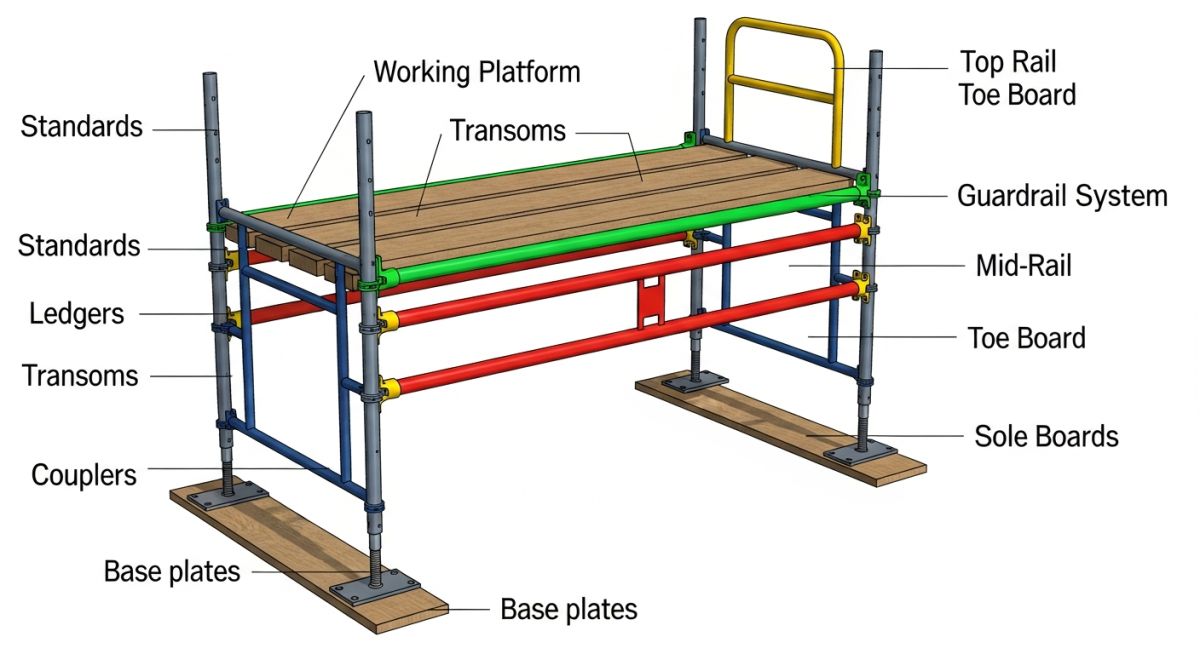
Standard Load Ratings
Scaffolding Load Ratings: Standardized classifications defining maximum allowable working loads and span limits for various structural configurations under international safety codes.
| Duty Classification | Rated Load (lb/sq ft) | Max Span of Planks (ft) | Max Post Spacing (ft) | Typical Applications |
|---|---|---|---|---|
| Light Duty | 25 | 10 | 8 | Painting, plastering, electrical work, light maintenance |
| Medium Duty | 50 | 8 | 8 | Bricklaying, concrete placement, general piping installation |
| Heavy Duty | 75 | 6 | 6 | Stone masonry, heavy equipment storage, structural steel erection |
| Special Duty | >75 | Engineered | Engineered | Heavy industrial piping, shoring, high-load storage platforms |
| Entity Name | Structural Acronym | Physical Parameter | Hyperlinked Standard Reference |
|---|---|---|---|
| Standard (Post) | STD | Axial Load Capacity | OSHA 1926.451 |
| Ledger (Runner) | LDG | Bending Moment | BS EN 12811-1 |
| Transom (Bearer) | TRM | Shear Capacity | OSHA 1926.451 |
| Coupler (Fitting) | CPL | Slip Resistance | BS EN 74-1 |
How to Verify Scaffolding Safety Onsite?
Scaffolding Safety Verification: A systematic pre-shift inspection protocol designed to verify structural alignment, connection integrity, and fall protection compliance before personnel access.
Before any worker steps onto a scaffold, a competent person must inspect the structure. In my experience, most scaffolding failures could have been prevented by a simple, disciplined walkdown. Use this checklist to verify the safety of your scaffolding systems:
Pre-Shift Scaffolding Inspection Checklist
-
Foundation and Sole Plates: Verify that sole plates are placed on firm, level ground. Ensure base plates are centered on the sole plates and there is no undermining or settling.
-
Plumbness and Alignment: Check that all vertical standards are plumb within the allowable tolerance (typically 1 in 400). Ensure ledgers and transoms are level.
-
Bracing and Stability: Confirm that diagonal face bracing and ledger bracing are installed per the design drawings. Verify that tie-ins to the permanent structure are secure and spaced correctly.
-
Planking and Decking: Ensure all working platforms are fully planked with no gaps greater than 1 inch. Verify that planks are secured against wind uplift and do not overhang supports by more than 12 inches unless designed otherwise.
-
Fall Protection: Check that top rails (38 to 45 inches high), mid rails, and toe boards are installed on all open sides of the platform. Verify that access ladders are clear and extend at least 3 feet above the landing platform.
Field Case Study: Real-World Application
Scaffolding Field Case Study: An analysis of structural remediation on a high-rise industrial boiler project to resolve structural deflection and ensure safety compliance.
The Problem: Structural Deflection in a High-Rise Boiler Scaffold
During a major shutdown at a petrochemical plant, a 120-foot tall tube-and-coupler scaffold erected inside an industrial boiler began showing visible lateral deflection (bowing) at the mid-height level. The field crew had added heavy piping components onto the working platforms, exceeding the medium-duty rating. The tie-ins to the boiler structure were spaced too far apart, violating the 4:1 height-to-base ratio and local wind/seismic load guidelines.
The Outcome: Structural Remediation and Safety Certification
I ordered an immediate evacuation of the scaffold and halted all work. We performed a structural analysis and implemented a remediation plan. We added diagonal bracing in both directions, reduced the vertical tie-in spacing from 26 feet to 13 feet, and replaced the overloaded working platforms with light-duty aluminum decks. The lateral deflection was completely eliminated, and the scaffold was certified safe for use.
This case highlights the importance of strict load management and regular structural inspections. Always perform a structural engineering review when modifying scaffold loads or configurations beyond standard design limits.
Frequently Asked Engineering Questions
Scaffolding Engineering FAQs: Expert answers to technical questions regarding scaffolding design, material selection, load capacities, and safety regulations.
What is the maximum height for scaffolding without engineering design?
What is the difference between a standard and a ledger?
How often must scaffolding be inspected?
What materials are allowed for scaffolding planks?
What is the 4-to-1 rule in scaffolding?
Can wood and steel scaffolding components be mixed?
===


