How Does Nickel in Stainless Steel Affect Performance and Safety?
In my 20-plus years of designing piping systems and selecting materials for high-pressure chemical reactors, I have frequently encountered clients and junior engineers who harbor deep misconceptions about the presence of nickel. Some worry about its potential toxicity, while others fail to grasp why we pay a premium for high-nickel alloys when cheaper ferritic alternatives exist. The reality is that without nickel, the modern process industry would ground to a halt.
From a practical engineering standpoint, nickel is not merely an additive; it is the primary driver behind the structural transformation that makes stainless steel the workhorse of industrial infrastructure. In this comprehensive guide, I will break down the exact metallurgical functions of this element, address the persistent safety concerns surrounding its use, and share field-tested insights on material selection.
Key Engineering Takeaways
- Phase Stabilization: Nickel transforms the magnetic, brittle body-centered cubic (BCC) ferrite structure into the highly ductile, non-magnetic face-centered cubic (FCC) austenite structure.
- Cryogenic Performance: Austenitic grades containing nickel do not exhibit a ductile-to-brittle transition temperature, making them indispensable for liquefied natural gas (LNG) piping.
- Corrosion Resistance: Nickel works synergistically with chromium to form a self-healing passive oxide layer that resists highly reducing acidic environments.
- Biocompatibility: When properly passivated, the nickel bound within the alloy matrix does not leach at harmful levels, satisfying strict FDA and NSF/ANSI 51 requirements.
The Metallurgical Role of Nickel in Stainless Steel
To understand why we rely so heavily on nickel, we must look at the iron-carbon phase diagram. Pure iron at room temperature has a body-centered cubic (BCC) crystal structure, known as ferrite. While ferritic steels are strong, they suffer from limited ductility and are highly susceptible to brittle fracture at low temperatures.
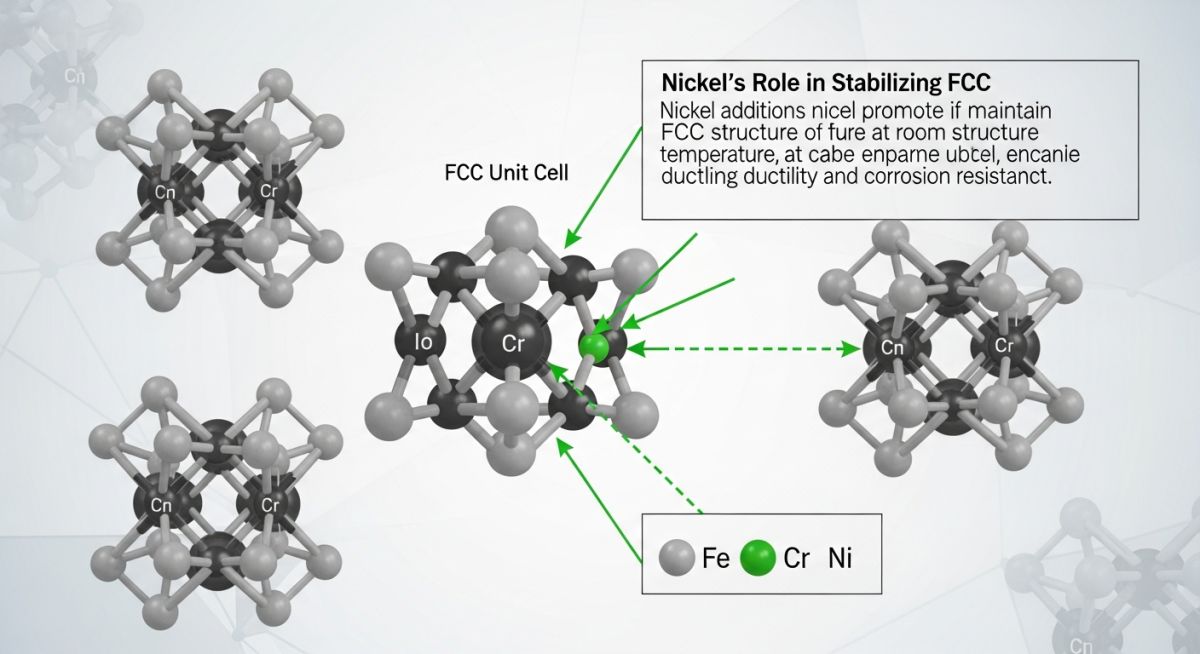
When we introduce chromium to provide corrosion resistance (typically a minimum of 10.5% per ASTM A240), the alloy remains ferritic. However, when we add nickel, it acts as an “austenite former.” It expands the gamma-phase field, allowing the face-centered cubic (FCC) structure to remain stable at room temperature and below.
In my field experience, using standard 304 or 316 stainless steel in warm, chloride-rich environments (such as coastal chemical plants) can lead to catastrophic chloride stress corrosion cracking. While nickel stabilizes the austenite phase, alloys with 8% to 10% nickel are actually at the peak of susceptibility to SCC. To mitigate this, you must either specify duplex stainless steels (which have lower nickel, around 4% to 6%, and a mixed ferrite-austenite structure) or move to high-nickel alloys containing more than 42% nickel.
The Nickel Equivalent Formula
In welding and metallurgy, we use the Schaeffler or DeLong diagrams to predict the microstructural phases of the weld metal. The balance between ferrite-forming elements (like chromium, molybdenum, and silicon) and austenite-forming elements (like nickel, carbon, manganese, and nitrogen) is calculated using the Nickel Equivalent (Ni Eq) formula:
This formula demonstrates that carbon and nitrogen are also powerful austenite stabilizers. However, carbon must be kept extremely low (typically less than 0.03% in “L” grades like 316L) to prevent chromium carbide precipitation during welding, which leads to intergranular corrosion. Therefore, nickel remains the most reliable and controllable element for maintaining the stable FCC phase without compromising corrosion resistance.
Mechanical and Physical Consequences of FCC Structure
The transition from a BCC to an FCC crystal lattice completely alters the physical and mechanical behavior of the metal:
- Non-Magnetic Behavior: Unlike ferritic and martensitic steels, fully austenitic stainless steels are non-magnetic in the annealed state, which is a key requirement for sensitive electronic and medical imaging equipment.
- Work Hardening: Austenitic steels exhibit a high rate of work hardening. This means that as they are deformed, they become significantly stronger, which is highly beneficial for structural components but requires specialized tooling for machining.
- Cryogenic Ductility: The FCC structure does not undergo a transition from ductile to brittle behavior at low temperatures. I have specified 304L and 316L for liquid nitrogen (-196°C) and liquid helium (-269°C) piping systems with absolute confidence, as they retain excellent impact toughness where carbon steels would shatter like glass.
Chemical Composition and Mechanical Properties
The table below outlines the relationship between nickel content, crystal structure, and mechanical properties across various common stainless steel grades. Note how the mechanical properties shift dramatically as the nickel content increases and stabilizes the austenitic phase.
| Grade (UNS) | Nickel Content (wt%) | Crystal Structure | Min. Yield Strength (MPa) | Min. Tensile Strength (MPa) | Elongation in 50mm (%) |
|---|---|---|---|---|---|
| 304 (S30400) | 8.0 – 10.5 | Austenitic | 205 | 515 | 40 |
| 316 (S31600) | 10.0 – 14.0 | Austenitic | 205 | 515 | 40 |
| 310S (S31008) | 19.0 – 22.0 | Austenitic | 205 | 515 | 40 |
| 2205 (S32205) | 4.5 – 6.5 | Duplex (50/50) | 450 | 655 | 25 |
| 430 (S43000) | 0.75 max | Ferritic | 205 | 450 | 22 |
This matrix maps specific metallurgical entities, physical parameters, and their corresponding engineering functions to the relevant international standards.
| Metallurgical Entity | Physical Parameter | Engineering Function | Standard Reference |
|---|---|---|---|
| Austenite Phase (FCC) | Lattice Parameter (a ≈ 0.36 nm) | Eliminates ductile-to-brittle transition; ensures cryogenic toughness. | ASME B31.3 Table A-1 |
| Nickel Equivalent (Ni Eq) | Calculated wt% ratio | Predicts weld metal microstructure and ferrite content. | AWS A5.4 / DeLong Diagram |
| Passive Oxide Film | Thickness (1 – 5 nm) | Prevents elemental leaching and localized pitting corrosion. | ASTM A967 / Passivation |
| Nickel Leaching Rate | Concentration (< 0.1 µg/cm²/week) | Ensures safety for food contact and pharmaceutical processing. | NSF/ANSI 51 |
Verifying Material Grade and Nickel Content
In my role as a lead quality auditor, I have seen projects suffer massive delays because the wrong grade of stainless steel was installed. A classic mistake is substituting 304 for 316, or worse, installing a low-nickel counterfeit alloy. The following checklist outlines the exact steps required to verify material integrity on-site.
Field Quality Control Checklist
-
Perform Positive Material Identification (PMI): Use a calibrated handheld X-ray Fluorescence (XRF) analyzer to verify the elemental composition. Ensure the nickel content matches the Material Test Report (MTR) within +/- 0.5%.
-
Cross-Reference Heat Numbers: Physically trace the heat number stamped on the pipe or fitting back to the original mill test certificate. Reject any components with illegible or missing heat numbers.
-
Verify Passivation Quality: Conduct a ferroxyl test or use a digital passivity meter to ensure the chromium-to-iron ratio on the surface is sufficient to prevent nickel leaching and rust spots.
-
Check Magnetic Response: Use a simple hand magnet. While cold-worked austenitic steel may show slight magnetism, fully annealed 304/316 should be virtually non-magnetic. Strong magnetism indicates incorrect heat treatment or a ferritic substitution.
-
Review Welding Procedures (WPS): Ensure the filler metal specified has a slightly higher nickel content than the base metal (e.g., using ER308L for 304L base metal) to prevent hot cracking in the weld pool.
Is the Nickel in Stainless Steel Harmful to Health?
This is the question that causes the most concern among the general public and even some safety officers: is the nickel in stainless steel harmful? It is well known that nickel is a common allergen, capable of causing contact dermatitis in sensitive individuals. However, there is a fundamental difference between metallic nickel and nickel alloyed within a stable crystal lattice.
In austenitic stainless steel, the nickel atoms are locked securely into the face-centered cubic matrix. Because of the high chromium content, a passive chromium oxide layer forms on the surface of the steel. This layer acts as an incredibly effective barrier, preventing the underlying nickel from migrating or leaching out, even when exposed to acidic foods or bodily fluids.
Field Case Study: Real-World Application
During the commissioning of a Water-for-Injection (WFI) piping loop at a major pharmaceutical facility, the client’s quality assurance team raised concerns about potential nickel contamination. The system was constructed from 316L stainless steel. Initial water samples taken immediately after welding and before passivation showed trace nickel levels of 0.12 mg/L, which exceeded the internal quality threshold of 0.05 mg/L. The client threatened to reject the entire piping installation, fearing that the nickel in the stainless steel would leach into the final injectable drug products.
I was brought in to audit the system. I identified that the elevated nickel levels were not due to continuous leaching from the bulk metal, but rather from microscopic weld spatter and unpassivated heat-tint zones. We implemented a rigorous chemical cleaning and passivation protocol in accordance with ASTM A967.
The system was flushed with a 10% citric acid solution at 65°C for 4 hours to selectively dissolve free iron and nickel from the surface, leaving behind a highly concentrated chromium oxide passive film. Following this treatment, subsequent water testing showed nickel levels dropped to “non-detectable” (less than 0.002 mg/L), well below the World Health Organization (WHO) drinking water limit of 0.07 mg/L. The system was successfully validated and approved for production.
This case study highlights a critical engineering reality: stainless steel is inherently safe and biocompatible, but its safety depends entirely on the quality of its surface finish and passivation. When properly treated, the nickel remains locked away, posing zero risk to human health.
Frequently Asked Engineering Questions
Why is nickel added to 300-series stainless steel?
Does nickel leach from stainless steel cookware into food?
Can nickel in stainless steel cause allergic contact dermatitis?
How does nickel content affect the weldability of stainless steel?
What is the difference between nickel-free and nickel-bearing stainless steel?
How does nickel influence the scrap value and recycling of stainless steel?
===FAQ_BLOCK===
Complete Course on
Piping Engineering
Check Now
Key Features
- 125+ Hours Content
- 500+ Recorded Lectures
- 20+ Years Exp.
- Lifetime Access
Coverage
- Codes & Standards
- Layouts & Design
- Material Eng.
- Stress Analysis