Common Mistakes Found in Geotechnical Reports: A Critical Review
In my two decades of piping engineering, I have seen countless multi-million dollar projects stalled by a single, poorly executed geotechnical report. When the soil parameters provided in the initial site investigation fail to account for seasonal water table fluctuations or localized liquefaction potential, the resulting foundation redesigns are not just expensive—they are catastrophic to the project schedule.
This guide dissects the most frequent errors I encounter in these reports, from insufficient borehole density to vague bearing capacity recommendations. By understanding these pitfalls, you can proactively challenge incomplete data before your structural team locks in the foundation design.
Key Takeaways for Project Success:
- Demand borehole spacing that aligns with ASCE 7 requirements for your specific structure type.
- Verify that groundwater measurements were taken over multiple seasons, not just a single snapshot.
- Ensure laboratory testing methods match the actual soil classification encountered on-site.
- Cross-reference soil bearing capacity with settlement calculations to avoid differential movement in piping racks.
Technical Analysis of Common Mistakes Found in Geotechnical Reports
Geotechnical Report Data Integrity: The rigorous verification of subsurface soil properties and groundwater conditions to establish reliable design parameters for heavy industrial foundations.
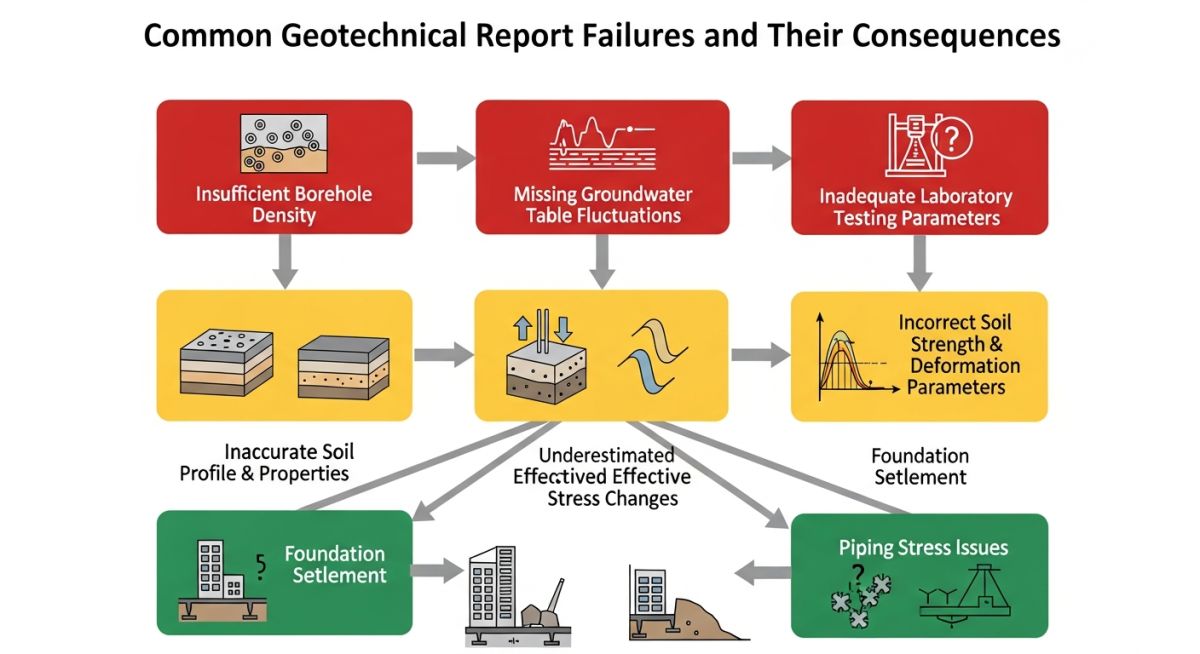
The primary failure point in most geotechnical reports is the lack of spatial density in borehole placement. When a report relies on sparse data points, it fails to capture the heterogeneity of the soil profile. For large-scale piping racks, I insist on a grid pattern that accounts for the specific footprint of the structure, ensuring that soft lenses or organic pockets are not missed between test locations.
Addressing Inadequate Testing and Data Gaps
Inadequate laboratory testing is another frequent oversight. Often, reports provide standard penetration test (SPT) values without correlating them to shear strength or consolidation parameters. For deep foundations, such as piles or drilled shafts, the absence of site-specific skin friction and end-bearing data forces the structural engineer to use conservative, often inefficient, design values.
Field Warning: The Groundwater Trap
Never accept a report that lists groundwater depth based on a single measurement taken during drilling. Drilling fluids can mask the true water table, and seasonal variations can shift the phreatic surface by several meters. Always require piezometer installations for long-term monitoring if the site is near a water body or in a high-precipitation zone.
When calculating the allowable bearing capacity, I look for the relationship between the ultimate bearing capacity and the factor of safety. A common mistake is applying a blanket factor of safety without considering the sensitivity of the soil. For clayey soils, the undrained shear strength must be evaluated using triaxial testing, not just simple field vane shear tests, to prevent long-term settlement issues.
Furthermore, the interaction between the soil and the foundation must be modeled using appropriate subgrade modulus values. If the report provides a single, static value for the modulus of subgrade reaction, it is likely insufficient for dynamic loads or large-diameter piping headers that require uniform support. I recommend requesting a range of values based on the expected load intensity and the size of the foundation mat.
Finally, ensure that the report explicitly addresses the potential for soil liquefaction if the site is in a seismic zone. Many reports provide a cursory statement that liquefaction is “unlikely” without performing the necessary cyclic stress ratio calculations. This is a major red flag that must be addressed through a supplemental investigation before proceeding to the detailed design phase.
Geotechnical Report Optimization: The strategic process of identifying and rectifying report deficiencies to enhance structural safety and project cost-efficiency.
Advantages of Rigorous Review
- Prevents catastrophic differential settlement in critical piping headers.
- Optimizes foundation concrete and steel volumes by using accurate soil parameters.
- Reduces the risk of mid-construction change orders due to unforeseen soil conditions.
- Ensures compliance with local building codes and international standards like ISO 2394.
- Provides a defensible technical basis for foundation design in case of future litigation.
Disadvantages of Incomplete Reporting
- Leads to over-designing foundations, significantly increasing material costs.
- Creates hidden risks of structural failure under extreme loading conditions.
- Causes severe project delays when soil issues are discovered during excavation.
- Increases liability for the engineering firm if the report is found to be negligent.
- Forces reliance on generic, non-site-specific soil data that may not apply.
Geotechnical Report Application: The practical implementation of subsurface data analysis across diverse industrial and civil infrastructure sectors.
Heavy Industrial Petrochemical Plants
In large-scale refinery projects, geotechnical reports are used to design massive mat foundations for compressor stations and pipe racks. Accurate soil data prevents the vibration-induced settlement that can misalign high-pressure piping systems and cause flange leaks.
Offshore Pipeline Shore Approaches
For pipeline landfall projects, the geotechnical report must characterize the liquefaction potential of coastal sands. This data is critical for determining the burial depth and the need for concrete weight coating to prevent pipeline buoyancy and lateral migration.
High-Voltage Transmission Infrastructure
Geotechnical reports for transmission towers focus on lateral load capacity and uplift resistance in varying soil types. Ensuring the report correctly identifies the soil-structure interaction parameters is vital for preventing tower collapse during high-wind events.
Urban Underground Utility Corridors
When installing deep utility tunnels in urban environments, geotechnical reports are essential for predicting ground movement and settlement. This prevents damage to adjacent building foundations and ensures the structural integrity of the tunnel lining under hydrostatic pressure.
When reviewing geotechnical reports for heavy industrial piping racks or compressor stations, I prioritize specific soil parameters that directly influence foundation settlement and lateral stability. The following table outlines the critical thresholds where data inconsistencies often lead to catastrophic structural failure or excessive differential settlement in pipe supports.
Engineers must cross-reference these values against the ASCE 7 standards for site classification and the ASTM D2487 classification system. If the reported values deviate significantly from regional geological expectations, it is a red flag indicating either poor sampling techniques or laboratory error.
| Parameter | Critical Threshold | Impact on Piping |
|---|---|---|
| Allowable Bearing Capacity | Less than 100 kPa | High risk of rack tilting |
| Groundwater Table Depth | Within 1.5m of FGL | Liquefaction and buoyancy issues |
| Soil Plasticity Index | Greater than 25 | Excessive shrink-swell movement |
Always verify that the testing methods used, such as Standard Penetration Tests (SPT) or Cone Penetration Tests (CPT), are appropriate for the soil profile identified. Discrepancies between field logs and lab results are the most common source of project delays during the foundation design phase.
This matrix serves as a technical bridge between raw geotechnical data and structural design requirements. By mapping specific soil entities to their corresponding engineering standards, we ensure that the design basis remains robust against the uncertainties often found in preliminary site investigation reports.
I have found that mapping these entities early in the FEED (Front-End Engineering Design) stage prevents the “weak recommendation” trap, where generic soil parameters are used for complex, high-load piping structures. Referencing the correct API 650 or ASME B31.3 requirements alongside these soil properties is mandatory for compliance.
| Entity | Standard | Application |
|---|---|---|
| SPT N-Value | ASTM D1586 | Foundation settlement analysis |
| Undrained Shear Strength | ASTM D2166 | Slope stability and bearing |
| Consolidation Coeff | ASTM D2435 | Long-term settlement prediction |
Use this matrix to audit the geotechnical consultant’s deliverables. If a report lacks the specific test data required by these standards, request an immediate supplemental investigation before finalizing your foundation drawings.
Before approving any foundation design, I perform a rigorous audit of the geotechnical report. This checklist ensures that no critical data gaps remain that could compromise the integrity of the piping infrastructure. Use this to validate the consultant’s findings against actual site conditions.
- Borehole Density: Verify that the number of boreholes meets the minimum requirements for the site footprint as per ASCE 7.
- Groundwater Monitoring: Confirm that groundwater levels were measured over a sufficient duration to account for seasonal fluctuations.
- Lab Testing Scope: Ensure that triaxial or consolidation tests were performed, not just basic index property tests.
- Recommendation Clarity: Check that the report provides specific allowable bearing pressures for different foundation types (shallow vs. deep).
- Consistency Check: Cross-reference the soil descriptions in the logs with the laboratory test results for discrepancies.
If any of these items are marked as “No” or “Insufficient,” you must issue a formal Request for Information (RFI) to the geotechnical firm. Never proceed with structural design based on assumptions or “typical” values provided in a report that lacks site-specific verification. The cost of a re-design due to poor data is always higher than the cost of a comprehensive site investigation.
Field Case Study: Real-World Application
The Problem: Inadequate Groundwater Data in a Coastal Refinery Expansion
- The geotechnical report failed to account for tidal influence on the groundwater table.
- Designers assumed a static water level, leading to an underestimation of buoyancy forces.
- Foundation excavations encountered unexpected water ingress, causing soil instability.
- The project suffered a three-week delay due to the need for emergency dewatering and redesign.
The Outcome: Successful Mitigation through Supplemental Investigation
- Implemented a piezometer monitoring program to establish true high-water marks.
- Redesigned foundations to include anti-buoyancy measures and waterproof concrete additives.
- Established a revised soil bearing capacity based on saturated conditions.
- Final structural integrity was maintained, preventing future differential settlement of the pipe racks.
My recommendation is to always demand a “worst-case” groundwater scenario in coastal or high-water-table projects. Never accept a report that provides only a single, static groundwater depth without historical context or seasonal variance data.
Frequently Asked Engineering Questions
How many boreholes are required for a standard pipe rack?
- For uniform sites, a spacing of 50 to 100 meters is often acceptable for preliminary design.
- In complex or variable soil conditions, I recommend spacing as close as 20 to 30 meters.
- Always ensure that at least one borehole is located at every major equipment foundation or heavy load point.
- Refer to ASCE 7 and local building codes for specific density requirements based on the structure’s importance factor.
What should I do if the report lacks groundwater data?
- Issue an RFI immediately to the geotechnical consultant requesting a supplemental investigation.
- If the site is near a water body, assume the worst-case scenario (surface level) for buoyancy calculations until proven otherwise.
- Consult historical regional data or nearby project reports to estimate potential water table levels.
- Never proceed with design based on an assumption of “dry” conditions if the site geology suggests otherwise.
Why are weak recommendations a risk to piping?
- Generic bearing capacities often ignore the specific settlement tolerances of sensitive piping systems.
- Lack of lateral soil resistance data can lead to unstable pipe racks under wind or seismic loads.
- Vague recommendations regarding soil improvement techniques can lead to improper site preparation.
- Always demand specific, actionable parameters that align with the structural design requirements of the project.
How do I identify inconsistent soil data?
- Check if the soil classification in the log matches the sieve analysis results in the lab report.
- Compare SPT N-values across adjacent boreholes to see if the soil strata are continuous.
- Look for discrepancies in moisture content between field observations and lab measurements.
- If the data does not make sense geologically, it is likely an error that requires clarification from the consultant.
What is the role of SPT in piping foundations?
- It provides the N-value, which is directly correlated to the allowable bearing pressure of the soil.
- It helps in identifying the depth of competent strata for deep foundation design.
- It is essential for liquefaction potential analysis in seismic zones as per ASTM D1586.
- Always ensure the N-values are corrected for overburden pressure and hammer efficiency to get accurate design data.
Can I use old reports for new projects?
- Site conditions change over time due to erosion, previous construction, or changes in the water table.
- Old reports may not meet current building code requirements or testing standards.
- The scope of the original investigation may not cover the specific needs of your new piping layout.
- Always perform a new, site-specific investigation to ensure the safety and longevity of your structural foundations.
Complete Course on
Piping Engineering
Check Now
Key Features
- 125+ Hours Content
- 500+ Recorded Lectures
- 20+ Years Exp.
- Lifetime Access
Coverage
- Codes & Standards
- Layouts & Design
- Material Eng.
- Stress Analysis

📚 Recommended Resources: Geotechnical Reports
Read these Guides
- 📄 How to Read and Interpret Geotechnical Investigation Reports for Engineers
- 📄 7 Common Mistakes Found in Topographical Survey Reports for Piping
- 📄 How to Interpret SPT N-Values for Reliable Geotechnical Foundation Design
- 📄 Optimizing Borehole Quantity and Location for Geotechnical Site Investigations