
How to Read and Interpret Geotechnical Investigation Reports
In my two decades of managing industrial piping and infrastructure projects, I have learned that the most expensive failures often occur before the first pipe rack is even erected. They start in the soil. A Geotechnical Investigation Report is not merely a stack of paper to be filed away; it is the fundamental blueprint for your structural integrity.
Many engineers glance at the “Recommendations” section and skip the raw data. This is a dangerous oversight. Understanding how to correlate borehole logs with laboratory test results allows you to identify potential settlement risks, groundwater interference, and soil corrosivity that could compromise your entire piping system.
Key Takeaways for Site Engineers:
- Always verify the Standard Penetration Test (SPT) N-values against the soil classification.
- Check the groundwater table depth during both dry and monsoon seasons.
- Cross-reference laboratory Atterberg limits with field moisture content to predict shrink-swell potential.
- Ensure foundation recommendations align with the specific load-bearing requirements of your equipment.
Deep-Dive: How to Read and Interpret Geotechnical Investigation Reports
Geotechnical Report Analysis: The technical process of synthesizing subsurface exploration data, including soil stratification, shear strength parameters, and consolidation characteristics, to establish safe bearing capacities for structural foundations.
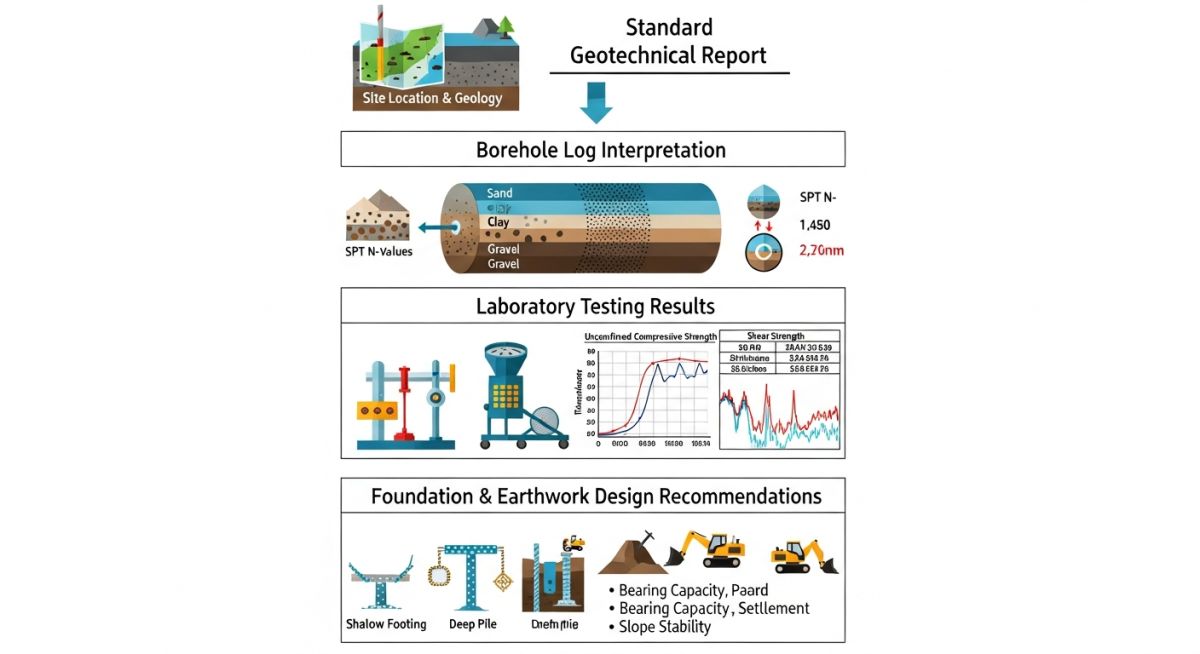
When I open a report, I start with the borehole logs. These logs are the “DNA” of your site. You must look for the correlation between the soil description (e.g., “silty clay with trace sand”) and the N-values. If you see high N-values in a clay layer, investigate further; it might indicate over-consolidation or the presence of boulders, which will drastically change your piling strategy.
Next, I focus on the laboratory results. Specifically, I look at the ASTM D4318 Atterberg limits. If the Plasticity Index (PI) is greater than 20, you are dealing with expansive soil. For a piping engineer, this means your underground firewater lines or buried conduits are at risk of shear failure due to soil movement. You must calculate the potential vertical rise (PVR) to determine if soil stabilization or deep foundations are required.
Field Warning: Groundwater Interference
Never ignore the groundwater table (GWT) elevation. If the GWT is within the zone of influence for your foundation, you must account for buoyancy forces and the reduction in effective stress. I have seen projects where the failure to account for a fluctuating GWT led to the flotation of underground storage tanks and the subsequent rupture of connected piping manifolds.
For foundation design, the report will provide an Allowable Bearing Capacity (ABC). However, you must verify if this value is based on shear failure or settlement limits. Usually, for large industrial structures, settlement is the governing factor. I calculate the total settlement using the compression index (Cc) provided in the consolidation test results. If the calculated settlement exceeds the allowable limit for your piping flexibility analysis, you must request a redesign or ground improvement.
Finally, check the chemical analysis of the soil. High sulfate content or low pH levels are aggressive to concrete and steel. If the report indicates high sulfate levels, you must specify sulfate-resistant cement (Type V) for your pile caps and footings to prevent long-term degradation of the structural integrity.
Geotechnical Data Utilization: The strategic application of subsurface findings to optimize foundation costs while mitigating long-term structural risk and maintenance liabilities.
Advantages
- Reduces uncertainty in foundation selection, preventing costly over-design.
- Identifies hidden site hazards like liquefaction zones or buried voids.
- Provides essential data for accurate piping stress analysis and settlement modeling.
- Ensures compliance with local building codes and international standards like ASCE 7.
- Optimizes earthwork volumes by defining cut-and-fill suitability.
Disadvantages
- Reports are point-specific; they may miss localized soil anomalies between boreholes.
- Laboratory testing can be time-consuming, potentially delaying project start dates.
- Interpretation requires high-level expertise; misreading data leads to catastrophic failure.
- Costs for comprehensive deep-site investigations can be significant for smaller projects.
- Data can become obsolete if site grading or drainage patterns change significantly.
Geotechnical Engineering Applications: The practical deployment of soil mechanics principles across diverse industrial and civil infrastructure sectors to ensure long-term operational stability.
Heavy Industrial Plant Foundations
For large-scale petrochemical or power plants, geotechnical reports are used to design deep pile foundations that bypass soft, compressible layers. By analyzing the skin friction and end-bearing capacity provided in the report, we ensure that heavy vibrating equipment and pipe racks remain stable under extreme operational loads.
Underground Pipeline Infrastructure
When installing long-distance transmission pipelines, geotechnical data is used to determine the corrosivity of the soil and the required bedding material. This prevents premature pipe wall thinning and ensures that the pipeline can withstand the lateral earth pressures and potential seismic shifts identified in the site investigation.
Slope Stability for Tank Farms
In facilities with large storage tanks, the geotechnical report provides the shear strength parameters necessary to perform slope stability analysis. This is critical for preventing landslides or embankment failures that could lead to massive containment breaches and environmental disasters.
Seismic Retrofitting and Liquefaction Analysis
In seismically active regions, the report is used to evaluate the liquefaction potential of saturated sandy soils. By calculating the cyclic stress ratio, engineers can determine if ground improvement techniques like stone columns or vibro-compaction are necessary to prevent foundation sinking during a seismic event.
When reviewing a geotechnical report, engineers must correlate field observations with laboratory-derived soil parameters. The table below summarizes the critical soil properties typically extracted from ASTM International standard tests, which form the backbone of your foundation design calculations. Understanding these values is essential for determining the allowable bearing capacity and predicting settlement behavior under structural loads.
I always emphasize that these parameters are not static; they represent a snapshot of the soil condition at the time of drilling. You must evaluate how seasonal water table fluctuations or future site grading might alter these values. Always cross-reference these laboratory results with the borehole logs to ensure the samples tested are representative of the strata where your foundation will actually sit.
| Parameter | Standard Test | Engineering Application |
|---|---|---|
| Standard Penetration Test (N-Value) | ASTM D1586 | Relative density and bearing capacity estimation |
| Atterberg Limits | ASTM D4318 | Soil plasticity and expansion potential |
| Consolidation Properties | ASTM D2435 | Long-term settlement magnitude and rate |
The following matrix maps the core entities found in a professional geotechnical report to their respective regulatory and analytical frameworks. As an engineer, you must treat this matrix as a navigation tool for your design process, ensuring that every soil entity identified in the field is accounted for in your structural safety calculations.
Consistency in terminology is vital for project communication. When you see terms like “Effective Stress” or “Undrained Shear Strength,” they must be mapped directly to the design assumptions used in your finite element analysis or traditional bearing capacity equations. Failure to align these entities often leads to over-conservative designs or, worse, catastrophic foundation failure due to misinterpretation of soil behavior.
Before finalizing your foundation design, you must perform a rigorous audit of the geotechnical report. This checklist ensures that no critical site data has been overlooked and that the recommendations provided are actionable for your specific structural requirements.
- Borehole Coverage: Verify that the number and depth of boreholes meet the minimum requirements of ASCE 7 for the building footprint size.
- Groundwater Data: Confirm that the seasonal high groundwater table is clearly identified, as this significantly impacts buoyancy and excavation stability.
- Soil Classification: Ensure all soil strata are classified per the Unified Soil Classification System (ASTM D2487).
- Seismic Parameters: Check that the Site Class (A-F) is defined for seismic design as per local building codes.
- Corrosivity Testing: Confirm that soil pH and sulfate content were tested to determine concrete exposure classes for foundation durability.
If any of these items are missing, do not proceed with the design. Request a supplemental investigation or clarification from the geotechnical engineer of record. Your signature on the structural drawings implies acceptance of these site conditions; therefore, due diligence at this stage is your primary defense against future litigation and structural failure.
The Problem: Unforeseen Soft Clay Lenses
A multi-story commercial project faced significant differential settlement during the initial foundation pour due to an overlooked soft clay lens.
- Borehole spacing was too wide to detect the localized soft soil pocket.
- The geotechnical report failed to highlight the potential for organic inclusions.
- The structural design assumed uniform bearing capacity across the entire site.
The Outcome: Remediation and Revised Design
The project team successfully mitigated the risk through a combination of soil stabilization and structural redesign.
- Implemented deep soil mixing to improve the shear strength of the clay lens.
- Increased the stiffness of the foundation mat to bridge the soft zone.
- Installed real-time settlement monitoring sensors to track performance during construction.
My recommendation: Always insist on a “Proof Roll” or additional localized probing if the site history suggests variable soil conditions. Never rely solely on a single report if the site geology appears complex or inconsistent.
Frequently Asked Engineering Questions
How do I interpret N-values from borehole logs?
The N-value, derived from ASTM D1586, represents the number of blows required to drive a split-spoon sampler 12 inches into the soil. It is a primary indicator of relative density for cohesionless soils.
- Values below 4 indicate very loose soil, requiring ground improvement.
- Values between 10 and 30 suggest medium dense soil suitable for shallow foundations.
- Always apply energy correction factors (N60) to normalize the data for hammer efficiency.
What is the significance of the groundwater table?
The groundwater table position is critical because it directly influences the effective stress of the soil and the buoyancy forces acting on your foundation.
- High water tables reduce the effective bearing capacity of granular soils.
- Excavation below the water table requires dewatering plans and potential shoring.
- Long-term fluctuations can lead to cyclic wetting and drying, causing settlement in expansive soils.
How are Atterberg Limits used in design?
Atterberg Limits define the moisture content boundaries between solid, semi-solid, plastic, and liquid states of fine-grained soils.
- The Plasticity Index (PI) helps identify the potential for soil expansion or shrinkage.
- High PI values indicate high-plasticity clays that may require moisture control or chemical stabilization.
- These limits are essential for classifying soils under the Unified Soil Classification System.
What is the difference between total and effective stress?
Total stress is the sum of the soil skeleton stress and the pore water pressure, while effective stress is the stress carried by the soil particles themselves.
- Effective stress governs the shear strength and volume change of the soil.
- In saturated conditions, pore water pressure can counteract applied loads, leading to instability.
- Always use effective stress parameters for long-term settlement and bearing capacity calculations.
When is a deep foundation recommended?
Deep foundations, such as piles or drilled shafts, are recommended when shallow strata lack the bearing capacity to support structural loads or when settlement limits are exceeded.
- Use deep foundations if the upper soil layers are highly compressible or liquefiable.
- Consider them for heavy structures where load distribution requires reaching competent bedrock.
- Evaluate the cost-benefit ratio against ground improvement techniques for shallow foundations.
How do I handle soil corrosivity in design?
Soil corrosivity is determined by testing for pH, resistivity, and sulfate content, which dictate the exposure class for concrete and steel foundations.
- High sulfate levels require sulfate-resistant cement (Type V) to prevent concrete degradation.
- Low resistivity indicates a highly corrosive environment for buried steel, necessitating cathodic protection.
- Always specify the appropriate concrete mix design based on the geotechnical report’s chemical analysis.
Complete Course on
Piping Engineering
Check Now
Key Features
- 125+ Hours Content
- 500+ Recorded Lectures
- 20+ Years Exp.
- Lifetime Access
Coverage
- Codes & Standards
- Layouts & Design
- Material Eng.
- Stress Analysis

📚 Recommended Resources: Geotechnical Investigation Reports
Read these Guides
- 📄 Mastering Topographical Survey Reports for Precision Piping Engineering Design
- 📄 Essential Geotechnical Investigation Terminology for Structural Foundation Design Success
- 📄 Essential Survey Instruments Used in Geotechnical Investigations for Site Analysis
- 📄 Geotechnical and Topographical Surveys: A Complete Guide for Engineers