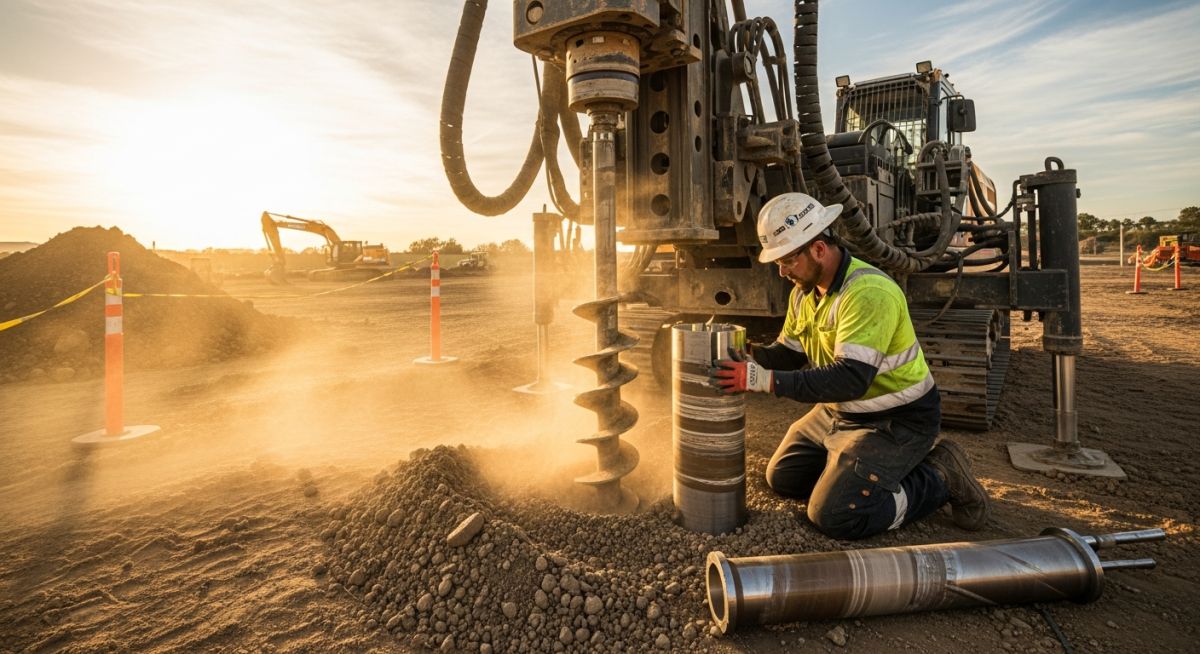
Important Terminology Used in Geotechnical Investigations
In my two decades of experience, I have seen countless projects face catastrophic delays simply because the design team misinterpreted basic soil reports. Understanding the language of geotechnical engineering is not just an academic exercise; it is the primary defense against foundation failure and structural settlement.
Whether you are dealing with SPT N-values for shallow foundations or RQD for rock-socketed piles, the precision of your data interpretation dictates the safety factor of your entire facility. This guide breaks down the essential terminology that every structural and piping engineer must master to ensure site integrity.
Key Takeaways for Engineers:
- Master the correlation between SPT N-values and soil relative density.
- Distinguish between total and effective stress in saturated soil conditions.
- Understand how Atterberg Limits define the plasticity and workability of clay soils.
- Recognize the impact of the water table on long-term settlement and bearing capacity.
Technical Deep-Dive: Geotechnical Investigation Terminology
Geotechnical Investigation Terminology: The systematic application of field and laboratory testing to derive soil shear strength, compressibility, and hydraulic conductivity for engineering design.
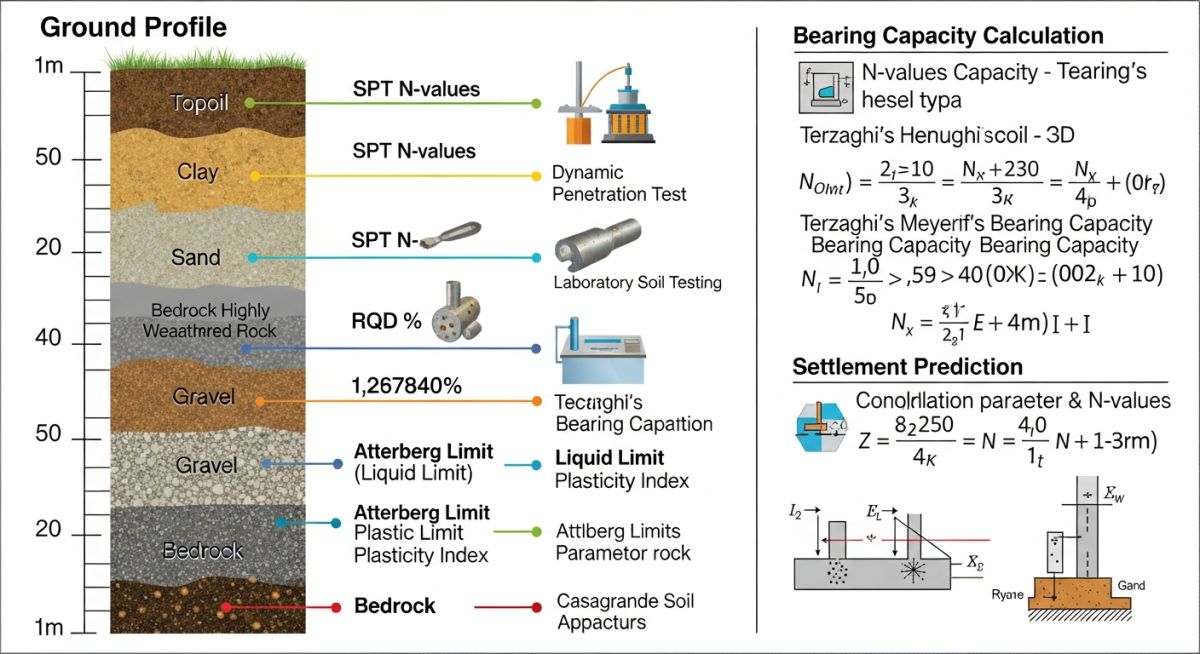
When I review a geotechnical report, I focus immediately on the Standard Penetration Test (SPT) N-value. Per ASTM D1586, the N-value represents the number of blows required to drive a split-spoon sampler 300mm into the soil. This value is the backbone of empirical correlations for relative density in sands and consistency in clays.
Rock Quality Designation (RQD) and Core Recovery
For rock foundations, we look at Core Recovery and RQD. Core recovery is the ratio of the length of rock recovered to the total length drilled. RQD is more specific: it is the sum of the lengths of all sound rock pieces greater than 100mm, divided by the total length of the core run.
Field Warning: RQD Limitations
RQD is highly dependent on the orientation of the borehole relative to rock joints. An RQD of 50% does not always indicate poor rock; it may simply mean the drill path intersected a vertical fracture set. Always cross-reference RQD with the Geological Strength Index (GSI) before finalizing pile depth.
Bearing Capacity and Settlement Analysis
Ultimate Bearing Capacity (q_u) is calculated using Terzaghi’s bearing capacity equation, which accounts for soil cohesion (c), surcharge (q), and unit weight (gamma). In practice, we apply a Factor of Safety (FoS) typically ranging from 2.5 to 3.0 to determine the Allowable Bearing Capacity.
Settlement, however, is often the governing factor for large industrial structures. We categorize this into immediate elastic settlement and long-term consolidation settlement. For cohesive soils, the consolidation settlement is determined by the compression index (Cc) derived from oedometer tests per ASTM D2435.
The water table position is critical here. A high water table reduces the effective stress of the soil, which directly lowers the bearing capacity and increases the risk of liquefaction during seismic events. Always ensure your design accounts for the highest anticipated seasonal water table level.
Geotechnical Investigation Benefits: The strategic use of standardized testing provides a quantifiable risk profile for subsurface conditions, enabling optimized foundation sizing and cost-effective material selection.
Advantages
- Reduces uncertainty in foundation depth requirements.
- Prevents structural failure due to differential settlement.
- Optimizes concrete and steel volumes for footings.
- Identifies potential chemical aggression (sulfates/chlorides) to concrete.
- Provides baseline data for seismic site classification.
Disadvantages
- High initial cost for deep borehole drilling.
- Point-source data may miss localized soil anomalies.
- Laboratory testing turnaround times can delay design.
- Correlation errors if empirical formulas are misapplied.
- Environmental impact of drilling fluids and site disturbance.
Geotechnical Investigation Applications: The application of soil mechanics principles to diverse infrastructure projects, ensuring structural stability across varying geological environments and loading conditions.
Heavy Industrial Plant Foundations
Large-scale processing plants require precise bearing capacity analysis to support heavy vibrating equipment and high-pressure piping racks. By utilizing SPT and CPT data, engineers can design mat foundations that mitigate the risk of uneven settlement under concentrated static loads.
Deep Foundation Piling Systems
In areas with soft, compressible surface soils, geotechnical investigations determine the required depth for end-bearing or friction piles. RQD and core recovery data are essential for verifying that piles are socketed into competent bedrock, ensuring long-term structural integrity for high-rise or offshore structures.
Pipeline Route Geotechnical Assessment
For cross-country pipeline projects, geotechnical investigations identify soil corrosivity and potential slope instability. Understanding the Atterberg limits and moisture content allows for the design of appropriate trench backfill and erosion control measures, preventing pipeline exposure or stress-induced leaks.
In my two decades of field experience, I have found that relying on raw data without applying standardized correlation factors often leads to catastrophic foundation failures. The table below summarizes the critical parameters I consistently monitor during site investigations, referencing ASTM D1586 for SPT and ASTM D2487 for soil classification.
These values serve as the primary inputs for calculating allowable bearing capacity and predicting settlement behavior in cohesive and non-cohesive soils. Always ensure that your field N-values are corrected for overburden pressure and hammer efficiency before utilizing them in the design equations provided in ASCE 7 standards.
| Parameter | Standard Reference | Primary Application |
|---|---|---|
| SPT N-Value | ASTM D1586 | Relative density and consistency estimation |
| RQD | ASTM D6032 | Rock mass quality and excavation assessment |
| Atterberg Limits | ASTM D4318 | Plasticity and soil classification |
| CBR Value | ASTM D1883 | Pavement design and subgrade strength |
The following matrix maps the essential geotechnical entities to their respective physical properties and structural design implications. Understanding these relationships is vital for any engineer performing site-specific seismic analysis or deep foundation design.
By cross-referencing these entities, you can identify potential risks such as liquefaction potential, excessive consolidation, or slope instability early in the project lifecycle. This matrix is designed to assist in the rapid verification of laboratory test results against field observations.
| Entity | Physical Property | Design Impact |
|---|---|---|
| UCS | Compressive Strength | Foundation load-bearing capacity |
| Water Table | Pore Pressure | Effective stress and buoyancy |
| Settlement | Deformation Modulus | Serviceability limit state compliance |
Geotechnical Investigation Verification: A systematic approach to site verification ensures that the data collected during the field investigation phase accurately reflects the subsurface conditions required for structural design. In my experience, skipping these verification steps often leads to significant cost overruns during the construction phase due to unforeseen soil behavior.
- Verify that SPT hammer energy calibration is current per ASTM D4633.
- Confirm that the groundwater table measurement has stabilized for at least 24 hours.
- Ensure core recovery samples are logged and photographed immediately upon extraction.
- Validate that Atterberg limit tests are performed on representative samples from each soil stratum.
- Check that the bearing capacity analysis accounts for the worst-case seasonal water table elevation.
- Confirm that settlement calculations include both immediate and long-term consolidation components.
Always document the site conditions at the time of drilling, including weather and surface drainage, as these factors directly influence the reliability of the ASCE design parameters derived from your investigation.
Field Case Study: Real-World Application
The Problem: Unexpected Settlement in High-Rise Foundation
- Inaccurate estimation of the water table depth led to incorrect effective stress calculations.
- SPT N-values were not corrected for overburden pressure, resulting in an overestimation of soil stiffness.
- The presence of a thin, highly compressible clay lens was missed during the initial borehole spacing.
- Differential settlement exceeded the allowable limits defined in the structural design code.
The Outcome: Successful Remediation and Design Adjustment
- Implemented a deep soil mixing program to stabilize the compressible clay lens.
- Revised the foundation design to incorporate a raft foundation, distributing loads more effectively.
- Installed piezometers to monitor real-time pore water pressure changes during construction.
- Achieved a 40 percent reduction in total settlement through targeted ground improvement techniques.
My recommendation for similar projects is to always perform a sensitivity analysis on your bearing capacity and settlement models. By varying the input parameters within a reasonable range, you can identify which variables have the most significant impact on your foundation performance.
Frequently Asked Engineering Questions
How does the water table affect bearing capacity?
- Buoyancy effects reduce the effective overburden pressure.
- Pore water pressure increases, potentially leading to a reduction in shear strength.
- Designers must apply correction factors for the water table location as specified in ASCE standards.
Why is RQD important for rock foundations?
- High RQD values indicate competent, massive rock suitable for high-load foundations.
- Low RQD values suggest fractured or weathered rock that may require grouting or deep foundations.
- It is calculated by summing the lengths of sound core pieces greater than 100mm, divided by the total core run length.
What is the significance of Atterberg Limits?
- The Plasticity Index (PI) helps classify the soil type and its potential for volume change.
- High PI values often indicate expansive clays that require special foundation considerations.
- These tests are fundamental to the Unified Soil Classification System (USCS) per ASTM D2487.
How do I interpret SPT N-values?
- N-values must be corrected for overburden pressure and hammer efficiency (N60).
- Low N-values in sands indicate a high risk of liquefaction during seismic events.
- High N-values in clays indicate stiff to hard consistency, providing higher bearing capacity.
What is the difference between UCS and CBR?
- UCS is typically used for foundation bearing capacity calculations.
- CBR is used to determine the required thickness of pavement layers.
- Both are essential for characterizing the mechanical behavior of the site soils.
How is settlement predicted in geotechnical design?
- Immediate settlement is calculated using elastic theory and the modulus of elasticity.
- Consolidation settlement is determined using the compression index (Cc) from oedometer tests.
- Total settlement must be compared against the serviceability limits of the structural design.
Complete Course on
Piping Engineering
Check Now
Key Features
- 125+ Hours Content
- 500+ Recorded Lectures
- 20+ Years Exp.
- Lifetime Access
Coverage
- Codes & Standards
- Layouts & Design
- Material Eng.
- Stress Analysis

📚 Recommended Resources: Geotechnical Investigation
Read these Guides
- 📄 Essential Survey Instruments Used in Geotechnical Investigations for Site Analysis
- 📄 Preparing a Comprehensive RFP for Geotechnical Investigations: Expert Guide
- 📄 Geotechnical and Topographical Surveys: A Complete Guide for Engineers
- 📄 Wind Turbine Foundations Explained: Design, Geotechnical, and Construction Methods