
Class 4 Cost Estimates: Strategic Budgeting for Capital Projects
In my two decades of managing multi-billion dollar piping and infrastructure projects, I have learned that the most dangerous phase of any capital investment is the “unknown-unknown” period. A Class 4 cost estimate serves as the primary bridge between a conceptual idea and a bankable project scope. When we operate at this level of maturity, we are not looking for precision; we are looking for the viability of the business case.
Engineers often struggle with the ambiguity of Class 4 estimates because they crave the certainty of a Class 1 or 2 estimate. However, forcing high-fidelity data into a low-maturity phase leads to “analysis paralysis.” This guide breaks down how to leverage AACE Recommended Practice 18R-97 to maintain project momentum while managing stakeholder expectations regarding accuracy and risk.
Key Takeaways
- Understand the 1% to 15% engineering maturity threshold.
- Master the -15% to -30% and +20% to +50% accuracy range.
- Learn why Class 4 estimates are the bedrock of Go/No-Go decisions.
- Identify the primary drivers of variance in early-stage project controls.
Technical Deep-Dive: Class 4 Cost Estimates Methodology
Class 4 Cost Estimates: Quantitative assessments derived from stochastic modeling and parametric data, intended to support project screening and initial capital allocation under AACE International standards.
When I prepare a Class 4 estimate, I am essentially building a statistical model rather than a material takeoff. At this stage, we lack P&IDs, isometric drawings, and finalized plot plans. Instead, we rely on historical data from similar brownfield or greenfield projects. The methodology hinges on parametric estimating, where we correlate cost to primary capacity drivers, such as throughput (barrels per day), heat duty (megawatts), or total installed horsepower.
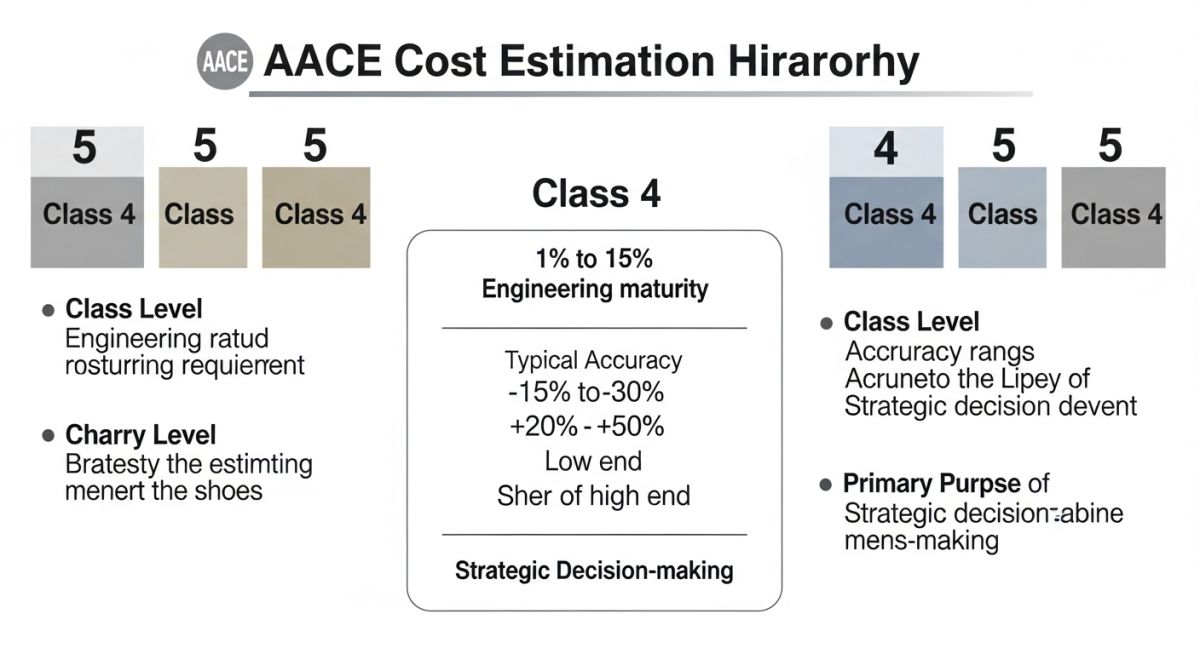
Engineering Maturity and Accuracy Ranges
The AACE 18R-97 standard dictates that a Class 4 estimate is prepared with 1% to 15% of project definition. This is a critical constraint. If your team has already completed 30% of the engineering, you are no longer in the Class 4 territory; you are moving toward Class 3. The accuracy range for Class 4 is typically -15% to -30% on the low end and +20% to +50% on the high end. This wide variance is not a sign of poor estimation; it is a reflection of the inherent risk in early-stage project definition.
Field Warning: The Trap of False Precision
Never attempt to “tighten” a Class 4 estimate by adding arbitrary contingency percentages without a risk-based assessment. In my experience, junior estimators often try to mask the lack of scope definition by inflating contingency, which leads to project rejection by the board. Instead, document the “Basis of Estimate” (BOE) clearly, highlighting the specific assumptions made regarding site conditions, labor productivity, and material escalation.
Stochastic Modeling and Parametric Drivers
To calculate the estimate, I utilize a top-down approach. We define the “Capacity Factor” and apply a “Cost-Capacity Factor” (often referred to as the six-tenths rule). If the cost of a known plant with capacity A is C1, the estimated cost C2 for a new plant with capacity B is calculated as C2 = C1 * (B/A)^x, where x is the scaling exponent. For most petrochemical units, x typically ranges from 0.6 to 0.7.
This calculation must be supplemented by location factors and time-based escalation indices. I always reference the Chemical Engineering Plant Cost Index (CEPCI) to adjust historical data to current market conditions. Without these adjustments, your Class 4 estimate will be fundamentally flawed, regardless of how sophisticated your parametric model appears.
Class 4 Cost Estimates: Strategic evaluation of project feasibility versus the inherent risks of limited engineering definition and high market volatility.
Advantages
- Rapid turnaround for early-stage investment decisions.
- Low cost of preparation compared to detailed engineering.
- Enables comparative analysis of multiple project alternatives.
- Identifies major cost drivers early in the lifecycle.
- Facilitates high-level risk identification and mitigation planning.
Disadvantages
- High potential for significant variance in final costs.
- Susceptible to “optimism bias” in early scope assumptions.
- Limited utility for procurement or detailed scheduling.
- Requires significant historical data to be reliable.
- Often misunderstood by stakeholders as a fixed budget.
Class 4 Cost Estimates: Practical deployment across diverse industrial sectors for capital planning and portfolio management.
Greenfield Refinery Expansion
During the initial screening of a new refinery unit, we utilize Class 4 estimates to determine if the projected internal rate of return justifies the capital expenditure. By applying parametric scaling to existing unit designs, we can quickly assess the impact of varying throughput capacities on the total installed cost without performing a full front-end engineering design (FEED).
Renewable Energy Infrastructure
For large-scale solar or wind farm developments, Class 4 estimates are essential for land acquisition and grid connection feasibility studies. We model the cost per megawatt based on regional labor rates and equipment procurement trends, allowing developers to filter out non-viable sites before committing to expensive environmental impact assessments.
Brownfield Debottlenecking Projects
In existing chemical plants, we use these estimates to evaluate the cost-benefit ratio of minor process modifications. By comparing the cost of adding a heat exchanger or a pump against the potential increase in production yield, we can prioritize maintenance and upgrade projects that offer the fastest payback period for the facility.
When evaluating capital project viability, the Class 4 cost estimate serves as a critical bridge between conceptual screening and definitive budget authorization. In my experience, engineers often struggle to distinguish between the inherent volatility of a Class 5 estimate and the structured, albeit preliminary, nature of Class 4. This table outlines the specific engineering deliverables and maturity markers required to satisfy AACE International Recommended Practice 18R-97.
The data below highlights the expected level of project definition (EPD) and the corresponding engineering effort required to achieve the target accuracy range of -15% to -30% on the low end and +20% to +50% on the high end. Understanding these thresholds is vital for project managers who must communicate risk profiles to stakeholders before moving into Front-End Engineering Design (FEED) phases.
| Parameter | Class 4 Requirement | Engineering Maturity |
|---|---|---|
| Project Definition | 1% to 15% | Preliminary Process Flow Diagrams |
| Methodology | Stochastic/Parametric | Equipment factored estimates |
| Accuracy Range | -15% to -30% / +20% to +50% | High uncertainty, low definition |
By adhering to these parameters, project teams ensure that the cost estimate reflects the current state of engineering maturity rather than wishful thinking. Always verify that your contingency allowances are calculated based on the specific risk register associated with these early-stage definitions.
The following matrix maps the core technical entities involved in the development of Class 4 cost estimates. As a piping and mechanical lead, I have found that the integration of these entities is what separates a professional estimate from a rough order of magnitude (ROM) guess. We utilize these mappings to ensure that every discipline—from civil works to instrumentation—is accounted for within the preliminary project scope.
This matrix serves as a reference for project controls teams to verify that the technical inputs align with the AACE International standards for cost classification. By standardizing these inputs, we minimize the variance between the initial estimate and the final project outturn cost, providing a more stable foundation for investment decisions.
| Entity | Acronym | Standard Reference |
|---|---|---|
| Level of Project Definition | LPD | CII IR113-2 |
| Cost Estimate Classification | CEC | AACE 18R-97 |
| Engineering Procurement Construction | EPC | ISO 10845 |
Utilizing this matrix allows for a consistent audit trail during the project lifecycle. When discrepancies arise, referring back to these mapped entities helps identify whether the issue stems from scope creep, inaccurate parametric data, or a failure to account for site-specific constraints.
Verification of a Class 4 cost estimate requires a disciplined approach to site data and engineering assumptions. In my years of project management, I have seen too many projects fail because the initial estimate ignored site-specific geotechnical or logistical constraints. This checklist is designed to ensure that your Class 4 estimate is grounded in reality, adhering to the rigorous standards set by AACE International.
Verification Checkpoints
- ✓ Confirm that the Process Flow Diagrams (PFDs) are at least 10% complete.
- ✓ Validate that major equipment lists include preliminary sizing and material specifications.
- ✓ Ensure that site-specific labor productivity factors are applied to the estimate.
- ✓ Verify that the contingency percentage reflects the high-risk nature of early-stage engineering.
- ✓ Cross-reference the estimate against historical data from similar brownfield or greenfield projects.
- ✓ Document all assumptions regarding utility tie-ins and infrastructure requirements.
Before finalizing your submission, ensure that every item on this list has been reviewed by a senior discipline lead. A Class 4 estimate is not merely a financial document; it is a technical roadmap. If the engineering maturity does not support the cost figures, the estimate must be flagged for further refinement. Always maintain a clear record of the “basis of estimate” (BOE) to facilitate future audits and project transitions into the FEED phase.
The Challenge: Inaccurate Early-Stage Budgeting
A mid-sized chemical plant expansion project faced a 40% cost overrun during the transition from conceptual design to FEED, primarily due to an improperly classified Class 4 estimate.
- Failure to account for complex brownfield tie-in requirements.
- Over-reliance on generic parametric data without site-specific adjustments.
- Lack of clear engineering deliverables at the 10% maturity mark.
- Underestimation of local labor market volatility and logistics costs.
The Outcome: Corrective Action and Stabilization
By re-evaluating the project using the AACE 18R-97 framework, the team successfully stabilized the budget and aligned stakeholder expectations.
- Reduced budget variance from 40% to within the 20% target range.
- Established a robust Basis of Estimate (BOE) document for all future phases.
- Improved communication between engineering and finance departments.
- Identified critical path risks early, allowing for proactive mitigation strategies.
My recommendation for similar projects is to treat the Class 4 estimate as a living document. Do not finalize the budget until the engineering maturity matches the required level of definition. If the data is missing, use a higher contingency factor and clearly communicate this risk to the project sponsors.
What is the primary purpose of a Class 4 estimate?
- Facilitates early-stage project screening and feasibility studies.
- Provides a baseline for comparing different project alternatives.
- Supports the initial allocation of capital for Front-End Engineering Design (FEED).
- Aligns with AACE International standards for early-stage project controls.
How does engineering maturity affect estimate accuracy?
- Low maturity (1-15%) results in wider accuracy ranges (up to +50%).
- High maturity (FEED/Detailed Design) narrows the range significantly.
- Engineering deliverables like PFDs and equipment lists reduce reliance on parametric assumptions.
- Consistent documentation of maturity levels is required by AACE International.
What methodology is best for Class 4 estimates?
- Utilize equipment-factored cost models for major mechanical components.
- Apply historical cost indices to adjust for inflation and location.
- Incorporate site-specific labor productivity factors to account for local conditions.
- Ensure the methodology is transparent and documented in the Basis of Estimate (BOE).
How should contingency be handled in Class 4?
- Apply contingency percentages that align with the +50% high-end accuracy range.
- Perform a qualitative risk assessment to identify major project threats.
- Ensure contingency is clearly separated from the base estimate in all reports.
- Review and adjust contingency as the project moves into the FEED phase.
What are the common pitfalls in Class 4?
- Over-optimism regarding labor productivity and site logistics.
- Failure to account for brownfield tie-in complexity.
- Lack of a clear Basis of Estimate (BOE) document.
- Misalignment between engineering maturity and cost classification.
How do I transition from Class 4 to FEED?
- Conduct a formal review of all assumptions made during the Class 4 phase.
- Update the project execution plan to reflect the new engineering requirements.
- Transition from parametric estimating to more detailed material take-offs.
- Ensure all stakeholders agree on the project scope before moving forward.
📚 Recommended Resources: Class 4 Cost Estimates
Read these Guides
🎥 Watch Tutorials

Complete Course on
Piping Engineering
Check Now
Key Features
- 125+ Hours Content
- 500+ Recorded Lectures
- 20+ Years Exp.
- Lifetime Access
Coverage
- Codes & Standards
- Layouts & Design
- Material Eng.
- Stress Analysis
