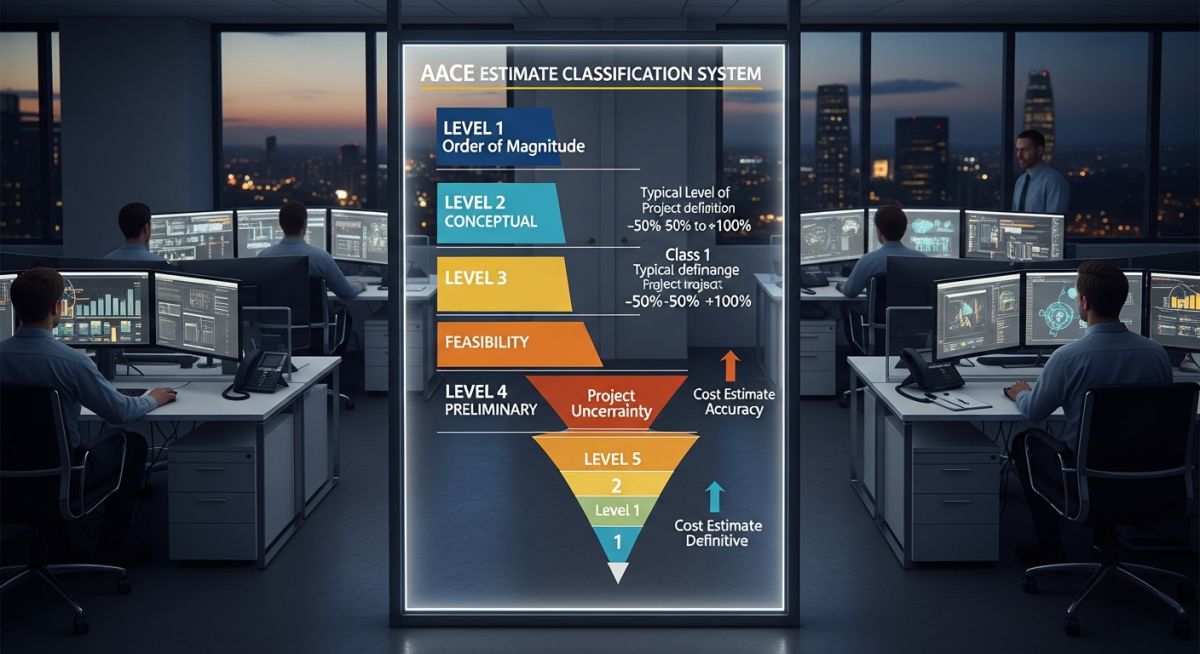
AACE Estimate Classification System: Mastering Project Cost Accuracy
In my two decades of managing complex piping and process plant projects, I have seen countless budgets spiral out of control simply because stakeholders confused a Class 5 screening estimate with a Class 2 definitive control budget. The AACE Estimate Classification System is not merely a bureaucratic requirement; it is the primary tool for managing risk and setting realistic financial expectations for owners and contractors alike.
When we talk about estimate maturity, we are essentially measuring the percentage of engineering completion. A Class 5 estimate might rely on 0% to 2% of project definition, whereas a Class 1 estimate requires near-total design completion. Understanding this spectrum allows us to communicate uncertainty effectively, ensuring that project sponsors understand that early-stage numbers are inherently volatile.
Key Takeaways for Project Success
- Align your estimate class with the current level of engineering design maturity.
- Use the AACE accuracy ranges to establish appropriate contingency buffers.
- Recognize that moving from Class 5 to Class 1 is a process of progressive refinement.
- Standardize your reporting to ensure all stakeholders speak the same language of risk.
AACE Estimate Classification System: Technical Maturity and Accuracy
AACE Estimate Classification System: A rigorous methodology for mapping project definition maturity against expected cost variance, governed by Recommended Practice 18R-97.
The core of the AACE system lies in the relationship between project definition and cost uncertainty. As an engineer, I view the classification as a roadmap for data acquisition. A Class 5 estimate is typically used for strategic business planning, where we might only have a block flow diagram and a rough capacity estimate. The accuracy range here is wide, often spanning -20% to -50% on the low end and +30% to +100% on the high end.
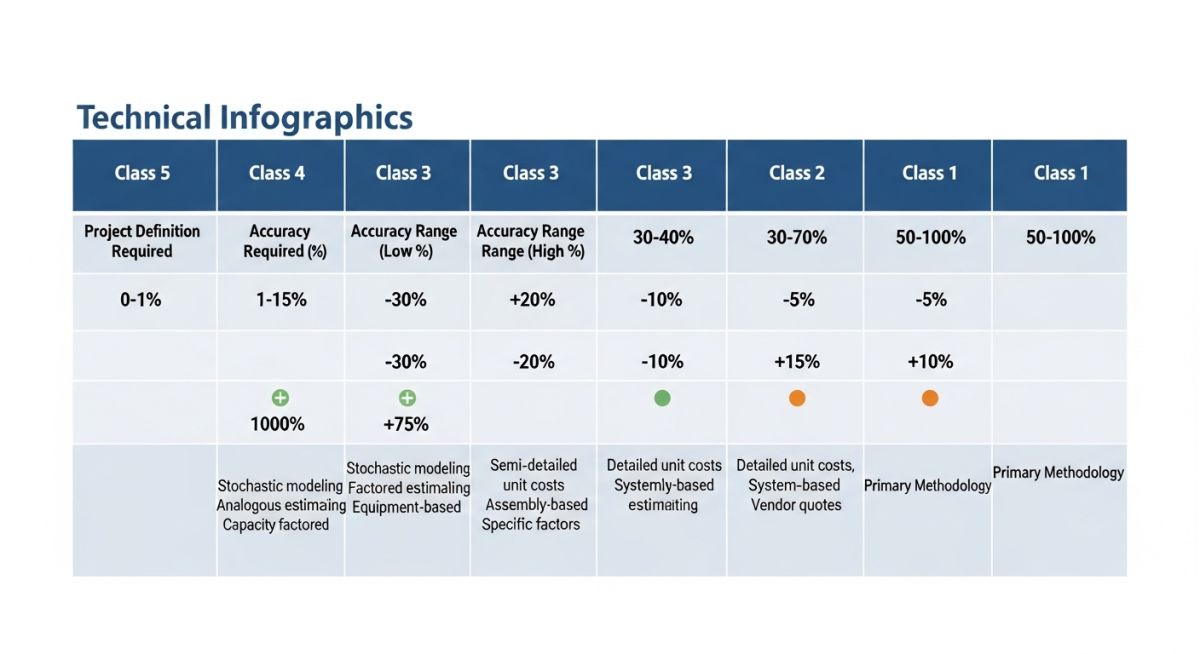
The Five Classes of Estimation
Each class represents a specific milestone in the project lifecycle. As we progress, we replace assumptions with hard data—such as P&IDs, equipment datasheets, and piping isometrics.
- Class 5: Concept Screening. Used for initial feasibility. Relies on historical data and parametric modeling.
- Class 4: Study or Feasibility. Requires 1% to 15% project definition. Often used for budget authorization.
- Class 3: Budget, Authorization, or Control. Requires 10% to 40% definition. This is the baseline for project execution.
- Class 2: Control or Bid/Tender. Requires 30% to 75% definition. Used for detailed procurement and construction planning.
- Class 1: Check Estimate or Final Estimate. Requires 65% to 100% definition. Used for final project closeout and performance analysis.
Engineering Warning: The Accuracy Trap
Never mistake a Class 3 estimate for a fixed-price bid. Even with 40% definition, the inherent volatility in material costs and labor productivity means that the accuracy range remains significant. Always apply the AACE-recommended contingency percentages based on the specific class of the estimate to avoid underfunding the project.
In my experience, the transition from Class 3 to Class 2 is where most projects face the greatest risk. This is the phase where piping layouts are finalized, and the bill of materials (BOM) shifts from estimated lengths to actual takeoff quantities. If your piping design software is not integrated with your cost database, you will inevitably see a “scope creep” in your estimate that is actually just a correction of previous under-estimations.
AACE Classification Benefits and Limitations: A critical assessment of how standardized estimation frameworks impact project governance and financial risk management.
Advantages
- Provides a common language for project stakeholders to discuss risk.
- Forces discipline in defining project scope before budget approval.
- Enables benchmarking against historical project performance data.
- Reduces the likelihood of “optimism bias” in early-stage project planning.
- Facilitates clear communication regarding the maturity of design data.
Disadvantages
- Requires significant time and resources to maintain high-class estimates.
- Can be misused by management to demand “Class 1” accuracy from “Class 5” data.
- Does not account for external market volatility or force majeure events.
- Often perceived as a rigid hurdle rather than a flexible management tool.
- Complexity can alienate non-technical stakeholders if not explained properly.
AACE Estimate Classification Implementation: Practical deployment of cost maturity standards across diverse industrial sectors and capital project phases.
Green Hydrogen Plant Development
In the rapidly evolving hydrogen sector, Class 5 estimates are used to evaluate the economic viability of various electrolysis technologies. By applying AACE standards, developers can compare the capital intensity of PEM versus Alkaline systems before committing to expensive front-end engineering design (FEED) studies.
Refinery Revamp and Debottlenecking
For brownfield piping modifications, Class 3 estimates are essential for securing capital authorization for plant turnarounds. We use these to account for the high uncertainty of tie-in costs and existing infrastructure integration, ensuring that the budget covers the inevitable site-based surprises.
Offshore Platform Structural Upgrades
Offshore projects demand high-precision Class 2 estimates due to the extreme costs of logistics and specialized labor. By reaching a 75% definition level, we minimize the risk of offshore change orders, which are exponentially more expensive than onshore design revisions.
In my two decades of managing capital piping projects, I have found that the AACE International framework serves as the primary language for communication between engineering teams and stakeholders. The table below delineates the relationship between project definition maturity and the expected accuracy range, which is critical for setting contingency levels during the Front-End Loading (FEL) phases.
When reviewing these ranges, remember that the “Low” and “High” values represent the 80th percentile of the probability distribution. These figures are not arbitrary; they are derived from historical data regarding scope definition, engineering progress, and market volatility. As a project moves from a Class 5 conceptual estimate to a Class 1 bid-ready estimate, the reduction in uncertainty is directly proportional to the engineering hours invested in P&IDs, plot plans, and material take-offs.
| Estimate Class | Maturity Level (%) | Expected Accuracy (Low) | Expected Accuracy (High) |
|---|---|---|---|
| Class 5 | 0% to 2% | -20% to -50% | +30% to +100% |
| Class 4 | 1% to 15% | -15% to -30% | +20% to +50% |
| Class 3 | 10% to 40% | -10% to -20% | +10% to +30% |
| Class 2 | 30% to 75% | -5% to -15% | +5% to +20% |
| Class 1 | 65% to 100% | -3% to -10% | +3% to +15% |
Engineers must ensure that the chosen class aligns with the project’s current stage gate. Attempting to force a Class 3 estimate when only 5% of the engineering is complete will inevitably lead to significant budget overruns and loss of credibility with project sponsors.
To effectively implement the AACE Estimate Classification System, one must map specific engineering deliverables to the maturity percentages. This matrix provides a technical cross-reference between project phases, key documentation, and the corresponding AACE classification requirements.
In my experience, the transition from Class 3 to Class 2 is the most critical juncture in piping engineering. This is where the transition from preliminary P&IDs to “Issued for Design” (IFD) documents occurs, and where the accuracy of the material take-off (MTO) shifts from parametric estimation to actual count-based quantification. Use this matrix to audit your current project documentation against the required maturity level.
| Deliverable | Primary Standard | Class 3 Requirement | Class 1 Requirement |
|---|---|---|---|
| P&ID Development | ASME Y14.1 | Preliminary/Draft | Issued for Construction |
| Plot Plan | API 560 | Conceptual Layout | Final Certified Plot |
| MTO Accuracy | AACE 18R-97 | Parametric/Factored | Detailed Take-off |
By maintaining this mapping, you ensure that your cost estimates are not just numbers on a spreadsheet, but are grounded in the physical reality of the engineering design progress.
Verification of the AACE Estimate Classification System requires a systematic audit of the project’s engineering maturity. Before finalizing any cost estimate, I personally verify that the documentation meets the minimum requirements for the assigned class. This prevents the common pitfall of “optimistic estimation,” where project teams assume a higher level of maturity than actually exists.
Site Verification Checkpoints
- Scope Definition: Confirm that the Project Scope Statement is signed off by all stakeholders and matches the estimate basis.
- P&ID Maturity: Verify that the P&ID revision level matches the required maturity percentage for the target AACE class.
- Equipment List: Ensure all long-lead items are identified and quoted, not just estimated via parametric factors.
- Site Conditions: Validate that geotechnical reports and site survey data are incorporated into the civil/structural cost components.
- Contingency Analysis: Confirm that the contingency is calculated based on a risk assessment, not a flat percentage.
- Market Volatility: Check that current commodity pricing (steel, copper, piping alloys) is reflected in the estimate.
If any of these checkpoints fail, the estimate must be downgraded to a lower class. It is far better to report a Class 4 estimate with high accuracy ranges than to present a “fake” Class 2 estimate that will inevitably fail during the execution phase. Always document the rationale for the chosen class in the estimate basis report to ensure transparency for future audits.
The Challenge: Premature Class 3 Estimation
A mid-stream facility project attempted to finalize a Class 3 estimate with only 5% engineering completion, leading to significant budget gaps.
- Underestimation of piping complexity due to lack of detailed routing.
- Failure to account for site-specific soil remediation costs.
- Reliance on outdated vendor quotes for major rotating equipment.
- Inadequate contingency for volatile steel market fluctuations.
The Outcome: Corrective Re-Classification
By re-classifying the project to Class 4 and performing a rigorous risk-based contingency analysis, the team regained stakeholder trust.
- Budget variance reduced from 40% to within the 15% accuracy range.
- Improved alignment between engineering deliverables and procurement schedules.
- Clearer communication of risk to the project board.
- Successful transition to Class 3 only after reaching 15% engineering maturity.
My recommendation is to always prioritize the integrity of the AACE classification over the pressure to show a “tight” budget. A transparent, well-defined estimate is the hallmark of a professional engineering organization.
Frequently Asked Engineering Questions
Can I use a Class 5 estimate for final project funding?
- The accuracy range is too wide, often exceeding 50% in either direction.
- It lacks the necessary engineering maturity to identify site-specific risks.
- It does not account for detailed procurement or construction labor productivity.
How does engineering maturity affect the contingency budget?
- Class 5 projects require high contingency to cover massive scope uncertainty.
- Class 1 projects require minimal contingency, primarily for unforeseen site conditions or force majeure.
- Always use a risk-based approach (Monte Carlo simulation) rather than a fixed percentage.
What is the difference between Class 2 and Class 1?
- Class 2: Based on 30-75% engineering; used for final investment decisions.
- Class 1: Based on 65-100% engineering; used for actual procurement and construction bidding.
- Class 1 estimates are essentially the final cost baseline before construction begins.
Why do AACE standards use ranges instead of fixed numbers?
- Market conditions for materials like steel and piping fluctuate daily.
- Labor productivity varies based on site conditions and weather.
- Scope creep is a reality in almost every capital project.
- Ranges provide a realistic view of the potential cost outcomes at the 80th percentile.
How do I handle scope changes in an AACE estimate?
- Re-evaluate the project’s maturity level.
- Update the estimate to reflect the new scope.
- Document the impact on the contingency budget.
- Communicate the change to stakeholders immediately to avoid budget surprises.
What is the role of parametric estimation in AACE classes?
- It allows for rapid assessment of multiple project options.
- It relies on the accuracy of the historical database.
- As the project matures, parametric methods should be replaced by bottom-up, count-based take-offs.
- Always validate parametric results against actual project benchmarks.
📚 Recommended Resources: AACE Estimate Classification System
Read these Guides
Complete Course on
Piping Engineering
Check Now
Key Features
- 125+ Hours Content
- 500+ Recorded Lectures
- 20+ Years Exp.
- Lifetime Access
Coverage
- Codes & Standards
- Layouts & Design
- Material Eng.
- Stress Analysis
