What is Cost Engineering? Fundamentals for Industrial Success
In my two decades of managing complex piping and infrastructure projects, I have learned that technical brilliance is only half the battle. A project that is engineered to perfection but fails to account for the volatile nature of material procurement, labor productivity, and contingency planning is a project destined for financial distress. Cost Engineering is the bridge between pure design and economic reality.
It is not merely about tracking invoices; it is a proactive discipline that integrates engineering data with financial forecasting. By applying rigorous AACE International standards, we transform raw project requirements into actionable budget models. This guide explores how we quantify risk, manage capital expenditure, and ensure that every dollar spent contributes to the structural and operational integrity of the final asset.
Key Takeaways
- Cost Engineering integrates technical scope with financial performance metrics.
- Estimating accuracy relies on historical data, parametric modeling, and risk-adjusted contingencies.
- Effective control requires real-time variance analysis against the baseline schedule.
- Standardized practices like ISO 15686 provide the framework for life-cycle costing.
The Technical Framework of Cost Engineering
Cost Engineering Lifecycle: A systematic approach to managing project costs from conceptual design through procurement, construction, and final commissioning, ensuring adherence to ASME and API project standards.
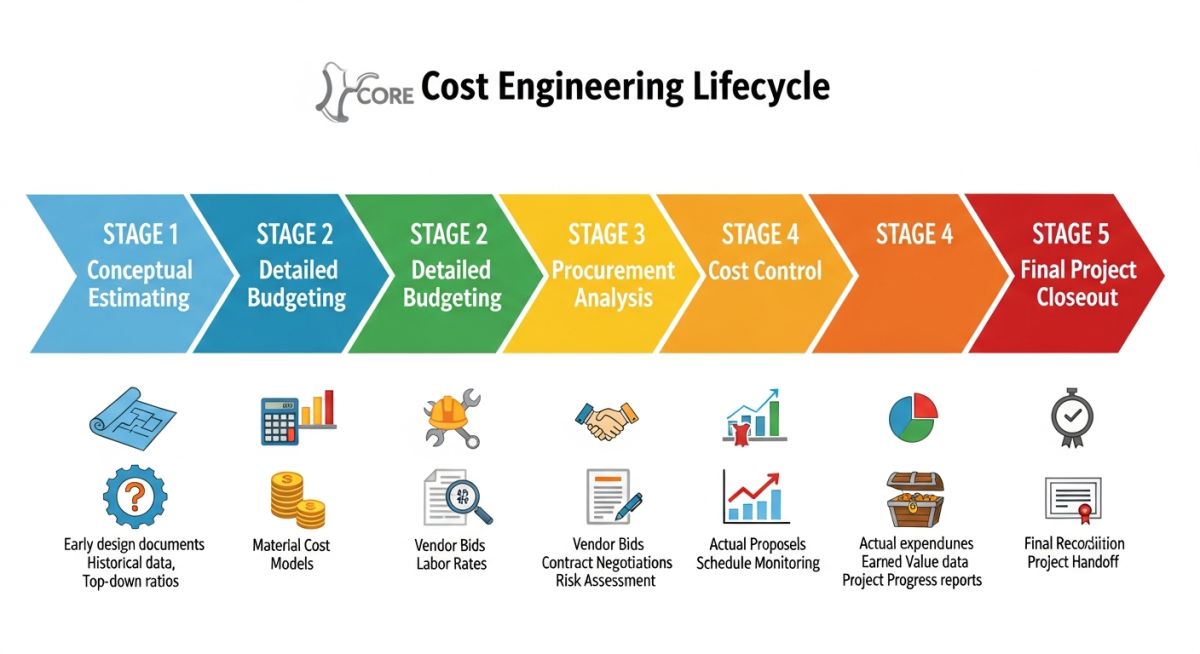
At the core of my practice, I utilize a multi-tiered approach to cost estimation. We begin with Class 5 estimates during the conceptual phase, where uncertainty is high, and move toward Class 1 estimates as the engineering design matures. The transition from a conceptual estimate to a definitive budget requires a deep understanding of the AACE Recommended Practice 18R-97.
When calculating the Total Installed Cost (TIC), we must account for Direct Field Costs (DFC) and Indirect Field Costs (IFC). DFC includes bulk materials—valves, fittings, and piping—calculated using the formula: Quantity x Unit Rate x (1 + Waste Factor). I emphasize that the waste factor is not a guess; it is derived from historical project data and site-specific installation complexity.
Field Warning: The Contingency Trap
Never treat contingency as a “slush fund.” In my experience, a contingency budget must be calculated based on a quantitative risk assessment (QRA). If you are not using a Monte Carlo simulation to determine the P50 or P80 confidence levels for your project budget, you are likely underestimating your exposure to market volatility and scope creep.
Cost control is the second pillar. We monitor the Earned Value Management (EVM) metrics, specifically the Cost Performance Index (CPI) and Schedule Performance Index (SPI). If the CPI drops below 1.0, it indicates that the project is over budget for the work performed. I mandate that my teams perform a root-cause analysis on any variance exceeding 5% of the monthly budget baseline.
Finally, we integrate life-cycle costing (LCC). This involves calculating the Net Present Value (NPV) of the asset, considering not just the initial capital expenditure (CAPEX) but also the operational expenditure (OPEX) over a 20-year horizon. By evaluating the cost of maintenance, energy consumption, and eventual decommissioning, we provide stakeholders with a true picture of the project’s economic viability.
Project Financial Optimization: The strategic balance of rigorous cost control and flexible risk management to maximize asset value while minimizing capital exposure.
Advantages
- Enhanced predictability of project cash flows.
- Early identification of scope creep through variance analysis.
- Improved procurement leverage via accurate quantity take-offs.
- Data-driven decision making for capital allocation.
- Alignment of engineering design with budget constraints.
Disadvantages
- High initial overhead for detailed data collection.
- Risk of “analysis paralysis” in complex modeling.
- Requires specialized software and trained personnel.
- Potential for friction between engineering and finance teams.
- Sensitivity to inaccurate historical input data.
Industrial Sector Implementation: The application of cost engineering methodologies to optimize capital-intensive projects across energy, chemical, and infrastructure sectors.
Refinery Turnaround Management
During major refinery shutdowns, cost engineers track thousands of individual work orders to prevent budget overruns. By applying real-time cost tracking to labor hours and material replacement, we ensure that the turnaround remains within the critical path schedule and financial constraints.
Green Hydrogen Plant Construction
Building new hydrogen infrastructure requires precise estimation of electrolyzer procurement and balance-of-plant piping costs. We use parametric modeling to account for the rapid technological shifts in the industry, ensuring that the capital budget remains resilient against supply chain fluctuations.
Offshore Platform Decommissioning
Decommissioning is a high-risk, high-cost phase that requires meticulous cost engineering to manage environmental liabilities and regulatory compliance. We calculate the total cost of asset removal, site restoration, and waste disposal, utilizing historical data from similar marine projects to mitigate financial uncertainty.
In my two decades of managing capital projects, I have found that the accuracy of cost engineering is directly proportional to the classification of the estimate. We rely heavily on the AACE International recommended practices to categorize our financial projections. These metrics allow project managers to understand the inherent uncertainty associated with early-stage conceptual designs versus final definitive estimates used for procurement and construction execution.
The table below outlines the standard relationship between project maturity and expected accuracy ranges. When reviewing these figures, remember that the “Expected Accuracy Range” is not merely a guess but a statistical representation of the project scope definition. As we move from Class 5 to Class 1, the engineering effort increases, and the contingency requirements typically decrease as risks are identified and mitigated through rigorous cost control processes.
| Estimate Class | Maturity Level | Purpose | Accuracy Range |
|---|---|---|---|
| Class 5 | 0% to 2% | Concept Screening | -20% to -50% / +30% to +100% |
| Class 3 | 10% to 40% | Budget Authorization | -10% to -20% / +10% to +30% |
| Class 1 | 50% to 100% | Bid/Tender/Control | -3% to -10% / +3% to +15% |
Always ensure your team aligns the estimate class with the current project phase. Attempting to use a Class 5 estimate for final procurement will inevitably lead to significant budget overruns and project failure.
Cost engineering is not an isolated discipline; it functions as the central nervous system of project management, integrating data from procurement, engineering, and construction. To maintain project health, we map various technical entities against their respective financial impact drivers. This matrix serves as a reference for identifying which project components require the most stringent cost monitoring based on their volatility and criticality to the overall project schedule.
By utilizing this mapping, engineers can prioritize their efforts on high-impact items such as long-lead equipment or complex piping systems. This structured approach ensures that we are not just tracking costs, but actively managing the variables that influence the final capital expenditure. The following table provides a high-level overview of these critical entities and the standards that govern their estimation and control.
| Entity | Primary Driver | Standard Reference |
|---|---|---|
| Direct Labor | Productivity Rates | PMBOK Guide |
| Bulk Materials | Market Commodity Index | ISO 15686 |
| Contingency | Risk Assessment | AACE RP 40R-08 |
Integrating these standards into your project management software is essential for real-time reporting. When these entities are properly mapped, the cost engineer can provide actionable insights to the project director before a budget variance becomes unmanageable.
As a lead engineer, I have seen many projects derail because the cost data on paper did not match the reality on the construction site. Verification is the bridge between theoretical estimation and actual project performance. This checklist is designed to ensure that your cost engineering team is capturing the necessary field data to maintain accurate project controls throughout the execution phase.
-
Scope Baseline Alignment: Verify that the current site work matches the original scope baseline defined in the PMBOK project charter. -
Productivity Tracking: Confirm that daily labor hours are being recorded against specific work breakdown structure (WBS) codes to calculate actual unit costs. -
Material Reconciliation: Audit the material take-off (MTO) against actual site deliveries to identify potential waste or procurement discrepancies. -
Change Order Documentation: Ensure every field change is documented with a signed change order before work commences to prevent unapproved cost creep. -
Risk Register Update: Review the site-specific risk register weekly to adjust contingency funds based on realized versus potential threats.
By systematically checking these items, you create a feedback loop that informs future estimates. Remember, cost engineering is a continuous process; if you stop verifying, you stop controlling. Always document the “why” behind any variance found during these site visits to improve the accuracy of your next project’s historical database.
The Problem: Uncontrolled Piping Material Escalation
During a major refinery expansion, we encountered a significant budget overrun due to poor tracking of piping bulk materials.
- Lack of integration between the procurement system and the cost control database.
- Inaccurate initial material take-offs (MTO) based on preliminary P&IDs.
- Failure to account for market price volatility in stainless steel alloys.
- Uncontrolled field-routed piping changes not captured in the cost report.
The Outcome: Restored Financial Stability
By implementing a rigorous cost engineering recovery plan, we successfully brought the project back within the authorized budget.
- Reduced material waste by 15% through strict site inventory management.
- Implemented a real-time cost tracking dashboard linked to the procurement system.
- Negotiated fixed-price contracts for remaining bulk materials to hedge against inflation.
- Achieved a 12% improvement in labor productivity by optimizing field workflows.
My recommendation for similar projects is to establish a “Cost-First” culture where every field supervisor understands the financial impact of their daily decisions. Without this alignment, even the most sophisticated cost engineering software will fail to prevent budget erosion.
What is the primary difference between cost estimating and cost control?
- Estimating sets the target budget and baseline.
- Control monitors performance against that baseline.
- Estimating uses parametric or bottom-up modeling.
- Control uses earned value management (EVM) to track progress.
How does contingency management impact project success?
- Contingency should be based on a quantitative risk analysis (QRA).
- It must be released only when specific risk events occur.
- Over-allocating contingency can make a project look uncompetitive.
- Under-allocating contingency leaves the project vulnerable to market shocks.
What role does Earned Value Management (EVM) play in cost engineering?
- It calculates the Cost Performance Index (CPI) to show efficiency.
- It provides the Schedule Performance Index (SPI) for time tracking.
- It enables accurate forecasting of the Estimate at Completion (EAC).
- It highlights potential issues long before they become critical failures.
Why is historical data important for cost estimation?
- It provides benchmarks for labor productivity and material costs.
- It helps in identifying recurring risks from similar project types.
- It allows for the calibration of parametric models.
- It serves as a reality check for optimistic project schedules.
How do you handle scope creep in cost engineering?
- Require a formal change request for any deviation from the baseline.
- Quantify the cost and schedule impact before approval.
- Communicate the trade-offs to the project sponsor clearly.
- Update the project budget immediately upon approval of the change.
What is the role of the cost engineer in procurement?
- They perform bid tabulations to compare vendor offerings.
- They analyze the total cost of ownership, not just the purchase price.
- They monitor market trends to advise on the best time to purchase.
- They ensure that contract terms include necessary cost-protection clauses.
Complete Course on
Piping Engineering
Check Now
Key Features
- 125+ Hours Content
- 500+ Recorded Lectures
- 20+ Years Exp.
- Lifetime Access
Coverage
- Codes & Standards
- Layouts & Design
- Material Eng.
- Stress Analysis

📚 Recommended Resources: Cost Engineering
Read these Guides
- 📄 Mastering AACE International Standards for Successful EPC Project Cost Engineering
- 📄 Levelized Cost of Hydrogen: Engineering Economics for Industrial Decarbonization
- 📄 Green Ammonia Plant Cost Estimation: The 2026 Engineering FEED Guide
- 📄 Ground Improvement Techniques for Renewable Energy Projects: Engineering Design Guide