
Class 5 Cost Estimates: Early Project Feasibility and Planning
In my two decades of managing capital projects, I have learned that the most critical decisions are often made when we have the least amount of data. A Class 5 estimate is not a precise calculation of material costs; it is a strategic tool used to determine if a project concept is worth further investment. When I sit down with stakeholders during the pre-feasibility stage, we are rarely looking at detailed piping and instrumentation diagrams. Instead, we are evaluating high-level capacity, rough location factors, and historical benchmarks.
Understanding the limitations of these estimates is vital for any project manager or lead engineer. If you treat a Class 5 estimate as a budget, you are setting your project up for failure. These estimates are designed to be broad, capturing the “order of magnitude” costs that allow organizations to filter out non-viable projects before significant engineering hours are spent.
Key Takeaways for Project Success:
- Class 5 estimates utilize 0% to 2% project definition maturity.
- Accuracy ranges typically fall between -20% to -50% on the low end and +30% to +100% on the high end.
- Primary methodology relies on stochastic modeling and historical cost data.
- They are intended for strategic screening, not for procurement or construction budgeting.
Class 5 Cost Estimates: Technical Framework and Standards
Class 5 Cost Estimates: These are defined by AACE International as conceptual estimates used for initial project screening, requiring minimal engineering definition and relying heavily on parametric modeling.
When I develop a Class 5 estimate, I am essentially performing a “sanity check” on a business idea. The engineering definition is almost non-existent at this stage. We might have a process flow diagram (PFD) or perhaps just a capacity requirement (e.g., “we need to process 50,000 barrels per day”). The methodology is almost exclusively stochastic, meaning we use statistical relationships between historical project data and the current scope.
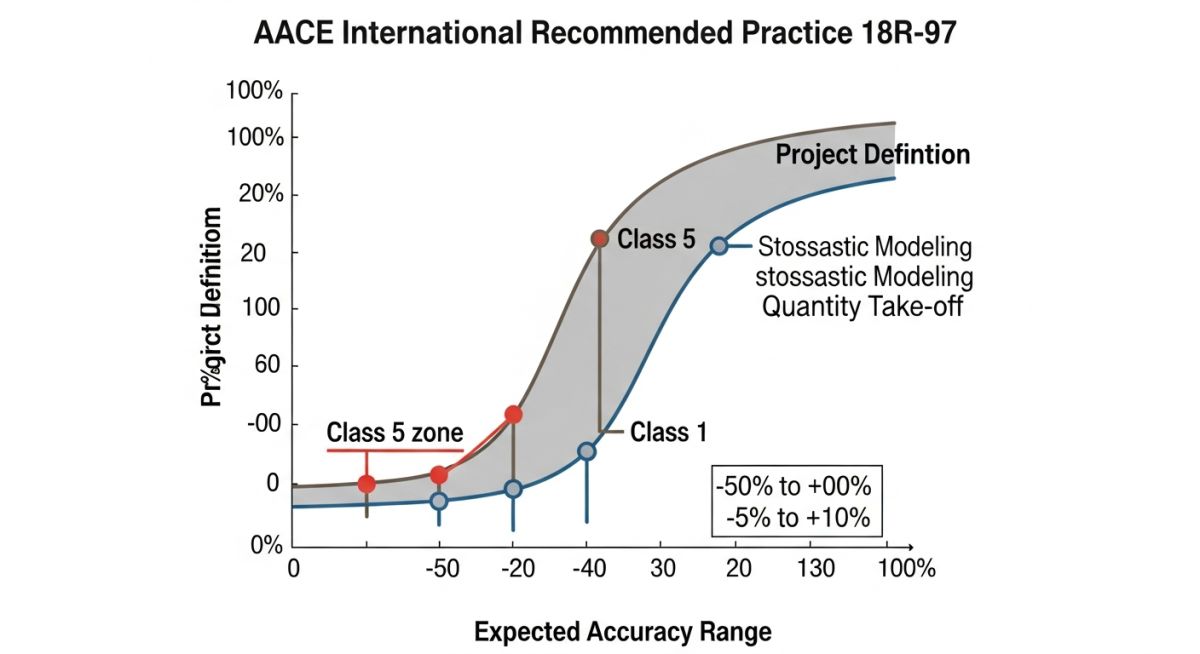
Methodology and Data Inputs
The primary input for a Class 5 estimate is historical data from similar projects. I often use “capacity factoring,” where the cost of a new facility is estimated by scaling the cost of a known facility using the power-law relationship: Cost2 = Cost1 * (Capacity2 / Capacity1)^x. The exponent ‘x’ typically ranges from 0.6 to 0.8 depending on the industry and the specific equipment involved.
Field Warning: The “Accuracy Trap”
Never confuse the accuracy range with the contingency. A Class 5 estimate has a wide accuracy range because the scope is undefined. Adding a 50% contingency to a poorly defined scope does not make it a Class 3 estimate. It simply masks the lack of engineering maturity. Always document the assumptions made during the parametric modeling phase to ensure stakeholders understand the volatility of the estimate.
Standardization and AACE Compliance
Adhering to AACE International Recommended Practice 18R-97 is non-negotiable in my practice. This standard provides the framework for classifying estimates based on the level of project definition. For Class 5, the maturity level is defined as 0% to 2%. This means that if you have completed your piping layout or finalized your equipment list, you have already moved past the Class 5 threshold.
The calculation process involves identifying the “major equipment” and applying a “Lang Factor” or similar multiplier to account for bulk materials, labor, and indirect costs. For example, in a chemical plant, the total installed cost might be estimated as 4 to 5 times the cost of the major mechanical equipment. This is a rough approximation, but it is sufficient for the intended purpose of the Class 5 estimate.
Class 5 Cost Estimates: These provide a rapid, low-cost mechanism for project portfolio management, though they carry significant risks due to their reliance on high-level assumptions and limited engineering data.
Advantages
- Minimal engineering hours required for development.
- Facilitates rapid screening of multiple project alternatives.
- Low cost of preparation compared to detailed estimates.
- Provides a baseline for early-stage risk assessment.
- Enables early identification of “go/no-go” project viability.
Disadvantages
- High potential for significant cost overruns if misused.
- Accuracy range is too wide for procurement or budgeting.
- Highly sensitive to the quality of historical data used.
- Often misinterpreted by non-technical stakeholders as a budget.
- Does not account for site-specific geotechnical or logistical constraints.
Class 5 Cost Estimates: These are utilized across diverse industrial sectors to support capital allocation, strategic planning, and early-stage feasibility analysis for large-scale infrastructure projects.
Strategic Portfolio Screening
In the oil and gas sector, I frequently use Class 5 estimates to compare the economic viability of different field development scenarios. By applying parametric models to various production capacities, we can quickly eliminate projects that do not meet the internal rate of return (IRR) thresholds before committing to expensive front-end engineering design (FEED) studies.
Capital Budgeting and Long-Range Planning
For large-scale utility infrastructure, such as power plant upgrades or water treatment facilities, Class 5 estimates serve as the foundation for 5-year and 10-year capital expenditure (CAPEX) plans. These estimates allow organizations to allocate funds to high-priority projects while maintaining the flexibility to pivot as more detailed engineering data becomes available.
Mergers and Acquisitions Due Diligence
When evaluating the potential acquisition of an industrial asset, Class 5 estimates are essential for assessing the cost of necessary retrofits or capacity expansions. By using historical cost data from similar facilities, we can quickly estimate the capital required to bring an acquired asset up to current operational standards or regulatory compliance levels.
When evaluating capital project viability, understanding the relationship between data maturity and estimate accuracy is paramount. A Class 5 estimate, as defined by AACE International, serves as the initial benchmark for project screening. At this stage, the engineering definition is typically limited to 0% to 2% of total project scope, meaning that the cost estimate relies heavily on parametric modeling, historical data from similar assets, and high-level capacity factoring rather than detailed material take-offs.
The following table outlines the standard industry expectations for Class 5 estimates compared to higher-fidelity classes. Note that the accuracy range is intentionally broad to account for the high degree of uncertainty inherent in early-stage conceptual planning. Project managers must utilize these ranges to set appropriate contingency buffers, ensuring that the financial risk profile is communicated clearly to stakeholders before significant capital is committed to front-end engineering design (FEED) phases.
| Estimate Class | Engineering Definition | Accuracy Range (Low) | Accuracy Range (High) | Primary Purpose |
|---|---|---|---|---|
| Class 5 | 0% to 2% | -20% to -50% | +30% to +100% | Concept Screening |
| Class 4 | 1% to 15% | -15% to -30% | +20% to +50% | Study/Feasibility |
| Class 3 | 10% to 40% | -10% to -20% | +10% to +30% | Budget Authorization |
The wide variance in Class 5 estimates is not a failure of the estimator, but a reflection of the project’s infancy. As the project progresses through the stage-gate process, the narrowing of these ranges provides the necessary confidence for final investment decisions (FID).
To effectively manage Class 5 cost estimates, engineers must map various technical inputs against standardized project control entities. This matrix provides a structural overview of the key variables that influence early-stage cost modeling, ensuring that all estimators align their methodologies with industry-recognized best practices for capital project development.
By standardizing these inputs, organizations can reduce the “optimism bias” that often plagues early-stage estimates. Each entity listed below represents a critical component of the total installed cost (TIC) calculation, requiring specific attention during the initial screening phase to ensure that the resulting estimate remains within the acceptable AACE accuracy bounds for a Class 5 deliverable.
| Entity | Standard/Reference | Impact Level | Methodology |
|---|---|---|---|
| Parametric Model | AACE 18R-97 | High | Statistical Regression |
| Capacity Factoring | ISO 15663 | Medium | Exponential Scaling |
| Contingency | PMBOK Guide | Critical | Risk-Adjusted Percentages |
This matrix serves as a foundational tool for project controls teams. By consistently applying these methodologies, you ensure that the Class 5 estimate remains a reliable instrument for strategic decision-making rather than a mere guess.
Validating a Class 5 cost estimate requires a rigorous review of the underlying assumptions and the quality of the input data. Because the engineering definition is minimal, the focus must shift from detailed quantity take-offs to the validity of the benchmarking data and the appropriateness of the scaling factors applied. Use this checklist to ensure your estimate meets the minimum requirements for a high-level feasibility study.
-
Benchmarking Source: Verify that the historical data used for the estimate is from a project of similar complexity, technology, and geographic location. -
Capacity Scaling: Ensure the exponential scaling factor (typically 0.6 to 0.7) is justified based on the specific equipment type and industry standards. -
Contingency Assessment: Confirm that the contingency percentage reflects the high uncertainty of the 0-2% engineering definition, typically ranging from 30% to 50%. -
Escalation Factors: Validate that the cost estimate includes appropriate escalation for labor, materials, and equipment based on the projected project schedule. -
Exclusions List: Clearly document all items excluded from the estimate, such as land acquisition, permitting fees, or owner-furnished equipment, to prevent scope gaps.
In my experience, the most common failure in Class 5 estimation is the omission of “soft costs” like engineering, procurement, and construction management (EPCM) fees. Ensure these are factored as a percentage of the total direct costs, as they often represent 15-25% of the total project budget at this early stage. Always document the “Basis of Estimate” (BOE) to provide a clear audit trail for future project phases.
The Challenge: Underestimating Brownfield Complexity
A mid-sized chemical plant attempted a Class 5 estimate for a new reactor installation without accounting for existing site constraints.
- Failure to account for tie-in complexity in a congested brownfield environment.
- Reliance on greenfield historical data without applying a brownfield complexity factor.
- Underestimation of demolition and site preparation costs.
- Lack of geotechnical data leading to inaccurate foundation cost assumptions.
The Outcome: Corrective Action and Improved Accuracy
By revising the estimate methodology, the project team successfully aligned the budget with reality.
- Applied a 1.4x complexity multiplier to account for brownfield tie-ins.
- Increased contingency from 20% to 45% to reflect the high site uncertainty.
- Integrated a preliminary site survey to identify major underground obstructions.
- Achieved a more realistic project authorization that prevented mid-project budget shocks.
My recommendation for similar scenarios is to always perform a “site walk-down” even during the Class 5 phase. A few hours of visual inspection can reveal significant cost drivers that parametric models will inevitably miss, saving millions in potential downstream change orders.
Frequently Asked Engineering Questions
Why is the Class 5 accuracy range so wide?
- Lack of detailed equipment specifications leads to reliance on generic cost curves.
- Uncertainty regarding site-specific conditions, such as soil quality or existing infrastructure, creates significant risk.
- Market volatility for raw materials and labor is difficult to predict at the conceptual stage.
- The range is intended to protect the project owner by highlighting the potential for significant cost growth as the design matures.
How do I determine the correct contingency for Class 5?
- Identify high-impact risks such as regulatory hurdles, technology maturity, and site access.
- Use a Monte Carlo simulation if sufficient historical data is available to model potential cost outcomes.
- Ensure that the contingency is clearly separated from the base estimate to maintain transparency.
- Review the contingency regularly as the project moves into the FEED phase and risks are mitigated.
What is the role of AACE International in this process?
- Standardizes terminology so that stakeholders have a shared understanding of estimate maturity.
- Provides guidelines for the level of engineering definition required for each class.
- Offers a common language for project controls professionals to communicate risk and uncertainty.
- Facilitates benchmarking by allowing projects to be compared on an “apples-to-apples” basis.
Can I use Class 5 estimates for budget approval?
- Using a Class 5 estimate for budget approval exposes the organization to significant financial risk.
- Budget authorization typically requires a Class 3 estimate, which has a much tighter accuracy range.
- The purpose of a Class 5 estimate is to decide whether to proceed with further engineering, not to commit full project capital.
- Always communicate the limitations of the estimate to executive leadership to manage expectations.
How do I improve the accuracy of my early estimates?
- Build a library of historical project data to serve as a baseline for future estimates.
- Involve experienced subject matter experts in the estimation process to identify potential pitfalls.
- Use parametric modeling software that is calibrated to your organization’s specific project history.
- Conduct regular “peer reviews” of the estimate to challenge assumptions and identify potential biases.
What are the most common “hidden” costs in Class 5?
- Permitting and regulatory compliance fees, which can vary significantly by location.
- Site preparation and remediation costs, especially in brownfield environments.
- Indirect costs such as EPCM, insurance, and financing charges.
- Escalation and currency exchange rate fluctuations for international projects.
📚 Recommended Resources: Class 5 Cost Estimates
Read these Guides
- 📄 AACE Estimate Classification System: A Guide for Piping Engineers
- 📄 Capital Cost Estimation Explained: A Guide for Piping Engineers
- 📄 Mastering Cost Engineering: Essential Lifecycle Management for Industrial Projects
- 📄 Mastering AACE International Standards for Successful EPC Project Cost Engineering
🎥 Watch Tutorials

Complete Course on
Piping Engineering
Check Now
Key Features
- 125+ Hours Content
- 500+ Recorded Lectures
- 20+ Years Exp.
- Lifetime Access
Coverage
- Codes & Standards
- Layouts & Design
- Material Eng.
- Stress Analysis
