
Mastering Class 3 Cost Estimates for FEED Projects
In my two decades of managing large-scale piping projects, I have learned that the Class 3 cost estimate is the most critical milestone for any Front-End Engineering Design (FEED) phase. It serves as the primary financial gatekeeper, determining whether a project receives the capital appropriation required for full-scale execution. Unlike earlier conceptual estimates, a Class 3 estimate demands a rigorous, data-driven approach that integrates piping material take-offs, preliminary stress analysis, and vendor-quoted equipment pricing.
When I review these estimates, I look for the “hidden” risks that often derail budgets during the detailed engineering phase. Achieving the required accuracy range is not merely about adding contingency; it is about the maturity of your engineering deliverables. This guide breaks down the technical requirements, the basis of estimate documentation, and the strategic risk considerations necessary to ensure your Class 3 estimate stands up to executive scrutiny.
Key Takeaways for Project Success:
- Understand the AACE 18R-97 requirements for FEED-level maturity.
- Master the transition from parametric to deterministic estimation methods.
- Identify the specific piping engineering deliverables required for accuracy.
- Implement robust risk-based contingency modeling for project authorization.
Technical Depth: Class 3 Cost Estimates in FEED
Class 3 Cost Estimates: A deterministic cost modeling approach requiring significant engineering definition to establish a baseline for capital project authorization and budget control.
To develop a robust Class 3 estimate, I rely on the AACE International framework, which mandates a project definition level of 10% to 40%. At this stage, the piping engineering team must have moved beyond simple PFDs to finalized P&IDs and preliminary 3D model layouts. The accuracy range of -20% to +30% is not a suggestion; it is a statistical expectation based on the maturity of your Bill of Quantities (BOQ).
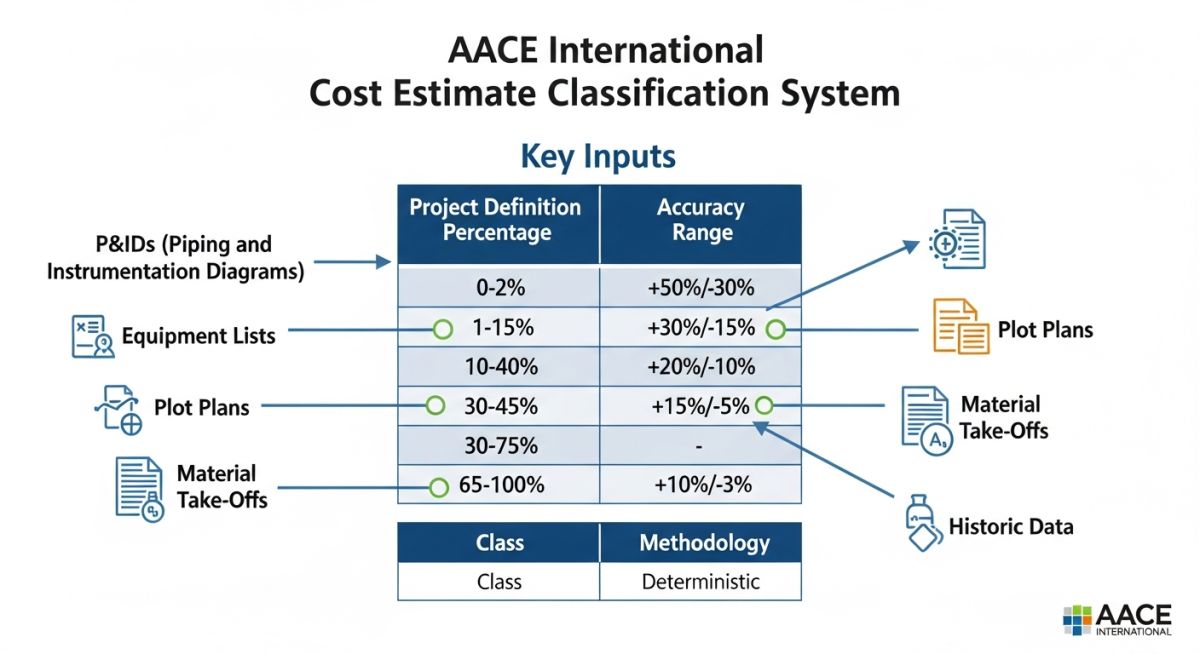
Deterministic Estimation Methodology
My process for building a Class 3 estimate involves a bottom-up approach for major piping components. I calculate the total linear footage of pipe by diameter and schedule, applying specific labor productivity factors based on the site location and complexity. For instance, if I am estimating a high-pressure alloy piping system, I do not use generic “per-inch-diameter” metrics. Instead, I calculate the weld count, the complexity of the spool fabrication, and the specific NDT requirements mandated by ASME B31.3.
Field Warning: The “Contingency Trap”
Many project managers attempt to hide poor engineering definition behind a high contingency percentage. In a Class 3 estimate, this is a red flag. If your engineering definition is below 15%, your contingency will likely need to be skewed toward the +30% upper bound to account for unknown piping routing, support requirements, and structural steel modifications. Always document the basis of your contingency using a formal risk register.
Piping Engineering Deliverables
To reach the required maturity, I ensure the following deliverables are locked before the estimate is finalized:
- Piping Material Specifications (PMS): Finalized to ensure accurate material cost indexing.
- Preliminary Plot Plan: Validated for pipe rack widths and equipment spacing.
- Equipment List: Including nozzle orientations to estimate piping run lengths.
- Stress Analysis Reports: Preliminary analysis for critical lines to determine support counts and expansion loop requirements.
By integrating these deliverables, the estimate shifts from a “guess” to a “basis of design.” I calculate the total installed cost (TIC) by summing the direct field costs (materials, labor, equipment) and indirect costs (engineering, procurement, construction management, and home office overhead). Each line item must be traceable to a specific engineering document, ensuring that when the project moves to the execution phase, the budget is defensible and transparent.
Class 3 Cost Estimates: A balanced approach to capital budgeting that provides sufficient detail for investment decisions while maintaining a manageable engineering effort during the FEED phase.
Advantages
- Provides a defensible baseline for capital appropriation requests.
- Enables early identification of high-cost piping material drivers.
- Reduces the risk of significant budget overruns during detailed engineering.
- Facilitates better procurement strategies for long-lead equipment.
- Allows for accurate cash flow forecasting for the project lifecycle.
Disadvantages
- Requires significant engineering man-hours during the FEED phase.
- High sensitivity to changes in project scope or site conditions.
- Risk of “scope creep” if the basis of estimate is not strictly controlled.
- Accuracy is limited by the maturity of vendor-provided equipment data.
- Can be time-consuming to update if the design basis changes frequently.
Class 3 Cost Estimates: Essential financial instruments applied across diverse industrial sectors to validate project viability and secure funding for complex engineering infrastructure.
Oil and Gas Midstream Infrastructure
In midstream projects, such as pipeline compressor stations, Class 3 estimates are used to evaluate the economic feasibility of connecting new production fields to existing processing hubs. The estimate focuses heavily on the cost of high-pressure piping, valve assemblies, and the associated civil works required for site preparation.
Chemical Plant Revamp and Expansion
When retrofitting existing chemical facilities, a Class 3 estimate is vital for assessing the impact of tie-ins and brownfield piping modifications. It allows engineers to account for the increased labor costs associated with working in congested, live-plant environments where safety and shutdown constraints are paramount.
Green Hydrogen Production Facilities
For emerging hydrogen projects, Class 3 estimates provide the necessary rigor to justify the high capital expenditure of electrolyzer units and specialized stainless steel piping systems. These estimates help stakeholders understand the cost sensitivity of hydrogen-compatible materials and the stringent welding requirements of the ASME B31.12 code.
Power Generation Plant Upgrades
In power plant upgrades, such as the installation of new heat recovery steam generators, Class 3 estimates are used to manage the complex integration of high-temperature, high-pressure piping. The estimate must accurately reflect the cost of specialized alloy materials and the rigorous NDT testing required to meet utility-grade reliability standards.
In my two decades of managing Front-End Engineering Design (FEED) packages, I have found that the Class 3 estimate serves as the definitive bridge between conceptual planning and final investment decision (FID). Unlike Class 4 or 5 estimates, which rely heavily on stochastic modeling and historical benchmarking, a Class 3 estimate requires a deterministic approach rooted in defined piping and instrumentation diagrams (P&IDs) and preliminary plot plans. The following table outlines the expected accuracy ranges and the corresponding level of project definition required to satisfy AACE International Recommended Practice 18R-97.
When reviewing these parameters, engineers must recognize that the accuracy range is not merely a statistical variance but a reflection of the maturity of the engineering deliverables. A project with 30% engineering completion will naturally fall at the higher end of the contingency spectrum, whereas a project nearing 40% completion allows for a tighter, more reliable estimate. It is imperative to document the “Basis of Estimate” (BOE) clearly, as this document acts as the primary defense during project audits and stakeholder reviews. Failure to align the engineering maturity with the estimate class often leads to significant budget overruns during the execution phase.
| Estimate Class | Project Definition (%) | Accuracy Range (Low/High) | Primary Purpose |
|---|---|---|---|
| Class 5 | 0% to 2% | -50% to +100% | Concept Screening |
| Class 4 | 1% to 15% | -30% to +50% | Feasibility Study |
| Class 3 | 10% to 40% | -20% to +30% | Budget Authorization |
| Class 2 | 30% to 75% | -15% to +20% | Control/Bid Estimate |
The technical integrity of a Class 3 cost estimate relies on the systematic mapping of engineering entities to their respective cost drivers. In my experience, the most common failure point in FEED cost estimation is the disconnect between the piping material specification (PMS) and the procurement lead times. By utilizing a structured matrix, project teams can ensure that every major equipment item, bulk material, and labor category is accounted for within the ASME B31.3 piping code requirements.
This matrix serves as a cross-reference tool for project managers to validate that the “Basis of Estimate” covers all critical path items. It is not enough to simply list quantities; one must define the source of the data, the pricing index used, and the specific risk allowance assigned to each category. This level of granularity is what separates a professional Class 3 estimate from a mere budgetary guess, providing the necessary confidence for project sponsors to commit capital.
| Entity Category | Standard Reference | Key Parameter |
|---|---|---|
| Piping Bulks | ASME B31.3 | Material Grade/Schedule |
| Rotating Equipment | API 610 | Power Rating/Material |
| Structural Steel | AISC 360 | Tonnage/Coating |
| Instrumentation | ISA 5.1 | Loop Count/Signal Type |
Class 3 Cost Estimates: A rigorous verification process is the cornerstone of a successful FEED phase. Before finalizing your estimate, I recommend conducting a formal “Estimate Review Session” where each discipline lead validates their input against the project scope. This checklist is designed to ensure that no critical cost driver is overlooked during the transition from preliminary design to budget authorization.
-
Scope Alignment: Confirm that the P&IDs match the latest plot plan and that all battery limit interfaces are clearly defined. -
Material Take-Off (MTO) Validation: Ensure MTOs are based on current piping specifications and include a 5-10% allowance for field routing adjustments. -
Labor Productivity Factors: Verify that labor rates account for site-specific conditions, including local union agreements and regional climate impacts. -
Contingency Analysis: Perform a Monte Carlo simulation or a deterministic risk assessment to justify the contingency percentage applied to the total installed cost. -
Escalation and Currency: Check that all pricing is adjusted for inflation and that currency exchange rates are locked for the duration of the procurement cycle.
Once these items are verified, the project manager must sign off on the “Basis of Estimate” document. This document should explicitly state the assumptions made regarding soil conditions, environmental permitting, and long-lead equipment delivery schedules. If any of these assumptions change during the execution phase, the project team will have a clear baseline to initiate a formal Change Management process, protecting the project’s financial health.
Field Case Study: Real-World Application
The Challenge: Inaccurate Piping Bulk Estimation
During a recent refinery expansion project, the initial Class 3 estimate failed to account for the complexity of tie-ins to existing brownfield infrastructure, leading to a significant budget shortfall.
- Underestimation of small-bore piping and valve quantities.
- Failure to account for non-destructive testing (NDT) requirements on existing lines.
- Inadequate allowance for site-specific scaffolding and access constraints.
- Lack of coordination between the piping design team and the construction contractor.
The Outcome: Corrective Action and Recovery
By implementing a revised “Basis of Estimate” and conducting a detailed field survey, we successfully realigned the project budget and avoided a total work stoppage.
- Achieved a 15% reduction in rework costs through improved tie-in planning.
- Established a robust change management log that tracked every deviation from the FEED baseline.
- Improved stakeholder confidence by providing transparent, data-driven monthly cost reports.
- Successfully completed the project within the revised, contingency-adjusted budget.
My recommendation for future projects is to prioritize “constructability reviews” during the FEED stage. By involving construction leads early, you can identify potential bottlenecks in piping routing and access that are often missed by design engineers working solely in a 3D modeling environment. This proactive approach is the most effective way to ensure your Class 3 estimate remains accurate throughout the project lifecycle.
Frequently Asked Engineering Questions
What defines the accuracy of a Class 3 estimate?
The accuracy of a Class 3 estimate is defined by the maturity of the engineering deliverables and the application of AACE International standards. It typically represents a range of -20% to +30% based on 10% to 40% project definition.
- It relies on deterministic data rather than stochastic modeling.
- It requires a defined P&ID and preliminary plot plan.
- It assumes that major equipment has been specified and quoted.
- It serves as the primary document for budget authorization and FID.
How does FEED maturity impact cost estimate reliability?
FEED maturity is the single most important factor in determining the reliability of your cost estimate. As engineering progresses, the “unknowns” are systematically replaced by “knowns,” which narrows the statistical variance of the total installed cost.
- Low maturity leads to high contingency requirements.
- High maturity allows for more precise procurement and labor estimates.
- Engineering deliverables like P&IDs and plot plans act as the foundation.
- A lack of maturity forces the estimator to rely on historical benchmarks, increasing risk.
What is the role of the Basis of Estimate?
The Basis of Estimate (BOE) is the formal document that outlines the assumptions, methodologies, and data sources used to develop the cost estimate. It is the primary reference point for project audits and change management.
- It documents the scope of work and exclusions.
- It lists the pricing indices and labor rates applied.
- It provides the justification for the contingency percentage.
- It serves as a legal and financial record for project stakeholders.
How should contingency be calculated for Class 3?
Contingency for a Class 3 estimate should be calculated using a combination of deterministic risk assessment and probabilistic modeling. It is not a “slush fund” but a calculated allowance for identified risks that have not yet been fully mitigated.
- Use a risk register to identify potential cost impacts.
- Apply Monte Carlo simulations to determine the P50 or P70 confidence levels.
- Ensure the contingency is aligned with the project’s risk profile.
- Document the rationale for the contingency in the Basis of Estimate.
What are the common pitfalls in FEED estimation?
Common pitfalls include failing to account for brownfield tie-in complexity, underestimating labor productivity, and ignoring the impact of long-lead equipment delivery schedules. These issues often stem from a lack of communication between design and construction teams.
- Inadequate site surveys leading to unforeseen field conditions.
- Misalignment between piping material specifications and procurement lead times.
- Failure to include indirect costs like engineering management and permitting.
- Over-reliance on historical data without adjusting for current market volatility.
How do I manage changes after the estimate?
Managing changes requires a formal Change Management process that tracks every deviation from the FEED baseline. This process must be integrated into the project controls system to ensure that the impact on budget and schedule is transparently communicated.
- Maintain a centralized change log with clear approval workflows.
- Quantify the cost and schedule impact of every change request.
- Ensure that all changes are approved by the project sponsor.
- Update the project baseline regularly to reflect approved changes.
📚 Recommended Resources: Class 3 Cost Estimates
Complete Course on
Piping Engineering
Check Now
Key Features
- 125+ Hours Content
- 500+ Recorded Lectures
- 20+ Years Exp.
- Lifetime Access
Coverage
- Codes & Standards
- Layouts & Design
- Material Eng.
- Stress Analysis
