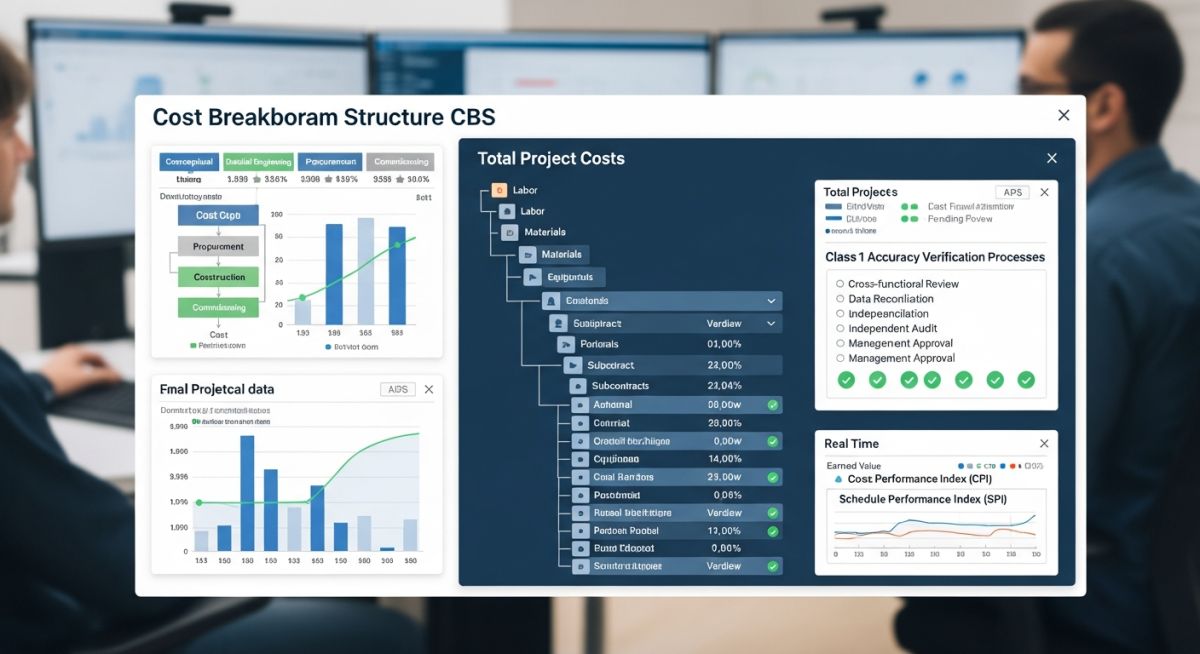
Class 1 Cost Estimates: Precision in Capital Project Planning
In my two decades of managing multi-billion dollar piping and infrastructure projects, I have learned that the difference between a profitable venture and a budget overrun often lies in the rigor of the final cost estimate. A Class 1 estimate is not merely a number; it is the culmination of detailed engineering, firm vendor quotes, and finalized construction labor rates.
When we reach the Class 1 stage, the design is typically 70% to 90% complete. This is the point where we transition from conceptual budgeting to “Approved for Construction” (AFC) financial control. If you are looking to stabilize your project cash flow and minimize contingency exposure, mastering the mechanics of this estimate class is your most effective tool.
Key Takeaways for Project Controls
- Achieve an accuracy range of -3% to -10% on the low end and +3% to +15% on the high end.
- Leverage firm, binding vendor quotations for all major equipment and long-lead items.
- Integrate finalized piping isometric take-offs and structural steel tonnage reports.
- Establish a robust baseline for change order management and performance tracking.
Technical Deep-Dive: Class 1 Cost Estimates
Class 1 Cost Estimates: A definitive, high-fidelity financial model requiring comprehensive engineering data, firm market pricing, and detailed construction execution plans to ensure project viability.
At the Class 1 level, the engineering team must provide a level of detail that allows for the issuance of “Approved for Construction” (AFC) packages. Unlike Class 4 or 5 estimates, which rely on parametric modeling and historical ratios, a Class 1 estimate is built from the ground up using specific material take-offs (MTOs) and validated labor productivity factors.
Engineering Data Requirements
To reach the required accuracy, I insist on the following data inputs being finalized before the estimate is locked:
- Piping MTOs: Extracted directly from 3D models, including all valves, fittings, and specialty components.
- Structural Steel: Tonnage calculations based on finalized connection details and shop drawings.
- Electrical/Instrumentation: Cable tray lengths, wire counts, and finalized I/O lists.
- Vendor Quotes: Firm, non-budgetary pricing for all long-lead equipment (pumps, compressors, vessels).
Field Warning: The Contingency Trap
Many project managers mistakenly reduce contingency too aggressively at the Class 1 stage. Even with 90% design completion, you must account for “unknown unknowns” in site conditions, such as subsurface obstructions or unforeseen regulatory compliance costs. A Class 1 estimate should still carry a 5-10% contingency to protect against execution-phase volatility.
Calculation Methodology
The calculation of a Class 1 estimate follows a deterministic approach. We calculate the Direct Field Cost (DFC) as the sum of material, labor, and equipment costs. The Indirect Field Cost (IFC) is then applied as a percentage or a fixed sum based on the construction schedule duration.
The formula for the total project cost (TPC) is: TPC = (Sum of DFC) + (Sum of IFC) + (Escalation) + (Contingency). Each component must be cross-referenced against the AACE International Recommended Practice 18R-97 to ensure compliance with industry standards for cost estimate classification.
Class 1 Cost Estimates: A strategic balance between extreme financial precision and the high administrative cost of detailed engineering development.
Advantages
- Provides a rock-solid baseline for tracking project performance and variance.
- Minimizes the risk of “scope creep” by locking in design requirements.
- Facilitates accurate procurement scheduling and vendor contract negotiations.
- Reduces the likelihood of major financial surprises during the construction phase.
- Enhances stakeholder confidence by providing a defensible, data-driven budget.
Disadvantages
- Requires significant time and engineering man-hours to complete.
- High cost of preparation can delay the project start if not managed correctly.
- Rigidity can make it difficult to incorporate late-stage design changes.
- Requires a high level of design maturity that may not be available early.
- False sense of security if the underlying market assumptions are flawed.
Class 1 Cost Estimates: Essential financial instruments for high-stakes industrial sectors where capital intensity demands absolute budgetary control.
Petrochemical Plant Revamps
In brownfield refinery upgrades, Class 1 estimates are used to manage the high risk of tie-in costs and existing infrastructure integration. By utilizing detailed laser scans and firm piping MTOs, engineers can accurately predict the cost of complex shutdowns and minimize downtime.
Large-Scale Power Generation
For combined-cycle power plants, the Class 1 estimate serves as the primary tool for managing the procurement of massive turbines and heat recovery steam generators. It ensures that the high capital expenditure is aligned with the long-term power purchase agreements and operational revenue projections.
Offshore Oil and Gas Platforms
Given the extreme cost of offshore logistics and labor, Class 1 estimates are mandatory for every module fabrication phase. This level of precision allows project teams to optimize the weight and material usage, which directly impacts the cost of transportation and installation in remote marine environments.
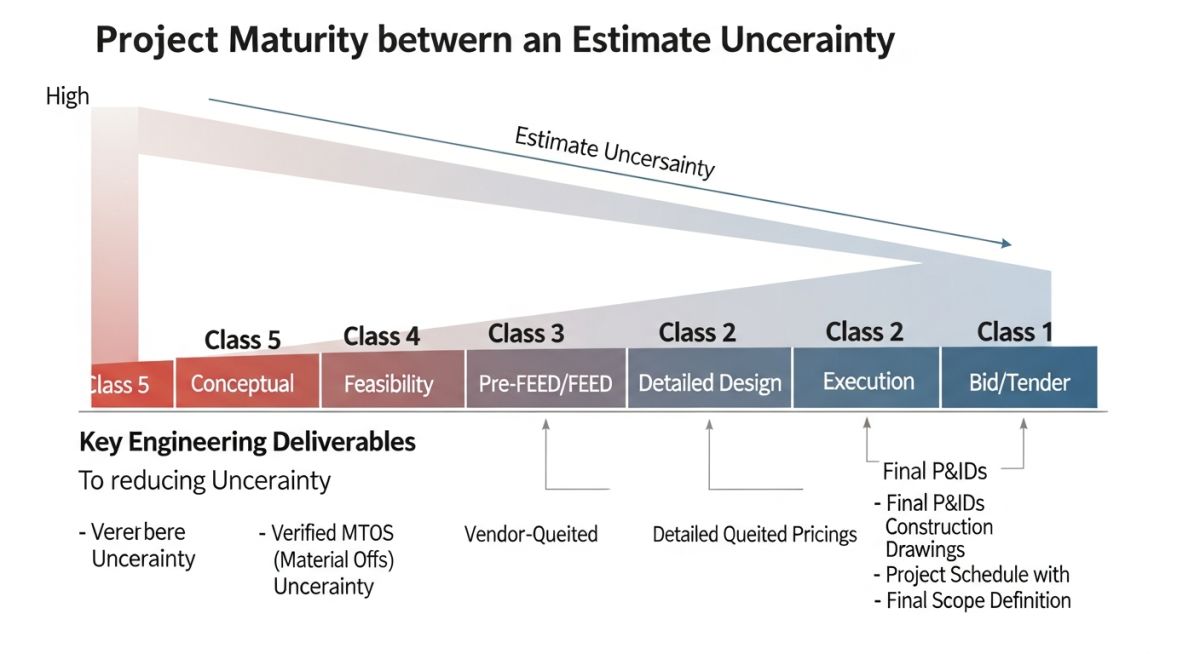
When evaluating the precision of a Class 1 cost estimate, engineers must recognize that this stage represents the final maturity of project definition. According to AACE International Recommended Practice 18R-97, a Class 1 estimate is typically prepared when the project definition is between 50% and 100% complete. This level of maturity allows for a significantly narrowed contingency range compared to earlier feasibility studies.
The following table outlines the expected accuracy ranges and the corresponding level of project definition required for reliable capital budgeting. These values are not merely suggestions; they serve as the baseline for Project Management Institute standards regarding risk management and financial forecasting. By aligning your procurement data with these ranges, you ensure that the final investment decision is backed by empirical, site-specific data rather than parametric assumptions.
| Estimate Class | Maturity Level | Accuracy Range (Low) | Accuracy Range (High) |
|---|---|---|---|
| Class 5 | 0% to 2% | -20% to -50% | +30% to +100% |
| Class 3 | 10% to 40% | -10% to -20% | +10% to +30% |
| Class 1 | 50% to 100% | -3% to -10% | +3% to +15% |
Note that the transition from Class 3 to Class 1 requires a rigorous audit of all vendor quotes and finalized construction labor rates. Failure to reconcile these figures often leads to budget overruns during the execution phase.
The following matrix maps the critical technical entities involved in developing a Class 1 cost estimate. In my experience, the integration of these variables is what separates a professional estimate from a mere budgetary guess. Each entity represents a specific data stream that must be validated against current market conditions and internal project controls.
By utilizing this matrix, project managers can identify which departments are responsible for specific data inputs, ensuring that the final cost planning reflects a holistic view of the project. This structure is essential for maintaining compliance with ISO 15686 standards for life cycle costing and capital expenditure management.
| Entity | Acronym | Primary Function | Standard Ref |
|---|---|---|---|
| Approved For Construction | AFC | Final design release | ASME B31.3 |
| Engineering Procurement Construction | EPC | Project delivery model | AACE 18R-97 |
| Total Installed Cost | TIC | Final budget baseline | ISO 15686 |
Always ensure that your TIC calculations account for regional labor productivity factors, as these can shift the final cost by as much as 15% regardless of material accuracy.
Verification of a Class 1 estimate requires a systematic review of all technical and commercial inputs. As an expert, I have seen many projects fail because the estimate was finalized without verifying the underlying AFC (Approved For Construction) documentation. Use this checklist to ensure your estimate meets the rigorous requirements of a final investment decision.
- ☐ Design Maturity Audit: Confirm that 90% or more of the P&IDs and plot plans are finalized and signed off by the lead engineer.
- ☐ Vendor Quote Reconciliation: Ensure all major equipment quotes are firm, valid for the project duration, and include freight and insurance costs.
- ☐ Labor Productivity Factors: Validate that the labor hours are adjusted for site-specific conditions, including weather, union agreements, and local site access constraints.
- ☐ Contingency Analysis: Perform a quantitative risk assessment to ensure the contingency budget covers identified risks rather than using a flat percentage.
- ☐ Escalation Clauses: Verify that material cost escalation is accounted for based on current market indices for steel, copper, and specialized alloys.
- ☐ Regulatory Compliance Costs: Include all costs associated with environmental permitting, safety audits, and local government inspection fees.
This checklist serves as your final gate review. If any item remains unchecked, the estimate should not be classified as Class 1. Proceeding with an incomplete verification process introduces significant financial risk that can jeopardize the entire capital project lifecycle.
The Problem: Inaccurate Material Take-Offs (MTOs)
A major petrochemical expansion project faced a 20% budget overrun during the construction phase due to poor MTO reconciliation at the Class 1 stage.
- Incomplete piping isometric drawings led to significant underestimation of valve and fitting counts.
- Failure to account for waste factors in structural steel procurement.
- Reliance on outdated vendor pricing for specialized instrumentation.
- Lack of coordination between the procurement team and the engineering design office.
The Outcome: Successful Budget Realignment
By implementing a rigorous Class 1 estimate audit, the project team successfully recovered the budget and completed the project within the revised contingency limits.
- Achieved a final cost variance of less than 4% against the revised Class 1 baseline.
- Implemented a real-time MTO tracking system linked to the 3D model.
- Reduced procurement lead times by 15% through early vendor engagement.
- Improved stakeholder confidence by providing transparent, data-driven financial reporting.
My recommendation is to always conduct a “blind” review of the MTOs by a third-party team before finalizing the Class 1 estimate. This simple step often uncovers discrepancies that internal teams overlook due to project fatigue.
What defines the transition from Class 3 to Class 1?
- Engineering maturity increases from 40% to over 90%.
- Vendor quotes move from budgetary estimates to firm, binding offers.
- Construction planning shifts from high-level scheduling to detailed, task-based sequencing.
- Contingency levels are reduced as the scope of work becomes clearly defined and risks are mitigated.
How does AFC stage impact cost accuracy?
- It provides a fixed baseline for material quantities, preventing scope creep.
- It allows contractors to provide accurate labor estimates based on finalized installation methods.
- It reduces the need for change orders, which are the primary cause of budget overruns in industrial projects.
- It aligns with ASME B31.3 and other relevant codes, ensuring that material specifications are locked in.
Why is contingency lower in Class 1 estimates?
- Design uncertainty is minimized due to high engineering maturity.
- Market volatility is mitigated by firm vendor contracts.
- Construction risks are better understood through site-specific geotechnical and logistical studies.
- The remaining contingency is reserved for “known unknowns” rather than broad, undefined project risks.
What role does labor productivity play in Class 1?
- Site access constraints can significantly reduce daily output.
- Weather conditions must be modeled based on historical data for the specific project location.
- Union labor agreements and shift patterns must be factored into the hourly rate calculations.
- Supervision ratios and the availability of skilled tradespeople directly impact the total installed cost.
How do I handle material cost escalation?
- Use recognized indices for steel, copper, and energy costs.
- Incorporate escalation clauses into your procurement contracts to shift risk to the vendor.
- Model different scenarios based on global economic forecasts.
- Ensure that the escalation budget is reviewed quarterly and adjusted as necessary during the project execution phase.
Can Class 1 estimates be used for EPC bidding?
- They provide a clear scope of work, reducing the ambiguity that leads to high risk premiums in bids.
- They allow for a direct comparison between different contractors’ proposals.
- They serve as the baseline for change order management throughout the project.
- They ensure that the owner and the contractor are aligned on the project’s technical and financial requirements from day one.
📚 Recommended Resources: Class 1 Cost Estimates
Complete Course on
Piping Engineering
Check Now
Key Features
- 125+ Hours Content
- 500+ Recorded Lectures
- 20+ Years Exp.
- Lifetime Access
Coverage
- Codes & Standards
- Layouts & Design
- Material Eng.
- Stress Analysis
