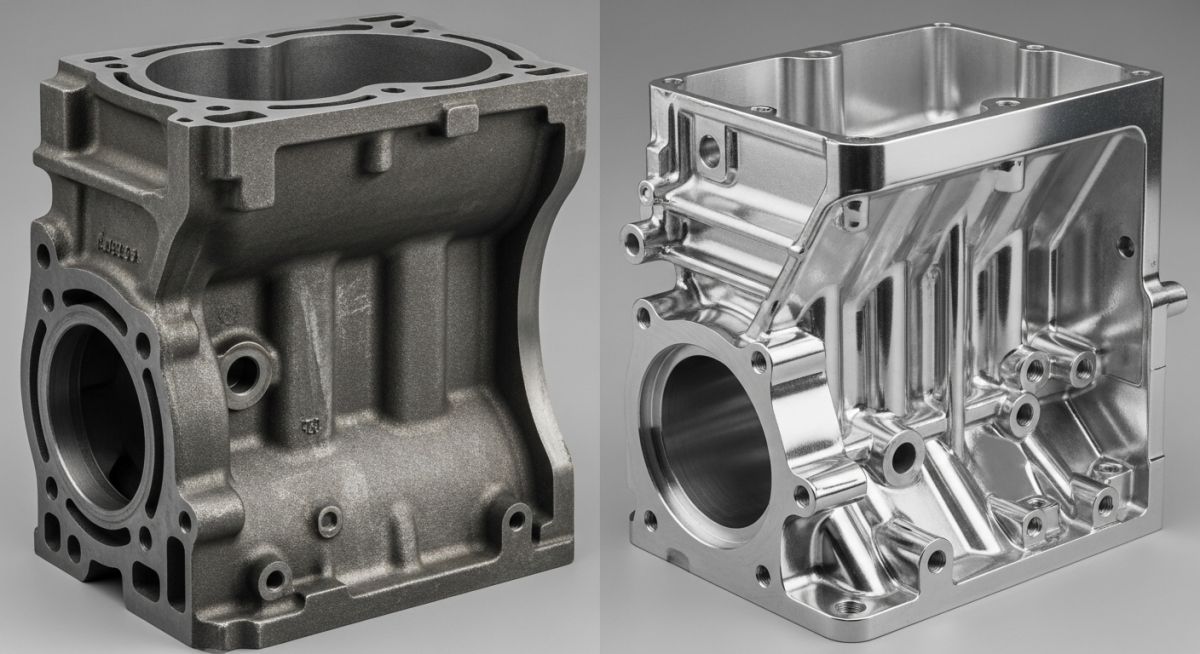
Cast Iron vs Cast Steel: How to Identify These Metals
In my 20-plus years of managing piping integrity in petrochemical plants, I have seen my share of catastrophic component failures. One of the most insidious issues is the accidental substitution of cast iron for cast steel in high-pressure, high-temperature lines. To the untrained eye, a freshly painted cast iron valve body looks identical to a cast steel one. However, putting cast iron into a high-stress hydrocarbon line is a recipe for disaster.
Understanding how to identify these metals on-site is not just academic knowledge; it is a fundamental safety requirement. In this guide, I will share the exact field methods, metallurgical differences, and testing protocols I use to prevent catastrophic material mix-ups.
Key Takeaways for Field Engineers
- Carbon content is the defining boundary: cast iron has more than 2% carbon, while cast steel has less.
- Spark testing provides an immediate, highly reliable visual indication of carbon structure in the field.
- Acoustic resonance (the “ring test”) can quickly separate the dampening properties of cast iron from the resonant ring of cast steel.
- Fracture surfaces reveal distinct differences: cast iron is dull and dark, while cast steel is bright and crystalline.
Complete Course on
Piping Engineering
Check Now
Key Features
- 125+ Hours Content
- 500+ Recorded Lectures
- 20+ Years Exp.
- Lifetime Access
Coverage
- Codes & Standards
- Layouts & Design
- Material Eng.
- Stress Analysis
How Do Metallurgical Structures Differ?
To understand why these metals behave so differently, we must look at their microstructures. In cast iron, the high carbon content (typically 2.1% to 4%) exceeds the solubility limit of the iron matrix. This excess carbon precipitates out as free graphite. In gray cast iron, this graphite forms sharp flakes. These flakes act as internal stress risers, which explains why gray iron is brittle and has virtually zero ductility. In ductile iron, magnesium or cerium additions force the graphite into spherical nodules, improving ductility but still falling short of cast steel’s toughness.
Cast steel, governed by standards like ASTM A216, contains carbon levels between 0.1% and 0.5%. Because the carbon remains dissolved or forms iron carbide (cementite) within a continuous ferrite-pearlite matrix, the material can deform plastically before fracturing. This continuous grain structure gives cast steel its high tensile strength, impact resistance, and weldability.
We can express the metallurgical difference using the Carbon Equivalent (CE) formula. For cast steel, we calculate weldability and structure using:
For cast irons, the Carbon Equivalent determines how close the alloy is to the eutectic point (4.3% CE), calculated as:
The Spark Test: Quick Field Verification
When I am on a construction site without access to a laboratory, the spark test is my preferred method for rapid identification. By holding a hand grinder with a standard grinding wheel against the component, we can observe the resulting spark stream.
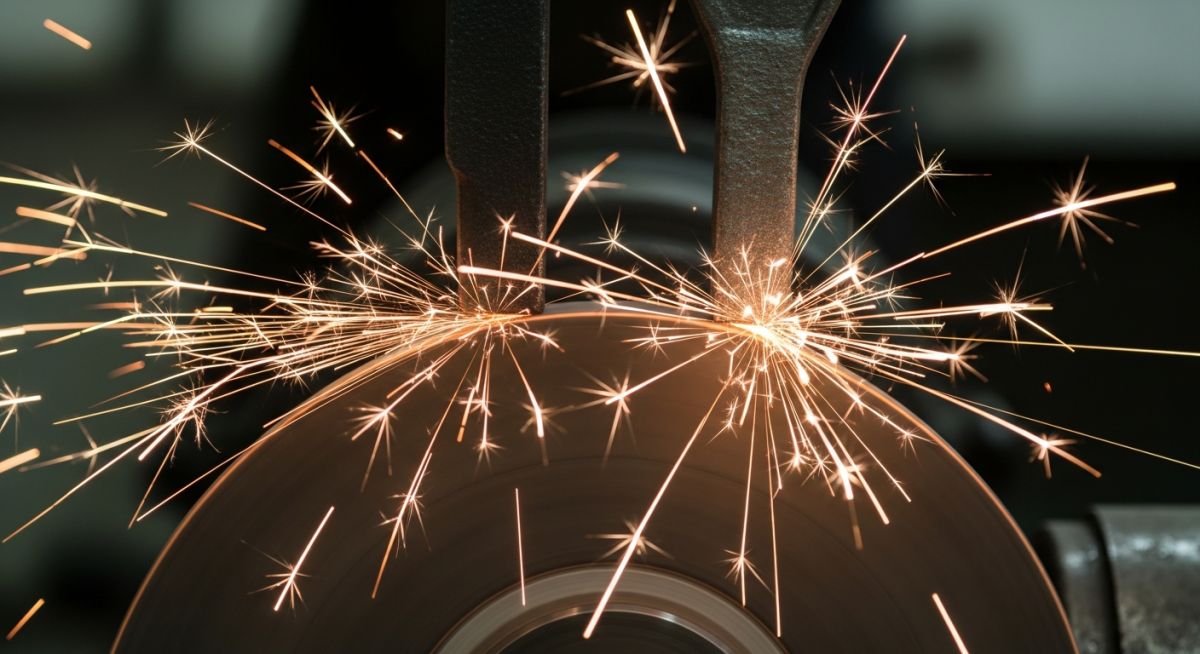
Cast iron produces a short, dull red-to-orange spark stream. The sparks do not travel far from the wheel, and they end in small, complex, feather-like bursts (carbon explosions) close to the metal surface. This is due to the high concentration of carbon flakes interrupting the stream.
Cast steel produces a long, bright white-to-yellow stream. The carrier lines are straight and continuous, throwing sparks several feet. The bursts occur at the very end of the stream and resemble sharp, distinct stars or forks.
Fracture Surface Analysis
If a component has failed or if you have access to a riser or casting sprue that can be broken, the fracture surface provides immediate proof. Gray cast iron fractures easily under impact, showing a dull, dark gray or black crystalline face. This dark coloration is caused by the exposed graphite flakes. Cast steel is highly resistant to fracture, requiring significant bending or deformation before tearing. When it does break, the fracture surface is bright, silvery, and highly reflective.
What Are the Key Mechanical Differences?
To design safe piping systems under ASME B31.3, we must respect the mechanical limits of these materials. The table below outlines the stark differences in tensile strength, yield strength, and elongation across common casting grades.
| Material Class | Common Grade | Tensile Strength (Min) | Yield Strength (Min) | Elongation (Min %) | ASME B31.3 Status |
|---|---|---|---|---|---|
| Gray Cast Iron | ASTM A48 Class 35 | 241 MPa (35 ksi) | Not Defined (Brittle) | < 0.5% | Highly Restricted |
| Ductile Cast Iron | ASTM A536 65-45-12 | 448 MPa (65 ksi) | 310 MPa (45 ksi) | 12% | Limited Pressure |
| Cast Carbon Steel | ASTM A216 Grade WCB | 485 MPa (70 ksi) | 250 MPa (36 ksi) | 22% | Fully Approved |
| Cast Alloy Steel | ASTM A217 Grade WC6 | 485 MPa (70 ksi) | 275 MPa (40 ksi) | 20% | High Temp Approved |
This matrix maps the physical parameters, structural acronyms, and hyperlinked standard references required for engineering design and material procurement.
| Acronym / Entity | Physical Parameter | Metallurgical Role | Standard Reference |
|---|---|---|---|
| WCB | Carbon Content ≤ 0.30% | Ensures weldability and high ductility in pressure-containing parts. | ASTM A216 WCB |
| SG Iron | Nodular Graphite Structure | Spheroidal graphite reduces stress concentration, increasing toughness. | ASTM A536 |
| LCC | Low Temp Impact Energy | Guarantees low-temperature toughness down to -46°C (-50°F). | ASTM A352 LCC |
| MTR | Chemical & Physical Verification | Mill Test Report certifying actual heat analysis and mechanical testing. | EN 10204 3.1 |
How to Verify Materials on Site?
Before any cast valve or fitting is welded or bolted into a process line, the field quality control team must verify its material class. I developed this checklist to ensure no cast iron component slips into a cast steel specification.
Field Inspection Protocol
-
Check Casting Marks: Look for raised letters on the body. Cast steel valves typically display “WCB”, “WCC”, or “CF8M”. Cast iron valves often show “GG25”, “Class 125”, or “A126”.
-
Perform the Acoustic Ring Test: Suspend the component or strike an unbolted flange edge lightly with a brass hammer. Cast steel will emit a clear, high-pitched, long-lasting musical ring. Cast iron will produce a dull, flat, rapidly decaying “thud”.
-
Inspect Surface Texture: Cast iron components generally have a rougher, sand-like surface texture due to the sand-casting process. Cast steel components are smoother, with cleaner parting lines and fewer surface irregularities.
-
Verify Mill Test Reports (MTR): Match the heat number stamped on the valve body with the physical MTR. Ensure the carbon content is below 0.30% for weldable steel grades.
-
Execute Portable Hardness Testing: If in doubt, use a portable Leeb hardness tester. Cast iron typically exhibits higher hardness values (often exceeding 200 HBW) but lacks the corresponding tensile ductility of cast steel.
Field Case Study: Real-World Application
The Problem: Catastrophic Valve Fracture
During a fast-tracked refinery turnaround, a 6-inch utility steam valve was replaced. The warehouse issued a valve that was visually identical to the specified ASTM A216 WCB cast steel valve. However, the issued valve was actually an ASTM A126 Class B gray cast iron valve intended for low-pressure water service. Within 48 hours of restarting the unit, a thermal shock event occurred when condensate hit the hot valve. The cast iron body fractured instantly along the flange neck, releasing high-pressure steam and forcing an emergency shutdown.
The Outcome: Forensic Investigation and Corrective Action
I was called in to lead the forensic investigation. We performed an on-site spark test on the fractured valve body, which immediately revealed the short, dull red spark stream characteristic of gray cast iron. Microstructural analysis confirmed a matrix dominated by large graphite flakes.
To prevent future occurrences, we implemented a strict Positive Material Identification (PMI) protocol for all warehouse stock. We also mandated that all cast iron valves in utility service be painted a distinct safety blue, while cast steel valves remained in standard industrial gray. This simple visual control, combined with mandatory acoustic ring tests during receiving inspection, completely eliminated material mix-ups on site.
Frequently Asked Engineering Questions
Can you weld cast iron to cast steel in pressure piping?
Why does cast steel ring while cast iron makes a dull thud?
How does ductile iron differ from cast steel in identification?
Can portable PMI machines distinguish cast iron from cast steel?
Why is cast iron used for pump casings if steel is stronger?
What is the temperature limit for cast iron in piping?
===FAQ_BLOCK===

📚 Recommended Resources: Cast Iron vs Cast Steel
Read these Guides
- 📄 Brittle Fracture vs Ductile Fracture: Definition, Mechanism, Differences
- 📄 What is Ductile Iron? | Types, Properties, and Applications of Ductile Iron
- 📄 How is Steel Made? Steel Production Process Explained from Field Experience
- 📄 What is a Foot Valve? Working, Types & Foot Valve vs Check Valve (2026)


