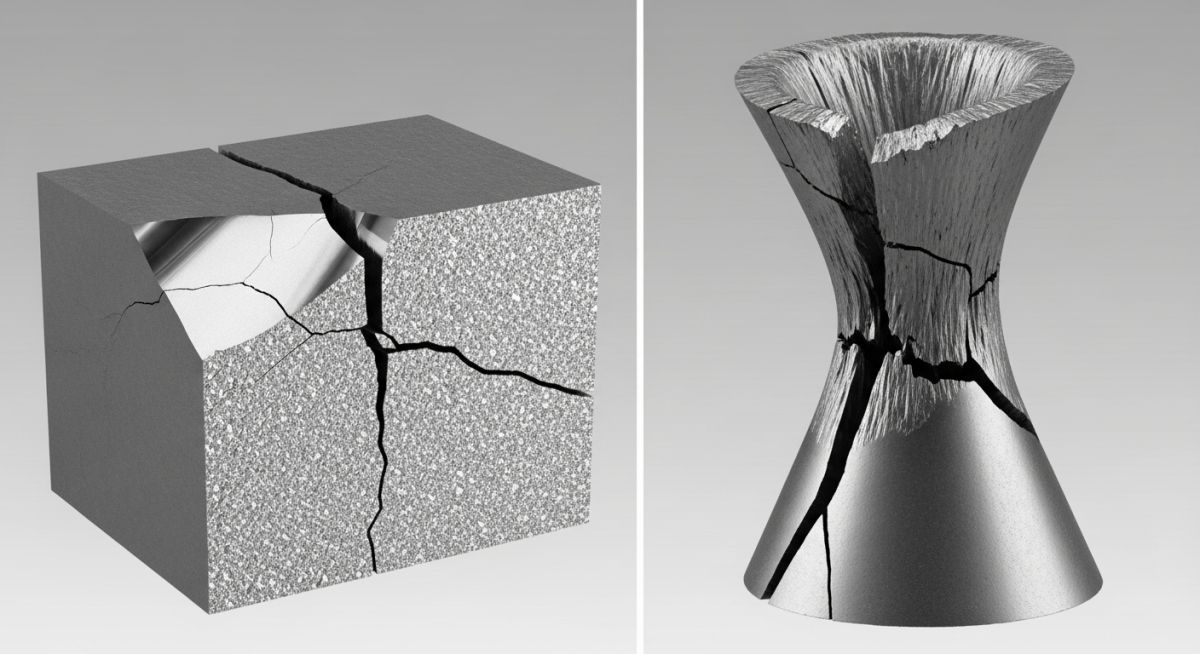
Brittle Fracture vs Ductile Fracture: Definition, Mechanism, Differences
In my 20+ years in piping and pressure systems, I’ve seen failures that give clear warning—and some that don’t. The difference often comes down to brittle fracture vs ductile fracture. One fails suddenly without deformation, while the other stretches and signals danger before rupture.
Understanding this distinction is not academic—it directly impacts plant safety, shutdown risk, and equipment life. If you’re handling pipelines, pressure vessels, or structural components, knowing how and why these fractures occur is critical.
✅ Key Engineering Takeaways
- Brittle fracture occurs suddenly with no plastic deformation
- Ductile fracture shows necking and warning before failure
- Low temperature and high stress concentration increase brittle failure risk
- Fracture toughness is the most critical parameter in failure analysis
- Design codes like ASME standards help prevent fracture-related failures
Brittle fracture occurs without deformation and propagates rapidly, while ductile fracture involves plastic deformation and energy absorption before failure. The key difference lies in crack propagation behavior, temperature sensitivity, and material toughness—making ductile fracture safer in engineering systems.
Interactive Engineering Quiz
Q1. What is the primary characteristic of brittle fracture?
Complete Course on
Piping Engineering
Check Now
Key Features
- 125+ Hours Content
- 500+ Recorded Lectures
- 20+ Years Exp.
- Lifetime Access
Coverage
- Codes & Standards
- Layouts & Design
- Material Eng.
- Stress Analysis
What is Brittle Fracture or Brittle Failure?
Brittle fracture is a failure mode where a material breaks suddenly without any significant plastic deformation. In my field experience across piping and pressure systems, brittle fracture is the most dangerous type because it gives almost no warning before complete failure.
This type of fracture typically occurs in materials like cast iron, high-carbon steel, and in carbon steel at low temperatures. The crack propagates at high speed once initiated, making it catastrophic in nature.
What is Ductile Fracture or Ductile Failure?
Ductile fracture, unlike brittle fracture, involves significant plastic deformation before failure. I’ve seen ductile failures in pressure vessels where the material stretches, necks, and visibly deforms before rupture.
This deformation acts as a warning mechanism, giving operators time to take corrective action. Materials like mild steel and aluminum typically undergo ductile fracture.
Brittle Fracture Mechanism
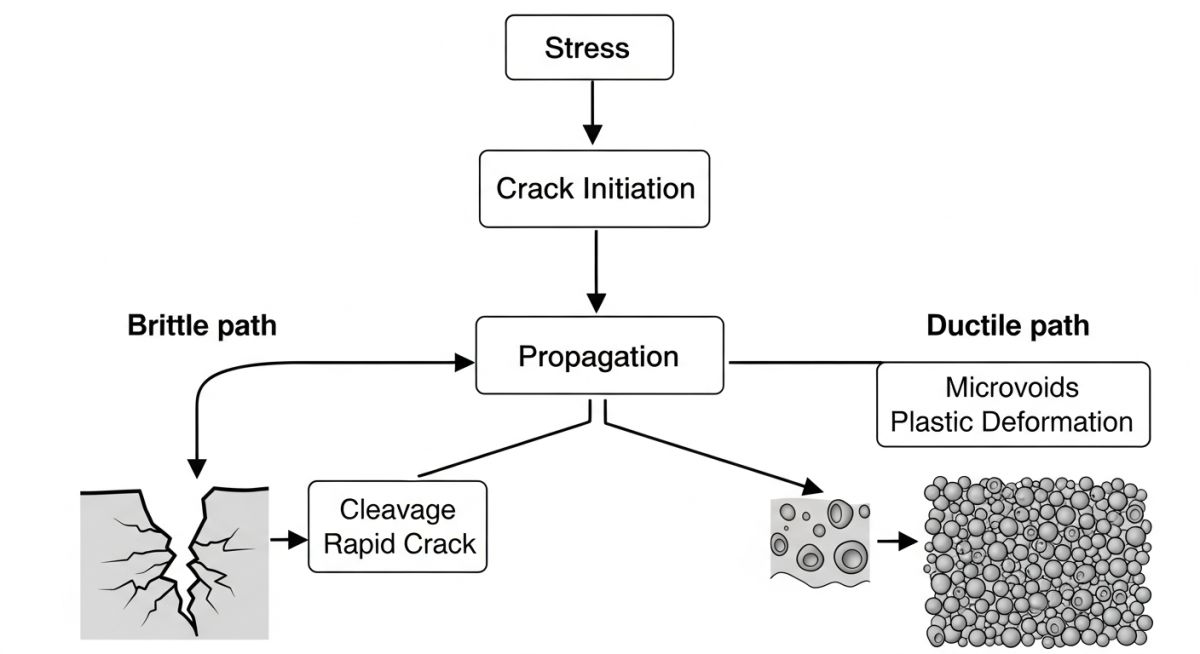
Brittle fracture occurs through a mechanism known as cleavage. The crack propagates along specific crystallographic planes with minimal energy absorption. Once the crack reaches a critical size, catastrophic failure occurs almost instantly.
This behavior is strongly influenced by stress concentration, temperature, and material toughness.
Causes of Brittle Fracture
- Low temperature operation (below ductile-to-brittle transition temperature)
- High strain rate loading
- Presence of cracks or defects
- Stress concentration zones (notches, welds)
- Poor material selection
- Improper heat treatment
Fracture Toughness
Fracture toughness is a critical property that defines a material’s resistance to crack propagation. It is represented as KIC and plays a key role in evaluating whether a crack will lead to catastrophic failure.
Engineering standards like ASME BPVC emphasize fracture toughness requirements for critical equipment.
Griffith’s Theory of Brittle Fracture
Griffith’s theory explains brittle fracture based on energy balance. According to this theory, fracture occurs when the energy release rate exceeds the surface energy required to create a new crack.
It can be expressed as: σ = √(2Eγ / πa), where σ is stress, E is Young’s modulus, γ is surface energy, and a is crack length.
Mechanism of Ductile Fracture
Ductile fracture involves microvoid formation, growth, and coalescence. As load increases, voids form around inclusions and defects, eventually merging to form a crack.
This process absorbs significant energy, making ductile materials much safer for engineering applications.
Brittle Fracture vs Ductile Fracture
The primary difference lies in deformation behavior and energy absorption. Brittle fracture is sudden and dangerous, while ductile fracture provides warning signs. In safety-critical systems, we always prefer ductile behavior.
| Parameter | Brittle Fracture | Ductile Fracture |
|---|---|---|
| Deformation | No plastic deformation | Significant plastic deformation |
| Crack Speed | Very fast | Slow |
| Energy Absorption | Low | High |
| Surface Appearance | Flat, shiny | Cup-and-cone |
| Temperature Sensitivity | High | Low |
| Engineering Preference | Avoid | Preferred |
| Relevant Standard | ASME BPVC Section VIII | ASME Material Standards |
Field Case Study: Real-World Application
During a refinery cold startup, a carbon steel pipeline suddenly ruptured without any visible deformation. The ambient temperature had dropped significantly overnight. The system failed instantly, leaving no time for operator intervention. Initial inspection showed a clean, flat fracture surface—indicating brittle failure.
Detailed analysis revealed that the operating temperature had fallen below the ductile-to-brittle transition temperature (DBTT). The material lacked sufficient fracture toughness under those conditions. The recommendation was to upgrade to low-temperature carbon steel (LTCS), enforce stricter material selection based on impact testing, and validate design using ASME BPVC guidelines .
My recommendation: Always align material selection, operating temperature, and fracture toughness requirements. In critical services, ductile behavior should be ensured through design validation, impact testing, and adherence to recognized standards like ASME Section VIII .
Frequently Asked Engineering Questions
What is the key difference between brittle and ductile fracture?
Why is brittle fracture considered dangerous?
What factors influence brittle fracture?
What is fracture toughness and why is it important?
How can brittle fracture be prevented in pipelines?
Which failure mode is preferred in engineering design?
