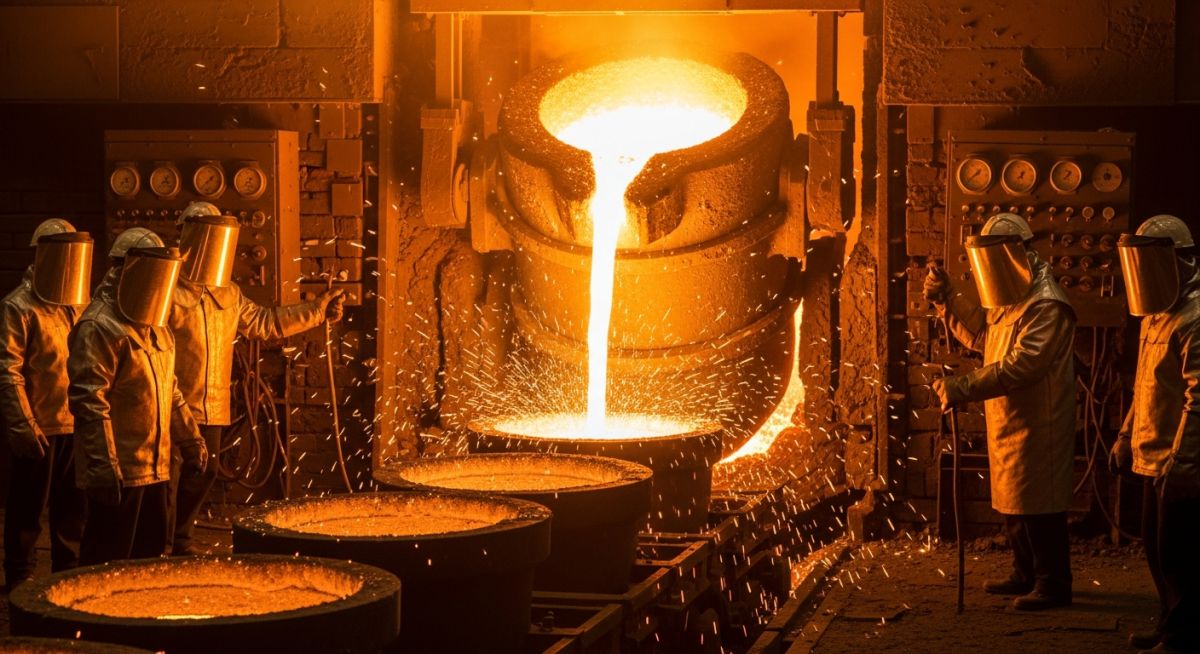
How is Steel Made? Steel Production Process Explained from Field Experience
In my 20+ years working across thermal plants, refineries, and fabrication yards, I’ve seen one truth repeatedly — steel is not just produced, it is engineered through controlled chaos. From iron ore to molten metal at 1500°C, every stage demands precise chemistry control, thermal balance, and operational discipline.
Whether it’s a blast furnace tapping delay or arc instability in an EAF, even minor deviations can compromise quality, cause downtime, or worse — safety hazards. So let’s break down how steel is actually made — the way it happens in real plants, not just textbooks.
🔑 Key Takeaways
- Steel is produced by removing impurities like carbon, sulfur, and phosphorus from iron.
- Blast furnace is used to produce pig iron from raw materials.
- Bessemer and Open Hearth are legacy processes replaced by modern methods.
- Electric Arc Furnace (EAF) is widely used today for scrap recycling-based steelmaking.
- Temperature control and chemical composition are critical to steel quality.
📌 Quick Answer: How is Steel Made?
Steel is made by converting iron into a refined alloy through processes like blast furnace and electric arc furnace. Impurities such as carbon, silicon, and sulfur are removed, and alloying elements are added to achieve desired properties. The molten steel is then cast, rolled, and finished into usable products.
Interactive Engineering Quiz
1. What is the primary purpose of a blast furnace?
What is Steel?
In my field experience across piping fabrication yards and EPC projects, steel is best understood not as a single material—but as a controlled alloy system. Fundamentally, steel is iron with a controlled percentage of carbon (typically 0.02% to 2%), along with alloying elements such as manganese, chromium, and nickel.
The entire objective of steelmaking is to remove unwanted impurities from raw iron and refine its chemistry to meet mechanical and corrosion requirements defined by standards like ASTM and ISO.
How is Steel Made? Steel Manufacturing Process
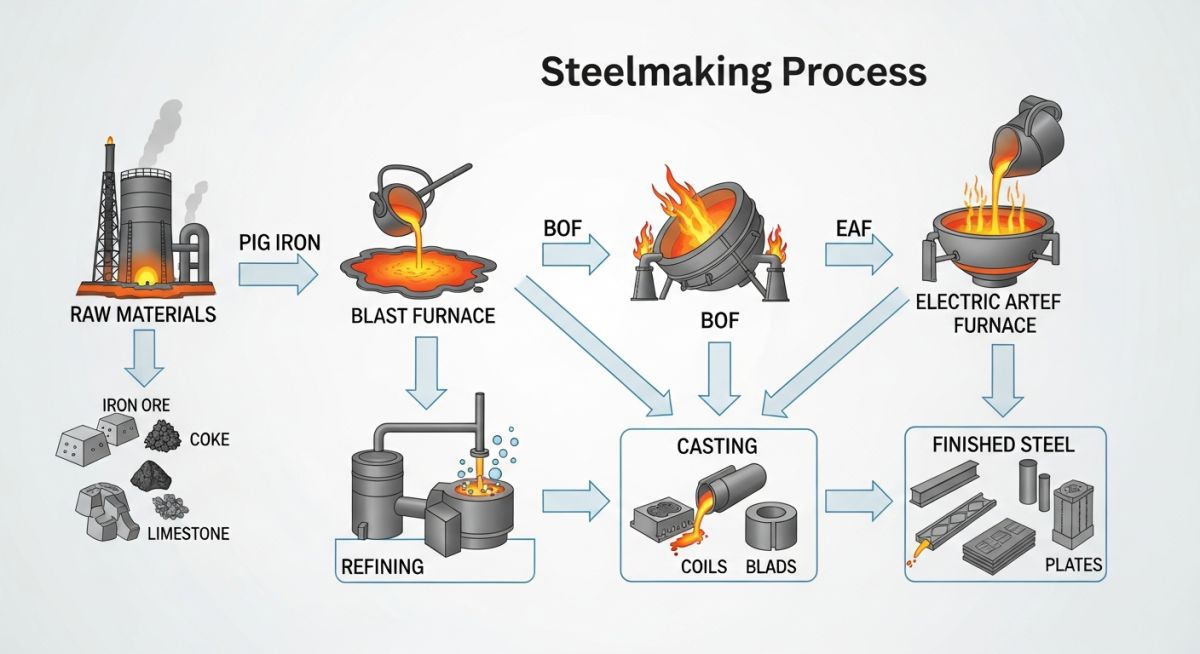
The steel production process involves three core stages:
- Iron production using Blast Furnace
- Steel refining (BOF, Bessemer, Open Hearth)
- Secondary processing (EAF, casting, rolling)
Each stage is governed by strict temperature control (~1500–1700°C) and chemical balance.
Blast Furnace Steel Production Process
The blast furnace is the starting point for primary steelmaking. Here, iron ore (Fe₂O₃), coke, and limestone are charged from the top, while preheated air (1000°C) is blown from the bottom.
The key reaction:
Fe₂O₃ + 3CO → 2Fe + 3CO₂
The output is pig iron, which contains high carbon (~4%) and impurities.
Steel Manufacturing Principle of the Bessemer Process
The Bessemer process was the first mass-production method for steel. Air is blown through molten pig iron to oxidize impurities.
Key oxidation reactions:
- C + O₂ → CO₂
- Si + O₂ → SiO₂
- Mn + O → MnO
Although now obsolete, this method laid the foundation for modern BOF converters used today in integrated plants.
Steel Making Principle by Open Hearth Process
The Open Hearth furnace uses a regenerative heating system. Scrap steel and pig iron are heated slowly, allowing better composition control.
However, due to long cycle time (8–10 hours) and high fuel consumption, this method has been phased out in favor of more efficient technologies.
Steel Production by Electric Arc Furnace (EAF)
The EAF process dominates modern steel recycling-based plants. It uses high-voltage electric arcs (up to 3500°C) to melt scrap steel or DRI (Direct Reduced Iron).
In one fabrication project I handled, inconsistent scrap feed caused arc instability. This led to:
- Excess electrode consumption
- Power fluctuation
- Non-uniform steel composition
The fix was simple but critical—maintaining a consistent charge mix ratio and pre-sorting scrap.
| Process | Raw Material | Temperature | Efficiency | Modern Usage |
|---|---|---|---|---|
| Blast Furnace | Iron Ore, Coke | ~1500°C | High | Primary Iron Production |
| Bessemer | Pig Iron | ~1600°C | Medium | Obsolete |
| Open Hearth | Scrap + Pig Iron | ~1600°C | Low | Replaced |
| Electric Arc Furnace | Scrap Steel | ~3500°C | Very High | Widely Used |
Field Case Study: Real-World Application
🔴 Problem Observed in Fabrication Plant
During a project, we experienced repeated inconsistencies in steel chemistry from an Electric Arc Furnace (EAF). The carbon levels fluctuated beyond acceptable limits defined by ASTM standards. This resulted in:
- Rejected batches during QA inspection
- Weld cracking during piping fabrication
- Unexpected mechanical failures under stress testing
After investigation, we identified inconsistent scrap composition as the root cause. We implemented:
- Strict scrap segregation based on prior usage
- Real-time carbon monitoring during melting
- Improved charge mix ratio control
Within weeks, steel quality stabilized and rejection rates dropped by over 35%.
My Recommendation: In real field conditions, steelmaking is not just a process—it is a control system. Always prioritize chemistry consistency, temperature control, and material traceability.
Frequently Asked Engineering Questions
What is the main raw material used in steel production?
Why is carbon controlled in steel?
What is pig iron in steelmaking?
Which is the most modern steelmaking process?
Why was the Bessemer process replaced?
What temperature is steel produced at?
💬 Reader discussions and insights will appear here after publishing.
📝 Comment form integration (WordPress or custom CMS) goes here.
- Boiler Design Basics for Engineers
- Piping Stress Analysis Guide
- Heat Exchanger Design Explained
Complete Course on
Piping Engineering
Check Now
Key Features
- 125+ Hours Content
- 500+ Recorded Lectures
- 20+ Years Exp.
- Lifetime Access
Coverage
- Codes & Standards
- Layouts & Design
- Material Eng.
- Stress Analysis

📚 Recommended Resources: How is Steel Made
Read these Guides
- 📄 Types of Steel: Complete Guide to Steel Grades, Classification & Real-World Applications
- 📄 How to Magnetize Stainless Steel? (Engineering Methods & Science 2026)
- 📄 Aluminum vs Stainless Steel: Key Differences You Should Know
- 📄 Introduction to FRP Pipes: Properties, Applications, Specifications, Codes, Joining & More


