
Basis of Estimate (BOE) Explained: Mastering Project Cost Accuracy
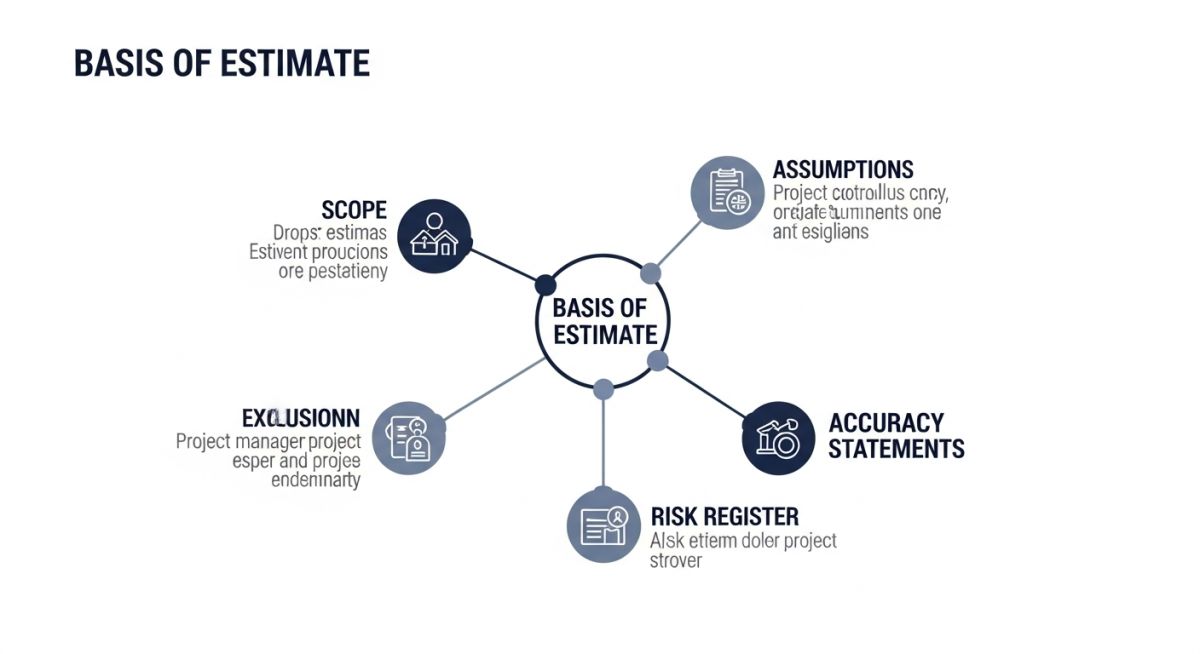
In my two decades of managing large-scale industrial piping and infrastructure projects, I have learned that the most accurate cost estimate is worthless if the stakeholders do not understand the “why” behind the numbers. A Basis of Estimate (BOE) serves as the technical narrative that bridges the gap between raw data and executive decision-making.
Without a rigorous BOE, projects often suffer from scope creep, misaligned expectations, and catastrophic budget overruns. I treat the BOE as a living document that evolves from the conceptual phase through to the final investment decision. It is not merely a collection of spreadsheets; it is a defensive engineering document that protects the project team from ambiguity.
Key Takeaways for Project Success:
- Establish clear boundaries to prevent scope leakage during the FEED phase.
- Document every assumption regarding labor productivity and material escalation.
- Quantify risks using probabilistic methods rather than simple contingency percentages.
- Maintain traceability between the engineering design basis and the final cost output.
Technical Framework for Basis of Estimate Development
Basis of Estimate Development: The systematic process of documenting the technical inputs, quantity take-offs, and pricing methodologies to ensure that the project cost estimate adheres to ASME and AACE recommended practices for capital project control.
Developing a robust Basis of Estimate requires a granular approach to data collection. In my experience, the most common failure point is the lack of correlation between the Piping and Instrumentation Diagrams (P&IDs) and the material take-off (MTO) sheets. When I lead an estimate review, I look for the “Golden Thread”—the direct link from the engineering design basis to the final cost line item.
The technical calculation of an estimate must account for specific site conditions. For instance, when calculating piping labor, we must apply a “Complexity Factor” (CF) to the base man-hours. This is calculated as: Total Man-Hours = (Base Hours x CF) + Indirects. If the piping density is high, the CF must be adjusted upward to reflect the restricted access and increased welding difficulty.
Field Warning: The “Hidden” Cost Trap
Never assume that material costs include freight, insurance, or site-specific handling. In my experience, failing to explicitly state these exclusions in the BOE leads to a 5-10% budget shortfall during the procurement phase. Always define the “Battery Limits” of your estimate to ensure that interface points with existing infrastructure are clearly accounted for.
Furthermore, the accuracy statement is the most critical section of the BOE. According to AACE Class 3 estimates, the expected accuracy range is typically -20% to +30%. If your BOE does not explicitly state the maturity of the engineering design (e.g., 30% P&ID completion), you are setting the project up for failure. I always require a “Design Maturity Matrix” to be attached to the BOE, which maps every major equipment item to its current engineering status.
Finally, risk quantification must move beyond a flat 10% contingency. I utilize a Monte Carlo simulation approach for high-value projects, documenting the P50 and P80 confidence levels within the BOE. This provides the project sponsor with a clear understanding of the financial exposure associated with specific technical uncertainties, such as soil conditions or long-lead equipment delivery delays.
Strategic Estimating Documentation: The implementation of a structured Basis of Estimate provides a defensible audit trail for project stakeholders while highlighting the inherent limitations of early-stage cost modeling.
Advantages
- Provides a clear audit trail for internal and external project reviews.
- Reduces scope creep by defining explicit project boundaries and exclusions.
- Facilitates accurate benchmarking against historical project data.
- Improves stakeholder confidence through transparent methodology disclosure.
- Enables precise identification of high-risk cost drivers early in the lifecycle.
Disadvantages
- Requires significant upfront engineering time and cross-departmental coordination.
- Can create a false sense of security if assumptions are not regularly updated.
- Demands high-level expertise to accurately quantify complex technical risks.
- May be perceived as overly bureaucratic by fast-track project teams.
- Risk of “analysis paralysis” when trying to define every minor variable.
Industrial Project Implementation: The application of a rigorous Basis of Estimate is essential across diverse sectors to ensure financial viability and technical alignment during the capital expenditure lifecycle.
Green Hydrogen Plant Design
In green hydrogen projects, the BOE must account for the high volatility of electrolyzer pricing and the integration of renewable energy sources. We define the power input requirements and water treatment costs as primary variables, ensuring that the estimate reflects the specific energy intensity of the chosen technology stack.
Brownfield Refinery Revamp
When working on brownfield refinery upgrades, the BOE is critical for documenting the “tie-in” costs and the impact of existing site congestion on labor productivity. We use the BOE to explicitly exclude costs associated with legacy equipment failure, which protects the project budget from unforeseen maintenance liabilities.
Offshore Platform Decommissioning
Decommissioning projects rely on the BOE to manage the extreme uncertainty of subsea conditions and environmental remediation requirements. By documenting the assumptions regarding vessel availability and weather-related downtime, the BOE provides a realistic financial framework for high-risk offshore operations.
Carbon Capture Infrastructure
For carbon capture and storage (CCS) projects, the BOE must integrate complex regulatory compliance costs and long-term monitoring expenses. We utilize the BOE to map the technical requirements for pipeline metallurgy and compression station power, ensuring that the estimate aligns with the specific carbon sequestration targets of the facility.
In my two decades of managing capital projects, I have observed that the most common failure point in cost engineering is the misalignment between the project phase and the expected accuracy of the estimate. A robust Basis of Estimate (BOE) must explicitly reference the AACE International recommended practices, specifically RP 18R-97, which defines the maturity levels of project definition deliverables. By mapping your estimate to these specific classes, you provide stakeholders with a clear understanding of the inherent uncertainty and the potential for cost variance as the design progresses from conceptual screening to definitive execution.
The following table outlines the correlation between engineering maturity, the purpose of the estimate, and the expected accuracy ranges. When drafting your BOE, you must justify the chosen class by citing the percentage of engineering completion, such as P&ID development status, equipment inquiry status, and the maturity of the piping material take-offs. Failing to align these metrics often leads to “estimate creep,” where stakeholders mistakenly interpret a Class 4 study estimate as a Class 2 budget authorization, resulting in significant financial friction during the project lifecycle.
| Estimate Class | Engineering Maturity | Accuracy Range | Primary Purpose |
|---|---|---|---|
| Class 5 | 0% to 2% | -50% to +100% | Concept Screening |
| Class 4 | 1% to 15% | -30% to +50% | Study or Feasibility |
| Class 3 | 10% to 40% | -20% to +30% | Budget Authorization |
| Class 2 | 30% to 75% | -15% to +20% | Control or Bid |
| Class 1 | 65% to 100% | -10% to +15% | Check Estimate |
Effective cost engineering requires a structured approach to data management, where every line item in the estimate is traceable to a specific technical document or engineering assumption. In my experience, the most defensible Basis of Estimate documents are those that utilize a clear cross-reference matrix, linking the cost components to the underlying technical specifications and project constraints. This transparency is vital during internal audits and when presenting the project budget to executive steering committees who demand granular justification for every dollar allocated.
The matrix below serves as a template for organizing your technical inputs. By categorizing your data into these specific entities, you ensure that the estimating team, the procurement department, and the engineering leads are all working from a single source of truth. This prevents the common pitfall of “hidden assumptions,” where an estimator might assume a specific material grade or construction method that contradicts the actual design intent documented in the project specifications or the ASME B31.3 piping code requirements.
| Entity Category | Technical Reference | Standard/Code | Risk Impact |
|---|---|---|---|
| Piping Materials | Piping Class Sheets | ASME B31.3 | High (Market Volatility) |
| Rotating Equipment | Data Sheets | API 610/617 | Medium (Lead Time) |
| Structural Steel | General Arrangement | AISC 360 | Low (Commodity Price) |
| Instrumentation | Loop Diagrams | ISA 5.1 | Medium (Integration) |
Before finalizing any Basis of Estimate, I mandate a rigorous peer review process using a standardized checklist. This ensures that no critical scope element is overlooked and that all assumptions are documented with sufficient technical depth. A well-vetted BOE is your primary defense against scope creep and budget overruns during the execution phase of the project.
-
[ ]
Scope Definition: Confirm that the project battery limits are clearly defined on the Plot Plan and P&IDs. -
[ ]
Material Take-offs: Verify that MTOs are based on the latest revision of the engineering drawings, not preliminary sketches. -
[ ]
Labor Productivity: Ensure that site-specific labor factors (e.g., weather, union agreements, shift patterns) are explicitly stated. -
[ ]
Escalation & Contingency: Validate that the contingency percentage aligns with the project risk register and the AACE estimate class. -
[ ]
Exclusions: Clearly list all items excluded from the estimate to prevent scope gaps during the procurement phase. -
[ ]
Currency & Taxes: Confirm that all pricing is in the correct currency and accounts for local tax regulations and import duties.
Each item on this list must be signed off by the lead engineer and the project manager. If an item is marked as “not applicable,” a written justification must be attached to the BOE document. This level of documentation is essential for maintaining project integrity and ensuring that the estimate remains a living document throughout the project lifecycle.
The Challenge: Incomplete Basis of Estimate for a Brownfield Expansion
- The project team failed to define the tie-in points for existing piping, leading to massive rework.
- Assumptions regarding existing structural steel capacity were made without field verification or NDT testing.
- The estimate excluded the cost of hazardous waste disposal, which was a significant regulatory requirement.
- Labor productivity factors were based on greenfield site data, ignoring the constraints of working in an active plant.
The Outcome: Implementing a Robust BOE Framework
- By revising the BOE to include a detailed tie-in register, we reduced field change orders by 40%.
- Field verification of structural steel resulted in a more accurate reinforcement plan, saving 15% in material costs.
- Including environmental compliance costs upfront prevented a major budget shortfall during the construction phase.
- Adjusting labor factors to reflect brownfield constraints provided a realistic schedule and cost baseline.
My recommendation for any project manager is to treat the Basis of Estimate as a living document. In this case, the initial failure to document assumptions led to a cascade of issues. By formalizing the BOE and requiring sign-off from all disciplines, we transformed the project from a high-risk endeavor into a controlled, predictable execution.
What is the primary purpose of a Basis of Estimate?
- It establishes a clear baseline for project control and performance measurement.
- It facilitates communication between engineering, procurement, and construction teams.
- It provides a defensible audit trail for internal and external financial reviews.
- It helps identify and mitigate potential cost risks before they manifest as overruns.
How do I handle exclusions in the Basis of Estimate?
- Categorize exclusions by discipline (e.g., civil, mechanical, electrical).
- Clearly state the reason for each exclusion (e.g., “covered by owner,” “deferred to future phase”).
- Reference the specific project documents or P&IDs that define the battery limits.
- Review the exclusion list with the client or project sponsor to ensure alignment.
What role does risk management play in the BOE?
- Identify technical, commercial, and environmental risks during the estimating phase.
- Assign probability and impact scores to each risk item.
- Use Monte Carlo simulations or similar methods to determine appropriate contingency levels.
- Document the mitigation strategies for each high-impact risk.
How should I document labor productivity assumptions?
- Cite the source of your productivity data (e.g., historical project data, industry benchmarks).
- Adjust rates for site-specific constraints like height, congestion, or hazardous work zones.
- Include allowances for shift premiums, overtime, and travel time if applicable.
- Clearly state the assumed crew composition and equipment utilization rates.
Why is the AACE estimate class important?
- It sets realistic expectations for budget variance and contingency requirements.
- It aligns the estimating process with the project’s stage-gate development.
- It provides a framework for comparing estimates across different projects or industries.
- It ensures that the level of engineering detail matches the required accuracy range.
How do I maintain the BOE during execution?
- Implement a formal change management process for all updates to the BOE.
- Document the impact of every change on the project budget and schedule.
- Regularly review the BOE with the project team to ensure it remains accurate.
- Use the updated BOE to inform future project estimates and improve organizational learning.
📚 Recommended Resources: Basis of Estimate
Complete Course on
Piping Engineering
Check Now
Key Features
- 125+ Hours Content
- 500+ Recorded Lectures
- 20+ Years Exp.
- Lifetime Access
Coverage
- Codes & Standards
- Layouts & Design
- Material Eng.
- Stress Analysis
