ASME Impact Testing Requirements: The 2026 Compliance Guide

ASME Impact Testing Requirements serve as the critical gatekeeper against catastrophic brittle fracture in pressure vessels and piping systems. While tensile strength confirms a material can hold pressure, impact testing confirms it won’t shatter like glass under sudden stress or low temperatures. In this guide, we demystify the complex exemption curves of ASME B31.3 and Section VIII to help you determine exactly when toughness verification is mandatory for your 2026 projects.
What is ASME Impact Testing?
It is a destructive test method (typically Charpy V-Notch) mandated by ASME Codes (B31.3, Section VIII, Section IX) to measure a material’s Notch Toughness. The goal is to ensure the metal can absorb energy without fracturing at its Minimum Design Metal Temperature (MDMT).
⚡ Materials Engineering Check: 2026 Edition
Loading Quiz…
Complete Course on
Piping Engineering
Check Now
Key Features
- 125+ Hours Content
- 500+ Recorded Lectures
- 20+ Years Exp.
- Lifetime Access
Coverage
- Codes & Standards
- Layouts & Design
- Material Eng.
- Stress Analysis
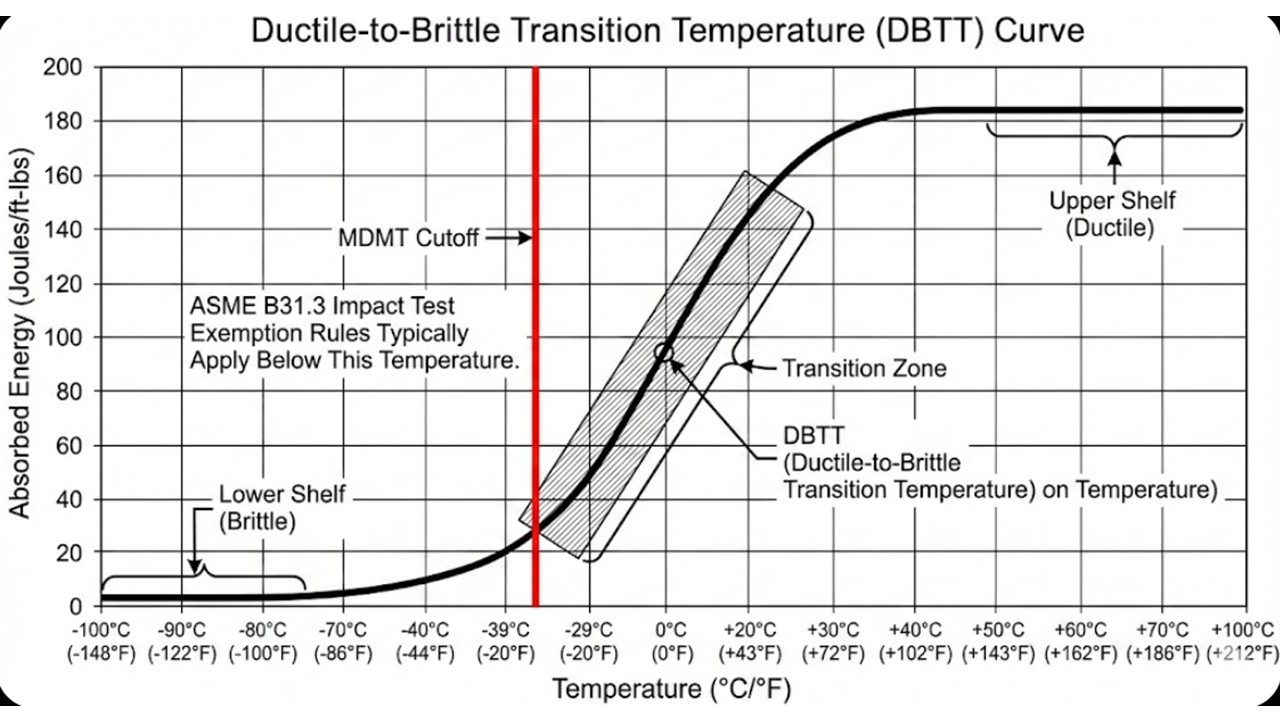
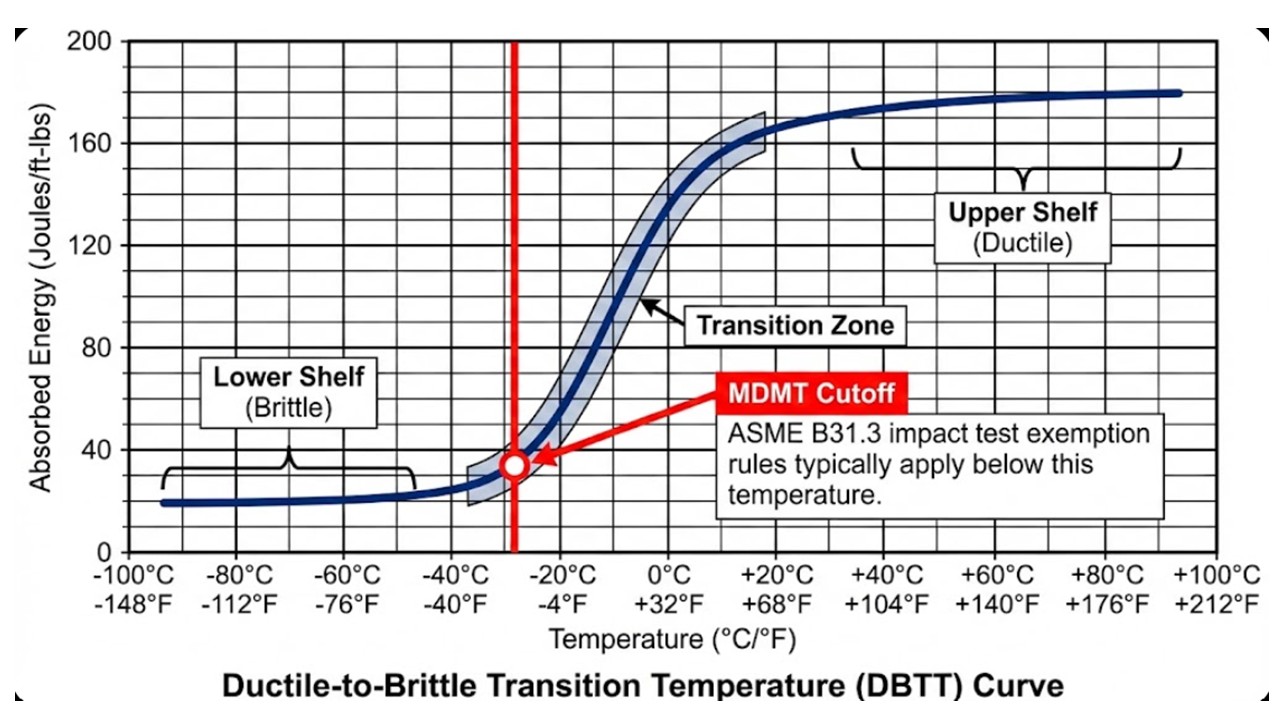
The Physics: Ductile-to-Brittle Transition (DBTT)
To understand ASME Impact Testing Requirements, one must first understand the behavior of ferritic steels. At ambient temperatures, carbon steel is typically ductile—it stretches before breaking. However, as the temperature drops, the atomic lattice structure becomes rigid, and the material can undergo a “Ductile-to-Brittle Transition.”
Below a certain critical temperature (the DBTT), the steel loses its ability to absorb energy and becomes susceptible to brittle fracture—shattering instantly like glass under stress. This specific temperature threshold is the foundation for determining the Minimum Design Metal Temperature (MDMT) for your asset.
Navigating Exemptions: When Can You Skip the Test?
The most searched topic by engineers is not how to perform the test, but how to avoid it. ASME Impact Testing Requirements are designed with “Exemption Curves” based on material quality and thickness. If your material is tough enough or your operating conditions are mild enough, the code allows you to bypass the costly destructive testing.
1. ASME B31.3 Impact Test Exemption (Piping)
For Process Piping, exemptions are primarily governed by Table A-1 and Figure 323.2.2A. The ASME B31.3 impact test exemption logic follows a flowchart:
- Material Curve: Is the material Curve A (e.g., A53 Pipe – Poor Toughness) or Curve D (e.g., A333 Gr 6 – High Toughness)?
- Thickness: Thicker walls require warmer Minimum Design Metal Temperatures to be exempt.
- Stress Ratio: If the pipe operates at low pressure (<30% of design stress), you may operate at significantly lower temperatures (down to -155°F) without testing.
2. ASME Section VIII Div 1 UCS-66 (Vessels)
For Pressure Vessels, ASME Section VIII Div 1 UCS-66 provides the governing curves. The code assigns materials to Curves A, B, C, or D.
Example: An SA-516 Gr. 70 plate (common vessel steel) falls on Curve B. However, if it is “Normalized,” it jumps to Curve D, allowing it to operate at much lower temperatures (e.g., -50°F) without requiring impact testing.
Passing the Test: Charpy V-Notch Acceptance Criteria
If your material fails the exemption check, you must perform the test. The ASME Impact Testing Requirements for acceptance are not a single number; they depend on the Yield Strength of the material and the specimen size.
The Three Pass Metrics
Measured in Joules (J) or foot-pounds (ft-lbs).
Typical Minimum: 15 to 20 ft-lbs (avg of 3 specimens) for standard carbon steel.
Measures how much the metal “bulged” at the break.
Requirement: Often 0.015 inches (15 mils) minimum for high-strength steels.
Visual inspection of the fracture surface.
Goal: Higher percentage of dull/fibrous texture indicates ductility.
*Note: Engineers often debate lateral expansion vs percent shear. ASME typically prioritizes Absorbed Energy and Lateral Expansion as the hard pass/fail metrics.
Material Assignments: UCS-66 / B31.3 Curves
The table below categorizes common piping and vessel materials by their toughness curve. Materials in Curve D are the “Gold Standard” for cold climates, often bypassing strict ASME Impact Testing Requirements.
| Curve Category | Description (Risk Level) | Common Materials (Examples) | Typical Exemption Temp (0.5″ Wall) |
|---|---|---|---|
| Curve A | Lowest Toughness (High Risk) | SA-106 Gr B (Un-normalized), A53, API 5L Gr B | +18°F (-8°C) |
| Curve B | Moderate Toughness | SA-516 Gr 70 (As-Rolled), A106 (Normalized) | -7°F (-22°C) |
| Curve C | Good Toughness | SA-516 Gr 60 (As-Rolled), SA-333 Gr 1 | -25°F (-32°C) |
| Curve D | Highest Toughness (Cryogenic Ready) | SA-516 Gr 70 (Normalized), SA-333 Gr 6 | -55°F (-48°C) |
*Data Source: Based on ASME Section VIII Div 1, Figure UCS-66 (2025/2026 Edition). Actual exemption values vary by precise thickness.
Field Engineering Report
Case Study: Preventing Brittle Fracture in Cryogenic Piping
Project Profile
- Location: LNG Terminal Expansion (Alberta, Canada)
- Design Temp (MDMT): -50°F (-45°C)
- Code: ASME B31.3 Process Piping
Material Specs
- Pipe: ASTM A333 Gr. 6 (Low Temp CS)
- Weld Consumable: E7018-1 H4R
- Condition: As-Welded (No PWHT)
The Issue: The “Essential Variable” Gap
During the fabrication of a flare knockout line for a 2026 LNG expansion project, the Quality Assurance (QA) team flagged a discrepancy in the documentation. The piping material (A333 Grade 6) was impact tested by the mill and certified for -50°F service (Curve D). However, the welding contractor had utilized a standard Welding Procedure Specification (WPS) that lacked low-temperature verification.
The contractor assumed that because the pipe was rated for low temps, the weld was automatically compliant. This is a critical error. Under ASME Impact Testing Requirements (specifically ASME Section IX), adding impact testing requirements changes the “Supplementary Essential Variables.” The existing procedure was invalid for this MDMT.
The Fix: Weld Procedure Qualification
To salvage the spool fabrication without scrapping the pipe, the engineering team ordered a weld procedure qualification impact test on a mock-up coupon immediately.
- Step 1 (Coupon Welding): A test coupon was welded using the exact parameters (Amps, Volts, Travel Speed) used in production to simulate the heat input.
- Step 2 (Notching): Three Charpy V-Notch specimens were cut from the Weld Metal (WM) and three from the Heat Affected Zone (HAZ).
- Step 3 (The Drop): The samples were cooled to -50°F and struck by the pendulum.
Lab Analysis & Results
The lab results highlighted the importance of analyzing lateral expansion vs percent shear.
While the absorbed energy (ft-lbs) marginally passed the minimum 15 ft-lb requirement, the visual inspection was concerning. The percent shear was low (indicating some crystallinity), but the lateral expansion measured 0.020 inches (20 mils), comfortably exceeding the 0.015-inch minimum. Since ASME B31.3 prioritizes lateral expansion as a measure of ductility for these grades, the procedure was deemed qualified.
Conclusion: The proactive qualification validated the welds, saving the project $50,000 in rework costs. It reinforced that compliance is not just about the base metal—the weld metal and HAZ must match the toughness of the system.
EPCLand YouTube Channel
2,500+ Videos • Daily Updates
Frequently Asked Questions: ASME Impact Compliance
What is the Minimum Design Metal Temperature (MDMT)?
The Minimum Design Metal Temperature (MDMT) is the lowest temperature at which a piping system or pressure vessel is expected to operate under load. It is the critical variable in determining whether the material remains ductile or becomes brittle. If your operating temperature is warmer than the MDMT derived from code curves, you are generally safe; if it is colder, impact testing is likely required.
How do I determine the ASME B31.3 impact test exemption?
To find the ASME B31.3 impact test exemption, consult Figure 323.2.2A in the code. You must know your material’s curve (A, B, C, or D) and its nominal wall thickness. Find the intersection on the graph: if your design temperature is above the curve, you are exempt. Additionally, if the stress ratio (operating pressure vs. design pressure) is low (e.g., <30%), the code grants further reductions in the minimum allowable temperature.
What is the significance of ASME Section VIII Div 1 UCS-66?
ASME Section VIII Div 1 UCS-66 is the governing article for impact testing in pressure vessels. It provides the “Governing Thickness” rules and the A-B-C-D material curves. It is stricter than B31.3 in some aspects, particularly regarding the evaluation of welded joints and the “coincident ratio” for stress reduction exemptions.
Does stainless steel require impact testing?
Generally, Austenitic Stainless Steels (like 304/316) are exempt from impact testing down to very low temperatures (-320°F / -196°C) because their face-centered cubic (FCC) crystal structure remains ductile in cryogenics. However, Carbon Steels (ferritic/body-centered cubic) are highly susceptible to the ductile-to-brittle transition and usually require strict verification.

Related posts:
![Outdoor pipeline block valve station with large isolation valves and actuators.]()
What are Pipeline Block Valves and How to Design Stations
![3D CAD model of an industrial process plant showing equipment clearances and access platforms.]()
A Guide to Plant Clearances and Access Requirements
![Engineering technical bid evaluation spreadsheet comparing vendor specifications and compliance metrics.]()
How to Master Technical Bid Evaluation for Complex Engineering Procurement
![Large-diameter steel pipes with protective blue anti-corrosive epoxy coating stacked in an industrial facility.]()
Protecting Steel Pipes with Anti-Corrosive Steel Pipe Coatings
![3D CAD model of industrial piping showing stress intensification factor heatmaps at elbows and tees.]()
Why Stress Intensification Factor in Piping Dictates Fatigue Life
![A collection of different industrial pipe flange gaskets on a workbench]()
How to Select the Best Pipe Flange Gaskets for Piping Systems