Piping Thermal Expansion and Contraction (Thermal Movement) in Piping Design
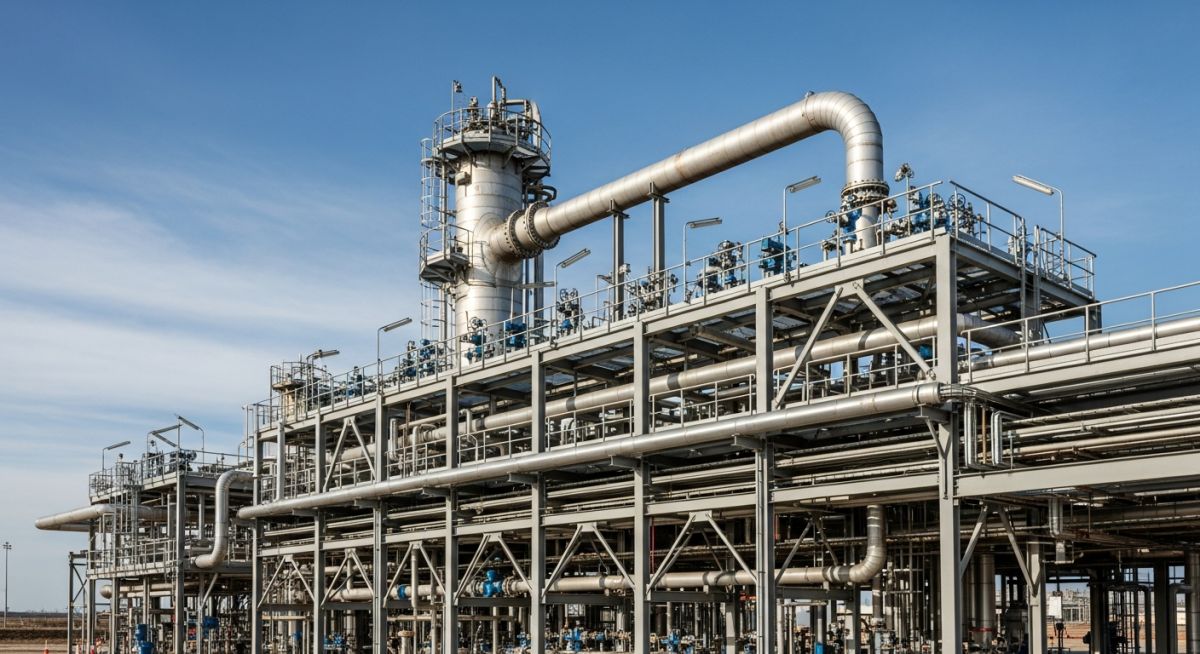
During my early years on the field, I stood on a pipe rack overseeing a high-pressure steam line commissioning. As the system reached 320°C, a deafening screech echoed through the utility block. A critical structural guide support was tearing away from the steel beam. The problem? The designer relied blindly on software without understanding actual physical piping thermal expansion. The structural anchor forces were wildly underestimated.
In my experience, you cannot design safe process facilities without accounting for thermal growth or shrinkage. When process lines cycle between ambient conditions and elevated operating temperatures, metals change physically. If you restrain this movement incorrectly, that internal strain converts directly into destructive force. This force routinely buckles structural steel, tears nozzle connections off expensive pumps, and splits pipe walls open.
But here is the catch: managing piping thermal expansion is not about locking the system down completely. It is about guiding the movement intelligently. Let us look closely at how we calculate, control, and design these high-stress networks to ensure full compliance with international engineering codes.
Key Takeaways for Field Engineers
- ✔ Linear expansion depends strictly on length, temperature delta, and material-specific coefficients.
- ✔ ASME B31.3 dictates displacement stress limits to prevent low-cycle fatigue failures.
- ✔ Direction changes and loops are always preferred over expensive mechanical expansion joints.
- ✔ Improper pipe guiding is the leading cause of expansion loop and bellows bucking.
What is Piping Thermal Expansion?
Piping thermal expansion is the dimensional change in a pipe length caused by temperature shifts during operation. When unconstrained, a pipe expands or contracts linearly. If restrained by structural anchors, this displacement generates severe internal thermal stresses, risking mechanical failure at pipe walls, supports, and sensitive equipment nozzles.
Table of Contents

SGE Voice-Search Interactive Flashcards
Hover or tap on mobile to reveal direct field answers and engineering code validations.
How does temperature change cause mechanical movement in industrial process lines?
Temperature shifts change molecular kinetic energy, forcing metals to expand or contract.
What is the core mathematical formula to find linear change from piping thermal expansion?
The fundamental formula is ΔL = L · α · ΔT using consistent metric or imperial units.
Why is the mean coefficient of thermal expansion critical for carbon steel pipes?
It accounts for non-linear metal expansion across varying process temperature ranges.
What happens if a hot process line is locked tightly between two rigid anchor points?
The restricted linear growth transforms into massive internal compressive structural reaction forces.
How does ASME B31.3 evaluate safe displacement stress ranges?
It uses a displacement stress formula based on cold and hot allowable code stresses.
Why does a larger pipe diameter require a larger expansion loop leg?
Larger outside diameters increase bending stiffness, demanding longer flexible legs to drop local stress.
What is the primary technical hazard of using metallic expansion bellows?
Bellows represent a pressure containment weak point susceptible to fatigue and corrosion.
Where should the first pipe guide be placed near an expansion loop?
The first directional guide must sit within a distance of four pipe diameters from the corner.
How does cold springing alter piping thermal expansion design forces?
It cuts the operational hot structural anchor loads by pre-stressing the pipe cold.
What structural role do directional anchors play in rack systems?
They divide complex lines into independent, manageable thermal movement segments.
Why do fluid transients present hazards to piping thermal expansion geometries?
Surge impulses create immense dynamic forces at the bends of thermal expansion loops.
Why are nested expansion loops aligned with the smallest line inside?
It allows multiple lines to expand concurrently without causing inter-pipe mechanical interference.
Piping Thermal Expansion Competency Test
No JS Engine ActiveWhat Causes Piping Thermal Expansion and Contraction in Industrial Networks?
At its core, piping thermal expansion is driven by atomic physics. When hot process media flows through a line, the metallic matrix absorbs heat energy. This thermal input intensifies atomic vibrations, forcing individual atoms further apart. This atomic shift manifests on the plant floor as measurable physical movement along the axial path.
But here is the catch: cold process media triggers the exact opposite behavior. Cryogenic lines or facilities exposed to sub-zero winters experience thermal contraction. This contraction shortens the pipe length, generating massive tensile pull forces on equipment headers.
In my experience, failing to design for both extremes creates severe field hazards. A line that performs beautifully at its 180°C operating temperature might fail structurally during an ambient shutdown if the contraction pulls the joints beyond their mechanical limits.
How Do You Calculate Piping Thermal Expansion or Contraction?
To size structural anchors and check flexibility, you must calculate total expected movement using accurate material parameters. Guessing or estimating on hot lines will lead to structural failures.
The Fundamental Equation: ΔL = L · α · ΔT Explained
The precise linear expansion or contraction of any industrial pipe uses a straightforward structural equation:
ΔL = L · α · ΔT
Where each component represents specific physical metrics that must use matching engineering units:
- ΔL: Total change in length (mm or inches).
- L: Total straight run length between anchor points (meters or feet).
- α: Mean coefficient of thermal expansion (mm/m/°C or in/in/°F).
- ΔT: Absolute temperature delta between installation and design extremes (°C or °F).
In the field, we actually do this differently than textbook calculations. Real-world thermal expansion coefficients change non-linearly across broad temperature ranges. Because of this variation, I always pull the mean coefficient directly from the official tables in ASME B31.3 Appendix C to ensure full compliance under regulatory audits.

Complete Course on Piping Engineering by Atul Singla
Master industrial flexibility analysis, anchor load qualification, expansion loop scaling, and code compliance under ASME B31.3. Learn directly from real-world field blueprints.
Critical Material Factors Influencing Piping Thermal Expansion Stress
Calculating dimensional growth is only half the battle. To verify if your pipe can absorb this change without bursting, buckling, or overstressing machinery connections, you must analyze structural material properties.
Allowable Working Stress Limits (ASME B31.3)
Under ASME B31.3, code compliance relies on the displacement stress range. The code limits thermal expansion stresses to ensure safety against low-cycle fatigue failures. This allowable stress limit incorporates both hot and cold operational values, giving the pipe structural breathing room during thermal cycles.
Modulus of Elasticity (E) Under Thermal Loads
The Modulus of Elasticity measures material stiffness. As process temperatures rise, this stiffness drops. A lower modulus means the material flexes more easily under hot conditions. However, the force it exerts on anchors when cold during shutdowns remains exceptionally high.
Pipe Outside Diameter (OD) and Wall Thickness Interactions
A large outside diameter increases a pipe section’s moment of inertia. This mechanical property makes the line structurally rigid against bending. When rigid lines try to expand, they generate huge axial reactions. Because of this structural stiffness, heavy, large-diameter headers demand massive expansion configurations compared to small utility lines.
| Material Designation | Mean Expansion Coefficient (α) (20°C to 200°C – mm/m/°C) |
Expansion Behavior | Typical Field Application |
|---|---|---|---|
| Carbon Steel (A106-B) | 12.1 x 10⁻⁶ | Moderate growth, high structural stiffness | High-pressure plant steam and hydrocarbon utilities |
| Stainless Steel (A312-TP304) | 16.9 x 10⁻⁶ | High growth, moderate operational stiffness | Corrosive process streams and food-grade processes |
| Chrome-Moly (A335-P11) | 11.5 x 10⁻⁶ | Low growth, extreme high-heat resistance | Superheated steam headers and power piping |
Piping Linear Thermal Expansion Estimator
Calculate estimated structural growth to verify flexibility layout spacing.
How Do You Mitigate and Control Piping Thermal Expansion Hazards?
Mitigating expansion forces requires structural flexibility. In my experience, attempting to fight thermal expansion with raw structural steel is a losing battle. You must design the routing to absorb the movement naturally.
Designing Industrial Systems to Absorb Piping Thermal Expansion Safely
We use specific layout configurations to safely handle thermal stress depending on the space and process parameters.
Leveraging Piping Thermal Expansion Direction Changes
Natural directional changes, like standard 90-degree elbows, are the easiest way to add flexibility. The pipe leg perpendicular to the expansion path acts as a cantilever, flexing safely to absorb growth without overstressing components.
Engineering Fabricated Pipe Offsets for High Expansion Loads
When a straight run lacks the flexibility of a natural corner, we offset the line around structural obstacles. These fabricated offsets clear site restrictions while providing two additional bends to redistribute high thermal forces.
Designing Critical Piping Thermal Expansion Loops
For long, straight runs on pipe racks, expansion loops are the primary design choice. By fabricating a U-shaped loop, we create flexible legs that flex symmetrically, preventing high axial loads from reaching anchors.
When to Deploy Proprietary Piping Thermal Expansion Joints
In tightly packed layouts where loops are too large, we use proprietary expansion joints or metallic bellows. These mechanical components compress or flex axially to absorb growth. However, they introduce a maintenance weak point and require precise structural guiding.
Field Case Study: The Danger of Misjudging Anchor Structural Forces

When I was working on a refinery expansion project, we noticed a major issue during the commissioning of a 14-inch crude transfer line. The line ran straight for 85 meters down a central pipe rack, operating at 240°C. The design engineer had placed a traditional U-shaped expansion loop midway down the run, which looked correct on paper.
But here is the catch: the designer used incorrect structural parameters in the software. They modeled the pipe guide supports with large, loose clearances, assuming the pipe could move freely side-to-side.
When the line reached operating temperature, the pipe expanded as expected. However, because the guides were too loose, the straight pipe runs buckled sideways instead of driving the expansion into the flexible legs of the loop. This unexpected lateral movement generated a massive structural force that twisted a major anchor support, tearing the anchor bolts right out of their concrete foundations.
The entire unit had to be shut down immediately. We corrected the failure by redesigning the support structure, rebuilding the concrete anchor block, and installing strict, close-clearance directional pipe guides. This layout forced the pipe to move exactly along its axial path, directing the expansion into the loop legs and keeping structural forces well within safe limits.
Step-by-Step Tutorial Video on Piping Thermal Expansion Loop Calculations
Video Resource Component Placeholder
Detailed computational walk-through using standard structural mechanics and code configurations.

About the Author: Atul Singla
Founder of EPCLAND & Senior Piping Design Consultant
With over a decade of hands-on experience in refinery construction, petrochemical facilities, and high-pressure steam network layout optimization, I specialize in complex flexibility analysis. I train engineers globally to bridge the critical gap between academic stress theory and actual structural field realities under ASME and API parameters.
Join the EPCLAND Engineering Ecosystem
Access field tools, real-time jobs, and technical discussions with peer design specialists.
Official Engineering References & Standards Verification
- To verify official structural code parameters, check out the American Society of Mechanical Engineers (ASME) repository.
- For equipment configuration rules, explore the American Petroleum Institute (API) guidelines.
- To learn more about standard baseline material metrics, review the International Organization for Standardization (ISO) records.
Frequently Asked Questions Regarding Piping Thermal Expansion
Direct, experience-backed answers to critical structural questions frequently encountered on the field.
Can I use heavy-duty anchor supports instead of adding loop flexibility?
Absolutely not. In my experience, attempting to fight piping thermal expansion with raw structural steel is a losing battle. The internal compressive forces generated by a locked hot process line can easily exceed hundreds of tons. This massive reaction force will shear anchor bolts, buckle heavy steel columns, or crack the concrete foundations before the pipe yields. You must design flexibility into the system using layout choices like loops or offsets.
Does a thick-walled pipe expand more than a thin-walled pipe?
No, wall thickness does not alter the linear expansion rate. The total growth depends entirely on the installation length, the temperature delta, and the material’s specific thermal expansion coefficient. However, thick-walled pipes are significantly stiffer. This increased rigidity means they apply much higher reaction forces onto equipment nozzles and structural anchors if their movement is restricted.
Why do my expansion loops cause severe vibrating issues on site?
This problem is usually caused by unmanaged fluid dynamics or poor structural support. High-velocity steam or two-phase flows create massive impact forces when changing directions rapidly at 90-degree loop elbows. If the adjacent pipe rack supports lack proper directional guides or damping pads, these flow transients turn into severe acoustic and structural vibrations, risking early fatigue cracks at the weld joints.
When should I specify cold springing for my pipe layout?
Cold springing is highly effective when you need to protect sensitive equipment nozzles, such as pump or turbine inlets, from high operational thermal forces. By cutting and pre-stressing the pipe short during cold installation, you reduce the reaction load when the line expands hot. But here is the catch: it requires expert craftsmanship to install on site, and it does not change the overall thermal displacement stress range calculated under ASME B31.3.
Why did my metallic bellows expansion joint buckle during testing?
Bellows failures are almost always caused by poor pipe guiding rather than an issue with the component itself. Axial bellows act like soft structural springs. If you do not install strict, close-clearance pipe guides within 4 diameters of the joint, the internal pressure will cause the line to twist and buckle sideways. Without these guides, the system cannot force the thermal movement to stay parallel to the bellows axis.
Can solar radiation trigger significant thermal expansion stresses?
Yes, absolutely. Long, uninsulated ambient lines running across open deserts or exposed pipe racks can reach temperatures up to 65°C from solar heating alone. If the system was installed during a cold winter dawn at 5°C, this 60°C temperature delta will cause significant linear growth. As a result, you must include solar thermal loads in your flexibility checks for all uninsulated cross-country pipelines.
📚 Recommended Resources: Piping Thermal Expansion
Read these Guides
- 📄 Test Your Knowledge: The Ultimate Piping Thermal Expansion Quiz for Engineers
- 📄 Anchor Evaluation in Piping Systems – Ensuring Stability in Thermal Expansion
- 📄 Hydraulic Calculation Guidelines: Master Class for Process Piping 2026
- 📄 Underground Piping Insulation: Engineering Guide & Standards 2026