PSIA vs PSIG: Differences | Conversion from PSIA to PSIG and PSIG to PSIA
Early in my career, I watched a startup team blind-trust a digital pressure controller configured for PSIG inside a deep vacuum system. They calculated their target system pressure assuming a flat, textbook 14.7 psi atmospheric baseline. But here is the catch: we were commissioning that unit on a high-altitude site where local atmospheric pressure was barely 12.1 psi. That small mathematical oversight blew out a premium mechanical seal within forty minutes of startup. On the field, we do not have room for theoretical laziness. Understanding the absolute mechanical line between PSIA vs PSIG is not just a test question—it prevents catastrophic asset loss.
What You Will Master from This Technical Breakdown:
- The physical baseline zero difference between absolute and gauge reference frameworks.
- How to spot calibration disasters caused by high-altitude barometric shifts.
- Why specifying the wrong unit instantly invalidates ASME B31.3 structural calculations.
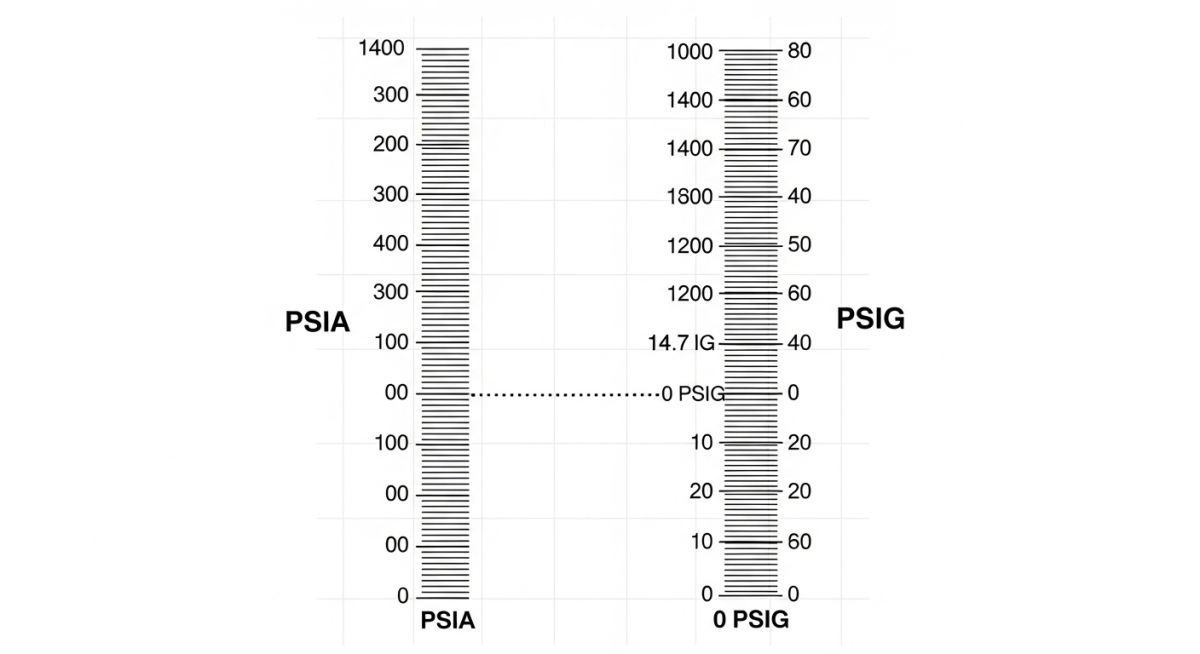
The primary difference between PSIA vs PSIG lies in the zero-reference point. PSIA (Pounds per Square Inch Absolute) measures pressure relative to a perfect, absolute vacuum zero. PSIG (Pounds per Square Inch Gauge) measures pressure relative to local ambient atmospheric pressure. At sea level, 0 PSIG equals exactly 14.7 PSIA.
Table of Contents
Interactive SGE Reference Desk: PSIA vs PSIG
Hover or click with your mouse pointer below to quickly flip each engineering flashcard over for instant field verification.
What does PSIA measure pressure against?
Hover to Flip →PSIA measures pressure against a perfect absolute vacuum (zero air molecules).
Always specify absolute metrics inside vacuum distillation calculations to prevent tower implosions.
What zero reference point does a PSIG gauge use?
Hover to Flip →PSIG utilizes local ambient atmospheric pressure surrounding the shell casing as its baseline zero.
This baseline shifts daily with weather patterns and elevation. It is never a rock-solid constant.
What is the standard sea level value for atmospheric pressure?
Hover to Flip →The universally agreed benchmark constant is exactly 14.70 psi at mean sea level.
Never use this 14.7 benchmark value if your site elevation sits higher than 300 meters.
How do you calculate PSIA if you know the PSIG value?
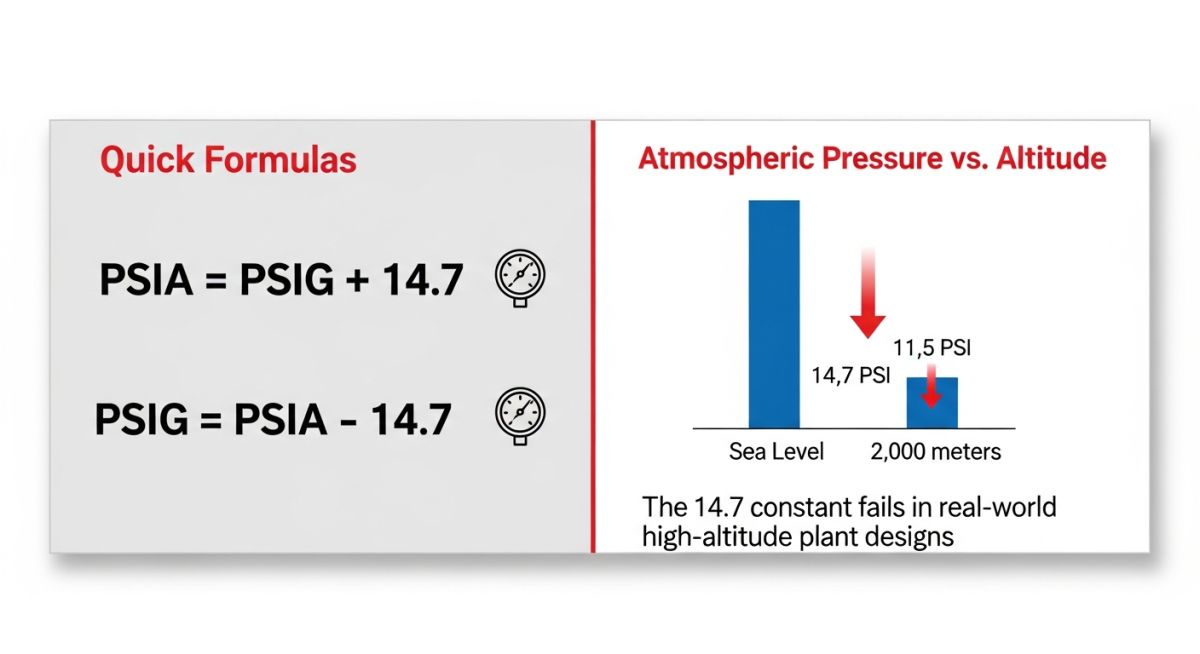
Hover to Flip →Apply the foundational formula: PSIA = PSIG + 14.7 (or local atmospheric pressure).
Grab local barometric readings from control room telemetry before computing critical system adjustments.
How do you convert PSIA back down into a PSIG reading?
Hover to Flip →Isolate gauge units using the formula: PSIG = PSIA – 14.7 (deducting local ambient pressure).
This conversion ensures your mechanical dial readings match physical realities on instrument walks.
What does a standard mechanical gauge read in an open room?
Hover to Flip →It indicates exactly 0 PSIG, completely ignoring the surrounding atmosphere pushing on it.
Do not mistake 0 PSIG for an empty system. Air is still inside at full atmospheric force.
What value will an absolute pressure transmitter read open to air?
Hover to Flip →It reads roughly 14.7 PSIA at sea level, tracking full environmental weight.
Perfect tool for cross-verifying weather-induced drift during standard instrument calibrations.
Why does geographical altitude disrupt the 14.7 constant?
Hover to Flip →Higher altitudes possess a thinner, less dense air column overhead, decreasing natural pressure.
Failing to adjust for this thin air completely breaks vacuum system loop calculations.
Which pressure unit is required for ASME B31.3 pipe wall sizing?
Hover to Flip →Mechanical designers require the internal design pressure in PSIG units.
Pipe burst stress is a product of differential force pushing outward against external air.
Can a standard PSIG gauge read a negative value?
Hover to Flip →Yes, dipping down to minus 14.7 PSIG indicating a perfect complete vacuum system condition.
We utilize compound gauges to track both standard operational pressures and vacuum purge cycles.
Is it possible to have a negative reading on a PSIA transmitter?
Hover to Flip →It is physically impossible. Zero PSIA represents a total absence of all thermal molecular movement.
If your DCS indicates negative values for a PSIA device, flag it immediately as a calibration loop fault.
Which unit is used for compressor performance calculation?
Hover to Flip →Process calculations mandate absolute PSIA units for precise density mapping.
Using gauge data here ruins mass balance modeling across the stages completely.
Field Competency Assessment: PSIA vs PSIG
Test your real-world pressure scaling acumen. Pure CSS engine—zero JavaScript execution.
A pressure gauge open to atmosphere on an offshore platform reads exactly 0 PSI. What unit scale is this hardware referencing?
You are calculating gas density values for a process compressor loop. Which unit metric must you hardcode into the formula?
If a refinery process line operates at a high altitude where atmospheric pressure is 12.0 PSI, what does 0 PSIG translate to in PSIA?
Is it possible to track an operational system metric reading of -5 PSIA on a deep vacuum transmitter system loop?
What is PSIA (Pounds per Square Inch Absolute)?
When I review process flow diagrams (PFDs) for vacuum distillation columns or high-pressure gas headers, I look for how pressure references are handled. PSIA stands for Pounds per Square Inch Absolute. It is a pressure scale that measures force relative to a perfect, absolute vacuum. Think of absolute vacuum as a complete void of matter. It is a space where no gas molecules exist to collide with a container wall. Because of this, 0 PSIA is the absolute bottom floor for pressure measurement. It is physically impossible to have a negative reading on a true absolute transmitter.
If you leave a PSIA sensor sitting completely open on a desk in a processing plant at sea level, it will not read zero. It will register roughly 14.7 PSIA. This happens because the instrument is active and weighing the column of air above it. This air baseline is what we call ambient atmospheric pressure.
⚠️ Atul’s Field Warning:
Do not let your engineering teams mix absolute metrics into mechanical piping layout sheets. Sizing calculations for compressor internals require PSIA data. However, the physical pressure rating for pipe flanges and walls is determined by differential force. Confusing these two values can lead to incorrect component selection.
What is PSIG (Pounds per Square Inch Gauge)?
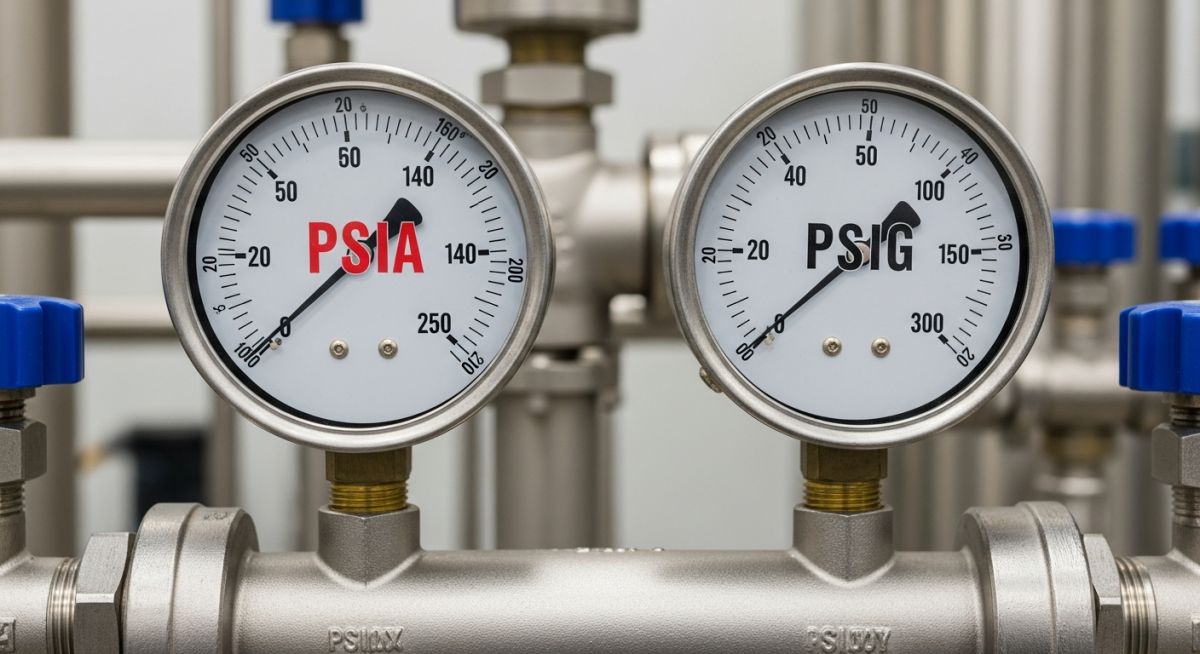
In my experience on the construction field, 90% of the mechanical dial gauges screwed into piping manifolds read in PSIG. This stands for Pounds per Square Inch Gauge. The gauge scale ignores ambient atmospheric pressure by using the current environmental air pressure as its starting zero baseline.
When a standard pressure gauge is open to the air, the pressure on the outside of its internal bourdon tube matches the pressure on the inside. Because these forces are balanced, the pointer rests exactly at 0 PSIG. This calibration approach makes gauge pressure highly useful for practical maintenance work. It tells you exactly how much pressure exists inside the pipe relative to the environment you are standing in.
Complete Course on Piping Engineering by Atul Singla on EPCLAND
Step past textbook theory. Learn real-world standard calculations, line sizing methods, and instrumentation calibration procedures based on my years of practical field experience.
Key Differences in the Field: PSIA vs PSIG
When evaluating PSIA vs PSIG, the variance centers entirely on the reference benchmark. ASME B31.3 and API 520 standards require precise pressure definitions because miscalculating the ambient baseline alters structural safety margins.
| Technical Metric | PSIA (Absolute Scale) | PSIG (Gauge Scale) |
|---|---|---|
| Zero Reference Point | Perfect absolute vacuum (0 molecules) | Local ambient atmospheric pressure |
| Sea-Level Reading Open to Air | ~14.70 PSI | 0.00 PSI |
| Negative Values Possible? | No (Physically impossible) | Yes (Down to -14.70 PSI in full vacuum) |
| Core Engineering Application | Thermodynamics, gas laws, vacuum systems | Pipe wall structural sizing, hydrotesting |
How to Convert Between PSIA vs PSIG (Formula & Local Barometric Nuances)
The baseline textbook math looks deceptively simple. But here is the catch: it assumes you are standing exactly at sea level under standard weather conditions.
Converting PSIG to PSIA: Accounting for Atmospheric Pressure
To derive absolute values from a mechanical gauge, add the local barometric value to your gauge measurement:
Converting PSIA to PSIG: The Sea-Level Standard vs High-Altitude Engineering
To isolate gauge pressure from process data loops, subtract the surrounding air force value:
Field Conversion Engine: PSIA vs PSIG
Input your pressure value, define your operational site profile, and view your calculated results instantly.
An input gauge reading of 0 PSIG open to atmosphere at standard sea level converts to an absolute value of 14.70 PSIA.
Field Case Study: The Cost of Confusing PSIA vs PSIG in Instrumentation
When I was working on a refinery expansion project situated at an elevation of nearly 1,400 meters above sea level, we hit a major commissioning issue. The project involved a vacuum flashing column designed to process heavy residual oil. The mechanical specifications for the vessel explicitly stated that the internal design operating limit was a deep vacuum, marked down to 1.5 PSIA.
The junior automation sub-contractor on site installed a replacement smart pressure transmitter. They calibrated the top-end loop span assuming standard sea-level atmospheric baseline values. They input the conversion parameters into the distributed control system (DCS) assuming that 0 PSIG would cleanly correspond to 14.7 PSIA.
In the field, we actually do this differently because altitude dictates reality. At 1,400 meters, the actual local ambient atmospheric pressure was only 12.4 PSI. Because the software was hardcoded with a false 14.7 baseline, the transmitter read out a value that was 2.3 psi higher than the real pressure inside the vessel. When the operator pulled the column down into a deep vacuum, the actual internal pressure dropped past the safe mechanical floor long before the control room screen flagged any danger.
Structural Failure Point:
The vessel was designed with external reinforcing stiffener rings to handle structural loads up to a vacuum. However, it was not built to withstand an unmonitored drop in pressure. The 2.3 psi instrumentation error caused an unmonitored pressure drop that exceeded the vessel's structural capacity, leading to an immediate failure of the middle shell plates.
The cost of that single unit reference error was significant. It led to weeks of plant downtime and required extensive structural repair work on the column shell. After that incident, I implemented a strict policy for all projects: every transmitter datasheet must clearly list both the operating pressure and the required reference scale, along with the actual barometric pressure of the site.

Engineering Governance & Professional Networks

Written by Atul Singla
For over two decades, I have led execution engineering loops, piping stress reviews, and commissioning routines for chemical storage centers and deep offshore facilities. I focus on bridging the gap between theoretical calculations and practical field execution to help engineering teams build safer, more reliable systems.
Official Code Authorities & Standards References:
Is 0 PSI an Absolute Vacuum?
When looking at PSIA vs PSIG, the answer changes entirely based on your chosen reference scale. On a PSIA transmitter, 0 PSI indicates a complete absolute vacuum. On a standard PSIG mechanical dial gauge, 0 PSI means the internal system matches local ambient atmospheric pressure. Let us look at common engineering questions to clarify these scale baseline differences.
What happens to a PSIG reading if local barometric weather pressure drops?
Because PSIG uses the ambient atmosphere as its zero point, a drop in local barometric pressure shifts the gauge baseline. This shift causes a sealed vessel's internal gauge reading to appear slightly higher, even though the actual number of gas molecules inside hasn't changed.
Why do process calculation packages like HYSYS default to PSIA metrics?
Chemical simulation packages use thermodynamic equations of state to model gas behavior. These mathematical models rely on absolute temperature and PSIA metrics to accurately compute gas density, enthalpy, and volumetric flow rates regardless of plant elevation.
Can a standard pressure gauge read a value below 0 PSIG?
Yes, when tracking vacuum systems, engineers use compound pressure gauges. These instruments measure negative values down to -14.7 PSIG at sea level, which represents a complete absolute vacuum.
How do you verify if an on-site transmitter uses PSIA vs PSIG scale frameworks?
Check the manufacturer engineering tag riveted onto the transmitter housing. If the tag isn't clear, vent the unit to the atmosphere. A PSIG sensor will drop to 0, while a PSIA unit will display the local atmospheric pressure, around 14.7 PSI at sea level.
Why does ASME code mandate gauge pressure for pipe wall hydrotesting verification?
Piping burst stresses depend on the difference between internal fluid pressure and external air pressure. Because PSIG measures this differential directly, it is the standard metric used to verify mechanical safety during high-pressure hydrotests.
Does ambient temperature alter a PSIA reading differently than a PSIG reading?
Ambient temperature variations change local air density and barometric pressure. A PSIG gauge is open to the air, so it naturally compensates for these environmental changes. A sealed PSIA reference cell remains unaffected by external air density shifts, though its internal sensing elements still require standard temperature compensation.