
Quantity Take-Off Explained: Precision in Piping Estimation
In my two decades of managing complex piping projects, I have learned that the difference between a profitable venture and a budget overrun often lies in the accuracy of the initial Quantity Take-Off (QTO). A QTO is not merely a list of parts; it is the technical foundation upon which procurement, scheduling, and cost control are built. When we fail to account for weld counts, bolt sets, or specific gasket materials, the downstream impact on the construction phase is catastrophic.
This guide dissects the methodology behind professional QTO, ensuring you move beyond simple counting to true engineering estimation. We will explore how to integrate your material take-offs with ISO 15926 data standards and how to avoid the common pitfalls that plague junior engineers during the estimation phase.
Key Takeaways
- Mastering the transition from P&IDs to Bill of Materials (BOM).
- Understanding the impact of piping class specifications on material selection.
- Implementing automated extraction techniques to minimize human error.
- Aligning procurement timelines with construction sequence requirements.
Piping Quantity Take-Off Engineering Methodology
Piping Quantity Take-Off Methodology: The rigorous technical procedure of extracting precise material counts from engineering design documents to ensure compliance with project specifications and ASME B31.3 pressure piping standards.
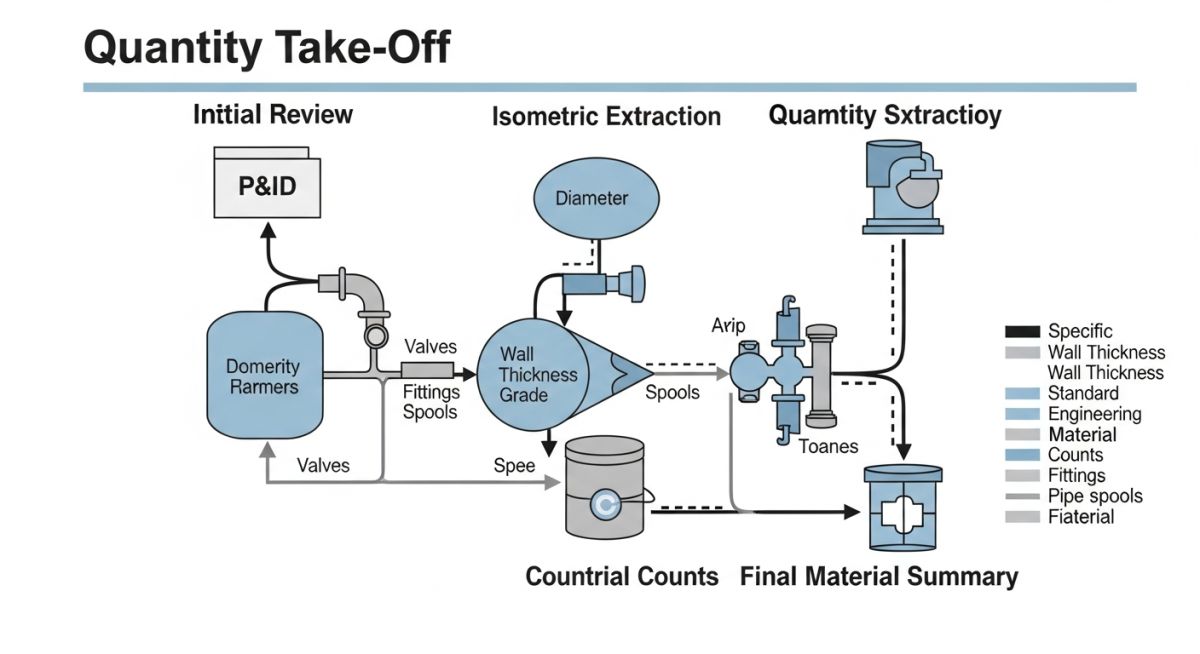
Executing a high-fidelity QTO requires a disciplined approach to reading Piping and Instrumentation Diagrams (P&IDs) and Isometric drawings. I start by categorizing materials into primary groups: pipe spools, fittings (elbows, tees, reducers), flanges, valves, and specialty items like strainers or expansion joints. Each category must be cross-referenced against the project’s Piping Material Specification (PMS).
Calculation and Stress Parameters
When calculating pipe lengths, we must account for the “cut length” rather than the “center-to-center” dimension. This involves subtracting the fitting dimensions (take-offs) from the total run length. For instance, if you have a 10-meter run with two 90-degree elbows, the pipe length is not 10 meters; it is 10 meters minus the specific fitting take-off values defined in ASME B16.9.
Field Warning: The “Hidden” Costs
Never ignore the “waste factor” and “bolt set” requirements. In my experience, failing to add a 5-10% contingency for pipe cutting waste or neglecting to include the correct number of stud bolts and nuts per flange connection (based on ASME B16.5) leads to immediate procurement delays during the construction phase.
Furthermore, valve quantification requires checking the valve trim, operator type (manual vs. actuator), and end connections. A common error is assuming all valves of a certain size are identical. Always verify the pressure-temperature rating against the specific piping class to ensure the material grade (e.g., A105 vs. LF2) is correct for the service temperature.
QTO Strategic Implementation: The evaluation of systematic material quantification processes to balance procurement efficiency against the inherent risks of manual estimation errors.
Advantages
- Drastic reduction in procurement lead times through accurate BOM generation.
- Enhanced cost predictability by minimizing emergency material orders.
- Improved construction sequencing by aligning material delivery with site needs.
- Clearer audit trails for project budget reconciliation and variance analysis.
Disadvantages
- High initial time investment required for manual drawing review.
- Susceptibility to human error if P&ID revisions are not tracked.
- Complexity in managing “bulk” items like gaskets and small-bore fittings.
- Dependency on the accuracy of the initial Piping Material Specification.
Industrial QTO Implementation: The application of standardized material quantification techniques across diverse sectors to ensure structural integrity and economic viability in piping infrastructure.
Refinery Revamp Projects
In brownfield refinery upgrades, QTO is essential for integrating new piping into existing, often congested, pipe racks. We must perform precise field verification to ensure that the new material take-offs account for existing tie-in points and potential interference with legacy infrastructure.
Cryogenic LNG Facilities
For LNG projects, material selection is governed by extreme low-temperature requirements, necessitating specialized stainless steel grades. The QTO process here focuses heavily on weld-count accuracy, as every weld represents a potential leak path and requires rigorous non-destructive testing (NDT) documentation.
High-Pressure Power Piping
In power generation, QTO involves managing high-alloy materials that are subject to strict ASME B31.1 requirements. The estimation must account for the high cost of these materials, where even a small over-estimation leads to significant financial waste, while under-estimation halts critical path construction.
In my two decades of managing piping projects, I have observed that the precision of a Quantity Take-Off (QTO) is directly proportional to the granularity of the data captured during the initial takeoff phase. Engineers often struggle with the transition from P&ID (Piping and Instrumentation Diagram) symbols to actual bill of materials (BOM) line items, leading to significant procurement gaps or excessive surplus.
The table below outlines the critical data parameters required for a robust QTO. By standardizing these inputs, we ensure that every valve, flange, and pipe spool is accounted for according to ASME B31.3 requirements. This structured approach minimizes the risk of “missing items” that typically plague the transition from FEED (Front-End Engineering Design) to detailed engineering.
| Component Type | Primary Metric | Standard Reference | Waste Factor |
|---|---|---|---|
| Carbon Steel Pipe | Linear Meters | ASME B36.10M | 5-8% |
| Flanges (WNRF) | Quantity (Each) | ASME B16.5 | 2% |
| Butt-Weld Fittings | Quantity (Each) | ASME B16.9 | 3% |
Always remember that the waste factor is not a “buffer” for poor design; it is a calculated allowance for site-specific cutting, welding defects, and potential field routing adjustments. Applying a blanket percentage across all materials is a common error that leads to budget inflation.
Effective project management requires a clear mapping between engineering entities and their corresponding procurement specifications. When performing a Quantity Take-Off, I categorize every item by its material class, pressure rating, and service condition to ensure the procurement team sources the correct components.
This matrix serves as a bridge between the design office and the supply chain. By aligning these entities, we reduce the frequency of “Request for Information” (RFI) cycles that occur when the material ordered does not match the piping class specifications defined in the project API standards.
| Entity | Acronym | Standard |
|---|---|---|
| Weld Neck Raised Face | WNRF | ASME B16.5 |
| Gate Valve | GV | API 600 |
| Long Radius Elbow | LRE | ASME B16.9 |
Maintaining this matrix throughout the project lifecycle allows for rapid updates when design changes occur. If a piping class is upgraded due to process temperature shifts, the matrix ensures that all associated components are flagged for re-evaluation in the QTO.
Quantity Take-Off Accuracy Verification: A successful QTO is not merely a desk exercise; it requires rigorous validation against site conditions and engineering standards. I have developed this checklist to ensure that every takeoff iteration is audit-ready and technically sound.
-
01.
Verify all P&ID line numbers match the isometric drawings exactly to prevent double-counting or omissions. -
02.
Confirm that the piping material specification (PMS) is the latest revision issued for construction. -
03.
Check that all specialty items (strainers, spectacle blinds, orifice plates) are listed with their specific tag numbers. -
04.
Validate that bolt sets and gaskets are calculated based on the flange rating and quantity, not just a generic count. -
05.
Ensure that field-weld allowances are included for every spool piece exceeding standard shipping lengths.
Before finalizing your QTO, perform a “sanity check” by comparing the total weight of the materials against historical data from similar projects. If your current estimate deviates by more than 15% from the historical average, investigate the specific line items causing the variance. Often, this reveals a misinterpretation of the piping class or an error in the software extraction settings. Always document your assumptions, especially regarding waste factors and field-weld counts, to provide a clear audit trail for the project management team.
The Challenge: Inaccurate Material Procurement
A recent refinery expansion project faced a 20% material shortage during the installation phase due to flawed QTO practices.
- Failure to account for small-bore piping fittings in the initial takeoff.
- Inconsistent application of waste factors across different pipe diameters.
- Lack of coordination between the 3D model extraction and the manual BOM.
- Ignoring the specific requirements for high-alloy materials in the procurement lead times.
The Outcome: Optimized Estimation Workflow
By implementing a standardized QTO protocol, we achieved a 95% accuracy rate in subsequent project phases.
- Reduced material surplus by 12% through precise waste factor calibration.
- Eliminated procurement delays by integrating the QTO directly with the ERP system.
- Improved inter-departmental communication between engineering and construction teams.
- Established a robust audit trail for all material quantities and specifications.
My recommendation for future projects is to mandate a “peer review” of the QTO by a senior piping engineer who was not involved in the initial takeoff. This fresh perspective is invaluable for identifying systemic errors that the original author might overlook due to familiarity bias.
How do I handle piping waste factors?
Waste factors should never be applied as a blanket percentage. Instead, I categorize them based on the material type and the complexity of the installation:
- Carbon steel pipe: 5% for standard runs, up to 10% for complex rack routing.
- High-alloy or exotic materials: 2-3% due to higher unit costs and stricter handling requirements.
- Small-bore piping: 10-15% to account for frequent cutting and fitting adjustments.
Always document the rationale for these factors in your QTO report to justify the budget to stakeholders.
What is the role of the P&ID in QTO?
The P&ID is the primary source of truth for the scope of work. In my experience, the QTO process must begin with a line-by-line verification of the P&ID to ensure:
- All valves, instruments, and specialty items are captured.
- Piping class breaks are correctly identified and accounted for in the material list.
- The flow direction and connectivity match the isometric drawings.
Any discrepancy between the P&ID and the 3D model must be resolved through a formal RFI process before the QTO is finalized.
How are bolt sets calculated accurately?
Bolt set calculation is a common area for error. I recommend using a database-driven approach where the bolt count is linked to the flange size and rating:
- Reference ASME B16.5 for the number of bolts per flange.
- Include a 10% spare allowance for lost or damaged hardware during installation.
- Ensure that the bolt length is calculated based on the flange thickness and the gasket type.
Never estimate bolts by weight; always count them as individual units to maintain procurement precision.
Why do QTOs fail during construction?
Most QTO failures stem from a disconnect between the engineering office and the field site. Common pitfalls include:
- Ignoring field-weld allowances for spool pieces.
- Failing to update the QTO when design changes are issued.
- Using outdated piping material specifications.
- Lack of communication regarding site-specific installation constraints.
Regular site visits and feedback loops with the construction team are essential to keep the QTO aligned with reality.
How to manage specialty items in QTO?
Specialty items like strainers, spectacle blinds, and orifice plates require individual tracking. I maintain a separate “Specialty Item Register” that includes:
- Unique tag numbers for every item.
- Manufacturer data sheets and procurement lead times.
- Specific installation requirements (e.g., orientation, accessibility).
By treating these as distinct entities rather than generic fittings, you ensure they are ordered with the correct specifications and arrive on time for installation.
What is the best software for QTO?
While many tools exist, the best software is one that integrates directly with your 3D modeling environment. I prefer tools that allow for:
- Automated BOM extraction from the 3D model.
- Customizable reporting templates for different project stakeholders.
- Version control to track changes throughout the design process.
Regardless of the software, the human element—verifying the data and applying engineering judgment—remains the most critical factor in a successful QTO.
📚 Recommended Resources: Quantity Take-Off
Read these Guides


Complete Course on
Piping Engineering
Check Now
Key Features
- 125+ Hours Content
- 500+ Recorded Lectures
- 20+ Years Exp.
- Lifetime Access
Coverage
- Codes & Standards
- Layouts & Design
- Material Eng.
- Stress Analysis
