What is MSS SP-58 and Why Is It Important?
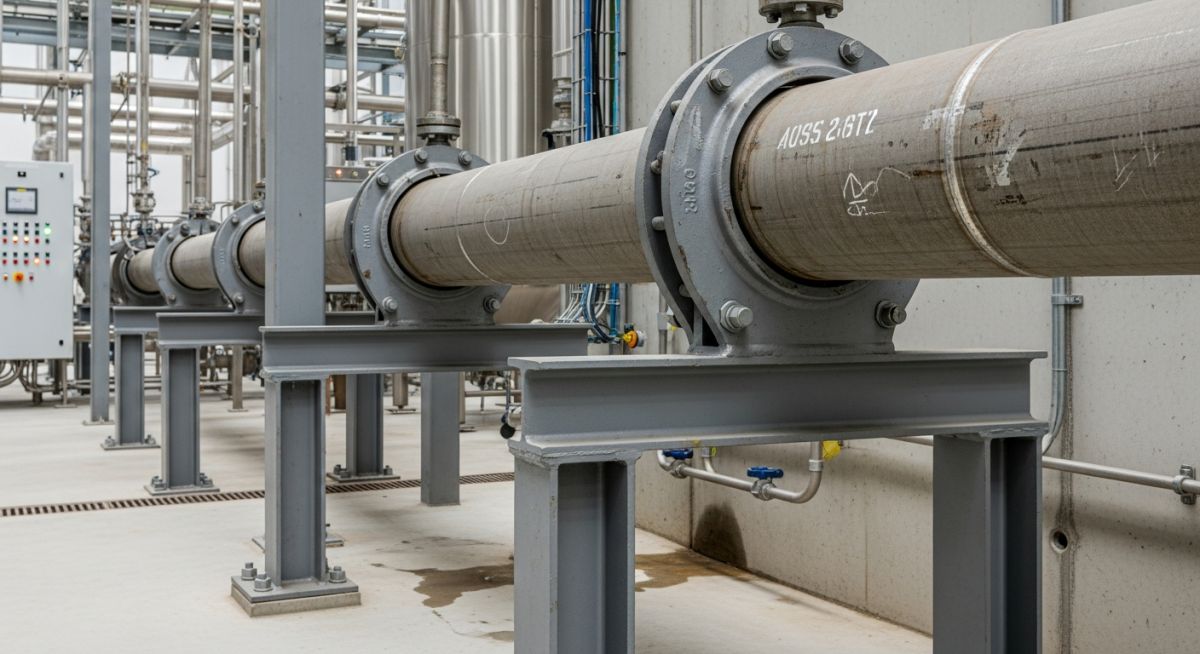
In my 20-plus years of walking refinery decks and power plant platforms, I have seen my share of piping failures. More often than not, the culprit is not a ruptured pipe wall or a blown valve gasket. It is a failed pipe support. When a support fails, it triggers a catastrophic domino effect of unbalanced loads, flange leaks, and equipment nozzle overstress. That is why understanding the Manufacturers Standardization Society (MSS) SP-58 standard is not just an academic exercise; it is a fundamental requirement for keeping your plant safe, compliant, and operational.
Historically, the industry struggled with fragmented guidelines. We had separate standards for design, materials, and selection. MSS SP-58 changed the game by consolidating five distinct standards into a single, comprehensive master document. This unified standard acts as the ultimate bridge between the piping stress engineer’s computer model and the physical reality of the pipe rack.
Key Engineering Takeaways
- Unified Framework: Consolidates design, selection, fabrication, and installation into one cohesive standard.
- Safety Factors: Mandates a strict five-to-one safety factor for tension members based on ultimate tensile strength.
- Standardized Types: Defines 59 distinct pipe support types to eliminate field-fabricated guesswork.
- Code Alignment: Integrates seamlessly with ASME B31.1 and ASME B31.3 piping codes.
How Does MSS SP-58 Govern Piping Design?
When I design a piping system, I must ensure that the supports can handle the deadweight of the pipe, the fluid, the insulation, and any transient dynamic loads like water hammer or wind. MSS SP-58 provides the exact mathematical and metallurgical boundaries to make this happen. It dictates that the allowable stress for hanger components must not exceed the lower of one-fifth of the minimum tensile strength or two-thirds of the yield strength of the material at the operating temperature.
Let us look at the math. If we are using standard carbon steel with an ultimate tensile strength of 60,000 pounds per square inch and a yield strength of 36,000 pounds per square inch, the allowable design stress is calculated as follows:
Allowable Stress based on Yield Strength = (36,000 * 2) / 3 = 24,000 psi
Governing Design Allowable Stress = Minimum of (12,000 psi, 24,000 psi) = 12,000 psi
This conservative approach ensures a robust safety margin, protecting the system against unexpected pressure surges or thermal excursions. Furthermore, the standard classifies supports into 59 distinct types, ranging from simple clevis hangers (Type 1) to complex constant support hangers (Type 54). This classification allows engineers to specify exact, pre-engineered components rather than relying on unrated, field-fabricated solutions.
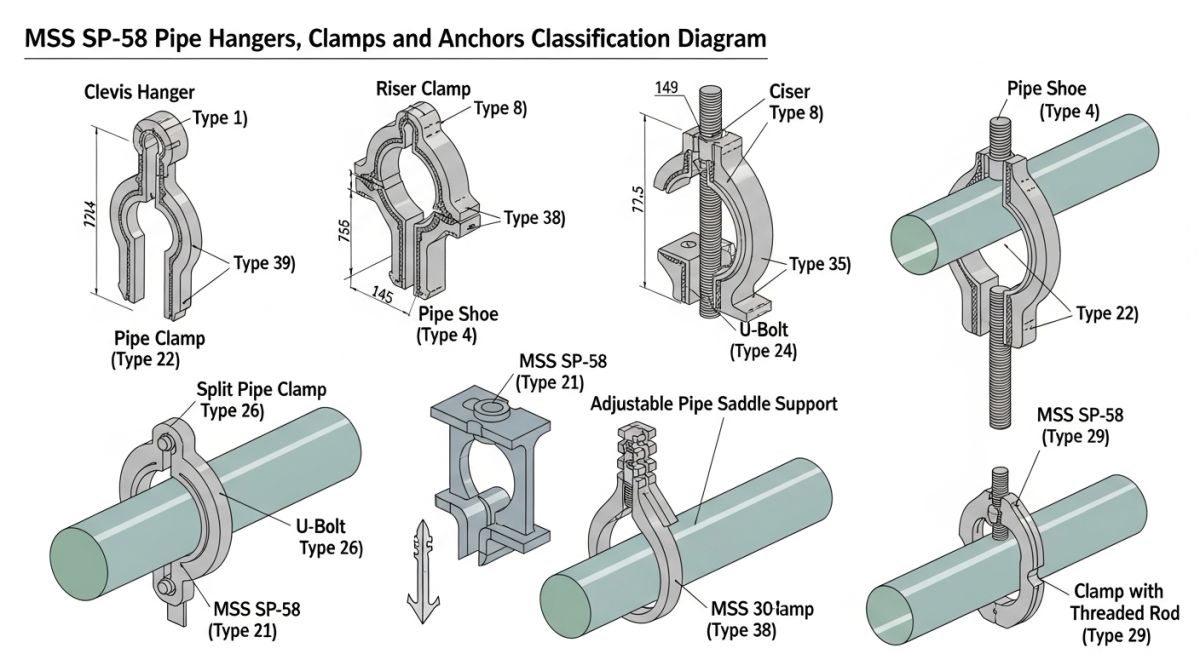
Another critical aspect of the standard is how it handles thermal movement. In high-temperature systems, pipes expand significantly. If you restrain this movement with rigid supports, you will generate massive thermal stresses that can buckle the pipe or tear the support from the structural steel. MSS SP-58 provides detailed selection criteria for variable spring hangers and constant support hangers, ensuring that the thermal displacement is absorbed without transferring excessive loads back to sensitive equipment nozzles, such as those on pumps or turbines.
| Support Type | MSS Type Designation | Temperature Range | Primary Application |
|---|---|---|---|
| Clevis Hanger | Type 1 | Ambient to 450°F (232°C) | Suspension of non-insulated or insulated stationary lines. |
| Riser Clamp | Type 26 | Ambient to 650°F (343°C) | Supporting vertical piping runs by transferring load to structural floors. |
| Variable Spring | Type 51 | -20°F to 650°F (-29°C to 343°C) | Supporting lines subject to moderate vertical thermal expansion. |
| Constant Support | Type 54 | Cryogenic to 1200°F (649°C) | Critical high-temperature piping with large vertical displacements. |
| Engineering Parameter | MSS SP-58 Requirement | Reference Standard | Compliance Verification Method |
|---|---|---|---|
| Material Traceability | Certified Material Test Reports (CMTR) for load-bearing components | ASTM Material Specs | Mill certificate review and heat number stamping verification. |
| Load Testing | Proof load testing at 1.5 times the rated design capacity | MSS SP-58 Section 7 | Hydrostatic test witness or certified factory test reports. |
| Thread Engagement | Minimum engagement equal to hanger rod diameter plus 0.25 inches | ASME B1.1 | Visual inspection via sight holes in rod couplings and turnbuckles. |
| Corrosion Protection | Hot-dip galvanizing or epoxy coating based on environmental class | ASTM A123 / A153 | Dry film thickness (DFT) gauge testing during receiving inspection. |
Why Is MSS SP-58 Critical for Field Installation?
During construction, I have often seen field crews install hangers in the wrong locations or fail to remove travel stops from spring supports. This checklist is designed to prevent those critical field errors, ensuring that your installation complies fully with the rigorous requirements of the standard.
Field Quality Control Checklist
Field Case Study: Real-World Application
The Problem: Catastrophic Vibration and Sagging
At a combined-cycle power plant in Texas, a 12-inch high-pressure steam line operating at 650 degrees Fahrenheit was experiencing severe, low-frequency vibration. During my site walkdown, I noticed that the line had sagged by nearly 2 inches between two structural columns. The field team had installed generic, unrated rigid supports fabricated from scrap structural steel. These rigid restraints were fighting the thermal expansion of the pipe, causing the pipe to bow downward and transferring massive, uncalculated loads to the steam turbine nozzle.
The Outcome: Engineered Compliance Restores Integrity
I immediately halted operations on that line and performed a comprehensive piping stress analysis. We replaced the rigid field-fabricated supports with engineered, MSS SP-58 compliant Type 51 variable spring hangers and Type 26 riser clamps. The new spring hangers were sized to handle the 4,500-pound operating load while accommodating 1.2 inches of vertical thermal growth. Once commissioned, the vibration ceased, the pipe returned to its design elevation, and the turbine nozzle loads dropped well within the allowable limits specified by NEMA SM 23.
This case highlights why we cannot afford to treat pipe supports as an afterthought. Relying on unrated, non-standardized supports is a recipe for structural failure. By adhering strictly to the MSS SP-58 standard, we ensured the long-term reliability of the plant’s critical steam system.
Frequently Asked Engineering Questions
What is the difference between MSS SP-58 and ASME B31.3 regarding pipe supports?
Why did MSS consolidate multiple standards into SP-58?
What is the safety factor required by MSS SP-58 for load-bearing components?
Can I use carbon steel supports for stainless steel piping under this standard?
How does MSS SP-58 address variable spring hanger calibration?
Are field-fabricated supports permitted under MSS SP-58?
===
Complete Course on
Piping Engineering
Check Now
Key Features
- 125+ Hours Content
- 500+ Recorded Lectures
- 20+ Years Exp.
- Lifetime Access
Coverage
- Codes & Standards
- Layouts & Design
- Material Eng.
- Stress Analysis
