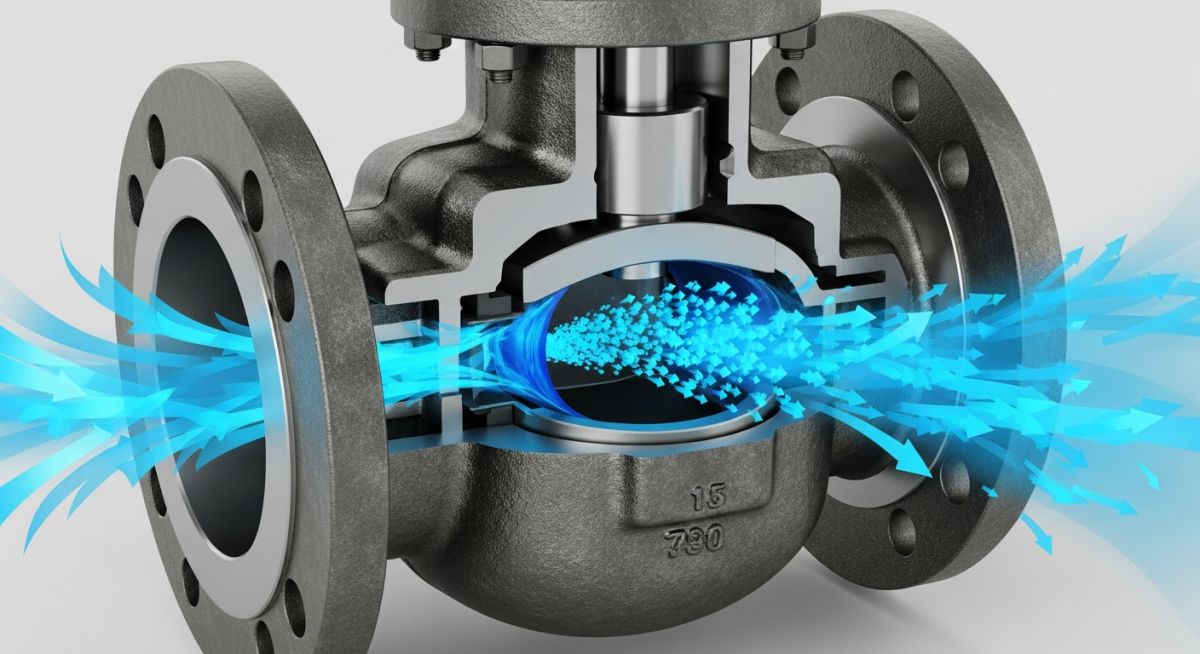

What is Valve Coefficient Cv and Why It Matters
In my 20 years of troubleshooting piping systems, I have seen countless control valves fail, cavitate, or choke simply because someone guessed the sizing. Selecting a valve based on nominal pipe size rather than the actual flow capacity is one of the most expensive mistakes you can make in process engineering. When you size a valve incorrectly, you do not just lose control accuracy; you risk destroying the valve trim, creating massive pressure drops, and shutting down entire production lines.
Understanding how to calculate and apply the flow coefficient is the foundation of reliable fluid dynamics. Whether you are dealing with high-pressure steam, viscous hydrocarbons, or simple cooling water, the math remains your only shield against system instability. Let us break down the core principles of this metric so you can design systems that operate flawlessly under any process condition.
Key Engineering Takeaways
- Master the physical meaning of flow capacity metrics to prevent control loop hunting.
- Learn the exact mathematical relationships governing liquid and gas flow through restrictions.
- Identify how specific gravity and pressure drop dictate your final valve selection.
- Avoid common sizing traps that lead to flashing, cavitation, and choked flow.
- Implement field-verified installation practices to match theoretical calculations with real-world performance.
Understanding the Valve Coefficient Cv Calculation
To calculate the capacity of a valve handling liquid flows, we rely on the fundamental relationship between flow rate, pressure drop, and specific gravity. The standard formula for non-compressible, non-vaporizing liquid flow is expressed as:
Where:
• Cv = Valve flow coefficient (gpm / psi^0.5)
• Q = Volumetric flow rate in gallons per minute (gpm)
• SG = Specific gravity of the fluid relative to water at sixty degrees Fahrenheit (dimensionless)
• delta_P = Pressure drop across the valve body in pounds per square inch (psi)
When dealing with compressible fluids like gases or steam, the calculation becomes more complex. Gases expand as pressure drops, which means we must account for the inlet pressure, temperature, and compressibility factor. The standard gas equation under non-choked conditions is defined by ISA-75.01.01 as:
Where:
• q = Gas flow rate in standard cubic feet per hour (scfh)
• Fp = Piping geometry factor (dimensionless)
• Py1 = Inlet absolute pressure (psia)
• x = Ratio of pressure drop to absolute inlet pressure (delta_P / P1)
• SG_gas = Specific gravity of the gas relative to air
• T = Absolute temperature in Rankine (Fahrenheit + 460)
• Z = Compressibility factor of the gas

In my field audits, I often find that engineers overlook the piping geometry factor (Fp). When you install a control valve that is smaller than the line size, the reducers and expanders introduce additional pressure losses. These losses effectively reduce the installed Cv of the valve. If you do not correct for these fittings using the Fp factor, your valve will not deliver the required flow rate at design conditions.
The table below provides typical maximum flow coefficient values for common valve types at 100% open positions. These values are representative of standard industrial designs complying with ANSI standards and should be used for preliminary sizing before consulting specific manufacturer catalogs.
| Nominal Size (NPS) | Globe Valve Cv (Equal %) | Ball Valve Cv (Full Port) | Butterfly Valve Cv (60° Open) | Butterfly Valve Cv (90° Open) |
|---|---|---|---|---|
| 1 Inch | 12 | 65 | 18 | 45 |
| 2 Inch | 48 | 240 | 75 | 170 |
| 3 Inch | 110 | 560 | 165 | 380 |
| 4 Inch | 195 | 980 | 310 | 720 |
| 6 Inch | 435 | 2200 | 720 | 1650 |
This matrix maps the core physical parameters, engineering acronyms, and standard references used during the control valve sizing and selection process.
| Parameter / Entity | Acronym | Standard Reference | Physical Significance |
|---|---|---|---|
| Valve Flow Coefficient | Cv | ISA-75.01.01 | Defines the volumetric flow capacity of a valve in US units. |
| Metric Flow Coefficient | Kv | IEC 60534 | Defines flow capacity in cubic meters per hour with a 1 bar pressure drop. |
| Piping Geometry Factor | Fp | ISA-75.01.01 | Corrects for pressure losses caused by reducers and fittings. |
| Liquid Pressure Recovery Factor | FL | IEC 60534-2-1 | Indicates the valve’s ability to recover pressure downstream of the vena contracta. |
Verifying Valve Coefficient Cv in the Field
Before you sign off on a control valve installation or troubleshoot an unstable loop, you must verify that the physical installation matches the design calculations. Use this checklist during your next site walkdown to ensure compliance with ASME B16.34 and process requirements.
Control Valve Sizing & Installation Audit
-
Verify Operating Range: Ensure the calculated Cv falls between 20% and 80% of the selected valve’s maximum Cv to maintain stable control.
-
Check Reducer Orientation: Confirm that concentric or eccentric reducers are installed correctly without creating air pockets or liquid traps.
-
Validate Upstream/Downstream Straight Runs: Ensure at least 10 nominal pipe diameters upstream and 5 downstream of straight pipe to minimize turbulence.
-
Inspect Pressure Tap Locations: Verify that field transmitters are located far enough from the valve to read true static pressures, not localized turbulence.
-
Confirm Trim Material Compatibility: Cross-reference the process fluid properties with the valve data sheet to prevent rapid erosion or chemical attack.
Field Case Study: Real-World Application
The Problem: Oversized Bypass Valve Failure
A chemical processing plant experienced severe vibration, piping fatigue, and deafening noise in a 4-inch water bypass line. The installed globe valve was sized based on the 4-inch line size, resulting in an oversized valve operating at only 8% to 12% opening during normal operations. This caused rapid seat erosion, severe cavitation, and unstable flow control that disrupted the downstream reactor.
The Outcome: Precision Cv Recalculation
I recalculated the required valve coefficient Cv based on the actual maximum flow of 150 gpm and a pressure drop of 45 psi. The calculated Cv was 22. We replaced the oversized 4-inch valve with a 2-inch control valve (Cv of 25) using reducers. The new valve operated at 65% opening, eliminating the vibration, reducing noise levels below 75 dBA, and extending trim life by five times.
This case highlights why you must never size a control valve based on the nominal pipe size. Always perform the formal Cv calculations using the actual minimum, normal, and maximum flow conditions. Sizing the valve to operate in its sweet spot (typically 50% to 70% open) ensures stable control and protects your piping infrastructure from destructive hydraulic forces.
Frequently Asked Engineering Questions
What is the difference between Cv and Kv?
How does fluid viscosity affect the calculated Cv?
Can a control valve have too high of a Cv value?
What is the relationship between Cv and pressure drop?
How does flashing affect the calculated Cv?
Why is the liquid pressure recovery factor (FL) important?
Complete Course on
Piping Engineering
Check Now
Key Features
- 125+ Hours Content
- 500+ Recorded Lectures
- 20+ Years Exp.
- Lifetime Access
Coverage
- Codes & Standards
- Layouts & Design
- Material Eng.
- Stress Analysis