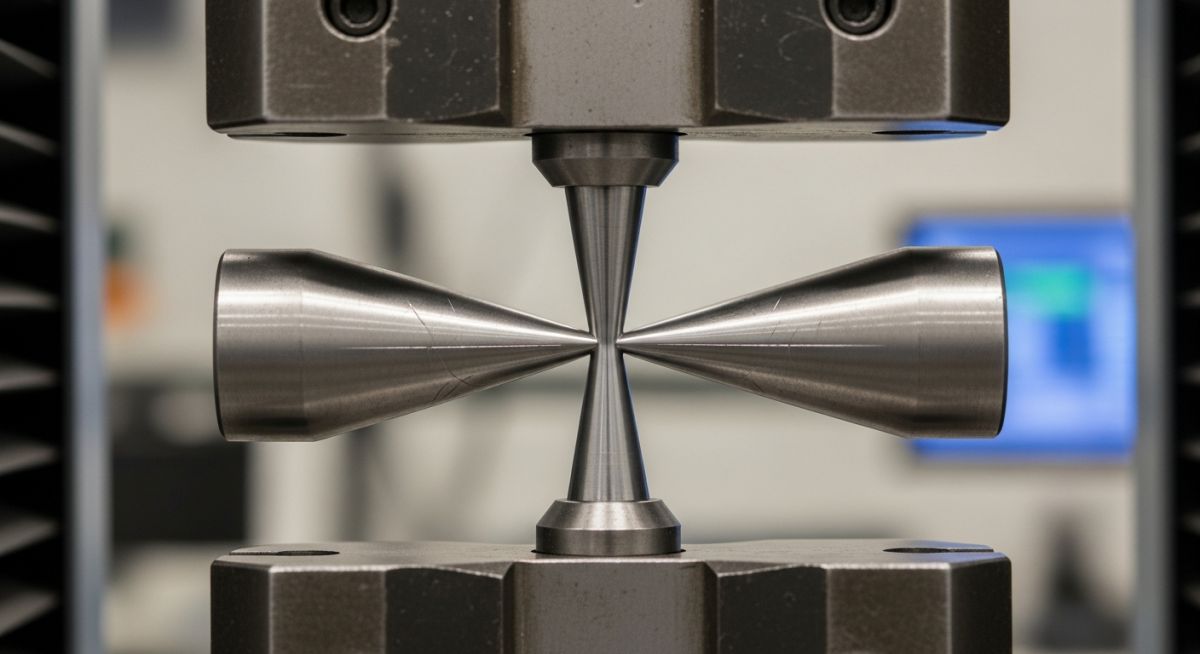
Young’s Modulus: Modulus of Elasticity and Young’s Modulus of Steels
In my 20-plus years of piping and structural engineering, I have seen many young engineers trip over a basic question: why do we design high-pressure piping systems using steel instead of a more flexible material? The answer lies deep within the molecular structure of the material, governed by its Modulus of Elasticity. When we calculate thermal expansion loops or structural support spans under ASME B31.3, this value is the bedrock of our stress analysis.
Understanding how materials deform under load is not just academic; it is a safety-critical requirement. Whether you are sizing a structural beam or analyzing the thermal stress of a steam line, you must master the mechanics of elastic deformation. Let us break down the mathematics, the physical realities, and the practical field applications of this critical material property.
- Master the exact mathematical derivation of the elastic modulus.
- Understand why steel outperforms rubber in structural elasticity.
- Apply ASTM testing standards to real-world piping design.
- Analyze how temperature fluctuations alter material stiffness.
Complete Course on
Piping Engineering
Check Now
Key Features
- 125+ Hours Content
- 500+ Recorded Lectures
- 20+ Years Exp.
- Lifetime Access
Coverage
- Codes & Standards
- Layouts & Design
- Material Eng.
- Stress Analysis
Understanding the Young’s Modulus Formula
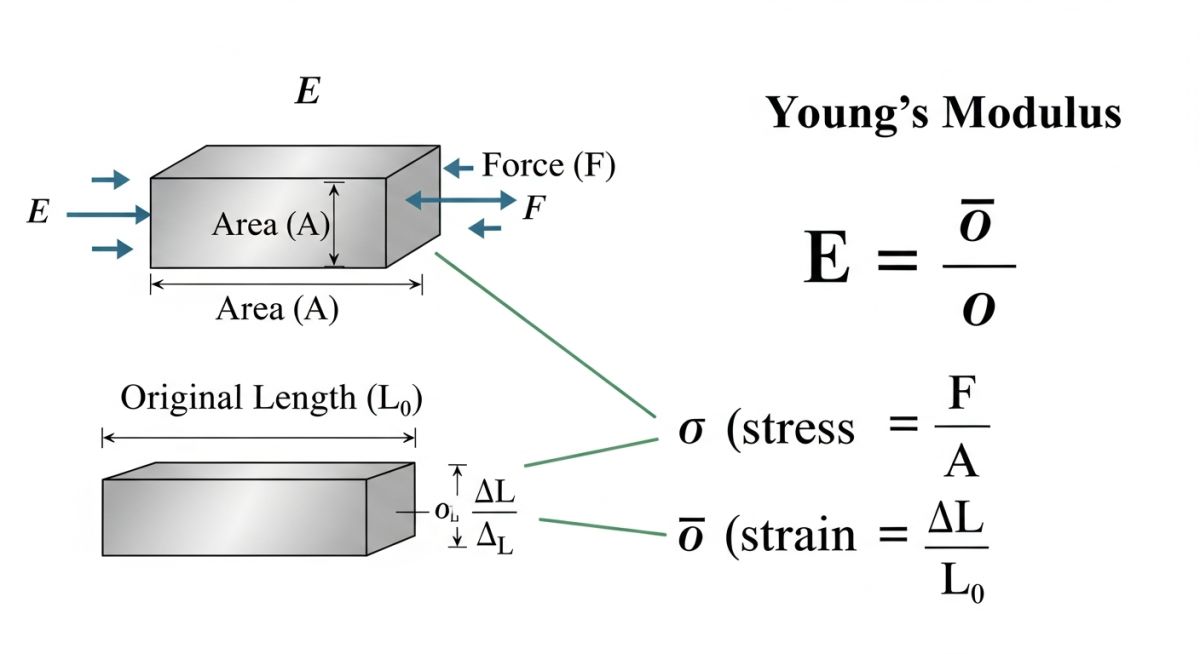
Young’s Modulus Formula: The mathematical expression E equals stress divided by strain quantifies a material’s resistance to elastic deformation under axial load. This ratio remains constant up to the proportional limit of the material as defined by ASTM E8 testing protocols.
To apply this in engineering design, we must dissect the relationship between force, geometry, and deformation. The modulus acts as a scaling factor. A higher value indicates that a material requires significant force to deform, making it highly resistant to stretching or compressing.
E=σ/ϵ
Stress-Strain Ratio: The fundamental equation represents the ratio of tensile stress to tensile strain, where stress is force per unit area and strain is the proportional deformation. This linear relationship forms the basis of Hooke’s Law in structural mechanics.
Here, the Greek letter sigma (σ) represents stress, which is the internal resisting force per unit area (F/A). The Greek letter epsilon (ε) represents strain, which is the dimensionless ratio of change in length to the original length (delta l / l). Because strain has no units, the Modulus of Elasticity (E) shares the same units as stress: Pascals (Pa), Megapascals (MPa), Gigapascals (GPa), or pounds per square inch (psi).
So, E=(F/A)/(δl/l)=F*l/A*δl
Expanded Elasticity Equation: The expanded formula calculates the modulus by multiplying the applied force and original length, then dividing by the cross-sectional area and change in length. This formulation allows direct calculation from raw tensile test data.
Let us look at the variables in this expanded equation:
- F: The axial force applied to the specimen (measured in Newtons or pounds-force).
- l: The original gauge length of the specimen before loading (measured in meters or inches).
- A: The cross-sectional area perpendicular to the applied force (measured in square meters or square inches).
- δl: The elongation or change in length under the applied load (measured in meters or inches).
Which is more elastic: Rubber or Steel?
Elasticity Comparison: Steel is scientifically more elastic than rubber because it requires a significantly higher force to produce a given deformation, meaning it returns to its original shape with greater force and precision. Rubber exhibits high flexibility but a very low modulus of elasticity.
This is one of the most common points of confusion for junior engineers. In everyday language, “elastic” means stretchable. In materials science and structural engineering, however, elasticity is defined by a material’s ability to resist deformation and return to its original shape once the load is removed.
Because steel has a high modulus (~200 GPa), it takes an enormous amount of stress to cause even a tiny fraction of strain. When the stress is removed, it snaps back to its original dimensions with extreme precision. Rubber, on the other hand, deforms easily under minimal stress (~0.01 to 0.1 GPa). It is highly flexible, but its low resistance to deformation makes it far less “elastic” in the strict engineering sense.
Never confuse flexibility with elasticity in structural design. Designing a piping support system assuming rubber-like flexibility will lead to catastrophic sagging, vibration, and eventual fatigue failure under ASME B31.3 limits. Always design structural members based on the high elastic modulus of structural steel.
Young’s modulus of Steel
Steel Elastic Modulus: Carbon steel and its common structural alloys exhibit a Young’s Modulus of approximately 200 Gigapascals or 29 million pounds per square inch. This value remains relatively stable across various heat treatments and carbon contents.
Approximate Young’s Modulus for Some Other Materials
Material Modulus Comparison: Different engineering materials exhibit widely varying elastic moduli, ranging from low-modulus polymers to high-modulus structural metals. Selecting the correct modulus is critical for accurate finite element analysis and structural design.
| Material Name | Young’s Modulus (GPa) | Young’s Modulus (Mpsi) | Typical Engineering Application |
|---|---|---|---|
| Carbon Steel (ASTM A106) | 200 | 29.0 | High-pressure process piping, structural beams |
| Stainless Steel 316 | 193 | 28.0 | Corrosive chemical lines, marine environments |
| Structural Aluminum (6061-T6) | 69 | 10.0 | Lightweight structural frames, aerospace panels |
| Copper Alloy (C12200) | 117 | 17.0 | Heat exchanger tubes, electrical conductors |
| Titanium (Grade 5) | 114 | 16.5 | High-strength aerospace components, medical implants |
| Vulcanized Rubber | 0.05 | 0.007 | Vibration isolators, expansion joints, gaskets |
| Entity / Acronym | Physical Parameter | Standard Reference | Engineering Significance |
|---|---|---|---|
| E | Modulus of Elasticity | ASTM E111 | Determines structural stiffness and deflection limits. |
| σ (Sigma) | Tensile Stress | ASTM E8 | Measures internal force intensity to prevent yield failure. |
| ε (Epsilon) | Engineering Strain | ASTM E8 | Quantifies physical deformation relative to original length. |
| ASME B31.3 | Process Piping Code | Table TM-1 | Provides temperature-adjusted modulus values for stress analysis. |
Factors Affecting Young’s Modulus
Modulus Influencing Factors: Temperature, alloying elements, and microstructural defects are the primary physical parameters that alter a material’s elastic modulus. Understanding these variations is essential for high-temperature piping and structural designs.
While we often treat the modulus as a constant in basic calculations, real-world conditions require a more nuanced approach. For instance, as temperature rises, the thermal energy of the atoms increases, causing them to vibrate more and expand the interatomic spacing. This weakens the atomic bonds, resulting in a lower elastic modulus.
-
Verify Mill Test Reports (MTRs): Cross-reference the heat number of the delivered steel with the MTR to confirm compliance with ASTM A106 or ASTM A36. -
Check Temperature Adjustments: Ensure the stress analysis software uses the temperature-adjusted modulus from ASME B31.3 Table TM-1 rather than the ambient 200 GPa value. -
Inspect for Microstructural Defects: Perform non-destructive testing (NDT) on critical structural welds to ensure no micro-cracking or voids compromise the effective cross-sectional area. -
Confirm Alloying Specifications: Verify that high-alloy steels (like Chrome-Moly) are correctly identified, as their modulus profiles differ from standard carbon steel at elevated temperatures.
Use of Young’s Modulus
Engineering Applications: The elastic modulus is utilized to calculate beam deflection, pipe thermal expansion stresses, and structural column buckling limits. Accurate application of this value prevents mechanical failures in high-pressure industrial systems.
Practical Applications of Young’s Modulus
Practical Engineering Uses: Real-world applications include designing bridge trusses, calculating pipeline expansion loops, and selecting materials for aerospace components. These calculations ensure structural integrity under dynamic and static loads.
A high-pressure steam line operating at 450°C was experiencing severe thermal expansion stresses, causing support shoes to lift and overstressing the manifold connection. The original design team used the ambient-temperature Young’s Modulus of Carbon Steel (200 GPa) instead of the temperature-adjusted value (approx. 165 GPa at 450°C per ASME B31.3 Table TM-1). This led to an over-designed, overly rigid piping layout that actually increased localized stress concentrations.
By recalculating the stress profile using the correct temperature-adjusted Young’s Modulus, we optimized the expansion loop geometry. This reduced the calculated stress by 18%, eliminated the need for expensive spring hangers, and saved the project 45,000 in unnecessary structural modifications.
This case highlights why we must never rely on simplified ambient values when designing systems that operate under extreme thermal conditions. Accurate material data is the difference between a safe, cost-effective design and a catastrophic field failure.
Frequently Asked Engineering Questions
What is the difference between Young’s Modulus and Shear Modulus?
Why does Young’s Modulus decrease at high temperatures?
How is Young’s Modulus measured experimentally?
Is Young’s Modulus the same as stiffness?
How does carbon content affect the Young’s Modulus of steel?
What ASME code governs the Modulus of Elasticity values for piping design?
About Me
About Me: Atul Singla is a veteran piping engineering consultant with over two decades of hands-on experience in petrochemical, power, and industrial piping design. I specialize in stress analysis, material selection, and ASME code compliance.
Throughout my career, I have led engineering teams on multi-billion dollar projects, ensuring that piping systems are designed to withstand extreme pressures and temperatures. My goal is to bridge the gap between complex academic theory and practical, on-site engineering realities.
3 thoughts on “Young’s Modulus | Modulus of Elasticity | Elastic Modulus | Young’s Modulus of Steels”
Community Feedback: Industry professionals and students frequently share their field experiences and technical queries regarding elastic modulus applications. Engaging with these real-world discussions helps clarify common design misconceptions.
John Doe, Lead Stress Analyst:
“Excellent breakdown of the rubber vs. steel paradox. I still see junior engineers getting this wrong during design reviews!”
Sarah Jenkins, Materials Engineer:
“The reminder about ASME B31.3 Table TM-1 is spot on. Temperature-adjusted modulus values are critical for high-temp steam lines.”
Miguel Silva, Piping Designer:
“This guide is a great reference. The expanded formula derivation is very clear and easy to follow.”
Leave a Reply Cancel reply
Comment Policy: We welcome professional insights, technical questions, and constructive feedback from the engineering community. Please ensure your comments adhere to professional standards and code references.
Recent Posts
Related Reading: Explore our latest technical articles covering piping stress analysis, material selection standards, and ASME code compliance updates. Stay informed with practical field insights.
===
