
Temporal Correlation Explained Under RFNBO Regulations
In my two decades of experience navigating complex energy infrastructure projects, I have rarely encountered a regulatory hurdle as precise as the temporal correlation requirements for green hydrogen. As we transition toward a decarbonized industrial landscape, the European Union’s Renewable Energy Directive (RED II) has established strict criteria for what constitutes truly “green” hydrogen. If your electrolyzer consumes grid power or dedicated renewable energy, you must prove that the generation and consumption occur in synchronized time blocks.
This is not merely an accounting exercise; it is a fundamental shift in how we design hydrogen production facilities. We are moving away from annual balancing toward granular, hourly matching. For engineers and project developers, this means our control systems, power purchase agreements (PPAs), and grid connection strategies must be integrated with high-fidelity data logging from day one.
Key Takeaways for Project Success
- Transition from monthly to hourly correlation by 2030 to meet EU mandates.
- Implement robust SCADA systems capable of sub-hourly data timestamping.
- Align PPA structures with the specific temporal requirements of your jurisdiction.
- Ensure electrolyzer ramp-up profiles match renewable generation volatility.
Complete Course on
Piping Engineering
Check Now
Key Features
- 125+ Hours Content
- 500+ Recorded Lectures
- 20+ Years Exp.
- Lifetime Access
Coverage
- Codes & Standards
- Layouts & Design
- Material Eng.
- Stress Analysis
Technical Deep-Dive: Temporal Correlation Explained
Temporal Correlation Framework: The technical methodology for synchronizing renewable energy input with hydrogen production output to satisfy the Delegated Act on RFNBOs, ensuring that the carbon intensity of the fuel remains below the defined threshold.
The core of the RFNBO (Renewable Fuels of Non-Biological Origin) regulation lies in the temporal matching of electricity production and consumption. Initially, the EU allows for monthly correlation, but this is a transitional phase. By January 1, 2030, all projects must shift to hourly correlation. This transition is designed to prevent the “greenwashing” of hydrogen produced during periods when the grid is dominated by fossil-fuel-based generation.
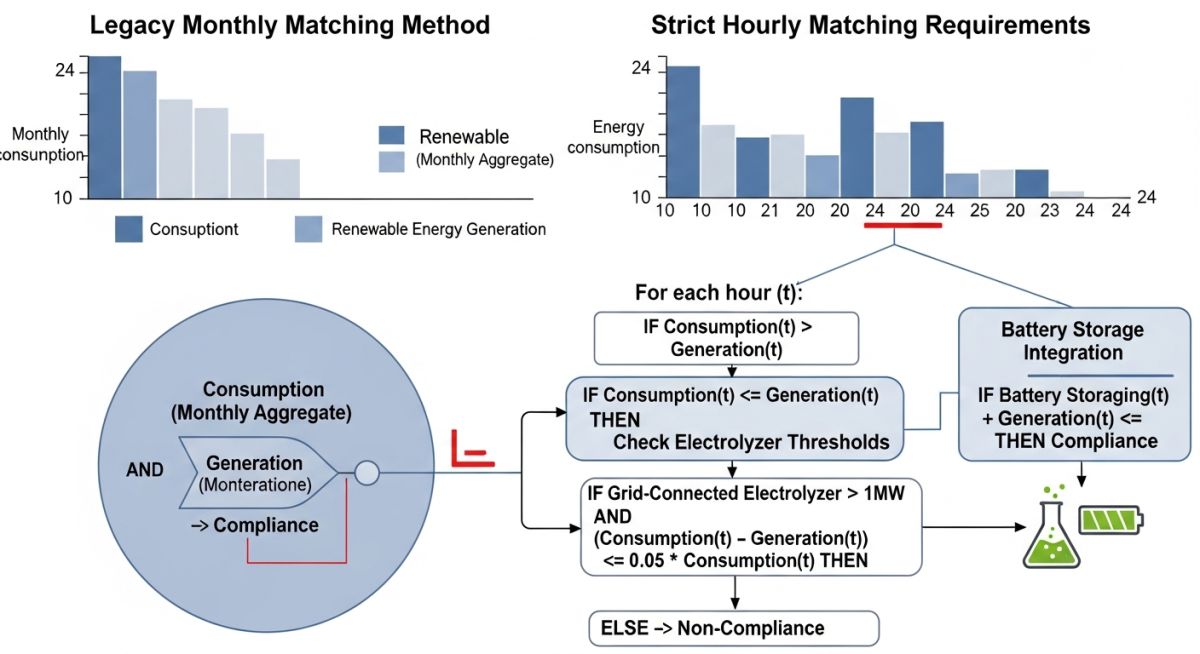
The Mechanics of Hourly Matching
To calculate the correlation, we must evaluate the energy balance within each hour (t). The fundamental constraint is that the electricity consumed by the electrolyzer (E_el) must be matched by the renewable electricity generated (E_ren) within the same hour, or stored in a battery system that was charged by the same renewable source during that hour.
Mathematically, for any given hour, the condition is: E_el(t) ≤ E_ren(t) + E_storage(t). If the electrolyzer consumes more than the renewable source provides, the excess must be accounted for via grid-based renewable certificates, provided they meet the strict additionality criteria. In my experience, this requires a sophisticated Energy Management System (EMS) that can handle millisecond-level data processing to ensure the hourly average remains compliant.
Standards and Compliance
Compliance is governed by the EU RED II Delegated Acts. We must reference the specific requirements for “Additionality,” “Geographical Correlation,” and “Temporal Correlation.” For engineers, this means your design documentation must include a “Temporal Compliance Report” that validates the hourly energy balance against the ENTSO-E grid data or local metering infrastructure.
When designing the electrical balance of plant (eBoP), I recommend installing redundant, certified revenue-grade meters at both the renewable generation point and the electrolyzer input. These meters must be synchronized via a common time protocol (like PTP – Precision Time Protocol) to ensure that the timestamps across the entire facility are identical, preventing any “drift” that could lead to non-compliance during an audit.
Temporal Correlation Impact: The operational and economic trade-offs associated with implementing high-granularity energy matching in green hydrogen production facilities.
Advantages
- Ensures genuine decarbonization by eliminating fossil-fuel-based grid reliance.
- Provides a clear, auditable trail for carbon credit verification and subsidies.
- Drives innovation in battery storage and hybrid renewable energy systems.
- Aligns production with peak renewable availability, reducing curtailment losses.
Disadvantages
- Significantly increases the Levelized Cost of Hydrogen (LCOH) due to lower utilization.
- Requires complex, expensive control systems and high-fidelity metering hardware.
- Increases operational risk if renewable generation drops unexpectedly.
- Demands more complex PPA negotiations and grid-balancing agreements.
Temporal Correlation Implementation: The practical deployment of hourly matching strategies across various industrial sectors to meet stringent EU regulatory standards for green hydrogen.
Industrial Feedstock Decarbonization
Large-scale ammonia and methanol plants are integrating dedicated wind farms with electrolyzers to replace steam methane reforming. By applying hourly temporal correlation, these facilities ensure that the hydrogen feedstock is certified as renewable, allowing the final chemical product to carry a low-carbon label for export to the EU market.
Heavy-Duty Transport Refueling Hubs
Hydrogen refueling stations for trucking fleets require high availability, which often necessitates a hybrid approach. Engineers use temporal correlation to manage the balance between on-site solar arrays, grid-connected renewable PPAs, and hydrogen storage buffers, ensuring that the fuel dispensed during peak hours remains compliant with RED II mandates.
Grid-Connected Electrolyzer Clusters
In regions with high renewable penetration, clusters of electrolyzers act as flexible loads to stabilize the grid. By adhering to hourly correlation, these clusters can participate in demand-response programs while simultaneously producing certified green hydrogen, effectively turning the electrolyzer into a dual-purpose asset for both energy storage and fuel production.
The transition from monthly to hourly temporal correlation represents a fundamental shift in how green hydrogen producers must validate their renewable energy inputs. Under the EU RED II Delegated Acts, the correlation requirement dictates the synchronization between the electricity generation timestamp and the electrolyzer operation window. This table outlines the critical thresholds and transition timelines that operators must integrate into their SCADA and energy management systems to maintain compliance.
Engineers must note that while monthly correlation is permitted during the initial phase-in period, the regulatory trajectory is strictly moving toward hourly granularity. Failure to align your data logging architecture with these specific intervals will result in the inability to certify hydrogen as renewable under the RFNBO framework. The following data points summarize the operational constraints and the corresponding regulatory expectations for facility design.
| Parameter | Monthly Correlation | Hourly Correlation |
|---|---|---|
| Regulatory Status | Transitional (until 2030) | Mandatory (Post-2030) |
| Data Granularity | Calendar Month | 60-Minute Intervals |
| Grid Balancing | Net-metering allowed | Strict synchronous matching |
| Compliance Risk | Low (High flexibility) | High (Requires storage) |
By mapping these parameters against your specific site generation profile, you can determine the necessary buffer capacity required for your hydrogen production units. The shift to hourly matching effectively forces a tighter coupling between intermittent renewable sources and the electrolyzer load, necessitating advanced predictive control algorithms.
To successfully navigate the RFNBO regulatory landscape, engineers must maintain a clear understanding of the technical entities involved in the certification chain. This matrix maps the physical assets, regulatory standards, and data verification protocols that define the compliance lifecycle. Each entity serves as a critical node in the audit trail required by independent certification bodies.
The integration of these entities requires a robust digital infrastructure capable of handling high-frequency time-series data. As an expert, I emphasize that the primary challenge is not just the generation of green power, but the immutable logging of that power’s origin and timing. The following matrix provides a structured overview of the technical components that must be documented in your project’s compliance dossier.
| Entity | Function | Standard Reference |
|---|---|---|
| Electrolyzer | Hydrogen production unit | ISO 22734 |
| PPA | Power Purchase Agreement | EU RED II |
| GO | Guarantee of Origin | CEN/EN 16325 |
| SCADA | Data logging system | IEC 62443 |
Maintaining this matrix ensures that your project remains audit-ready. I recommend updating this mapping quarterly to account for any shifts in local grid regulations or updates to the EU Delegated Acts regarding renewable hydrogen production.
Temporal Correlation Compliance: Ensuring your facility meets the strict hourly matching requirements requires a rigorous site-level verification process. As a piping and process engineer, I have developed this checklist to ensure that your instrumentation and data management systems are fully aligned with the EU RED II requirements for renewable hydrogen production.
-
Meter Synchronization: Verify that all electricity meters (both generation and consumption) are synchronized to a common UTC time source with a maximum drift of less than 1 second. -
Data Logging Frequency: Confirm that the SCADA system is configured to record energy flows at a minimum resolution of 15 minutes, allowing for aggregation into hourly blocks. -
PPA Alignment: Ensure the Power Purchase Agreement explicitly includes the hourly matching clause, allowing for the transfer of renewable attributes on a per-hour basis. -
Audit Trail Integrity: Validate that the data storage solution is immutable and compliant with IEC 62443 cybersecurity standards to prevent tampering with production logs. -
Grid Connection Verification: Confirm that the point of connection allows for the physical separation of renewable energy flows from grid-supplied power during non-generation hours.
This checklist is not exhaustive but serves as the baseline for any facility aiming for RFNBO certification. In my experience, the most common point of failure is the lack of time-synchronization between the renewable energy source and the electrolyzer control system. Always conduct a dry-run audit of your data logs before the official certification process begins to identify any gaps in your temporal correlation reporting.
Problem: Mismatched Generation and Electrolyzer Load
A 20MW green hydrogen facility faced significant compliance risks due to a lack of temporal correlation between their solar farm and the electrolyzer operation.
- Solar generation peaked at midday, while the electrolyzer operated on a 24/7 baseload profile.
- The facility lacked sufficient battery storage to bridge the gap during non-sunlight hours.
- Existing SCADA logs showed significant grid-power usage during peak production hours, violating RFNBO rules.
- The lack of hourly matching meant the hydrogen produced could not be certified as renewable.
Outcome: Implementation of Dynamic Load Control
By integrating a predictive energy management system, the facility successfully aligned its production with renewable availability.
- Installed a 5MWh BESS (Battery Energy Storage System) to buffer intermittent solar output.
- Implemented a dynamic load-following algorithm that throttled the electrolyzer based on real-time solar availability.
- Achieved 98% hourly correlation compliance, verified by an independent third-party auditor.
- Successfully secured RFNBO certification, enabling the sale of hydrogen at a premium market rate.
My recommendation for similar projects is to prioritize the integration of energy storage early in the design phase. Relying solely on grid-balancing is becoming increasingly difficult under the tightening EU regulations, and proactive load management is the only sustainable path forward.
Frequently Asked Engineering Questions
What is the primary purpose of temporal correlation?
- Prevents reliance on non-renewable grid power during off-peak generation.
- Ensures the physical link between renewable energy production and consumption.
- Supports the integrity of the EU RED II certification framework.
How does hourly matching differ from monthly matching?
- Monthly matching allows for net-metering across different times of the day.
- Hourly matching requires precise synchronization of generation and load.
- Hourly matching is the future standard to ensure true grid-neutrality.
Are there exceptions to the hourly correlation rule?
- Transition period ends in 2030 for most facilities.
- Specific exemptions may apply for pilot projects or research facilities.
- Always consult the latest EU RED II guidance for your specific region.
What data is required for an RFNBO audit?
- Time-stamped electricity meter readings.
- Proof of PPA validity and renewable energy source location.
- Verified logs from the electrolyzer control system.
How does battery storage impact correlation compliance?
- Enables the use of renewable energy outside of generation hours.
- Reduces the need for grid-supplied power during off-peak times.
- Essential for meeting the strict hourly matching requirements.
What are the risks of non-compliance?
- Loss of financial incentives and subsidies.
- Inability to sell hydrogen as “green” or “renewable.”
- Reputational damage and potential legal consequences for mislabeling.
