
Understanding RFNBO Geographic Correlation Rules for Green Hydrogen Projects
In my 20-plus years of engineering industrial energy systems, I have seen many regulatory shifts, but none as structurally demanding as the EU’s Delegated Acts on Renewable Fuels of Non-Biological Origin (RFNBO). When designing a green hydrogen facility, you cannot simply buy green certificates from Spain and run an electrolyzer in Germany. The physical reality of the grid matters. I have sat in project alignment meetings where multi-million dollar procurement strategies were scrapped because the team overlooked the strict spatial boundaries of bidding zones. This guide breaks down the exact geographic rules you must design your power purchase agreements (PPAs) around.
Key Takeaways
- Electrolyzers must reside in the same bidding zone as their contracted renewable energy source.
- Cross-border sourcing is permitted only under strict day-ahead market price conditions to prevent grid strain.
- Direct physical lines bypass bidding zone rules but require strict off-grid isolation.
- TSO-driven bidding zone splits present a major long-term regulatory risk for 15-year PPAs.
How RFNBO Geographic Correlation Impacts Project Siting
To understand the engineering constraints of RFNBO compliance, we must look at how the European Union defines bidding zones. A bidding zone is the largest geographical area within which market participants can exchange energy without capacity allocation. Under the EU Delegated Regulation 2023/1184, the geographic correlation rule ensures that the electrolyzer does not create localized grid congestion by drawing power from a constrained region.
If your electrolyzer is in Bidding Zone A, your renewable generation asset must also be in Bidding Zone A. However, the regulation provides a critical exception for adjacent bidding zones. This exception is governed by day-ahead electricity prices.
The Adjacent Zone Price Rule
Let P_source be the day-ahead electricity price in the renewable generation bidding zone, and P_electrolyzer be the day-ahead price in the hydrogen production bidding zone.
P_source ≥ P_electrolyzer
This mathematical condition must be met during the hour of production. If the price in the sourcing zone is lower than the electrolyzer’s zone, it indicates that power is flowing from a cheap, potentially congested zone to an expensive zone. Importing power under these conditions without explicit transmission capacity allocation is prohibited for RFNBO compliance.
Field Warning: Bidding Zone Re-configurations
In my project reviews, I always warn developers about structural grid changes. Transmission System Operators (TSOs) can split bidding zones to manage structural congestion (as seen in Sweden’s SE1-SE4 split). If your 15-year PPA is signed with a wind farm that suddenly ends up in a newly split, non-adjacent zone, your RFNBO compliance status could evaporate overnight. Always include regulatory change clauses in your PPA contracts.
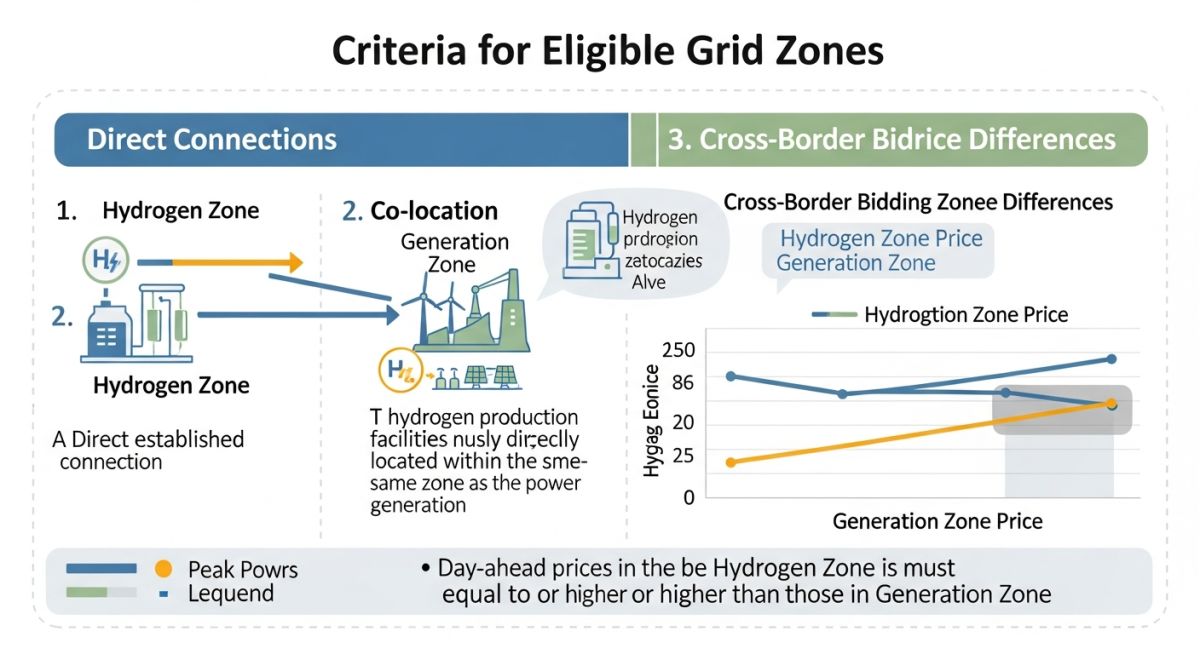
The following tables outline the specific geographic sourcing scenarios and technical mapping parameters required to satisfy the EU Delegated Regulation 2023/1184.
| Sourcing Scenario | Sourcing Zone | Electrolyzer Zone | Price Condition | Compliance Status |
|---|---|---|---|---|
| Same Bidding Zone | Zone A | Zone A | None (Always Compliant) | Compliant |
| Adjacent Zone (High Price) | Zone B (Adjacent) | Zone A | P_ZoneB ≥ P_ZoneA | Compliant |
| Adjacent Zone (Low Price) | Zone B (Adjacent) | Zone A | P_ZoneB < P_ZoneA | Non-Compliant |
| Non-Adjacent Zone | Zone C (Distant) | Zone A | Any Price | Non-Compliant |
| Offshore Adjacent Zone | Offshore Zone D | Onshore Zone A | P_ZoneD ≥ P_ZoneA | Compliant |
Technical Mapping & Specifications Matrix
| Technical Parameter | Definition & Scope | RFNBO Limit / Requirement | Verification Method |
|---|---|---|---|
| Bidding Zone ID | ENTSO-E EIC code of the bidding zone. | Must match or be adjacent. | Registry check via ENTSO-E portal. |
| Temporal Resolution | Timeframe for matching power and production. | Hourly matching (by 2030). | Smart meter data reconciliation. |
| Direct Line Isolation | Physical cable connecting generation to electrolyzer. | No grid power injection allowed. | Physical engineering design audit. |
| Import Allocation | Cross-border transmission capacity rights. | Must prove physical capacity reservation. | TSO capacity contract review. |
Verifying RFNBO Geographic Correlation for Project Approval
Before committing capital to a green hydrogen project, you must run a rigorous site verification process. In my experience, relying on high-level regional maps is a recipe for regulatory failure. You must verify the exact connection points at the substation level.
Engineering Verification Steps
-
✔
Substation EIC Code Verification: Extract the Energy Identification Codes (EIC) for both the electrolyzer connection point and the renewable generation substation. Confirm both reside in the same ENTSO-E bidding zone.
-
✔
Adjacent Zone Price Mapping: For adjacent zone PPAs, establish a data pipeline to pull hourly day-ahead prices from Nord Pool, EPEX SPOT, or relevant regional exchanges to automate compliance checks.
-
✔
Direct Line Physical Audit: If utilizing a direct line, verify that no grid-connected backfeed path exists that could invalidate the off-grid status under Article 3.
-
✔
TSO Congestion Forecast: Review the 10-Year Network Development Plan (TYNDP) from ENTSO-E to assess the risk of future bidding zone splits affecting your project site.
Field Case Study: Real-World Application
The Problem: Price Divergence in Cross-Border PPAs
A developer planned a 50MW electrolyzer project in Denmark (DK2 bidding zone) and secured a long-term PPA with an offshore wind farm located in Sweden (SE4 bidding zone). While the zones are adjacent, winter grid congestion caused the day-ahead price in SE4 to drop below DK2 for 18% of the operating hours. Under RFNBO rules, any hydrogen produced during those hours could not be certified as green, threatening the project’s economic viability and off-take agreements.
The Outcome: Dynamic Curtailment and PPA Restructuring
I worked with the engineering team to integrate a real-time compliance controller. This system automatically curtails electrolyzer load or switches to alternative local bidding zone power sources when the SE4 price drops below the DK2 price. Additionally, we restructured the PPA to include a price-matching clause, ensuring the wind developer compensated for the lost green premium during non-compliant hours. This technical-commercial solution secured full RED II certification.
This case highlights that geographic correlation is not just a siting decision; it is an active operational parameter. Engineers must design control systems that are aware of electricity market prices to maintain compliance dynamically.
Frequently Asked Engineering Questions
What happens to RFNBO geographic correlation if a bidding zone is split by the TSO?
Can offshore wind farms in exclusive economic zones (EEZs) comply with geographic correlation?
How does the day-ahead price relation rule work for adjacent bidding zones?
Are direct lines exempt from bidding zone geographic correlation rules?
How does cross-border power procurement affect the additionality requirement?
What documentation is required to prove geographic correlation during an audit?
Complete Course on
Piping Engineering
Check Now
Key Features
- 125+ Hours Content
- 500+ Recorded Lectures
- 20+ Years Exp.
- Lifetime Access
Coverage
- Codes & Standards
- Layouts & Design
- Material Eng.
- Stress Analysis
