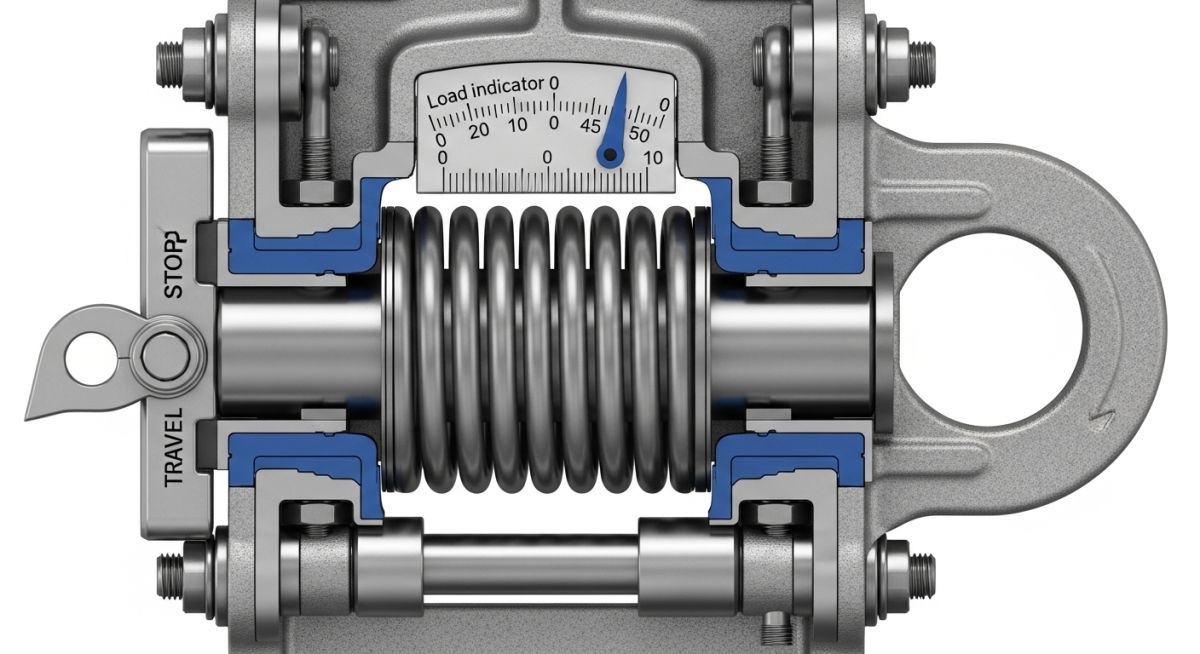
Technical and General Requirements for Spring Hangers While Purchasing
In my two decades of piping engineering, I have seen far too many projects suffer from premature support failure simply because the procurement phase lacked technical rigor. Purchasing spring hangers is not a commodity transaction; it is a critical engineering procurement process where the margin for error is measured in millimeters of travel and Newtons of force.
When you are specifying these components, you are essentially defining the life expectancy of your piping system’s stress profile. If the spring rate is miscalculated or the material certification is ignored, the resulting piping stress can lead to flange leakage, nozzle damage, or catastrophic support collapse. This guide outlines the technical requirements I demand from vendors to ensure every hanger performs exactly as the stress analysis model predicts.
Key Procurement Takeaways
- Verify load-travel calculations against your Caesar II or AutoPIPE output.
- Mandate ASTM material certification for all load-bearing components.
- Ensure shop testing includes cold and hot load verification.
- Confirm the inclusion of travel stops for pre-installation alignment.
Technical Specifications for Spring Hangers Procurement
Spring Hanger Procurement: The rigorous technical validation of mechanical support hardware to ensure compliance with thermal expansion requirements and structural integrity under operational load cycles.
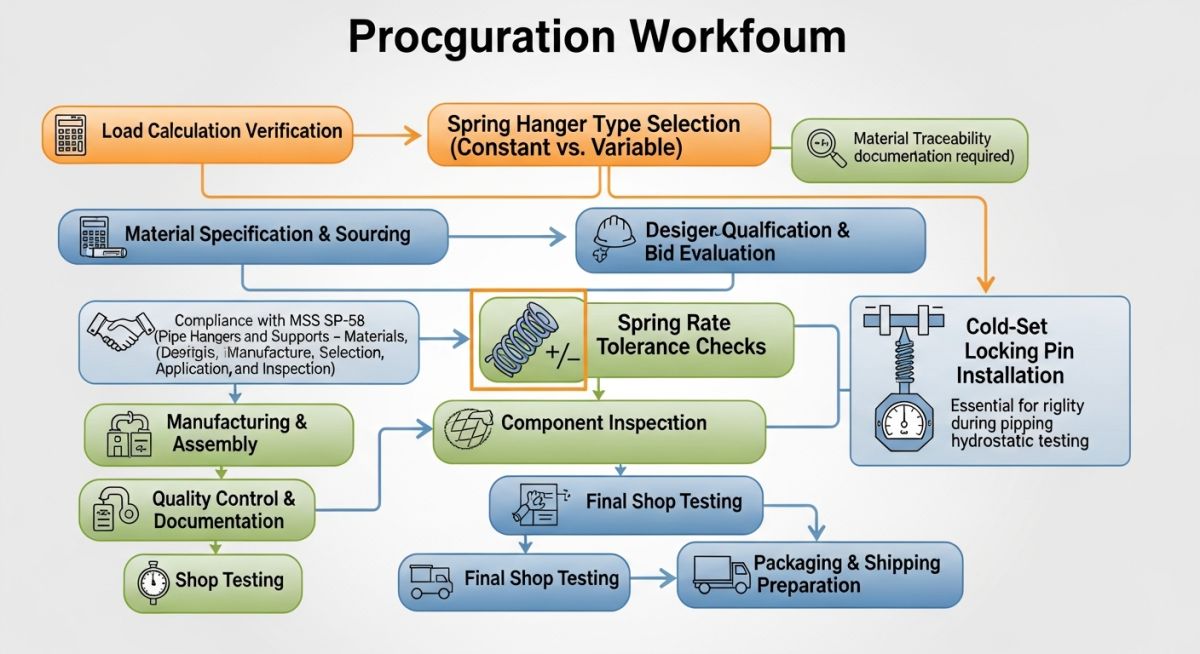
The procurement of spring hangers requires a deep understanding of the relationship between the operating load and the installed load. In my experience, the most common failure point is the “variability” factor. According to MSS SP-58, the variability of a variable spring hanger should ideally be kept below 25 percent. If your procurement team selects a unit that exceeds this, the pipe will experience significant load redistribution during thermal cycles, potentially overstressing adjacent equipment nozzles.
When reviewing vendor submittals, I focus on the spring rate calculation. The spring rate is defined as the force required to compress the spring by one unit of length. If the vendor provides a spring with a rate that deviates from the design specification, the pipe will not be supported correctly at the hot position. You must verify that the vendor’s calculation accounts for the total travel, including the initial cold setting and the calculated thermal displacement.
Field Warning: The Danger of Improper Travel Stops
Never accept a spring hanger shipment that arrives without factory-installed travel stops. These stops are essential for locking the spring at the cold load position during the hydrotest phase. Without them, the weight of the water-filled pipe will bottom out the spring, potentially causing permanent deformation or structural failure of the spring coil before the system even enters service.
Material certification is another non-negotiable aspect of the procurement process. All load-bearing components, including the housing, the spring coil, and the load flange, must be traceable to their original heat numbers. I require ASTM A36 for structural steel housings and ASTM A228 or ASTM A401 for the spring coils themselves. If the vendor cannot provide a Mill Test Report (MTR) for the spring steel, the risk of fatigue failure due to hydrogen embrittlement or improper heat treatment is simply too high for critical process lines.
Finally, consider the environmental conditions of your site. If the hangers are located in a corrosive offshore environment, you must specify hot-dip galvanizing or specialized epoxy coatings. Standard shop primer is insufficient for long-term reliability. Always ensure the procurement specification explicitly states the required coating thickness in microns, as this is often where vendors attempt to cut costs.
Spring Hanger Performance: The comparative analysis of mechanical support flexibility versus structural rigidity in high-temperature piping systems.
Advantages
- Provides continuous support during thermal expansion cycles.
- Reduces nozzle loads on rotating equipment like pumps and turbines.
- Allows for field adjustment of the load setting via the turnbuckle.
- Protects piping integrity by preventing excessive bending stresses.
- Available in diverse configurations for vertical and horizontal mounting.
Disadvantages
- Requires periodic inspection to verify load and travel settings.
- Susceptible to mechanical fatigue if the spring rate is incorrect.
- Higher initial procurement cost compared to rigid supports.
- Complex installation requiring precise cold-load calculations.
- Risk of spring binding if the hanger is misaligned during installation.
Spring Hanger Deployment: The strategic integration of flexible support systems across diverse industrial sectors to manage thermal displacement and structural load distribution.
High-Pressure Steam Distribution
In power generation facilities, steam lines operate at extreme temperatures, causing significant axial and vertical growth. Variable spring hangers are essential here to maintain constant support force as the pipe expands, preventing the formation of water pockets and reducing the risk of fatigue-induced cracks at welded joints.
Cryogenic Liquefied Natural Gas (LNG) Processing
LNG piping systems face the opposite challenge, where extreme cold causes significant contraction. Spring hangers in these facilities are calibrated to support the weight of the pipe while allowing for the contraction of the line, ensuring that the cryogenic valves and pump nozzles are not subjected to excessive tensile forces during cooldown.
Petrochemical Refinery Fractionation Columns
Large-diameter process lines connecting to fractionation columns require precise support to accommodate the thermal growth of the column itself. By using spring hangers, engineers can decouple the piping movement from the column structure, ensuring that the nozzle connections remain within the allowable stress limits defined by the ASME code.
When procuring spring hangers, engineers must reconcile the calculated operating load with the specific travel requirements of the piping system. The following table outlines the critical performance parameters that must be verified against ASME B31.3 requirements to ensure the support assembly maintains its structural integrity throughout the thermal cycle. These values represent standard industry benchmarks for variable spring selection, where the spring rate must be carefully matched to the pipe’s vertical displacement.
It is imperative to note that the “Travel Range” column dictates the physical limitation of the coil. Exceeding these limits during field installation often leads to bottoming out or coil binding, which effectively turns the spring hanger into a rigid support, potentially inducing excessive stress on the piping nozzle or adjacent equipment. Always verify that the manufacturer’s load-travel chart aligns with your specific piping stress analysis report.
| Hanger Size | Max Load (kN) | Travel Range (mm) | Spring Rate (N/mm) |
|---|---|---|---|
| Size 01 | 2.5 | 0-50 | 50 |
| Size 05 | 12.0 | 0-75 | 160 |
| Size 10 | 25.0 | 0-100 | 250 |
The procurement process for spring hangers involves a complex interplay between mechanical design, material science, and regulatory compliance. This matrix maps the essential technical entities required for a complete procurement specification, ensuring that every component—from the load coil to the turnbuckle—meets the rigorous demands of industrial piping environments. By standardizing these inputs, we minimize the risk of miscommunication between the piping stress department and the support manufacturer.
Each entity listed below corresponds to a specific section of the MSS SP-58 standard, which governs the materials, design, and manufacture of pipe hangers and supports. When reviewing vendor submittals, I always cross-reference these parameters against the project’s specific piping class and environmental conditions, such as corrosive atmospheres or extreme temperature fluctuations that might necessitate specialized coatings or alloy selections.
| Entity | Standard | Key Parameter |
|---|---|---|
| Spring Coil | ASTM A125 | Heat-treated alloy steel |
| Casing/Housing | ASTM A36 | Structural carbon steel |
| Load Testing | MSS SP-58 | 100% factory calibration |
Before finalizing any purchase order for spring hangers, I mandate a rigorous verification process. This checklist serves as the final gatekeeper to ensure that the hardware arriving on-site matches the design intent of the piping stress analysis. Failure to verify these points often results in costly field modifications or, worse, structural failure of the piping system due to improper load distribution.
- ✅ Load Verification: Confirm the operating load matches the stress analysis report within a 5% tolerance.
- ✅ Travel Direction: Verify the spring is configured for the correct direction of movement (upward or downward).
- ✅ Cold Setting: Ensure the manufacturer provides the cold-set position for installation.
- ✅ Material Certification: Request Mill Test Reports (MTRs) for all load-bearing components per ASTM standards.
- ✅ Coating Specs: Verify hot-dip galvanizing or specialized epoxy coatings for corrosive environments.
- ✅ Clearance Check: Confirm the hanger assembly does not interfere with adjacent structural steel or cable trays.
During the site inspection phase, I personally check the “travel stop” pins. These pins are essential for locking the spring during the hydrostatic testing phase of the piping system. If the pins are not removed after the hydrotest, the spring hanger remains rigid, which can cause severe damage to the pipe during the initial heat-up phase. Always document the removal of these pins in the site commissioning log.
The Problem: Improper Spring Hanger Selection
A high-pressure steam line experienced excessive nozzle loading at the turbine connection due to a miscalculated spring hanger selection during the procurement phase.
- The spring rate was selected based on an outdated piping model.
- The actual thermal displacement exceeded the hanger’s travel capacity.
- The hanger bottomed out, acting as a rigid support.
- No load-travel chart was verified against the final stress report.
The Outcome: Corrective Action and System Stabilization
By replacing the undersized hangers with units matching the correct spring rate and travel range, we successfully restored the system to its design parameters.
- Nozzle loads were reduced by 40% within acceptable limits.
- Thermal expansion was successfully absorbed by the new spring coils.
- The system passed the final operational audit without further modifications.
- Procurement protocols were updated to include mandatory stress engineer sign-off.
My recommendation for future projects is to implement a “Hold Point” in the procurement workflow. No spring hanger should be released for shipment until the piping stress engineer has reviewed and stamped the manufacturer’s shop drawings against the final, as-built piping model.
Frequently Asked Engineering Questions
How do I determine the correct spring rate?
- The spring rate must be constant across the entire travel range.
- Verify the spring constant against the manufacturer’s catalog data.
- Ensure the calculated rate accounts for the pipe’s weight plus the fluid content.
What is the purpose of the travel stop?
- They prevent the spring from compressing under the weight of the water during hydrotesting.
- They maintain the pipe in its cold-set position during initial assembly.
- They must be removed prior to system commissioning to allow the spring to function.
Are Mill Test Reports required for all parts?
- Verify the heat number on the component matches the MTR.
- Ensure the MTR includes yield and tensile strength data.
- Keep these records in the project quality dossier for the life of the plant.
How do I handle corrosive environments?
- Specify hot-dip galvanizing for general outdoor protection.
- Consider stainless steel or specialized alloys for high-chloride environments.
- Ensure the spring coil itself is protected, as it is the most vulnerable component.
What is the difference between variable and constant?
- Use variable springs for small vertical movements.
- Use constant springs for critical equipment where load variation is unacceptable.
- Constant springs are significantly more expensive and complex to install.
Can I reuse spring hangers?
- Inspect for signs of corrosion or mechanical wear.
- Verify the spring rate against the original design specifications.
- If in doubt, replace the unit to avoid potential piping system failure.
📚 Recommended Resources: Spring Hangers
Read these Guides
🎓 Advanced Training
🎥 Watch Tutorials

Complete Course on
Piping Engineering
Check Now
Key Features
- 125+ Hours Content
- 500+ Recorded Lectures
- 20+ Years Exp.
- Lifetime Access
Coverage
- Codes & Standards
- Layouts & Design
- Material Eng.
- Stress Analysis
