Rock Classification Systems Used in Geotechnical Engineering
In my two decades of experience across heavy industrial and infrastructure projects, I have learned that the ground is the most unpredictable variable in any design. Relying on intuition is a recipe for failure; instead, we utilize rigorous Rock Classification Systems to translate geological uncertainty into actionable engineering parameters. Whether you are designing a deep foundation for a process plant or a tunnel for utility piping, understanding the interplay between Rock Quality Designation (RQD), the Rock Mass Rating (RMR) system, and the Q-System is non-negotiable.
This guide breaks down these systems to help you move beyond basic lithology and into the realm of quantitative rock mechanics. We will explore how these metrics dictate support pressure, excavation methods, and long-term structural integrity.
Key Takeaways for Geotechnical Success:
- Master the transition from qualitative rock description to quantitative RMR and Q-System values.
- Understand how RQD serves as the foundational metric for rock mass quality assessment.
- Learn to correlate classification outputs with specific support requirements for tunnels and foundations.
- Apply standardized ASTM and ISRM protocols to ensure site safety and regulatory compliance.
Rock Classification Systems and Structural Mechanics
Rock Mass Characterization: The systematic process of evaluating geological discontinuities and intact rock strength to determine the mechanical behavior of the rock mass under structural loading.
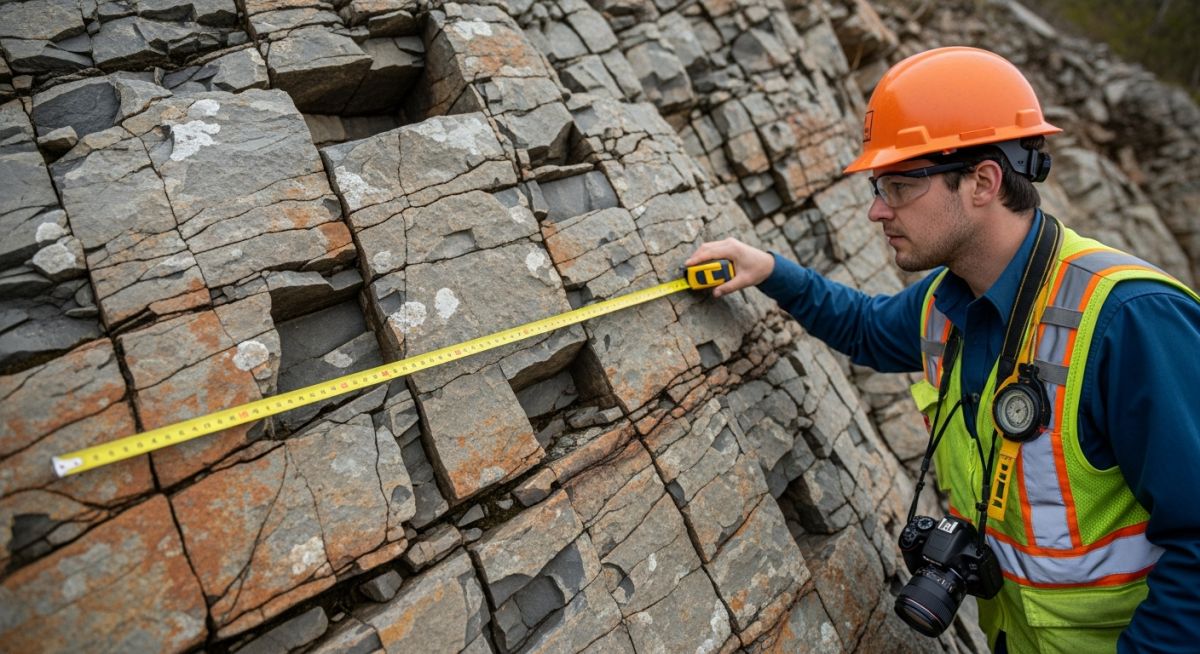
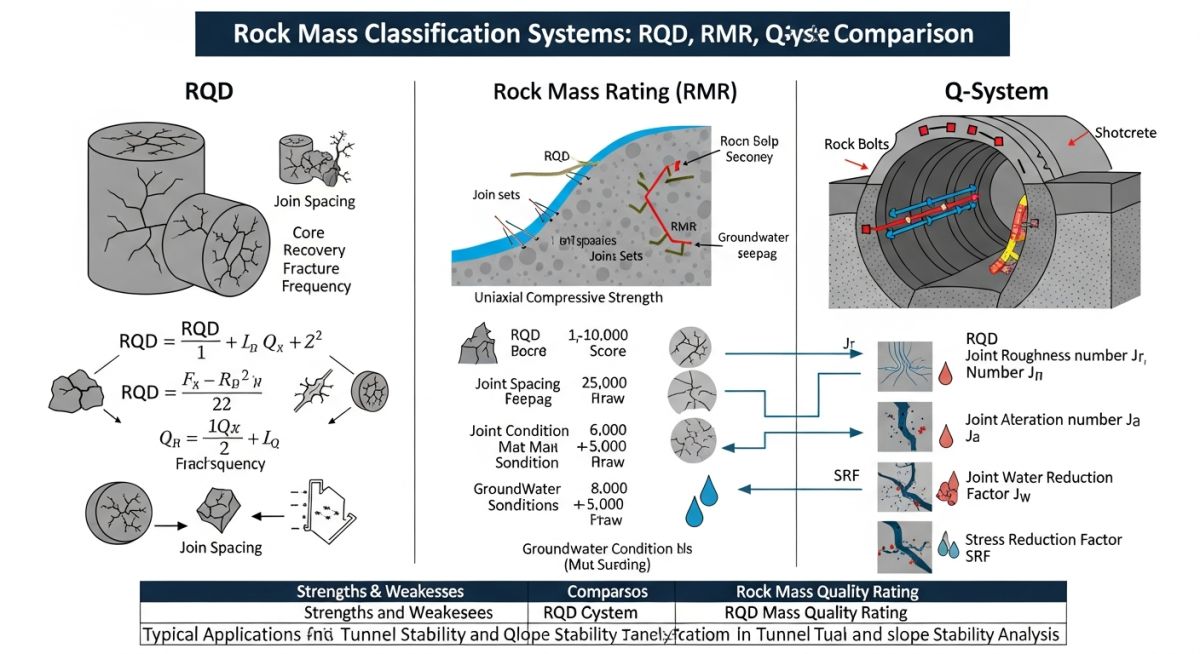
When I evaluate a site, I start with the Rock Quality Designation (RQD). Developed by Deere in 1964, RQD is a simple yet powerful index that measures the percentage of core pieces longer than 100mm in a drill run. It is the first filter in our classification process. However, RQD alone is insufficient because it ignores joint orientation and aperture. This is where the RMR system, introduced by Bieniawski, becomes the industry standard for civil engineering.
The RMR system integrates six parameters: uniaxial compressive strength, RQD, spacing of discontinuities, condition of discontinuities, groundwater conditions, and orientation of discontinuities. The sum of these ratings provides a score from 0 to 100, which we then map to five rock mass classes. In my experience, the RMR system is particularly effective for predicting stand-up time in tunneling projects.
Field Warning: The Groundwater Variable
Never underestimate the impact of pore water pressure on rock mass stability. In the RMR system, groundwater conditions can swing the final rating by up to 15 points. Always perform piezometric monitoring before finalizing your support design, as high-pressure inflows can turn a “Good” rock mass into a “Poor” one overnight.
The Q-System, developed by Barton et al. at the Norwegian Geotechnical Institute, takes a different approach. It focuses on the block size and the inter-block shear strength. The Q-value is calculated as the ratio of three pairs of parameters: (RQD/Jn) multiplied by (Jr/Ja) multiplied by (Jw/SRF). This system is highly sensitive to the stress reduction factor (SRF), making it the preferred choice for deep-level mining and high-overburden tunneling.
For structural engineers, the critical takeaway is the correlation between these systems and the deformation modulus. We often use the empirical formula: Em = 10^((RMR-10)/40) to estimate the rock mass modulus. This value is then fed into our finite element models to predict settlement for heavy equipment foundations. Always verify these empirical correlations with site-specific plate load tests or pressuremeter data to ensure your design remains within the safety margins defined by ASCE standards.
Classification System Trade-offs: A critical evaluation of the operational benefits and inherent limitations of using empirical rock mass classification in geotechnical design.
Advantages
- Provides a standardized language for communication between geologists and structural engineers.
- Reduces reliance on subjective qualitative descriptions by using numerical indices.
- Allows for rapid estimation of support requirements during preliminary design phases.
- Facilitates empirical correlation with rock mass deformation and strength parameters.
- Highly effective for benchmarking site conditions against historical project databases.
Disadvantages
- Empirical formulas may not account for site-specific anisotropy or complex stress paths.
- RQD is highly dependent on drilling orientation and core recovery quality.
- Classification systems can be misused if applied outside their original geological context.
- Does not replace the need for rigorous numerical modeling in high-risk excavations.
- Groundwater and stress parameters are often estimated, leading to potential design errors.
Geotechnical Design Integration: Practical deployment of rock classification systems across diverse infrastructure and industrial sectors to ensure structural stability and operational safety.
Deep Tunneling and Utility Infrastructure
In deep tunneling, the Q-System is used to determine the necessary rock bolt density and shotcrete thickness. By calculating the equivalent dimension of the tunnel, we can predict the required support pressure to prevent rock mass collapse during the excavation cycle.
Heavy Industrial Foundation Design
For process plants located on rock, we use RMR values to estimate the allowable bearing capacity and settlement characteristics. This ensures that heavy vibrating equipment, such as compressors or turbines, does not induce differential settlement that could compromise piping alignment.
Slope Stability and Open-Pit Mining
Rock mass classification is vital for assessing the stability of high-wall slopes in mining operations. By identifying zones of low RMR, engineers can implement targeted drainage and reinforcement strategies to prevent large-scale slope failures that threaten personnel and equipment.
Hydroelectric Dam Foundation Analysis
The integrity of dam foundations relies on the rock mass modulus derived from classification systems. We analyze the RQD and joint conditions to determine the extent of dental concrete or grouting required to seal discontinuities and prevent seepage under the dam structure.
Selecting the appropriate rock mass classification system requires a deep understanding of the specific project requirements, such as tunnel span, support pressure, or foundation bearing capacity. While the Rock Mass Rating (RMR) system excels in providing a general assessment of rock quality for various civil engineering applications, the Q-System is specifically tailored for tunneling and underground excavation support design. My experience suggests that engineers must often utilize both systems in tandem to cross-validate findings, especially in heterogeneous geological formations where joint orientation and groundwater conditions vary significantly across the site.
The following table outlines the primary input parameters for the most common classification systems. Note that while RQD serves as a foundational metric for both, the weighting and inclusion of secondary factors like joint condition and stress state differ fundamentally between the RMR and Q-System methodologies. Understanding these nuances is critical for accurate structural modeling and cost estimation in rock mechanics.
| Parameter | RMR System | Q-System | Standard Reference |
|---|---|---|---|
| Rock Quality Designation | Included (Weighted) | Included (RQD/Jn) | ASTM D6032 |
| Joint Set Number | Not Direct | Primary Factor | ISRM Standards |
| Groundwater Condition | Included | Included (Jw) | ASME/API |
| Stress State | Adjustment Only | Primary Factor (SRF) | Eurocode 7 |
The following matrix maps the core technical entities used in rock mass characterization to their respective engineering functions. In my practice, I have found that misinterpreting these entities often leads to over-conservative support designs or, worse, catastrophic structural failure during excavation. Each entity represents a specific physical property of the rock mass that must be quantified through rigorous field logging and laboratory testing.
By standardizing these inputs, we ensure that the geotechnical model remains consistent throughout the project lifecycle, from initial site investigation to final structural verification. This matrix serves as a quick-reference guide for junior engineers and project managers to align their data collection efforts with international best practices and regulatory requirements.
| Entity | Function | Standard |
|---|---|---|
| UCS | Uniaxial Compressive Strength | ASTM D7012 |
| RQD | Rock Quality Designation | ASTM D6032 |
| JRC | Joint Roughness Coefficient | ISRM |
| SRF | Stress Reduction Factor | NGI Guidelines |
Rock Mass Classification Verification: Ensuring the integrity of geotechnical data requires a systematic approach to site verification. Before finalizing any structural design based on RMR or Q-System outputs, I mandate that the following checklist be completed by the field engineering team to mitigate risks associated with data bias or insufficient sampling.
-
Core Recovery Validation: Verify that core recovery percentages match the RQD calculations and that drilling fluid loss is documented per ASTM D2113. -
Joint Orientation Mapping: Confirm that at least three distinct joint sets have been mapped using stereographic projection to assess potential wedge failure modes. -
Groundwater Inflow Assessment: Measure pore water pressure at multiple depths to determine the Jw factor for Q-System calculations accurately. -
In-Situ Stress Measurement: Ensure that the Stress Reduction Factor (SRF) accounts for local tectonic stress concentrations, not just overburden pressure. -
Calibration of Equipment: Validate that all pressure transducers and borehole cameras are calibrated according to current ISO 9001 standards.
Site verification is not a one-time event but a continuous process. If the observed rock mass behavior during initial excavation deviates from the predicted classification, the design must be re-evaluated immediately. Always document these deviations in the site logbook to maintain a clear audit trail for future structural maintenance and safety reviews.
Problem: Unexpected Tunnel Convergence in Weak Rock
- Initial RMR classification overestimated rock mass strength due to poor core recovery.
- High horizontal stress components were ignored during the preliminary design phase.
- Excessive tunnel convergence observed within 48 hours of excavation.
- Inadequate support spacing led to localized roof instability.
Outcome: Successful Remediation and Design Optimization
- Re-classification using the Q-System identified a lower Q-value, necessitating immediate support upgrades.
- Installation of systematic rock bolting and fiber-reinforced shotcrete stabilized the tunnel face.
- Real-time monitoring confirmed that convergence rates stabilized within acceptable limits.
- Project timeline was maintained through proactive geotechnical risk management.
This case study highlights the danger of relying on a single classification system without considering the broader geological context. My recommendation is to always perform a sensitivity analysis on your classification inputs. If the rock mass is highly fractured or subject to high tectonic stresses, the RMR and Q-System must be adjusted to reflect these realities, ensuring that the final support design is both safe and economically viable.
Frequently Asked Engineering Questions
How does RQD influence the RMR system?
- It provides a quantitative measure of rock jointing and fracturing.
- Higher RQD values correlate with higher RMR scores, indicating better rock quality.
- Engineers must ensure RQD is calculated according to ASTM D6032 to maintain consistency.
- It is essential to note that RQD alone is insufficient for design; it must be combined with joint condition and orientation data.
When should I prefer the Q-System over RMR?
- It incorporates the Stress Reduction Factor (SRF), which is critical in deep underground environments.
- The system provides direct correlations to support requirements like bolt length and shotcrete thickness.
- It is more sensitive to the number of joint sets, which is a key factor in tunnel stability.
- Use the Q-System when the project involves complex underground geometries where stress-induced failure is a primary concern.
What is the role of the Stress Reduction Factor?
- It helps identify potential for rockbursts or squeezing ground conditions.
- Values are determined based on the ratio of rock strength to induced stress.
- High SRF values indicate a high-risk environment requiring specialized support measures.
- Proper assessment of SRF is vital for deep tunneling projects where overburden pressure is significant.
How do I handle groundwater in classification?
- In RMR, groundwater is assessed based on inflow rates and pressure conditions.
- In the Q-System, the Jw factor is used to adjust the final Q-value based on water pressure and flow.
- Always conduct piezometric monitoring to obtain accurate data for these parameters.
- Failure to account for groundwater can lead to significant underestimation of support requirements.
Can I use RMR for foundation design?
- It provides a basis for determining the rock mass modulus and allowable bearing pressure.
- Engineers often use empirical correlations to link RMR values to foundation settlement.
- It is essential to verify these correlations with site-specific plate load tests.
- Always consider the influence of joint orientation on the overall stability of the foundation block.
What are the limitations of these systems?
- They are empirical and based on historical data, which may not apply to all geological settings.
- They do not replace the need for detailed numerical modeling in complex projects.
- Subjectivity in logging can lead to variations in classification results between different engineers.
- Always use these systems as a guide, not as a substitute for professional engineering judgment and site-specific testing.
Complete Course on
Piping Engineering
Check Now
Key Features
- 125+ Hours Content
- 500+ Recorded Lectures
- 20+ Years Exp.
- Lifetime Access
Coverage
- Codes & Standards
- Layouts & Design
- Material Eng.
- Stress Analysis

📚 Recommended Resources: Rock Classification Systems
Related posts:
![Cross-section diagram showing a steel solar pile foundation embedded in layered soil profiles for structural analysis.]()
Essential Geotechnical Pile Design Data for Utility-Scale Solar Structures
![Professional surveyor conducting Topographical Surveys for Solar Projects on a large-scale utility site with complex terrain.]()
Topographical Surveys for Solar Projects: A Technical Engineering Guide
![A geotechnical drill rig performing soil sampling on a large, open field intended for a utility-scale solar farm project.]()
Geotechnical Investigation for Solar Farms: Essential Site Design Guide
![Isometric site plan showing Utility Corridor Planning for Data Centres with color-coded power, water, and telecom infrastructure paths.]()
Utility Corridor Planning for Data Centres: A Strategic Engineering Guide
![Aerial view of a data centre site showcasing perimeter drainage systems, detention basins, and site grading for flood prevention.]()
Drainage Design Considerations for Data Centres: A Technical Guide
![Professional surveyor using a Total Station on a large data centre construction site for topographical mapping.]()
Topographical Surveys for Data Centre Projects: A Technical Guide