Industrial PVC Piping and Fittings: Applications, Standards, and Support Spans
In my 20+ years of piping engineering, I have seen many engineers treat plastic piping as a simple utility material. This is a major mistake. When designed correctly, industrial PVC systems handle aggressive chemicals that eat carbon steel for breakfast. However, designing these systems requires a completely different mindset than metallic piping. We must account for thermal expansion, lower mechanical strength, and temperature-dependent support spans to prevent catastrophic field failures.
Key Engineering Takeaways
- Understand how temperature derating factors drastically reduce the allowable operating pressure of PVC systems.
- Master the exact support span calculations to prevent sagging and joint stress.
- Learn the critical differences between Schedule 40 and Schedule 80 PVC systems for industrial applications.
Complete Course on
Piping Engineering
Check Now
Key Features
- 125+ Hours Content
- 500+ Recorded Lectures
- 20+ Years Exp.
- Lifetime Access
Coverage
- Codes & Standards
- Layouts & Design
- Material Eng.
- Stress Analysis
Why Select PVC Piping and Fittings Today?
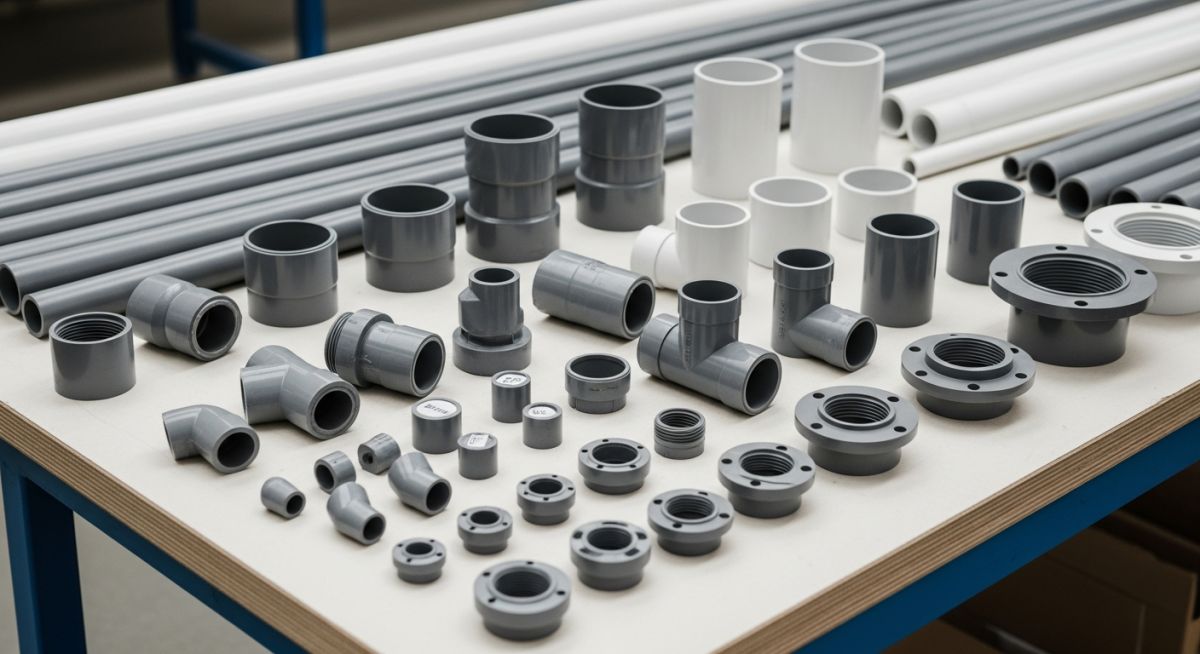
Industrial PVC Applications: The strategic deployment of polyvinyl chloride systems in chemical processing, water treatment, and corrosive environments where metallic piping suffers from galvanic or chemical corrosion.
In my experience, the primary driver for selecting PVC is its exceptional chemical resistance. Unlike carbon steel, which suffers from localized pitting and general corrosion when exposed to acids, bases, and salt solutions, PVC remains completely inert. This makes it the standard choice for sodium hypochlorite, hydrochloric acid, and demineralized water systems.
Chemical Reaction and Molecular Bonding
PVC Polymerization: The chemical synthesis of vinyl chloride monomer into long-chain polyvinyl chloride polymers utilizing suspension or emulsion polymerization techniques.
The molecular structure of PVC consists of a carbon backbone where every second carbon atom is bonded to a chlorine atom. This polar chlorine bond creates strong intermolecular forces, giving PVC its rigid, amorphous structure. This high chlorine content (approximately 57% by weight) also provides inherent flame retardancy, as the material will not support combustion once the external heat source is removed.
Manufacturing of PVC Piping
Extrusion Manufacturing: The continuous thermal processing of PVC dry blend compound through a twin-screw extruder to form seamless cylindrical pipe profiles.
The manufacturing process begins with a dry blend of PVC resin, stabilizers, lubricants, pigments, and impact modifiers. This blend is fed into a twin-screw extruder where it is subjected to high shear and temperatures ranging from 360°F to 400°F (182°C to 204°C). The molten plastic is forced through an annular die to form the pipe profile, which is then sized in a vacuum calibration sleeve and cooled rapidly in water baths to lock in the dimensions.
How to Support PVC Piping and Fittings Safely
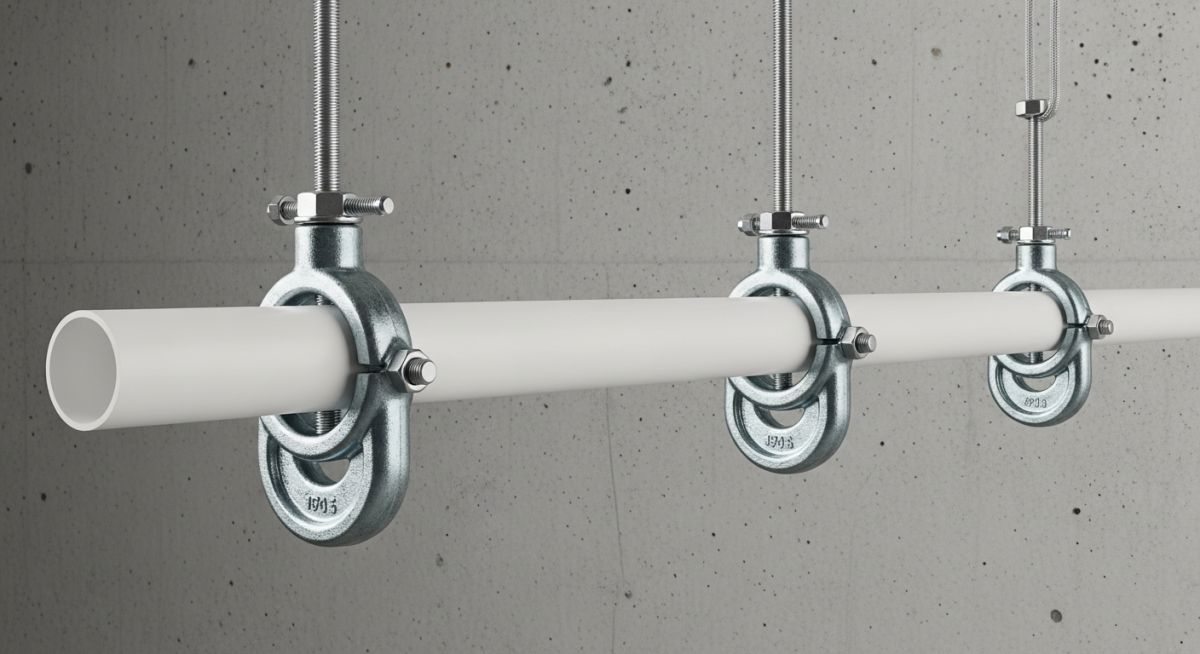
PVC Support Spans: The calculated maximum distance between structural pipe hangers designed to limit mid-span deflection to acceptable engineering limits under full operating loads.
Unlike steel, PVC has a relatively low modulus of elasticity (approximately 400,000 psi at 73°F compared to steel’s 29,000,000 psi). This means PVC is far more flexible and requires significantly closer support spacing. If you space PVC hangers using steel piping standards, the pipe will sag, creating liquid pockets, high stress concentrations at fittings, and eventual joint failure.
To calculate the maximum support span (L) for a horizontal PVC line, we use the standard beam deflection formula modified for plastic piping:
Where:
L = Support span (feet)
y = Permissible deflection (typically limited to 0.1 inches to prevent pooling)
E = Modulus of elasticity of PVC at the operating temperature (psi)
I = Moment of inertia of the pipe cross-section (in⁴) = (π / 64) * (OD⁴ – ID⁴)
w = Total weight of the pipe filled with water (lb/ft)
Never design PVC support spans using nominal room temperature values if your operating temperature is elevated. At 140°F (60°C), the modulus of elasticity of PVC drops by over 50%, requiring you to reduce your support spans by approximately 30% to 40% to prevent catastrophic sagging.
UV Resistance of PVC Piping
UV Degradation Protection: The mitigation of solar ultraviolet radiation damage to PVC molecules through compounding additives or protective external coatings.
When PVC is exposed to direct sunlight, UV radiation causes a chemical reaction called dehydrochlorination. This reaction breaks down the polymer chains, leading to discoloration (yellowing or browning) and a reduction in impact strength. In my experience, the tensile strength and pressure rating remain largely unaffected, but the pipe becomes brittle. To protect outdoor installations, I always specify painting the exposed pipe with a high-quality, water-based latex paint.
Heat Tracing of PVC Piping
PVC Heat Tracing: The application of low-temperature electric heating cables to maintain fluid temperatures or prevent freezing in thermoplastic lines.
Steam tracing must never be used on PVC piping due to the extreme temperatures involved. Instead, use self-regulating electric heat tracing cables. The cable must be rated for plastic pipes, and the thermostat must be set to ensure the pipe wall temperature never exceeds the maximum operating limit of 140°F (60°C). I always recommend wrapping the pipe in aluminum foil before applying the heat tape to distribute the heat evenly around the circumference.
PVC Piping Schedule and Dimensions
PVC Pipe Dimensions: The standardized outer diameters, wall thicknesses, and pressure ratings of Schedule 40 and Schedule 80 PVC pipes governed by ASTM D1785.
| NPS (Inches) | Schedule | Outer Diameter (in) | Wall Thickness (in) | Max Pressure at 73°F (PSI) | Max Pressure at 140°F (PSI) |
|---|---|---|---|---|---|
| 1/2″ | Sch 40 | 0.840 | 0.109 | 600 | 132 |
| 1/2″ | Sch 80 | 0.840 | 0.147 | 850 | 187 |
| 1″ | Sch 40 | 1.315 | 0.133 | 450 | 99 |
| 1″ | Sch 80 | 1.315 | 0.179 | 630 | 138 |
| 2″ | Sch 40 | 2.375 | 0.154 | 280 | 61 |
| 2″ | Sch 80 | 2.375 | 0.218 | 400 | 88 |
| 4″ | Sch 40 | 4.500 | 0.237 | 220 | 48 |
| 4″ | Sch 80 | 4.500 | 0.337 | 320 | 70 |
Technical Mapping & Specifications Matrix
Piping Standards Matrix: The cross-reference mapping of industrial thermoplastic standards, material classifications, and design codes.
| Standard Code | Scope / Description | Material Class | Primary Application |
|---|---|---|---|
| ASTM D1785 | Standard Specification for PVC Pipe (Sch 40, 80, 120) | PVC 1120 (Cell Class 12454) | Industrial pressure piping systems |
| ASTM D2467 | Standard Specification for Sch 80 PVC Socket-Type Fittings | PVC 1120 (Cell Class 12454) | High-pressure socket-welded connections |
| ASME B31.3 | Chapter VII: Nonmetallic Piping and Piping Lined with Nonmetals | All qualified thermoplastics | Process plant design compliance |
| NSF/ANSI 61 | Drinking Water System Components – Health Effects | Food-grade PVC compounds | Potable water distribution |
Site Inspection Checklist for PVC
PVC Field Verification: The systematic quality control protocol executed prior to and during the installation of thermoplastic piping systems to ensure code compliance.
In my years of field auditing, I have found that over 80% of PVC piping failures are caused by poor solvent welding practices or incorrect hanger placement. Use this checklist on your job site to ensure your crew is executing the installation to industrial standards.
Field Verification Checkpoints
-
Chamfering and Deburring: Ensure all pipe ends are cut square and chamfered at a 10 to 15-degree angle. Sharp edges scrape the solvent cement off the fitting socket, causing dry spots and leaks.
-
Primer Application: Verify that a purple primer conforming to ASTM F656 is applied to both the pipe and fitting before the solvent cement. Primer is not optional; it chemically softens the PVC to allow molecular fusion.
-
Hanger Selection: Confirm that all hangers have broad, smooth surfaces. Sharp metallic edges will cut into the soft PVC pipe over time. Do not clamp the pipe tightly; it must be free to move axially for thermal expansion.
-
Cure Times: Enforce strict adherence to the solvent cement manufacturer’s cure time table before pressure testing. Testing a wet joint will blow the pipe right out of the fitting.
Field Case Study: Real-World Application
The Problem: Catastrophic Sagging in a Sodium Hypochlorite Line
During a site audit at a Gulf Coast chemical plant, I was called to inspect a newly installed 3-inch Schedule 80 PVC line carrying 15% sodium hypochlorite. The operating temperature was 115°F (46°C). The field contractor had spaced the pipe hangers at 8-foot intervals, which is standard for carbon steel but completely ignored the temperature derating of PVC. Within three weeks of operation, the line developed severe sagging, resulting in a 2.5-inch mid-span deflection that pooled chemical and put extreme bending stress on the socket-welded elbows.
The Outcome: Re-Engineering and Remediation
I immediately ordered the system shut down and calculated the correct support span for the operating conditions. At 115°F, the modulus of elasticity of PVC drops to approximately 280,000 psi. Using the deflection formula, we determined the maximum allowable support span was actually 4.5 feet. We re-hung the line with continuous structural steel angle trays to support the pipe along its entire length and installed a expansion loop to handle the thermal expansion. The system has now run for over five years without a single leak or deflection issue.
Frequently Asked Engineering Questions
What is the maximum operating temperature for industrial PVC piping?
Can I use compressed air or gases in PVC piping systems?
How does the pressure rating of PVC change with temperature?
What is the difference between Schedule 40 and Schedule 80 PVC?
How do you handle thermal expansion in long PVC pipe runs?
Can PVC piping be threaded?