Power Conversion System Design: Industrial Standards and Grid Integration
In my two decades of managing complex industrial infrastructure, I have observed that the reliability of any energy storage project hinges entirely on the robustness of its Power Conversion System. Whether you are integrating utility-scale solar or stabilizing a microgrid, the PCS acts as the intelligent bridge between raw DC potential and the rigid requirements of the AC grid.
This guide dissects the technical architecture of modern conversion units, focusing on the transition from traditional thyristor-based designs to high-frequency insulated-gate bipolar transistor (IGBT) topologies. We will explore how these systems handle reactive power compensation, harmonic distortion, and the critical thermal management required for long-term operational stability.
Key Engineering Takeaways
- Understanding the transition from passive rectification to active four-quadrant power control.
- Evaluating thermal derating factors based on ambient site conditions and altitude.
- Implementing grid-forming versus grid-following control strategies for microgrid resilience.
- Navigating the compliance landscape of IEEE 519 for harmonic current limits.
Technical Architecture of a Power Conversion System
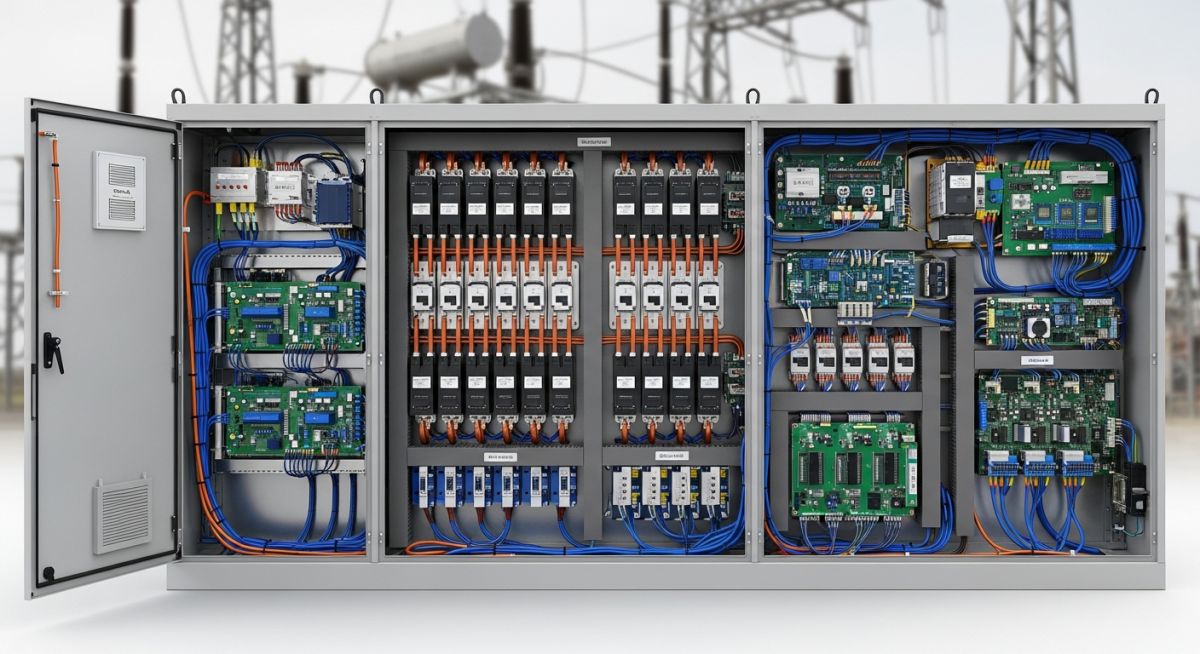
Power Conversion System Topology: A sophisticated power electronics assembly utilizing pulse-width modulation to synthesize AC waveforms from DC inputs while maintaining strict synchronization with grid frequency and phase parameters.
The core of any industrial PCS is the DC-to-AC inverter stage, typically utilizing a three-level neutral-point clamped (NPC) topology. This design significantly reduces the voltage stress on individual switching components compared to traditional two-level inverters. In my experience, the selection of switching frequency is a trade-off between filter size and switching losses. Higher frequencies allow for smaller passive components (inductors and capacitors) but increase the thermal load on the IGBT modules, necessitating advanced liquid cooling systems.
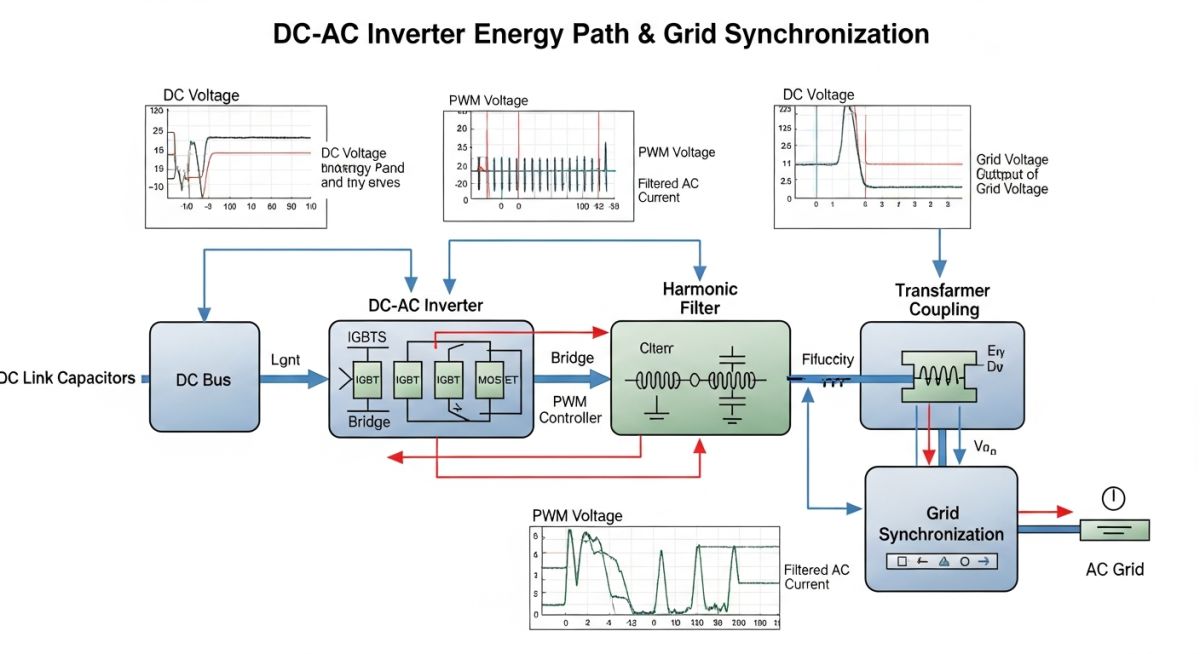
AC-DC and DC-AC Conversion Dynamics
The conversion process relies on the precise control of the modulation index. For a standard three-phase output, the relationship between the DC link voltage (Vdc) and the AC line-to-line voltage (Vac) is governed by the modulation index (m). In a typical PWM scheme, the peak AC voltage is limited by the DC bus voltage, where Vac_peak = m * (Vdc / 2). If the DC bus voltage drops due to battery discharge, the PCS must adjust the modulation index to maintain the required AC output, often hitting the over-modulation region which introduces unwanted harmonics.
Field Warning: Harmonic Distortion
Failure to properly tune the LCL filter in the PCS output stage can lead to resonance at the switching frequency. Always verify that the resonant frequency of your filter is at least 10 times the fundamental grid frequency but significantly lower than the switching frequency to avoid interference with control loops.
Grid support functions are now mandatory in most jurisdictions. The PCS must be capable of providing dynamic voltage support through reactive power injection (Q-control) and frequency regulation through active power curtailment or injection (P-f droop control). These functions are defined under IEEE 1547-2018, which dictates the ride-through capabilities during grid disturbances. When designing these systems, I always ensure the control software is capable of sub-cycle response times to meet the fault-ride-through (FRT) requirements of modern transmission operators.
Power Conversion System Operational Trade-offs: A critical evaluation of the performance benefits and inherent engineering constraints associated with modern high-power bidirectional inverter architectures.
Advantages
- Bidirectional Flexibility: Seamless transition between charging and discharging modes without mechanical switching.
- Grid Stability: Advanced reactive power compensation improves local power factor and voltage profiles.
- High Efficiency: Modern SiC (Silicon Carbide) MOSFETs achieve conversion efficiencies exceeding 98.5%.
- Scalability: Modular design allows for parallel operation to meet multi-megawatt capacity requirements.
Disadvantages
- Thermal Sensitivity: High power density requires complex cooling, increasing maintenance overhead.
- Harmonic Injection: High-frequency switching requires robust filtering to meet strict IEEE 519 standards.
- Complexity: Advanced control algorithms require specialized firmware updates and cybersecurity hardening.
- Cost: High initial capital expenditure for high-performance power electronics and control hardware.
Industrial Power Conversion System Deployments: Strategic implementation of bidirectional conversion technology across diverse energy sectors to optimize load management and grid reliability.
Utility-Scale Battery Energy Storage
PCS units serve as the primary interface for large-scale lithium-ion arrays, providing frequency regulation and peak shaving services. These systems must handle high-speed ramp rates to respond to grid frequency deviations within milliseconds.
Renewable Energy Integration
In solar and wind farms, the PCS manages the intermittent DC output, converting it into grid-compliant AC power. Advanced control logic ensures that the system can provide synthetic inertia to the grid, mimicking the behavior of traditional rotating synchronous generators.
Industrial Microgrid Stabilization
Manufacturing facilities utilize PCS technology to island from the main grid during outages, maintaining critical loads through local energy storage. The system must manage seamless transitions between grid-connected and islanded modes without tripping sensitive production equipment.
When evaluating a Power Conversion System for industrial integration, engineers must prioritize specific performance metrics that dictate long-term reliability and grid compliance. The following table outlines the critical operating parameters that define the efficiency and thermal management requirements for high-capacity inverters and rectifiers. These values are derived from IEEE 519 harmonic distortion standards and IEC 62477 safety requirements for power electronic converter systems.
It is vital to note that efficiency ratings are rarely static; they fluctuate based on the load profile and the ambient temperature of the installation site. In my experience, selecting a system based solely on peak efficiency often leads to premature component failure if the unit is frequently operated at partial loads. Always review the manufacturer’s derating curves against your specific site’s thermal profile to ensure the NEMA enclosure rating is sufficient for the heat dissipation requirements of the power modules.
| Parameter | Typical Range | Standard Reference |
|---|---|---|
| Total Harmonic Distortion (THD) | Less than 3 percent | IEEE 519 |
| Conversion Efficiency | 96 to 98.5 percent | IEC 61683 |
| Switching Frequency | 2 to 20 kilohertz | IEC 62477-1 |
The complexity of a modern Power Conversion System requires a structured approach to component mapping, especially when integrating battery energy storage systems (BESS) or renewable generation sources. This matrix categorizes the primary electrical entities and their corresponding regulatory standards, providing a clear roadmap for procurement and system design verification. By aligning these entities with their respective standards, engineers can mitigate risks associated with electromagnetic interference and grid instability.
In my professional practice, I have observed that failing to map these entities early in the FEED (Front-End Engineering Design) phase often results in costly change orders during the commissioning stage. Pay close attention to the communication protocols listed, as these are the backbone of the grid support functions that allow the PCS to respond to frequency and voltage fluctuations in real-time. Ensure that your control architecture is compatible with the site’s SCADA system to maintain full visibility over the conversion process.
| Entity | Function | Standard |
|---|---|---|
| IGBT Modules | High-speed power switching | IEC 60747 |
| DC Link Capacitors | Voltage ripple suppression | IEC 61071 |
| Modbus/DNP3 Interface | Grid control communication | IEEE 1815 |
Before energizing any Power Conversion System, a rigorous site verification process is mandatory to ensure safety and performance. This checklist serves as a final gate for engineering teams to confirm that all physical and logical connections meet the design specifications and local utility requirements. In my experience, skipping these steps often leads to catastrophic failure during the initial synchronization with the grid.
- Grounding Integrity: Verify that the PCS chassis and DC-side negative terminals are bonded to the site grounding grid per NFPA 70.
- Thermal Clearance: Confirm that air intake and exhaust paths meet the manufacturer’s minimum clearance requirements to prevent thermal throttling.
- Communication Latency: Test the response time of the PCS to grid frequency setpoint changes; latency must be below 100 milliseconds.
- Protection Settings: Validate that over-voltage and under-voltage trip points are programmed according to the local utility interconnection agreement.
- Insulation Resistance: Perform a megger test on all power cables to ensure no short-to-ground conditions exist prior to DC bus energization.
Always document the results of these checks in a formal commissioning report. If any parameter falls outside the specified range, do not proceed with energization. The cost of a failed startup due to improper grounding or misconfigured protection settings far outweighs the time required to perform these essential verification steps.
Problem: Grid Instability in Industrial Microgrid
A large-scale manufacturing facility experienced frequent tripping of their Power Conversion System during peak load shifts, leading to significant production downtime.
- Inadequate harmonic filtering causing voltage spikes.
- Misalignment between PCS control logic and utility grid frequency.
- Insufficient DC link capacitance to handle rapid load transients.
- Lack of reactive power compensation during motor startup sequences.
Outcome: Optimized Grid Support and Stability
Following a comprehensive system audit and firmware upgrade, the facility achieved stable operation with a 40 percent reduction in harmonic distortion.
- Implemented active power filtering to meet IEEE 519 standards.
- Recalibrated frequency response curves for seamless grid synchronization.
- Installed additional surge protection devices on the DC bus.
- Achieved 99.9 percent uptime during subsequent peak load testing.
My recommendation for similar scenarios is to prioritize the integration of advanced grid-forming control algorithms. These allow the PCS to act as a voltage source, providing the necessary inertia to stabilize the microgrid even when the main utility connection is weak or fluctuating.
What is the primary role of DC link capacitors in a PCS?
- Smoothing the DC voltage ripple generated by the switching action of the IGBTs.
- Providing a low-impedance path for high-frequency current transients.
- Protecting the DC source from voltage spikes caused by inductive load switching.
- Maintaining stable DC bus voltage during transient load changes or grid faults.
How does bidirectional operation benefit energy storage systems?
- Enables peak shaving by discharging stored energy during high-demand periods.
- Facilitates grid frequency regulation by absorbing or injecting power as needed.
- Supports black-start capabilities for microgrids during utility outages.
- Optimizes the lifecycle of battery assets by managing charge/discharge rates based on grid signals.
Why is switching frequency optimization critical for efficiency?
- Higher frequencies reduce the size of passive filters but increase switching losses in the IGBTs.
- Lower frequencies improve overall conversion efficiency but require larger, heavier magnetic components.
- Optimal frequency selection balances thermal management with electromagnetic compatibility (EMC) requirements.
- Modern wide-bandgap materials like Silicon Carbide allow for higher frequencies without the traditional efficiency penalty.
What standards govern grid support functions for PCS?
- IEEE 1547 provides the standard for interconnecting distributed resources with electric power systems.
- UL 1741 SA/SB outlines the testing requirements for grid-support utility-interactive inverters.
- IEC 61850 defines the communication protocols for substation automation and grid integration.
- Compliance with these standards is mandatory for utility-scale projects to ensure safe operation during grid disturbances.
How do I mitigate electromagnetic interference in a PCS?
- Use shielded power cables and ensure proper termination to the ground plane.
- Implement common-mode chokes on the output side to suppress high-frequency noise.
- Maintain physical separation between power-carrying conductors and low-voltage control signal wiring.
- Ensure the enclosure provides adequate shielding and is properly bonded to the site ground.
What are the key factors for selecting a PCS vendor?
- Verify the vendor’s track record with similar grid-scale applications and utility interconnection requirements.
- Assess the availability of local technical support and spare parts inventory.
- Review the software update policy and the ease of integrating the PCS with existing SCADA systems.
- Request independent test reports confirming compliance with relevant international standards like IEC and IEEE.
Complete Course on
Piping Engineering
Check Now
Key Features
- 125+ Hours Content
- 500+ Recorded Lectures
- 20+ Years Exp.
- Lifetime Access
Coverage
- Codes & Standards
- Layouts & Design
- Material Eng.
- Stress Analysis

📚 Recommended Resources: Power Conversion System
Read these Guides
- 📄 Battery Energy Storage Systems: Engineering Design and Operational Fundamentals
- 📄 Battery Energy Storage Systems: A Comprehensive Engineering Design Guide
- 📄 Battery Energy Storage Systems for Wind Projects: Design and Integration
- 📄 Grid Integration of Wind Power Plants: Technical Design and Standards
Related posts:
![Technical diagram of a Battery Management System architecture showing master and slave controllers connected to lithium-ion battery modules in an industrial rack.]()
Battery Management System Explained: Engineering Design and Protection Functions
![Aerial view of a utility-scale BESS plant showing battery containers, power conversion systems, and electrical switchgear infrastructure.]()
Major Components of a BESS Plant: A Technical Engineering Overview
![Professional studio shot of LFP, NMC, and Sodium-Ion battery cells arranged on an engineering workbench for technical comparison.]()
Battery Chemistry Comparison: LFP vs NMC vs Sodium-Ion Explained
![Cross-section of a prismatic lithium-ion battery cell showing internal layers and terminal connections for BESS applications.]()
Lithium-Ion Batteries Explained for BESS Applications: A Technical Guide
![Industrial containerized Battery Energy Storage Systems site showing battery enclosures and power conversion skids.]()
Battery Energy Storage Systems: Engineering Design and Operational Fundamentals
![Utility-scale Battery Energy Storage Systems facility showing modular battery containers and power conversion equipment.]()
Battery Energy Storage Systems: A Comprehensive Engineering Design Guide