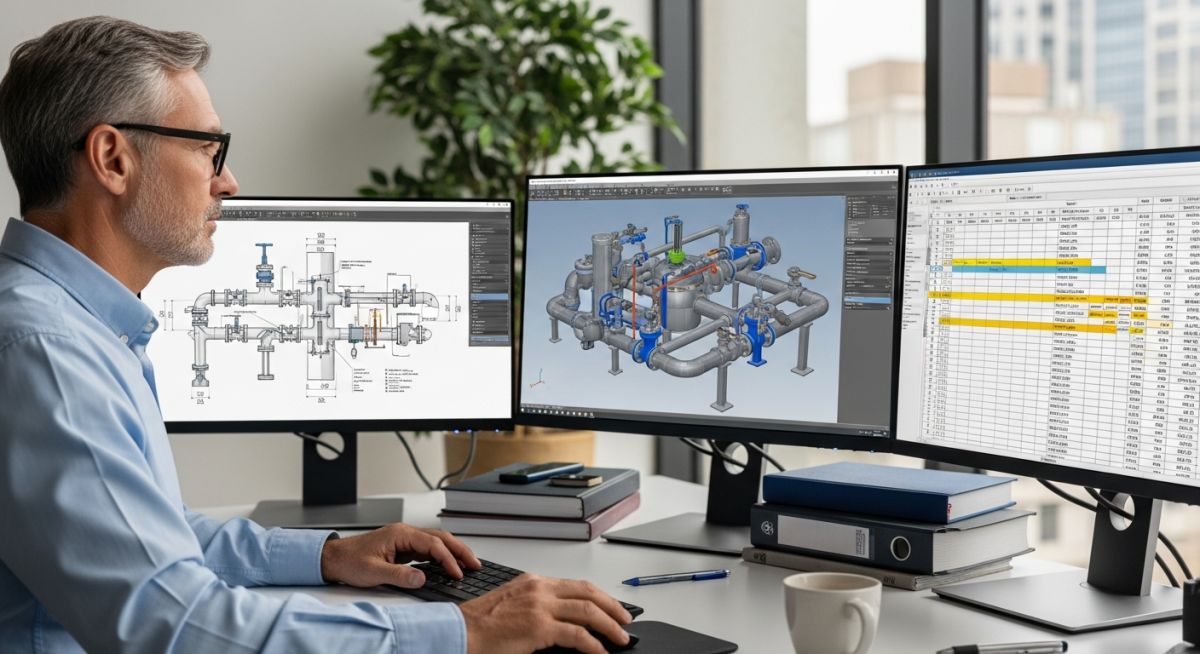
Mastering Piping Material Take-Off for Industrial Project Success
In my two decades of experience, I have seen multi-million dollar projects stall simply because the Piping Material Take-Off (MTO) was treated as a clerical task rather than an engineering discipline. An accurate MTO is the backbone of your procurement strategy, directly influencing your site’s ability to maintain construction velocity without costly field rework or material shortages.
When we perform an MTO, we are not just counting valves and fittings; we are validating the integrity of the entire piping design against the P&ID and isometric drawings. This process requires a deep understanding of material grades, pressure ratings, and the specific dimensional requirements dictated by the project’s piping classes. If your MTO is flawed, your procurement team buys the wrong items, and your field team faces the nightmare of “missing pieces” during the critical path of installation.
Key Takeaways for MTO Excellence
- Integrate MTO software with 3D modeling tools to minimize manual entry errors.
- Always account for a 5-10% wastage factor on bulk items like gaskets and bolts.
- Perform regular audits between the MTO database and the latest revision of P&IDs.
- Standardize your MTO templates to ensure consistency across different project phases.
Technical Execution of Piping Material Take-Off
Piping Material Take-Off Accuracy: The rigorous technical verification of component quantities against isometric drawings and piping specifications to ensure full compliance with ASME B31.3 pressure-temperature ratings.
Executing a precise MTO requires a structured approach that begins with the extraction of data from the 3D model or isometric drawings. I always start by verifying the Piping Class (Spec) against the project’s Master Specification Index. If the design calls for A106 Gr. B pipe, but the MTO inadvertently includes A333 Gr. 6, you are looking at a potential catastrophic failure in low-temperature service environments. You must cross-reference every line item with the ASME B31.3 code requirements for material compatibility.
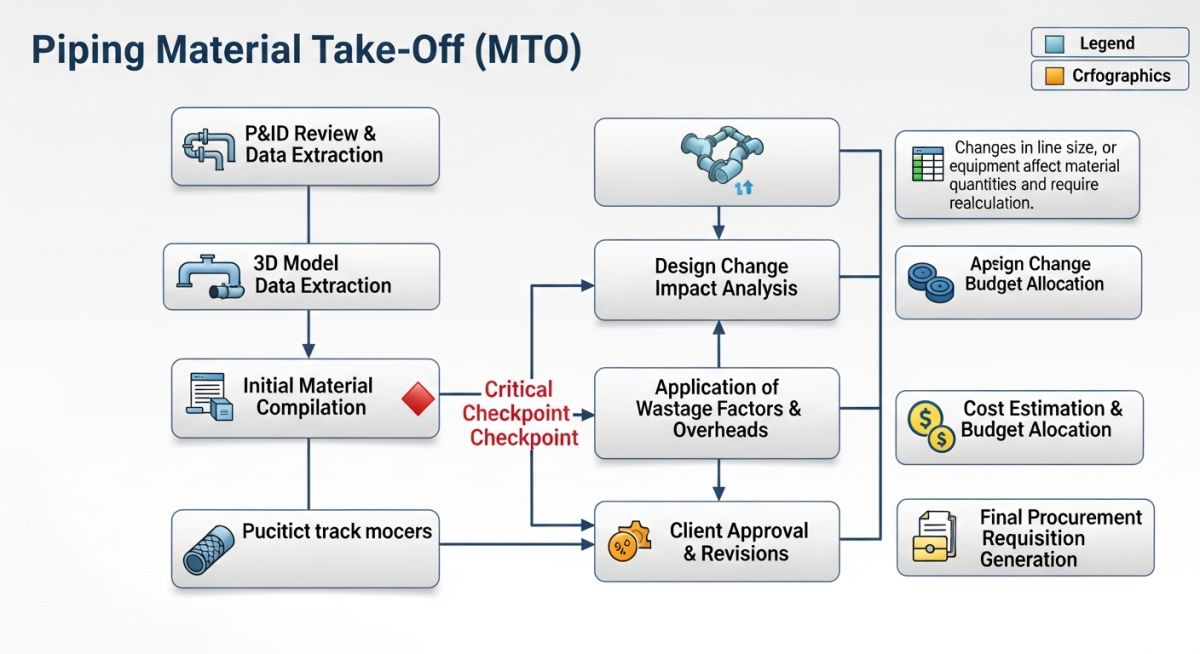
Calculating Bulk Material Requirements
When calculating bulk materials, specifically for flanges and bolting, I utilize a standard multiplier based on the flange rating and size. For instance, a 6-inch 150# flange requires 8 bolts. However, the MTO must account for the stud length, which is determined by the flange thickness plus the gasket thickness and the nut engagement length. If you fail to calculate the stud length correctly, you will find yourself with thousands of dollars in unusable hardware on-site.
Field Warning: The “Hidden” MTO Trap
Never assume that the MTO software automatically accounts for field-run piping or small-bore vents and drains. These are frequently omitted from 3D models. I mandate that my team manually adds a 15% contingency for small-bore piping (2-inch and below) to cover field-routed connections that are often finalized only during the construction phase.
Standardization and Code Compliance
Adherence to ASME B16.5 for flanges and ASME B16.9 for fittings is non-negotiable. During the MTO process, I verify that the pressure-temperature ratings of all components match the design pressure of the piping system. If the system is designed for 600 psi, every valve, fitting, and flange must be rated for that pressure class or higher. Any deviation requires a formal Management of Change (MOC) process, which should be documented within your MTO tracking system.
Finally, consider the impact of corrosion allowance. If your design specifies a 3mm corrosion allowance, your MTO must reflect the correct wall thickness (Schedule) to ensure the pipe remains compliant throughout its intended service life. I always double-check the wall thickness calculations against the ASME B31.3 pressure design formula to ensure that the selected schedule is not just procurement-ready, but structurally sound for the operating conditions.
MTO Strategic Implementation: The systematic evaluation of benefits and operational risks associated with automated versus manual piping material quantification methods in large-scale industrial projects.
Advantages
- Drastic reduction in human error through automated 3D model extraction.
- Improved procurement lead times by generating accurate, early-stage bulk orders.
- Enhanced cost control via real-time tracking of material price fluctuations.
- Seamless integration with ERP systems for automated inventory management.
- Clearer audit trails for regulatory compliance and project documentation.
Disadvantages
- High initial investment in specialized MTO software and training.
- Risk of “garbage in, garbage out” if the 3D model is poorly maintained.
- Difficulty in capturing non-modeled items like field-run small-bore piping.
- Over-reliance on software can lead to a loss of fundamental engineering oversight.
- Complexity in managing revisions across multiple engineering disciplines.
Industrial MTO Deployment: The application of precise material quantification methodologies across diverse sectors to optimize supply chain logistics and ensure structural integrity in complex piping networks.
Refinery Revamp Projects
In brownfield refinery upgrades, MTO accuracy is critical due to the limited space and the need for precise tie-in materials. We use laser scanning to update the 3D model, ensuring the MTO reflects the exact existing conditions, which prevents costly field modifications during the short turnaround windows.
Offshore Platform Piping
Weight is the primary constraint in offshore engineering, making precise MTO essential to avoid over-ordering and exceeding structural load limits. By calculating the exact weight of every valve and fitting, we ensure the platform remains within its buoyancy and structural capacity limits while maintaining safety.
Cryogenic LNG Facilities
Material selection in LNG plants is highly specialized, requiring strict adherence to low-temperature impact testing standards. Our MTO process here focuses on verifying the material certificates for every stainless steel component to ensure they meet the cryogenic service requirements defined by the project specifications.
High-Pressure Power Piping
In power generation, the MTO must account for the high-temperature creep resistance of alloy steels like P91. We track every weld and fitting to ensure that the procurement process aligns with the rigorous quality control and heat-treatment requirements necessary for high-pressure steam service.
In my two decades of experience, I have observed that the accuracy of a Piping Material Take-Off (MTO) relies heavily on the systematic categorization of components. Engineers must distinguish between bulk items, which are quantified by length or weight, and engineered items, which are tracked by individual tag numbers. This table outlines the standard classification parameters I utilize to ensure that procurement teams align their purchasing strategies with the specific requirements of ASME B31.3.
By applying these classifications early in the FEED (Front-End Engineering Design) phase, we mitigate the risk of procurement delays and site-level material shortages. Each category requires a unique approach to contingency planning, as bulk items often carry a standard 5-10% waste factor, whereas specialized valves or instrumentation components require precise, one-to-one reconciliation against the Piping and Instrumentation Diagrams (P&IDs).
| Component Category | Quantification Unit | Standard Reference | Waste Factor |
|---|---|---|---|
| Line Pipe (Carbon Steel) | Linear Meters (LM) | ASME B36.10M | 5% |
| Buttweld Fittings | Each (EA) | ASME B16.9 | 2% |
| Flanges | Each (EA) | ASME B16.5 | 1% |
| Gaskets/Bolting | Set (SET) | ASME B16.20/21 | 10% |
The following matrix serves as a technical bridge between the physical piping components and the digital data structures required for modern ERP (Enterprise Resource Planning) systems. When I manage large-scale projects, I ensure that every line item in the MTO is mapped to its corresponding material specification and pressure class to prevent cross-contamination of material grades during the procurement cycle.
This mapping is essential for maintaining the integrity of the piping design throughout the project lifecycle. By standardizing the nomenclature and technical attributes, we ensure that the procurement team, the warehouse staff, and the field installation crew are all referencing the same technical data, thereby reducing the likelihood of installation errors or non-compliant material usage on site.
| Entity | Acronym | Primary Standard | Critical Parameter |
|---|---|---|---|
| Piping Material Specification | PMS | ASME B31.3 | Pressure/Temperature Rating |
| Bill of Materials | BOM | ISO 10303 | Unique Part Number |
| Material Test Report | MTR | ASTM A999 | Chemical Composition |
Before any material is released for construction, I mandate a rigorous site verification process. Even the most accurate office-based MTO can fail if it does not account for site-specific constraints, such as existing pipe racks, structural interferences, or field-routed lines that deviate from the original isometric drawings. This checklist is designed to bridge the gap between the digital model and the physical reality of the construction site.
-
Isometric Reconciliation: Verify that the final “Issued for Construction” (IFC) isometric drawings match the MTO database exactly. -
Field Routing Check: Confirm that any field-routed piping has been measured and added to the MTO with appropriate waste factors. -
Material Compatibility: Ensure all gaskets and bolting materials are compatible with the process fluid as defined in the ASME B31.3 piping class. -
Valve Tagging: Cross-reference all valve tag numbers against the P&ID to ensure the correct pressure rating and trim material are ordered. -
Support Material: Validate that structural steel for pipe supports is included in the MTO, as these are often overlooked in pure piping take-offs.
By following this checklist, you ensure that the procurement cycle remains uninterrupted. I have seen projects stall for weeks because a simple gasket set was omitted from the initial MTO; do not let your project become a victim of such oversights. Always perform a final “walk-down” of the piping system to confirm that the physical installation matches the design intent before finalizing the procurement order.
The Challenge: MTO Discrepancy in a Brownfield Expansion
During a recent refinery expansion, we encountered a significant material shortage due to inaccurate MTO data regarding existing pipe rack capacity and routing.
- Failure to account for “as-built” deviations in the existing piping layout.
- Inconsistent application of waste factors for small-bore piping (less than 2 inches).
- Lack of coordination between the structural and piping design teams regarding support locations.
The Outcome: Optimized Procurement and Reduced Waste
By implementing a revised MTO verification protocol, we successfully recovered the project schedule and reduced material waste by 15%.
- Integrated 3D laser scanning to update the “as-built” model before finalizing the MTO.
- Standardized the waste factor calculation based on historical site data rather than generic industry averages.
- Established a weekly cross-functional review meeting to align piping and structural material requirements.
My recommendation for similar projects is to prioritize the accuracy of the “as-built” data. Never rely solely on legacy drawings; always verify the physical site conditions, especially in brownfield environments where modifications over time have likely rendered original documentation obsolete.
How do I determine the correct waste factor for piping materials?
- For standard carbon steel pipe, use a 5% factor for straight runs and 10% for complex spool configurations.
- For high-alloy or exotic materials, reduce the waste factor to 2-3% due to the high cost of the material.
- Always review historical data from previous projects of similar scope to refine these percentages.
What is the role of ASME B31.3 in MTO accuracy?
- It defines the allowable stress values for materials, which directly impacts wall thickness and weight calculations.
- It mandates the use of certified components, ensuring that the MTO only includes items that meet the required pressure-temperature ratings.
- Compliance with this standard is non-negotiable for safety and regulatory approval in process piping projects.
How should I handle MTO changes during the construction phase?
- Every field change must be documented via a Field Change Request (FCR) or a Design Change Notice (DCN).
- The MTO database must be updated in real-time to reflect these changes to prevent procurement of obsolete materials.
- Regular reconciliation meetings between the construction manager and the piping lead are essential to track these modifications.
Why is small-bore piping often excluded from initial MTOs?
- Underestimation of material quantities, leading to site delays.
- Increased reliance on field-measured lengths, which are prone to human error.
- I recommend assigning a “bulk allowance” for small-bore piping based on the total number of connections and estimated average run lengths.
What is the best software for managing piping MTOs?
- Industry standards like AVEVA E3D or Intergraph SmartPlant are excellent for large-scale projects.
- For smaller projects, a well-structured Excel database linked to the isometric extraction process can be highly effective.
- The key is not the software itself, but the consistency of the data input and the rigor of the validation process.
How do I ensure material traceability in the MTO?
- Requiring Material Test Reports (MTRs) for every batch of pipe and fittings.
- Implementing a unique heat number tracking system in the MTO database.
- Conducting regular audits of the warehouse to ensure that the physical material matches the documentation in the MTO.
📚 Recommended Resources: Piping Material Take-Off
Read these Guides
🎓 Advanced Training


Complete Course on
Piping Engineering
Check Now
Key Features
- 125+ Hours Content
- 500+ Recorded Lectures
- 20+ Years Exp.
- Lifetime Access
Coverage
- Codes & Standards
- Layouts & Design
- Material Eng.
- Stress Analysis
