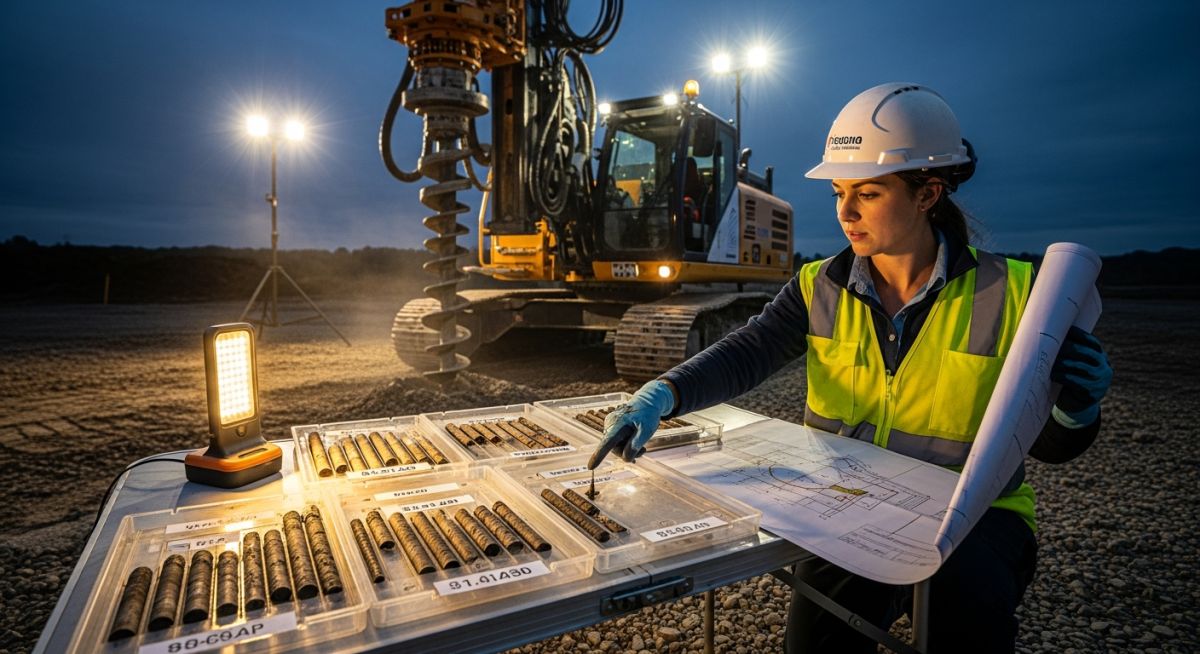
How to Prepare an RFP for Geotechnical Investigations
In my two decades of managing large-scale industrial piping and infrastructure projects, I have seen far too many schedules derailed by poorly scoped geotechnical investigations. When you issue an RFP for geotechnical services, you are not just buying drilling hours; you are purchasing the foundational data that dictates your foundation design, settlement calculations, and overall project risk profile.
A vague RFP leads to change orders, insufficient borehole density, and critical gaps in soil parameter data. This guide outlines how to structure your requirements to ensure you receive high-quality, actionable data that stands up to rigorous engineering review.
Key Takeaways for RFP Success
- Define clear borehole spacing based on structure footprint and site geology.
- Mandate specific laboratory testing suites aligned with your foundation type.
- Require comprehensive reporting that includes liquefaction analysis and bearing capacity.
- Establish strict QA/QC protocols for field logging and sample preservation.
Technical Requirements for Geotechnical Investigations
Geotechnical Investigation Scoping: The technical definition of subsurface exploration parameters, including depth, sampling frequency, and in-situ testing methods, required to satisfy structural design codes.
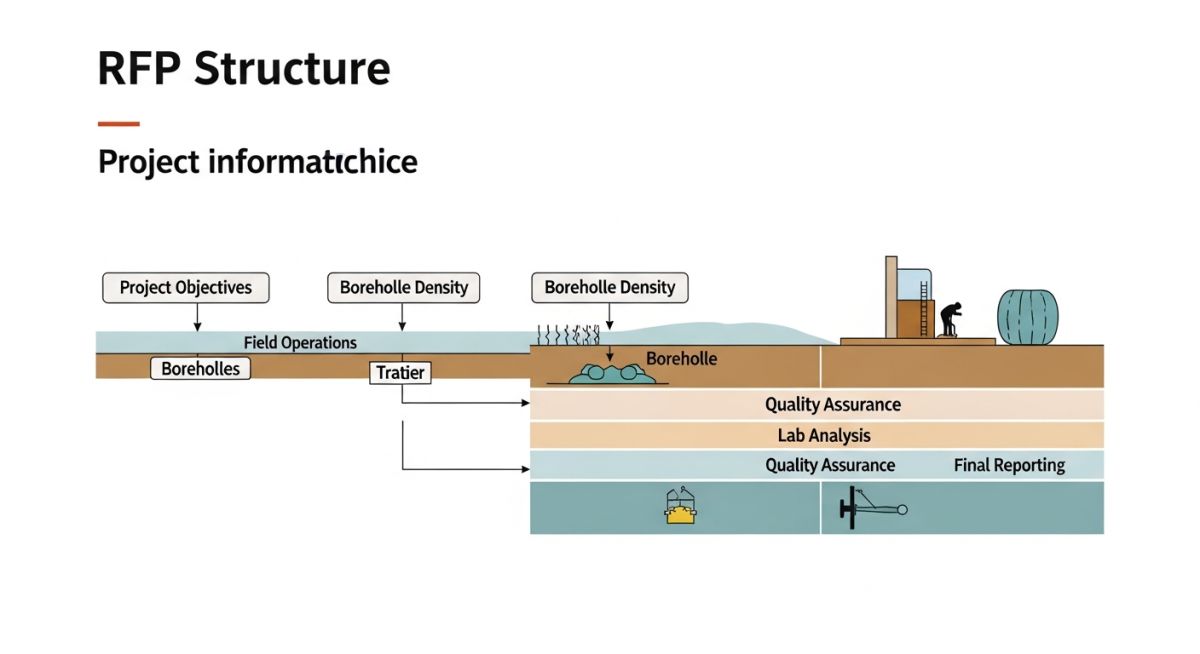
When I draft an RFP, I start by defining the minimum borehole requirements. For industrial facilities, I typically reference ASTM D1586 for Standard Penetration Testing (SPT). You must specify the grid spacing; for heavy equipment foundations, a 20-meter to 30-meter grid is often insufficient. I prefer a 15-meter grid for critical load-bearing areas to capture subsurface variability.
Field Warning: The Depth Trap
Never leave the depth of boreholes to the contractor’s discretion. Always specify a minimum depth based on the anticipated zone of influence of your foundation loads. For deep foundations, ensure boreholes extend at least 5 meters into competent rock or dense strata to confirm pile end-bearing capacity.
Laboratory Testing and Analysis
Your RFP must explicitly list the required laboratory tests. Do not simply ask for “standard testing.” You need to mandate specific suites based on your soil profile. For cohesive soils, require Atterberg Limits (ASTM D4318) and Unconfined Compressive Strength tests. For granular soils, focus on grain size distribution and relative density.
If your project involves dynamic loads, such as reciprocating compressors or large pumps, you must include cyclic triaxial testing in your RFP. This is often overlooked, leading to significant vibration issues during commissioning. Ensure the laboratory is accredited under AASHTO or equivalent national standards.
Reporting and Design Parameters
The final report is your primary deliverable. I require the consultant to provide:
- Boring logs with detailed soil classification per ASTM D2487.
- Allowable bearing capacity for shallow foundations at various depths.
- Settlement analysis, including both immediate and consolidation settlement.
- Liquefaction potential analysis if the site is in a seismic zone.
- Recommendations for ground improvement if the native soil is inadequate.
RFP Structural Efficacy: The comparative analysis of implementing a highly detailed, prescriptive RFP versus a performance-based scope for geotechnical site investigations.
Advantages of Prescriptive RFPs
- Eliminates ambiguity in contractor pricing and scope.
- Ensures all bidders provide comparable, high-quality data.
- Reduces the risk of change orders during the investigation phase.
- Provides a clear baseline for legal and technical accountability.
- Facilitates faster review of proposals by the engineering team.
Disadvantages of Over-Specification
- May inadvertently exclude innovative, cost-effective investigation methods.
- Can lead to higher costs if requirements exceed actual project needs.
- Requires significant upfront engineering time to draft correctly.
- Risk of “check-the-box” compliance rather than site-specific insight.
- Potential for rigid adherence to specs even when site conditions change.
Geotechnical RFP Deployment: The practical application of structured investigation procurement across diverse industrial and civil infrastructure sectors.
Heavy Industrial Plant Foundations
For large-scale refineries or chemical plants, the RFP must prioritize deep borehole penetration to assess soil stratification for heavy equipment loads. This ensures that vibration-sensitive machinery is supported by foundations that meet strict settlement tolerances.
Cross-Country Pipeline Infrastructure
When procuring geotechnical services for pipelines, the RFP should focus on soil corrosivity testing and slope stability analysis. These investigations are critical for determining the need for specialized pipe coatings and trench stabilization measures in varying terrain.
Offshore Wind Farm Support Structures
For offshore projects, the RFP must mandate specialized marine geotechnical investigations, including cone penetration testing (CPT) and seabed sampling. These data points are essential for designing monopile or jacket foundations that resist complex hydrodynamic and wind-induced forces.
When drafting an RFP for geotechnical investigations, the precision of your input parameters dictates the quality of the final design report. I have consistently observed that projects failing to specify minimum borehole depths or sampling frequencies often suffer from significant change orders during the foundation design phase. The following table outlines the industry-standard baseline requirements that should be explicitly requested from your geotechnical consultant to ensure compliance with ASTM D420 and ASCE guidelines.
These parameters are not merely suggestions; they represent the minimum threshold for establishing a reliable soil profile. By mandating these specific metrics, you force the consultant to provide a data set that is statistically significant for structural load calculations, settlement analysis, and seismic site classification. Always ensure that the RFP requires the consultant to justify any deviations from these standards based on site-specific geological conditions encountered during the field program.
| Parameter | Standard Requirement | Reference Standard |
|---|---|---|
| Standard Penetration Test (SPT) | Every 1.5 meters or change in strata | ASTM D1586 |
| Borehole Spacing (Structures) | 15 to 30 meters grid pattern | ASCE 20-96 |
| Undisturbed Sampling | Shelby tube in cohesive soils | ASTM D1587 |
The following matrix serves as a technical cross-reference for project managers and lead engineers to map specific site investigation deliverables against the required analytical outputs. In my experience, the most common failure point in procurement is the disconnect between field data collection and the final geotechnical design parameters required for structural foundation modeling. This matrix ensures that every field activity is directly tied to a specific design requirement, preventing the collection of “orphan data” that adds cost without providing engineering value.
By utilizing this mapping, you can verify that your RFP scope covers the full lifecycle of the investigation, from initial site reconnaissance to the final geotechnical design report. This structure is particularly useful when auditing consultant proposals, as it allows you to quickly identify missing analytical components or insufficient testing frequencies that could compromise the integrity of the foundation design. Always cross-reference these entities with your local building code requirements to ensure full regulatory compliance.
| Entity | Primary Function | Standard |
|---|---|---|
| Atterberg Limits | Soil plasticity and classification | ASTM D4318 |
| Triaxial Shear Test | Effective stress and shear strength | ASTM D4767 |
| Consolidation Test | Settlement prediction modeling | ASTM D2435 |
Geotechnical Investigation Scope Verification: Ensuring that the field investigation aligns with the project’s structural requirements is a critical step in the procurement process. This checklist provides a structured approach to verifying that your RFP requirements are met during the execution phase of the geotechnical investigation.
-
Utility Clearance: Verify that the consultant has obtained all necessary underground utility permits and performed a private utility locate before mobilization. -
Borehole Depth Verification: Confirm that the drilling rig is capable of reaching the target depth specified in the RFP, including potential refusal in rock. -
Sample Preservation: Ensure that all Shelby tubes and split-spoon samples are properly sealed and stored to prevent moisture loss or disturbance during transport. -
Groundwater Monitoring: Validate that the consultant has installed piezometers or recorded static water levels at least 24 hours after drilling completion. -
QA/QC Documentation: Review daily field logs for consistency with ASTM standards and ensure all equipment calibration certificates are current.
By systematically reviewing these items, you mitigate the risk of incomplete data sets that often lead to conservative, high-cost foundation designs. Always document any deviations from the original scope in a formal field change order to maintain a clear audit trail for the project’s geotechnical design parameters.
Field Case Study: Real-World Application
The Problem: Inadequate Borehole Depth for High-Rise Foundation
A major commercial project faced significant delays when the initial geotechnical investigation failed to penetrate the dense glacial till layer, leading to an underestimation of settlement risks.
- RFP failed to specify a minimum depth into competent bearing strata.
- Drilling equipment was undersized for the site’s geological profile.
- Lack of intermediate testing resulted in missing a soft clay lens at depth.
- Consultant relied on historical data rather than site-specific deep borings.
The Outcome: Successful Remediation and Design Optimization
By implementing a revised investigation scope, the project team successfully identified the soft clay lens and adjusted the foundation design to utilize deep piles, avoiding catastrophic settlement.
- Redrilling confirmed the presence of the soft clay lens at 25 meters.
- Foundation design was shifted from shallow footings to deep pile foundations.
- Total project cost savings achieved by avoiding post-construction settlement repairs.
- Improved site safety and structural integrity through accurate soil modeling.
My recommendation for future projects is to always include a “contingency depth” clause in your RFP, requiring the consultant to consult with the lead structural engineer if the target bearing stratum is not encountered at the anticipated depth.
Frequently Asked Engineering Questions
How do I determine the appropriate number of boreholes?
- For simple structures, use a grid spacing of 30 meters.
- For complex or high-load structures, reduce spacing to 15 meters.
- Always place at least one borehole at the location of the heaviest structural load.
- Increase density in areas with known geological variability or historical fill.
What are the essential laboratory tests for foundation design?
- Atterberg Limits (ASTM D4318) for soil classification.
- Consolidation testing (ASTM D2435) for settlement prediction in cohesive soils.
- Triaxial shear testing (ASTM D4767) for effective stress analysis.
- Sieve analysis for grain size distribution and permeability estimation.
How should I handle groundwater monitoring in the RFP?
- Installation of temporary piezometers in at least 25 percent of boreholes.
- Recording of water levels at least 24 hours after drilling to allow for stabilization.
- Reporting of seasonal high groundwater levels based on local historical data.
- Chemical testing of groundwater if the site is in an industrial area to assess potential concrete corrosion.
What is the importance of QA/QC in geotechnical investigations?
- Calibration records for all drilling and testing equipment.
- Independent review of the final geotechnical report by a licensed professional engineer.
- Verification of sample labeling and chain-of-custody documentation.
- Periodic site visits by the project owner’s representative to observe drilling procedures.
How do I define reporting requirements for the consultant?
- Detailed borehole logs with soil classification and SPT N-values.
- Site plan showing all borehole locations and site topography.
- Recommendations for foundation types, including allowable bearing capacities.
- Analysis of seismic site classification and liquefaction potential.
- Discussion of construction considerations, such as excavation support and dewatering.
What are common omissions in geotechnical RFPs?
- Failing to specify the required depth of investigation relative to the structure’s foundation level.
- Neglecting to request seismic site classification data.
- Omitting requirements for environmental soil screening if contamination is suspected.
- Not defining the format for digital data delivery, such as GIS or CAD files.
Complete Course on
Piping Engineering
Check Now
Key Features
- 125+ Hours Content
- 500+ Recorded Lectures
- 20+ Years Exp.
- Lifetime Access
Coverage
- Codes & Standards
- Layouts & Design
- Material Eng.
- Stress Analysis
