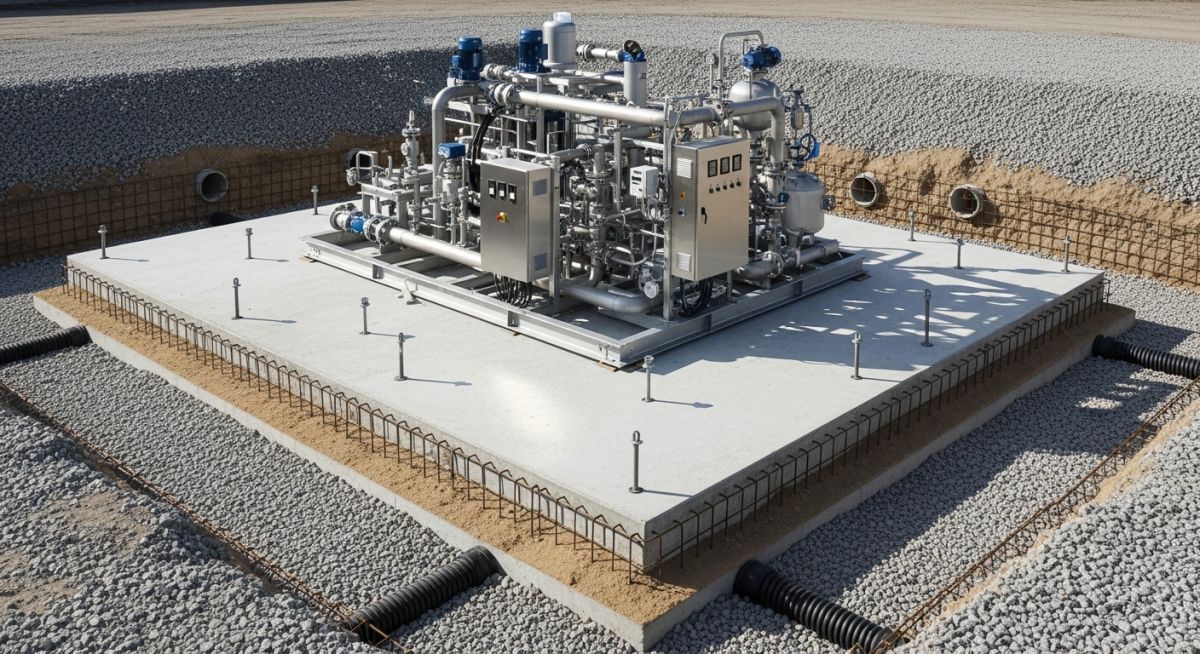
Geotechnical Considerations for Electrolyzer Facilities: A Design Guide
In my two decades of experience managing industrial piping and facility infrastructure, I have observed that the success of a green hydrogen project often hinges on the invisible work beneath the surface. Electrolyzer skids are not merely heavy; they are sensitive to differential settlement, which can induce significant stress on interconnected high-pressure piping and electrical busbars.
When we design foundations for these facilities, we are balancing the high static loads of the electrolyzer stacks with the dynamic requirements of auxiliary balance-of-plant equipment. If the geotechnical investigation is insufficient, the resulting settlement can lead to misalignment of critical process connections, potentially compromising the integrity of the entire hydrogen generation train.
Key Takeaways for Project Success:
- Prioritize site-specific geotechnical investigations to identify liquefaction potential.
- Implement strict differential settlement criteria to protect rigid piping manifolds.
- Account for dynamic loading from pumps and compressors in the foundation mass.
- Ensure drainage systems prevent groundwater saturation of the sub-base.
Geotechnical Considerations for Electrolyzer Facilities
Foundation Design Parameters: The technical evaluation of soil bearing capacity and load distribution required to ensure the structural stability of hydrogen production skids under static and operational conditions.
Designing for electrolyzer facilities requires a departure from standard warehouse foundation practices. Because these skids often feature integrated piping manifolds, the allowable differential settlement is significantly tighter than that of a standard steel structure. I typically target a maximum angular distortion of 1/500 to prevent overstressing the flange connections at the skid boundaries.
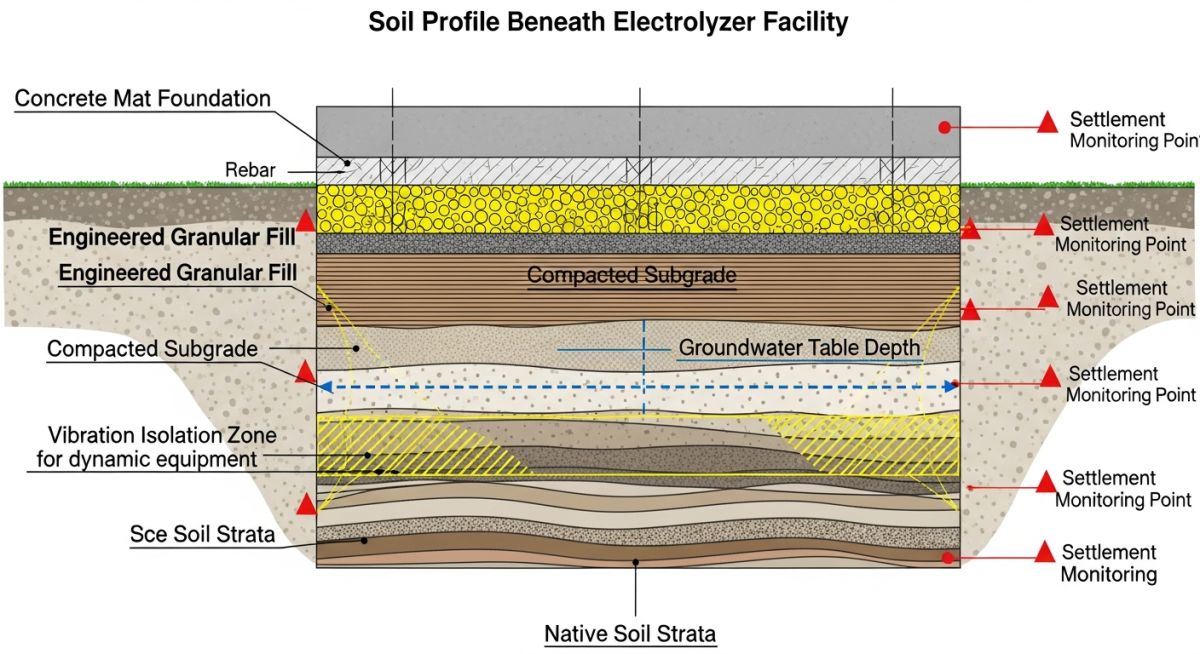
Calculating Bearing Capacity and Load Distribution
The primary calculation involves determining the ultimate bearing capacity of the soil using the Terzaghi or Meyerhof bearing capacity equations. For a typical electrolyzer skid, the load is often concentrated at the skid frame corners. We must calculate the pressure distribution under the mat foundation to ensure it does not exceed the allowable bearing pressure of the soil, typically verified through ASTM D1194 plate load tests.
Field Warning: Soil Moisture Sensitivity
In my experience, the most common failure point in hydrogen plant foundations is the neglect of groundwater fluctuations. If the water table rises, the effective stress in the soil decreases, which can lead to sudden, unexpected settlement. Always design for the highest anticipated groundwater level, not the current site conditions.
Dynamic Equipment Considerations
Electrolyzer plants are rarely static. They include high-speed pumps, cooling fans, and sometimes reciprocating compressors for hydrogen storage. These components introduce dynamic loads that can cause soil vibration and long-term densification. I recommend a dynamic soil analysis if the operating frequency of the equipment is within 20% of the natural frequency of the foundation-soil system.
To mitigate these effects, we often use a mass-heavy concrete mat foundation to increase the system’s inertia. This effectively shifts the natural frequency away from the operating frequency of the equipment, preventing resonance. Furthermore, the use of vibration isolation pads between the equipment skid and the concrete foundation is a standard practice I insist upon to decouple the dynamic forces from the primary structural slab.
Foundation Engineering Trade-offs: The comparative analysis of structural design methodologies for hydrogen facilities, balancing cost-efficiency against long-term operational reliability and maintenance requirements.
Advantages
- Rigid mat foundations provide superior protection against differential settlement for sensitive piping.
- Engineered fill layers allow for precise control over sub-grade modulus and drainage.
- Mass-heavy designs effectively dampen high-frequency vibrations from auxiliary pumps.
- Standardized concrete specifications simplify procurement and quality control on-site.
Disadvantages
- Deep excavation requirements can significantly increase project timelines and costs.
- High-mass foundations require extensive reinforcement, increasing the carbon footprint of the build.
- Complex soil stabilization techniques are often needed in high-water-table environments.
- Rigid foundations can be susceptible to cracking if thermal expansion is not managed.
Industrial Infrastructure Deployment: The practical implementation of geotechnical design standards across diverse hydrogen production environments, ensuring structural integrity for varying site conditions and operational scales.
Large-Scale PEM Electrolyzer Parks
In massive PEM electrolyzer arrays, the foundation must support hundreds of tons of equipment across a continuous slab. We utilize a post-tensioned concrete design to minimize shrinkage cracks and ensure the entire array remains perfectly level, which is critical for the uniform distribution of electrolyte fluids.
Offshore Hydrogen Production Platforms
Geotechnical considerations for offshore platforms involve extreme soil-structure interaction challenges, including wave-induced cyclic loading. We employ deep-driven pile foundations to reach stable strata, ensuring the electrolyzer skids remain operational despite the dynamic movement of the platform structure.
Brownfield Industrial Site Retrofitting
When integrating electrolyzers into existing chemical plants, we often encounter contaminated or loose fill soils. The application of deep soil mixing or jet grouting is required to improve the bearing capacity of the existing ground before the new, heavy electrolyzer foundations can be safely installed.
When designing foundations for large-scale electrolyzer skids, the geotechnical engineer must reconcile the high static weight of the equipment with the stringent settlement tolerances required for internal stack alignment. Electrolyzer modules, particularly PEM or Alkaline systems, are sensitive to differential settlement, which can induce stress on interconnecting piping and internal membrane assemblies. The following table summarizes the typical design parameters I utilize when evaluating soil bearing capacity and foundation performance for these specific industrial assets.
These values are derived from standard ASCE 7 load combinations and ACI 318 concrete design standards. It is imperative to note that site-specific soil investigation reports often supersede these general guidelines, especially in regions with high seismic activity or liquefaction potential. Always ensure that the allowable bearing pressure is verified against the actual contact area of the skid frame to prevent localized shear failure.
| Parameter | Typical Range | Standard Reference |
|---|---|---|
| Allowable Bearing Capacity | 150 – 300 kPa | ASTM D2487 |
| Total Settlement Limit | 25 mm | ASCE 7-22 |
| Differential Settlement | 1:500 slope | API 650 |
| Subgrade Modulus (k) | 25 – 80 MN/m3 | ACI 360R |
The integration of geotechnical data into the broader hydrogen plant design requires a clear understanding of how soil mechanics interact with structural and mechanical components. This matrix maps the critical entities involved in the site development phase, linking physical soil properties to the corresponding engineering standards and design requirements. By maintaining this traceability, we ensure that the foundation design remains robust against both static and dynamic loading scenarios.
In my experience, the most common failure point in green hydrogen projects is the disconnect between the geotechnical report and the structural foundation design. This matrix serves as a bridge, ensuring that the design team accounts for soil-structure interaction (SSI) effects, particularly when dealing with high-frequency vibration from auxiliary compressors or pumps associated with the electrolyzer balance-of-plant. Use this as a reference to verify that all site-specific constraints are addressed during the FEED (Front-End Engineering Design) stage.
| Entity | Standard | Primary Function |
|---|---|---|
| Soil Liquefaction | ASCE 7 | Seismic stability assessment |
| Dynamic Loading | API 618 | Vibration isolation design |
| Corrosion Potential | NACE SP0169 | Foundation reinforcement protection |
Geotechnical Considerations for Electrolyzer Facilities require a rigorous verification process before any concrete is poured. As a lead engineer, I have developed this checklist to ensure that all site-specific geotechnical risks are mitigated. Failure to validate these items can lead to catastrophic foundation failure or long-term operational downtime due to equipment misalignment.
-
Soil Bearing Capacity: Verify that the allowable bearing pressure exceeds the maximum factored load of the electrolyzer skid, including full water/electrolyte inventory. -
Groundwater Table: Confirm the depth of the water table relative to the foundation base to prevent buoyancy issues or uplift forces during construction. -
Seismic Site Class: Determine the site class per ASCE 7 to calculate the appropriate seismic design coefficients for the foundation. -
Corrosivity Testing: Perform soil resistivity and pH testing to determine if cathodic protection or sulfate-resistant cement is required for the foundation. -
Dynamic Isolation: Ensure that the foundation mass is sufficient to dampen vibrations from auxiliary pumps, preventing resonance with the electrolyzer stack.
Always document the results of these checks in the project geotechnical file. If any parameter falls outside the design envelope, a re-evaluation of the foundation type—such as moving from a slab-on-grade to a deep pile foundation—is mandatory to maintain the structural integrity of the hydrogen production unit.
Problem: Unexpected Differential Settlement in a PEM Electrolyzer Array
- The site was located on reclaimed land with varying soil density, leading to non-uniform settlement.
- The electrolyzer skid experienced a 15mm tilt over a 3-meter span, exceeding the manufacturer’s tolerance.
- Internal piping connections began to leak due to excessive stress induced by the foundation movement.
- The initial geotechnical report failed to identify a localized lens of soft organic clay beneath the primary skid location.
Outcome: Successful Remediation and Structural Stabilization
- Implemented a jet-grouting program to stabilize the soft clay lens beneath the affected foundation area.
- Installed a rigid reinforced concrete mat foundation to bridge the remaining soil variability.
- Monitored settlement using precision survey markers for six months post-remediation to ensure stability.
- Achieved a final differential settlement of less than 3mm, well within the operational requirements for the electrolyzer stack.
My recommendation for future projects is to conduct a more dense grid of soil borings in areas with known geological variability. Relying on a standard 20-meter grid is often insufficient for high-precision industrial equipment like electrolyzers.
What are the primary settlement limits for electrolyzer skids?
- Total settlement should generally not exceed 25mm to prevent piping strain.
- Differential settlement is the more critical metric, often limited to 1:500 or 1:1000 to maintain internal stack alignment.
- Exceeding these limits can lead to internal membrane damage or seal failure, which are costly to repair.
- Always consult the specific OEM (Original Equipment Manufacturer) manual, as some high-capacity PEM systems have even tighter tolerances.
How does groundwater affect foundation design for hydrogen plants?
- Buoyancy forces can cause foundation uplift if the structure is not sufficiently heavy or anchored.
- Saturated soils may lose bearing capacity, requiring soil improvement or deep foundations.
- Construction dewatering is often necessary, which can cause settlement in adjacent structures if not managed correctly.
- Corrosion protection for concrete and steel reinforcement must be enhanced if the groundwater is aggressive or contains high sulfate levels.
Why is dynamic equipment consideration important for electrolyzers?
- Resonance between the equipment frequency and the foundation natural frequency can lead to excessive amplitude.
- Vibration can cause fatigue in piping connections and electrical terminations.
- Foundation mass must be designed to dampen these vibrations, often requiring inertia blocks or vibration isolation pads.
- Consult API 618 for reciprocating compressor foundation design guidelines, which are often applicable to hydrogen plant auxiliary equipment.
What soil testing is required for a green hydrogen plant?
- Standard Penetration Tests (SPT) to determine soil density and bearing capacity.
- Cone Penetration Tests (CPT) for continuous soil profiling and liquefaction assessment.
- Laboratory testing including Atterberg limits, sieve analysis, and moisture content.
- Chemical analysis of soil and groundwater to assess corrosivity for buried steel and concrete.
- Seismic shear wave velocity testing to determine the site class for seismic design.
How do I mitigate liquefaction risk in seismic zones?
- Ground improvement techniques such as vibro-compaction, stone columns, or deep soil mixing.
- Deep foundation systems like piles or drilled shafts that bypass the liquefiable soil layers.
- Site selection to avoid areas with loose, saturated, cohesionless soils.
- Rigid mat foundations that can bridge localized liquefaction zones, though this requires careful structural analysis.
- Always refer to ASCE 7 for the latest seismic hazard mapping and liquefaction potential analysis procedures.
What is the role of cathodic protection in foundation design?
- Preventing the corrosion of steel reinforcement bars (rebar) within the concrete foundation.
- Mitigating the effects of stray currents from electrical equipment or nearby power grids.
- Extending the service life of the foundation in aggressive soil conditions, such as high-salinity or acidic environments.
- Compliance with NACE standards for corrosion control, which is a standard requirement for long-term industrial asset management.
Complete Course on
Piping Engineering
Check Now
Key Features
- 125+ Hours Content
- 500+ Recorded Lectures
- 20+ Years Exp.
- Lifetime Access
Coverage
- Codes & Standards
- Layouts & Design
- Material Eng.
- Stress Analysis

📚 Recommended Resources: Geotechnical
Read these Guides
- 📄 Managing Geotechnical Risks in Solar Projects: A Technical Engineering Guide
- 📄 Essential Geotechnical Pile Design Data for Utility-Scale Solar Structures
- 📄 Geotechnical Investigation for Solar Farms: Essential Site Design Guide
- 📄 Geotechnical Requirements for Data Centres: A Structural Engineering Guide