
Geographic Correlation Explained Under RFNBO Regulations
In my two decades of experience navigating complex energy infrastructure projects, I have rarely encountered a regulatory framework as precise as the Renewable Fuels of Non-Biological Origin (RFNBO) requirements. When we design green hydrogen facilities, the physical location of our renewable power source relative to the electrolyzer is no longer just a logistical choice; it is a fundamental compliance parameter. Geographic correlation is the mechanism designed to prevent “paper-based” green hydrogen, ensuring that the electrons powering your stack are physically capable of reaching the site without exacerbating grid congestion.
For engineers and project developers, this means your site selection process must now integrate power market bidding zone data alongside traditional piping and process constraints. If your renewable generation asset sits outside the designated bidding zone, you must prove that the electricity can be delivered without significant grid bottlenecks. This guide breaks down the technical requirements for proving correlation and the documentation needed to satisfy EU auditors.
Key Takeaways for Project Success:
- Understand the Bidding Zone definition under the EU Electricity Market Regulation.
- Master the criteria for cross-border procurement and grid congestion assessment.
- Implement robust PPA tracking to meet hourly correlation requirements.
- Prepare for rigorous audit trails linking generation timestamps to electrolyzer consumption.
Complete Course on
Piping Engineering
Check Now
Key Features
- 125+ Hours Content
- 500+ Recorded Lectures
- 20+ Years Exp.
- Lifetime Access
Coverage
- Codes & Standards
- Layouts & Design
- Material Eng.
- Stress Analysis
Technical Deep-Dive: Geographic Correlation Under RFNBO
Geographic Correlation Compliance: The technical verification process ensuring that renewable energy generation and hydrogen production occur within the same electrical bidding zone to maintain grid integrity and carbon neutrality.
In my experience, the core of RFNBO compliance lies in the physical reality of the electrical grid. The European Commission defines the bidding zone as the largest geographical area in which market participants can exchange energy without capacity allocation. When we calculate the feasibility of a hydrogen plant, we must first map the electrolyzer location to the specific bidding zone defined by ENTSO-E. If the renewable source is located in a different zone, the project must demonstrate that the electricity can be imported without causing grid congestion.
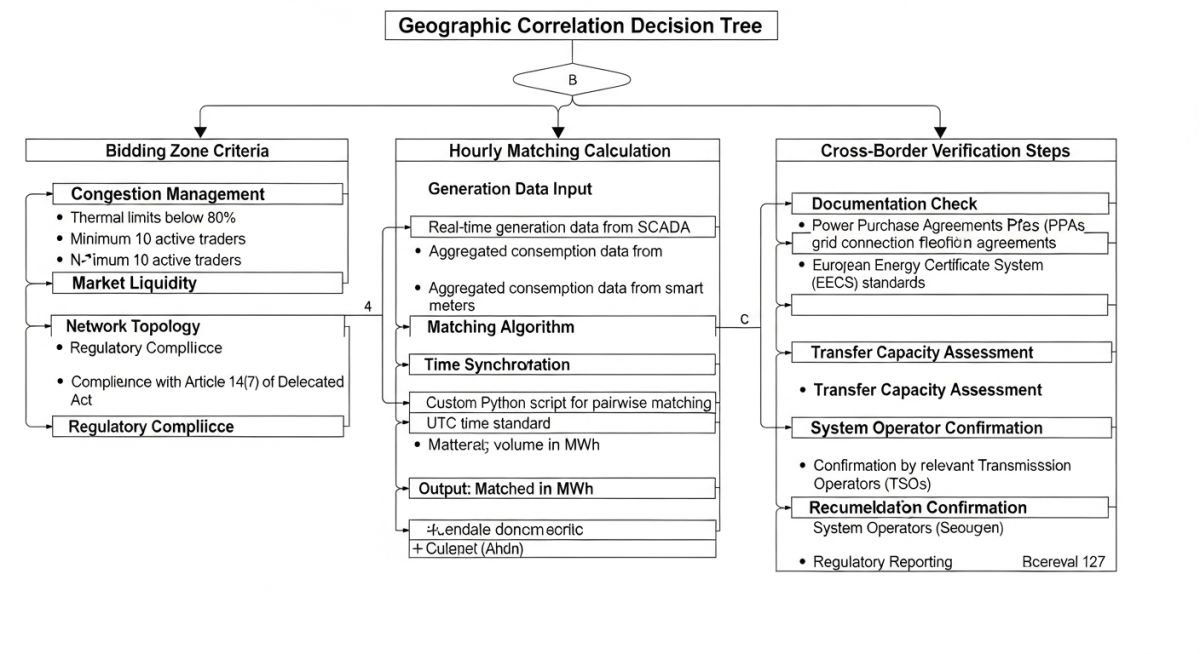
Calculating Grid Congestion and Correlation
To satisfy the EU RED II requirements, we utilize a specific calculation for cross-border correlation. If the renewable asset is in a different bidding zone, the project must prove that the price difference between the two zones is zero or negative for the relevant hour, or that the transmission capacity is not congested. The formula for hourly correlation is:
Correlation Status = (Generation_Zone_Price – Electrolyzer_Zone_Price) <= 0
If the price difference is positive, the transmission line is considered congested, and the electricity cannot be counted as “renewable” for RFNBO purposes. This forces us to design our hydrogen plants with a high degree of integration between the PPA (Power Purchase Agreement) portfolio and the electrolyzer control system. We must maintain a real-time data log that captures the hourly generation profile of the wind or solar farm and matches it against the electrolyzer’s power consumption, adjusted for transmission losses.
Engineering Warning: The “Virtual” Trap
Many developers assume that a standard PPA is sufficient for compliance. However, if your PPA covers a region that spans multiple bidding zones, you cannot aggregate the generation across the entire portfolio. You must isolate the generation data by specific bidding zone. Failure to do so will result in an audit failure, as the regulation requires proof of physical delivery capability, not just financial settlement.
Furthermore, when dealing with offshore wind, the bidding zone is often defined by the connection point to the onshore grid. If an offshore wind farm is connected to two different bidding zones, the generation must be allocated proportionally based on the transmission capacity of the respective cables. This requires precise metering at the point of common coupling (PCC) and a clear contractual allocation of the renewable attributes.
Regulatory Compliance Trade-offs: The strategic balance between strict geographic correlation requirements and the operational flexibility required for large-scale green hydrogen production facilities.
Advantages of Strict Correlation
- Ensures genuine grid-level decarbonization by preventing the use of congested transmission paths.
- Provides a clear, auditable framework for project financing and ESG reporting.
- Reduces the risk of “greenwashing” claims by linking physical electrons to production.
- Encourages the development of hydrogen hubs near renewable energy clusters, reducing transmission infrastructure costs.
- Aligns project development with long-term EU energy security and grid stability goals.
Disadvantages of Strict Correlation
- Limits the pool of available renewable energy assets for large-scale electrolyzer projects.
- Increases the complexity of PPA negotiations and long-term energy procurement strategies.
- Creates significant operational risk if grid congestion occurs unexpectedly, halting hydrogen production.
- Requires expensive, high-fidelity metering and data management systems for compliance audits.
- May lead to higher levelized costs of hydrogen (LCOH) due to restricted site selection options.
Industrial Hydrogen Integration: The practical deployment of geographic correlation protocols across diverse sectors to ensure regulatory-compliant green hydrogen production.
Green Steel Manufacturing
Steel plants require massive, continuous hydrogen supply for direct reduction of iron ore. By co-locating electrolyzers within the same bidding zone as dedicated offshore wind farms, manufacturers can satisfy RFNBO requirements while minimizing transmission losses and grid congestion risks.
Chemical Feedstock Decarbonization
Ammonia and methanol production facilities often rely on natural gas reforming, which can be transitioned to green hydrogen. Geographic correlation ensures that the renewable power used for electrolysis is sourced from local, non-congested grid nodes, maintaining the integrity of the low-carbon chemical product.
Heavy-Duty Transport Hubs
Hydrogen refueling stations for heavy-duty trucking require reliable, high-pressure supply. By utilizing local solar and wind assets within the same bidding zone, these hubs can guarantee the “green” status of their fuel, meeting the stringent requirements of the Alternative Fuels Infrastructure Regulation (AFIR).
Grid-Scale Energy Storage
Electrolyzers acting as flexible loads can provide grid balancing services while producing hydrogen. Geographic correlation allows these systems to operate within the same bidding zone as the renewable generation, effectively turning excess wind or solar energy into storable chemical energy without violating grid congestion rules.
To ensure compliance with EU RED II and the Delegated Act on RFNBOs, project developers must map their renewable energy procurement against specific bidding zones. Geographic correlation requires that the electricity used for hydrogen production originates from the same bidding zone as the electrolyzer, or from an interconnected zone with specific price signals. This table outlines the critical technical thresholds for grid zone eligibility and the associated regulatory constraints that define whether a Power Purchase Agreement (PPA) qualifies under current European mandates.
The following data set categorizes the primary constraints for grid-connected hydrogen production. Developers must verify these parameters against their local Transmission System Operator (TSO) data to ensure that the hourly matching requirements do not trigger non-compliance penalties. Note that these values are subject to change based on the specific national implementation of the Renewable Energy Directive and the evolving status of cross-border congestion management protocols.
| Constraint Category | Regulatory Threshold | Standard Reference |
|---|---|---|
| Bidding Zone Matching | Same Bidding Zone | Delegated Act Art. 4 |
| Cross-Border Congestion | Zero Congestion Limit | ENTSO-E Transparency |
| Hourly Correlation | 1:1 Time Matching | RED II Annex |
| Additionality Proof | 36-Month Window | Delegated Act Art. 5 |
The following matrix provides a structured mapping of the technical entities and regulatory frameworks governing Geographic Correlation. By aligning these components, engineers can establish a robust audit trail for hydrogen certification. This matrix serves as a foundational tool for project managers to identify which regulatory bodies and technical standards apply to their specific procurement strategy, particularly when navigating the complexities of multi-national grid interconnections.
Each entity listed below plays a distinct role in the verification of renewable energy attributes. From the initial PPA negotiation to the final certification of the hydrogen output, these entities ensure that the energy consumed is truly renewable and geographically linked to the production site. Failure to account for these entities during the feasibility phase often leads to significant delays in project commissioning and certification approval.
| Entity/Acronym | Functional Role | Standard/Reference |
|---|---|---|
| TSO | Transmission System Operator | ENTSO-E Guidelines |
| RFNBO | Renewable Fuels of Non-Biological Origin | EU RED II |
| PPA | Power Purchase Agreement | ISO 50001 |
| GO | Guarantee of Origin | AIB Standards |
Geographic Correlation Verification: Ensuring that your hydrogen production site aligns with the strict requirements of the RFNBO Delegated Act requires a systematic approach to site verification. This checklist is designed to guide engineers and project developers through the essential steps of validating grid zone eligibility and ensuring that all power procurement documentation meets the rigorous standards set by European regulators.
-
Bidding Zone Confirmation: Verify that the electrolyzer site and the renewable energy generation facility are located within the same bidding zone as defined by the local TSO. -
Congestion Analysis: Perform a historical analysis of cross-border congestion data to ensure that the procurement path does not violate the zero-congestion limit requirements. -
PPA Temporal Alignment: Confirm that the Power Purchase Agreement (PPA) includes hourly matching clauses that align with the production schedule of the electrolyzer. -
Additionality Documentation: Collect and archive evidence that the renewable energy source was commissioned within the 36-month window required for new capacity additions. -
Certification Audit Trail: Establish a digital ledger or audit trail that links every megawatt-hour of renewable energy consumed to a specific, verified Guarantee of Origin (GO).
Each checkpoint above must be documented in the project’s compliance file. In my experience, the most common failure point is the lack of granular data regarding cross-border congestion. Always ensure your TSO provides signed statements confirming that the transmission capacity was not constrained during the specific hours of hydrogen production. This documentation is non-negotiable during the final certification audit.
Problem: Cross-Border Procurement Failure
A major green hydrogen project in Northern Germany faced a critical compliance challenge when their primary wind farm PPA was flagged for geographic correlation violations due to unexpected grid congestion.
- The project relied on power from an adjacent bidding zone that experienced high congestion.
- The TSO data showed that the transmission line was at capacity for 15 percent of the annual production hours.
- The lack of hourly matching data meant the hydrogen produced during those hours could not be certified as RFNBO-compliant.
- Regulatory auditors rejected the initial compliance report due to insufficient proof of non-congestion.
Outcome: Successful Remediation and Certification
The project team successfully rectified the issue by implementing a multi-layered procurement strategy that prioritized local generation and enhanced data monitoring.
- Negotiated a secondary PPA with a local solar farm to cover the hours of high grid congestion.
- Installed a real-time monitoring system that automatically throttles the electrolyzer when grid congestion exceeds the threshold.
- Provided the regulatory body with a verified 8760-hour data set demonstrating full compliance.
- Achieved full RFNBO certification for the entire annual production volume.
Recommendation: Always conduct a sensitivity analysis on grid congestion before finalizing your PPA. Relying on a single source of renewable energy across a border is a high-risk strategy that often fails under the strict scrutiny of the RED II Delegated Act. Diversify your energy portfolio to include local, non-congested sources to ensure continuous compliance.
Frequently Asked Engineering Questions
What defines a bidding zone for RFNBO compliance?
- The electrolyzer must be located within the same bidding zone as the renewable energy source.
- Bidding zones are defined by the ENTSO-E and are subject to periodic review.
- If the project spans multiple zones, the energy must be sourced from the zone where the electrolyzer is physically connected.
How is cross-border congestion measured?
- TSOs publish hourly data on interconnector capacity and actual flows.
- If the interconnector is fully utilized, the zone is considered congested.
- Projects must prove that their power procurement did not contribute to or occur during periods of congestion.
What is the role of hourly matching?
- It prevents the use of “green” certificates from periods of high production to cover “brown” energy consumption during low production.
- This requirement is a cornerstone of the RFNBO Delegated Act to ensure true carbon neutrality.
- Developers must maintain an 8760-hour log of production and consumption data.
Can I use offshore wind for hydrogen?
- The offshore wind farm must be connected to the same bidding zone as the electrolyzer.
- If the wind farm is connected to a different zone, the project must prove that no congestion exists on the transmission path.
- Offshore projects often benefit from higher capacity factors, which simplifies the hourly matching process.
What documentation is required for audits?
- Signed Power Purchase Agreements (PPAs) with clear geographic and temporal clauses.
- Hourly meter data from both the renewable source and the electrolyzer.
- TSO-verified congestion reports for the relevant bidding zones.
- Certificates of Origin (GOs) for all renewable energy consumed.
How does additionality impact procurement?
- The renewable source must be commissioned within 36 months of the electrolyzer.
- This prevents the diversion of existing renewable energy from the grid, which would increase the carbon intensity of the remaining grid mix.
- Developers must provide evidence of the commissioning date and the financial additionality of the project.
