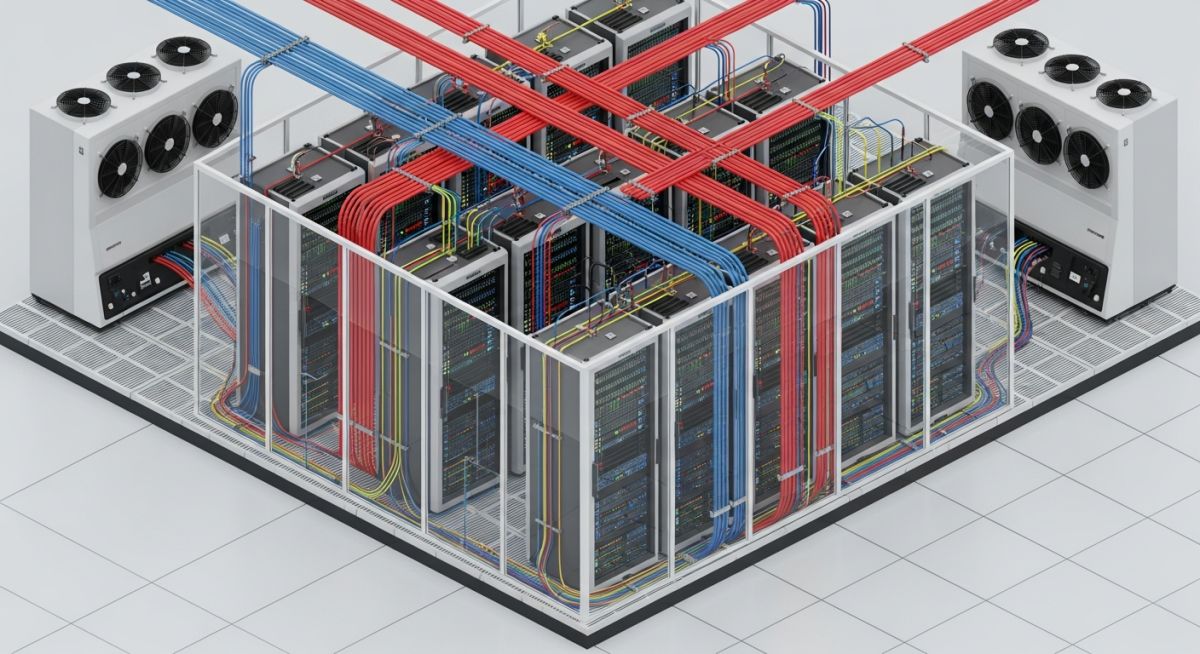
Data Centre Energy Efficiency and PUE Explained
In my two decades of engineering, I have witnessed the evolution of data centres from simple server rooms to massive, energy-hungry industrial facilities. Achieving true data centre energy efficiency is no longer just a sustainability goal; it is a fundamental requirement for operational viability and cost control. As power densities climb, the gap between total facility power and actual IT load—the core of the PUE metric—becomes the primary battlefield for facility managers and engineers.
This guide dissects the mechanics of energy consumption, moving beyond basic definitions to explore how we calculate, monitor, and improve performance. We will look at the interplay between HVAC systems, uninterruptible power supplies (UPS), and server utilization to ensure your facility operates at peak efficiency.
Key Takeaways:
- Master the PUE formula: Total Facility Power divided by IT Equipment Power.
- Identify the hidden energy sinks in cooling and power distribution.
- Implement ASHRAE TC 9.9 thermal guidelines for immediate efficiency gains.
- Understand the impact of UPS efficiency modes on overall facility PUE.
Understanding Data Centre Energy Efficiency and PUE
PUE Calculation Fundamentals: The Power Usage Effectiveness (PUE) metric provides a standardized ratio of total facility energy consumption to the energy delivered specifically to IT equipment, serving as the industry benchmark for infrastructure performance.
To calculate PUE, we must isolate the energy consumed by the IT load from the energy consumed by the support infrastructure. The formula is straightforward: PUE equals Total Facility Power divided by IT Equipment Power. However, the complexity lies in the measurement points. According to ASHRAE standards, IT equipment power must be measured at the output of the PDU (Power Distribution Unit) to ensure we are capturing the actual load delivered to the servers, excluding losses from the UPS and distribution cabling.
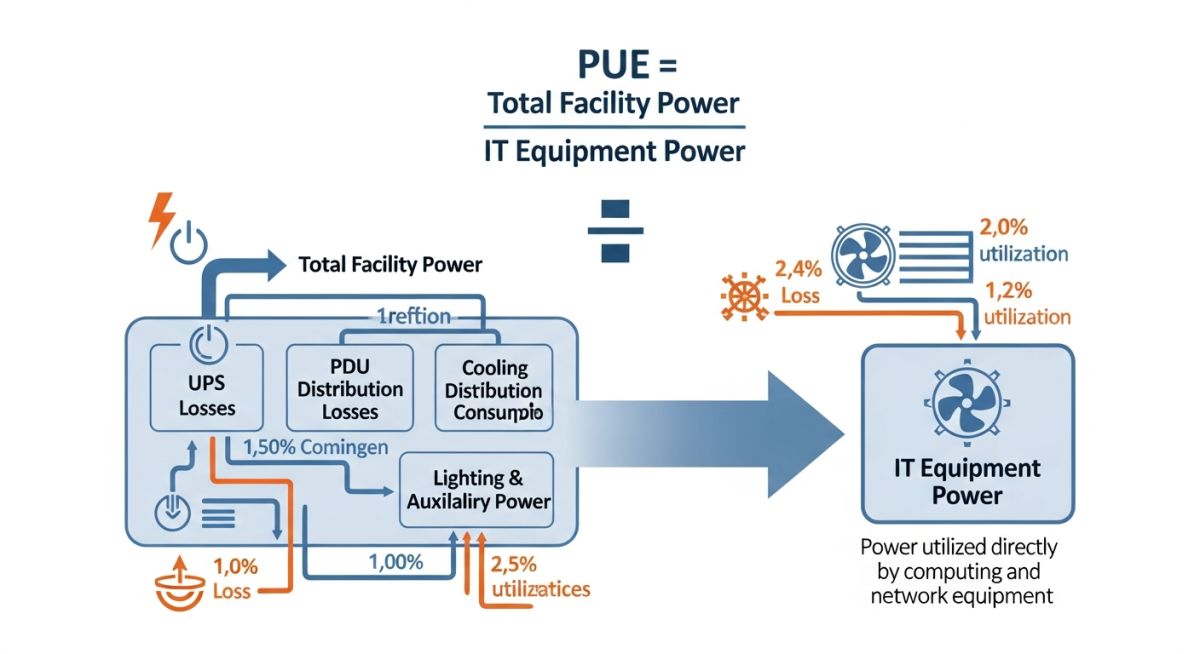
In my experience, the most common error in PUE calculation is the inclusion of non-IT loads in the denominator. If you measure at the utility meter, you are capturing the entire facility, but you must subtract the cooling, lighting, and power conversion losses to arrive at the true IT load. A PUE of 1.0 represents perfect efficiency, where every watt of power is used by the IT equipment. Most legacy facilities operate between 1.8 and 2.5, while modern hyperscale facilities strive for 1.1 to 1.2.
Field Warning: Measurement Accuracy
Inaccurate sensor placement is the silent killer of efficiency programs. If your PDU meters are not calibrated annually, your PUE data will drift, leading to false conclusions about cooling optimization. Always ensure that your measurement points align with the ISO/IEC 30134-2 standard for data centre resource efficiency.
Cooling optimization is the largest lever for improving PUE. By increasing the supply air temperature to the server inlets, we reduce the load on chillers and CRAC (Computer Room Air Conditioner) units. Following ASHRAE TC 9.9 guidelines, many modern facilities now operate at inlet temperatures up to 27 degrees Celsius. This shift allows for increased use of economizers (free cooling), which bypasses mechanical refrigeration entirely during cooler ambient conditions.
Electrical optimization focuses on the conversion chain. UPS systems often operate at lower efficiencies when running at partial loads. By right-sizing the UPS capacity to match the actual IT load, we can significantly reduce heat rejection requirements and power waste. Furthermore, high-efficiency transformers and busway distribution systems minimize the I-squared-R losses that plague older cable-heavy designs.
Efficiency Metric Implementation: The adoption of PUE as a primary KPI allows for quantifiable infrastructure benchmarking, though it requires rigorous measurement discipline to avoid data skewing.
Advantages
- Provides a clear, universal language for comparing facility performance across global portfolios.
- Identifies specific infrastructure subsystems that are underperforming or wasting energy.
- Justifies capital expenditure for high-efficiency cooling and power equipment.
- Enables real-time monitoring of the impact of operational changes on energy costs.
Disadvantages
- Does not account for IT hardware efficiency, potentially masking inefficient server utilization.
- Can be manipulated by excluding certain support loads or using inaccurate measurement points.
- Focuses solely on energy, ignoring water usage effectiveness (WUE) or carbon intensity.
- Requires significant investment in sub-metering infrastructure to be truly accurate.
Infrastructure Performance Optimization: Applying energy efficiency metrics across diverse operational environments ensures that both legacy retrofits and new builds meet modern sustainability and cost-reduction targets.
Hyperscale Cloud Infrastructure
In hyperscale environments, PUE is the primary driver for massive-scale cooling design, often utilizing direct evaporative cooling to achieve PUE values near 1.05. These facilities leverage automated control loops that adjust fan speeds and water flow based on real-time server inlet temperatures, ensuring that cooling energy is only expended exactly where and when it is needed.
Legacy Enterprise Data Centre Retrofits
For older facilities, the application of PUE metrics involves a phased approach to replacing aging CRAC units with high-efficiency in-row cooling solutions. By installing hot-aisle containment systems, engineers can prevent the mixing of supply and return air, which drastically reduces the bypass airflow and allows for higher setpoints on the cooling plant.
Edge Computing Deployments
Edge data centres present unique challenges due to their distributed nature and lack of dedicated facility staff. Here, PUE is used to validate the performance of modular, self-contained micro-data centres that utilize passive cooling or integrated heat exchangers, ensuring that the energy footprint remains minimal even in remote or non-traditional building environments.
To achieve operational excellence in modern facilities, engineers must rely on standardized performance metrics that quantify energy distribution. The following table outlines the critical efficiency indicators that define the relationship between IT load and facility-wide power consumption, as established by The Green Grid and ASHRAE guidelines.
These metrics allow for the granular assessment of cooling, lighting, and power conversion losses. By tracking these values, facility managers can identify specific subsystems that deviate from design specifications, enabling targeted retrofits that significantly lower the total Power Usage Effectiveness (PUE) of the data centre environment.
| Metric | Definition | Target Range |
|---|---|---|
| PUE | Total Facility Power / IT Equipment Power | 1.2 to 1.5 |
| DCIE | IT Equipment Power / Total Facility Power | 65% to 85% |
| CUE | Total Carbon Emissions / IT Equipment Power | Site Dependent |
The following matrix maps the core technical entities involved in data centre energy management to their respective industry standards and physical parameters. This mapping is essential for engineers performing site audits or designing new high-density server halls, as it ensures that every component—from the uninterruptible power supply (UPS) to the computer room air conditioning (CRAC) units—aligns with global sustainability benchmarks.
By cross-referencing these entities, you can maintain compliance with ISO 50001 energy management systems. This structured approach prevents the common pitfall of siloed optimization, where improving one subsystem inadvertently degrades the performance of another, such as increasing fan speeds to compensate for poor airflow management.
| Entity | Standard | Primary Parameter |
|---|---|---|
| UPS Systems | IEC 62040 | Efficiency at partial load |
| HVAC/CRAC | ASHRAE TC 9.9 | Inlet temperature/humidity |
| Power Distribution | NFPA 70 | Voltage drop and harmonics |
Data Centre Efficiency Audit: A systematic verification of facility infrastructure is required to maintain optimal PUE levels. This checklist serves as a baseline for engineers to conduct site-wide assessments, ensuring that mechanical and electrical systems operate within their design envelopes while minimizing parasitic energy losses.
- Airflow Management: Verify that all blanking panels are installed in empty rack spaces to prevent hot air recirculation.
- Temperature Setpoints: Confirm that cold aisle temperatures align with ASHRAE recommended ranges (18 to 27 degrees Celsius).
- UPS Efficiency: Check for high-efficiency “eco-mode” settings on UPS units, ensuring they do not compromise power quality or redundancy requirements.
- Lighting Controls: Ensure motion sensors are active in all server halls and support areas to reduce non-essential power draw.
- Power Metering: Validate that branch circuit monitoring is calibrated and reporting data to the DCIM software at 15-minute intervals.
Regular verification of these points is not merely a maintenance task but a core engineering requirement. By documenting these checks, you create a historical performance log that is invaluable for future capacity planning and energy reduction initiatives. Always cross-reference your findings with the original design intent and the current IEEE standards for power distribution.
Field Case Study: Real-World Application
Problem: High PUE in Legacy Facility
A mid-sized data centre reported a PUE of 2.1, significantly higher than the industry average, primarily due to inefficient cooling distribution and legacy UPS hardware.
- Excessive bypass air through cable cutouts in the raised floor.
- UPS units operating at 60% load, resulting in high conversion losses.
- Lack of containment, leading to mixing of supply and return air streams.
- Over-cooling of the entire room to compensate for localized hot spots.
Outcome: Optimized Efficiency Gains
Following a targeted retrofit, the facility achieved a PUE reduction to 1.45, representing a 30% improvement in energy efficiency.
- Installation of hot aisle containment systems reduced cooling demand by 18%.
- Replacement of legacy UPS with modular, high-efficiency units improved conversion efficiency by 5%.
- Sealing of floor penetrations eliminated bypass air, allowing for higher supply air temperatures.
- Implementation of variable frequency drives on CRAC fans saved 12% in annual fan energy.
My recommendation for similar facilities is to prioritize low-cost airflow management improvements before investing in expensive hardware replacements. Often, the most significant gains in PUE are found in the physical organization of the white space rather than the mechanical plant itself.
Frequently Asked Engineering Questions
How does partial load affect UPS efficiency?
- Internal components like transformers and rectifiers have fixed losses that remain constant regardless of load.
- Modern modular UPS systems allow for “sleep” modes where individual power modules shut down during low-load periods.
- Engineers should size UPS systems to operate in the 60% to 80% load range to maximize efficiency per IEC 62040.
What is the role of DCIM in PUE tracking?
- It aggregates data from power meters, sensors, and cooling units into a centralized dashboard.
- DCIM allows for the correlation of IT workload spikes with energy consumption, identifying inefficient server utilization.
- Automated reporting ensures compliance with sustainability audits by providing granular, time-stamped energy data.
Can higher inlet temperatures improve PUE?
- ASHRAE guidelines now support wider temperature ranges, reducing the need for mechanical refrigeration.
- Higher setpoints decrease the temperature difference between the supply air and the ambient environment.
- Engineers must ensure that server hardware is rated for these higher temperatures to avoid reliability issues.
How do harmonics affect electrical efficiency?
- This heat represents wasted energy, which increases the total facility power draw without contributing to IT output.
- Harmonics can also cause nuisance tripping of circuit breakers, impacting facility availability.
- Installing harmonic filters or K-rated transformers helps mitigate these losses and improves overall power quality.
What is the difference between PUE and DCIE?
- PUE (Power Usage Effectiveness) is the ratio of total facility power to IT equipment power, where lower is better.
- DCIE (Data Centre Infrastructure Efficiency) is the reciprocal, representing the percentage of total power used by IT equipment.
- While PUE is the industry standard, DCIE provides a more intuitive percentage-based view of how much energy is actually “productive.”
Why is containment critical for efficiency?
- Without containment, cooling units must work harder to overcome the thermal bypass, leading to higher fan energy consumption.
- Containment allows for higher return air temperatures, which improves the efficiency of the chiller plant.
- It is one of the most cost-effective ways to increase the cooling capacity of an existing data centre without adding new CRAC units.
Complete Course on
Piping Engineering
Check Now
Key Features
- 125+ Hours Content
- 500+ Recorded Lectures
- 20+ Years Exp.
- Lifetime Access
Coverage
- Codes & Standards
- Layouts & Design
- Material Eng.
- Stress Analysis

📚 Recommended Resources: Data Centre Energy Efficiency
Read these Guides
- 📄 Renewable Energy for Data Centres: Engineering Sustainable Infrastructure Solutions
- 📄 Battery Energy Storage Systems for Data Centres: Engineering Design Guide
- 📄 Liquid Cooling for AI Data Centres: Engineering High-Density Thermal Solutions
- 📄 Data Centre Cooling Systems: Engineering Design and Efficiency Standards