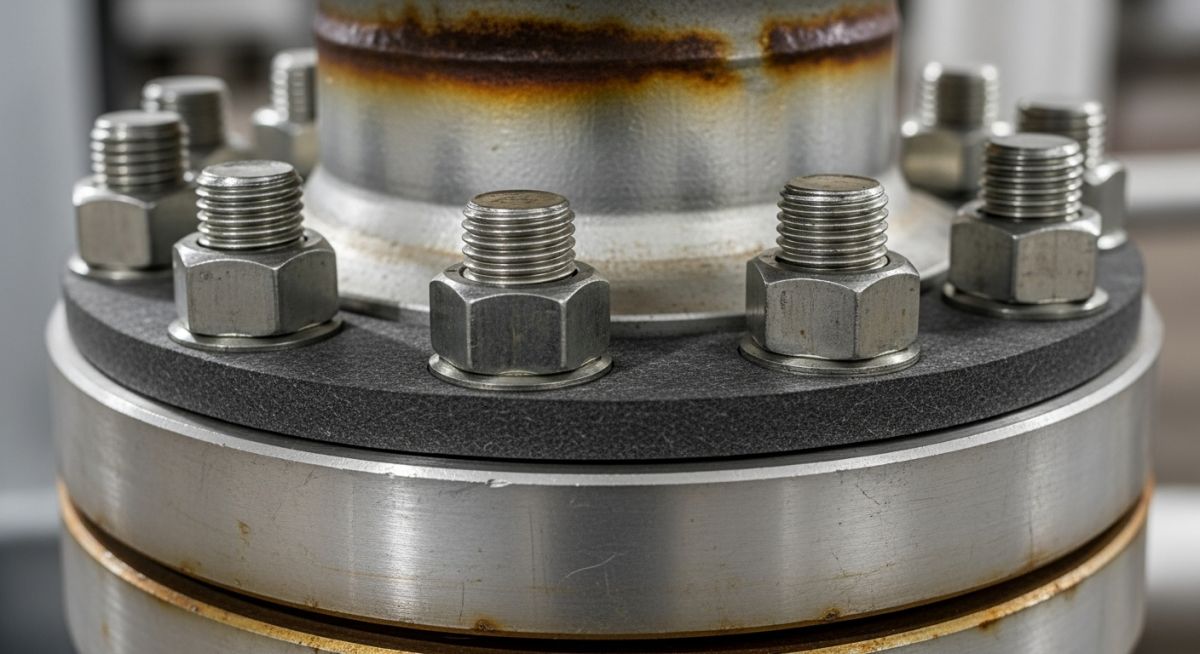
How to Select a Bolt? | The Definitive Bolt Selection Process
In my two decades of piping design, I have seen far too many catastrophic leaks caused by “standard” bolts being used in non-standard environments. Selecting the right fastener is not merely about matching thread counts; it is a rigorous exercise in material science, stress analysis, and environmental compatibility. When you are designing a high-pressure flange connection, the bolt is the primary component maintaining the seal integrity against internal fluid forces.
This guide breaks down the complex decision-making matrix required to specify bolting materials, grades, and coatings. We will move beyond simple catalog lookups to understand how thermal expansion, hydrogen embrittlement, and galvanic corrosion dictate your final selection. If you ignore the nuances of the ASME standards, you are essentially gambling with the safety of your entire piping network.
Key Takeaways for Engineers
- Master the distinction between ASTM A193 B7 and B8 materials for temperature-specific applications.
- Understand the critical role of bolt preload in preventing flange separation under cyclic loading.
- Learn to evaluate environmental factors like H2S concentration and chloride stress corrosion cracking.
- Apply ASME PCC-1 guidelines to ensure consistent bolt tensioning across all flange sizes.
Mastering the Technical Bolt Selection Process
Bolt Selection Process: The engineering practice of evaluating mechanical properties, chemical composition, and environmental resistance to ensure fastener performance meets the design life of the piping system.
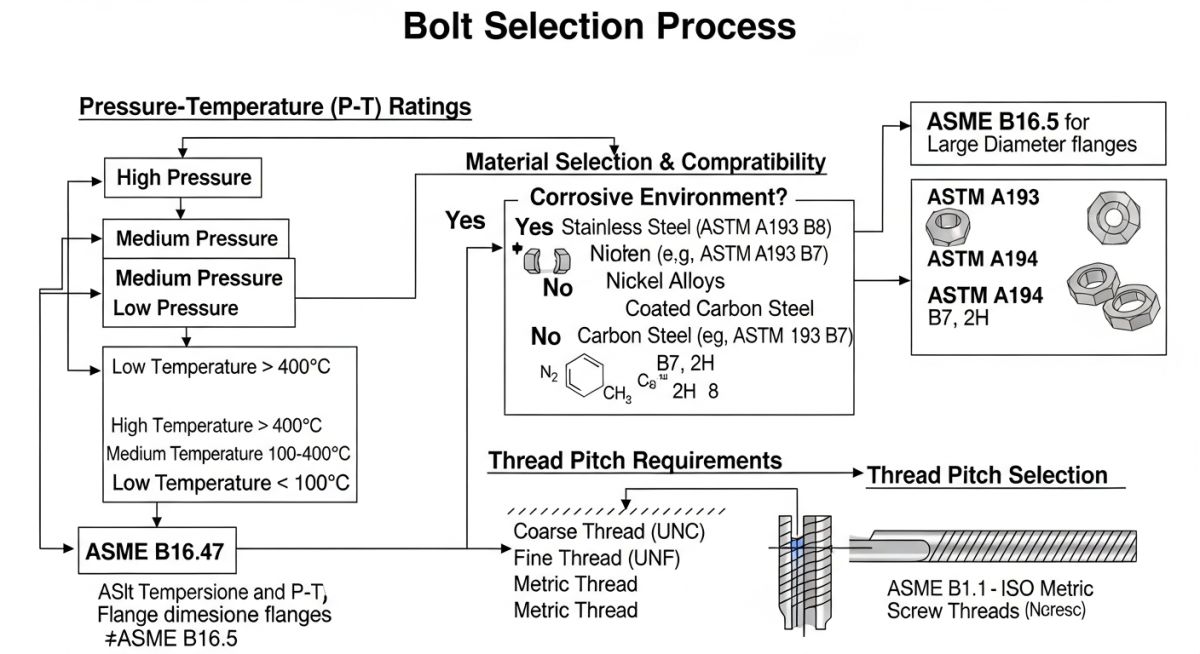
The first step in the selection process is defining the service temperature. For low-temperature applications, we look to ASTM A320, which provides the necessary Charpy V-notch impact toughness. Conversely, for high-temperature steam or hydrocarbon service, ASTM A193 Grade B7 is the industry workhorse. However, B7 is susceptible to corrosion, requiring careful consideration of coatings or material upgrades to B8 (stainless steel) or B8M (molybdenum-bearing stainless).
When calculating the required bolt load, we must account for the gasket seating stress and the hydrostatic end force. The total load (W) is defined by the sum of the gasket load (Wm1) and the internal pressure force (Wm2). In my experience, engineers often underestimate the impact of thermal expansion on bolt stress. If the piping system operates at 400 degrees Celsius, the differential thermal expansion between the flange and the bolt can lead to significant loss of preload, resulting in a leak.
To determine the bolt diameter and quantity, we refer to ASME B16.5. This standard provides the bolt circle diameter and hole sizes for standard flanges. Once the geometry is fixed, we calculate the required torque using the formula: Torque = K * Diameter * Load. The nut factor (K) is highly dependent on the lubricant used. Using a dry bolt versus one coated with molybdenum disulfide can change the required torque by as much as 40 percent.
Finally, consider the environmental impact. In sour gas service (H2S), we must adhere to NACE MR0175 to prevent sulfide stress cracking. This often necessitates the use of specialized materials like B7M or even Inconel for extreme conditions. Always document your selection criteria in the piping material specification (PMS) to ensure consistency across the project lifecycle.
Fastener Selection Trade-offs: The comparative analysis of material performance, cost, and maintenance requirements for industrial bolting solutions.
Advantages of Standardized Selection
- ASTM A193 B7 offers excellent yield strength for high-pressure applications.
- Standardized dimensions per ASME B16.5 ensure global interchangeability of parts.
- Stainless steel grades (B8/B8M) provide superior resistance to atmospheric corrosion.
- Controlled bolting procedures (ASME PCC-1) significantly reduce the risk of joint leakage.
- Wide availability of certified materials reduces procurement lead times for major projects.
Disadvantages & Technical Risks
- Carbon steel bolts require frequent maintenance or protective coatings in coastal environments.
- High-strength bolts are susceptible to hydrogen embrittlement if not properly heat-treated.
- Incorrect nut factor assumptions lead to either under-tightening or bolt yielding.
- Galvanic corrosion occurs when stainless bolts are used with carbon steel flanges without isolation.
- Thermal cycling can cause stress relaxation, requiring periodic re-torquing of the joint.
Industrial Fastener Deployment: The practical implementation of bolt selection protocols across diverse high-stakes engineering environments.
High-Pressure Steam Power Generation
In power plants, bolting must withstand extreme temperatures exceeding 500 degrees Celsius. We specify ASTM A193 B16 bolts for these applications due to their superior creep resistance and ability to maintain preload under sustained thermal stress.
Offshore Oil and Gas Platforms
The marine environment demands high corrosion resistance, leading to the selection of B8M stainless steel or coated B7 bolts. We utilize specialized fluoropolymer coatings to prevent salt-spray degradation and ensure the bolts can be removed during future maintenance shutdowns.
Sour Gas Processing Facilities
When handling hydrogen sulfide, we strictly follow NACE MR0175 requirements to prevent catastrophic brittle failure. This involves selecting B7M bolts with controlled hardness levels, ensuring the material remains ductile even in the presence of corrosive contaminants.
Cryogenic Liquefied Natural Gas (LNG) Plants
At temperatures as low as minus 162 degrees Celsius, standard carbon steel becomes brittle and prone to fracture. We specify ASTM A320 L7 bolts, which are specifically heat-treated to maintain impact toughness at cryogenic temperatures, ensuring the integrity of the LNG transfer lines.
Selecting the correct bolting material requires a deep understanding of the operating temperature range and the corrosive nature of the process fluid. In my experience, engineers often overlook the thermal expansion coefficients of the bolt relative to the flange material, which can lead to significant loss of bolt preload during thermal cycling. The following table outlines the most common ASTM specifications utilized in industrial piping systems, categorized by their primary mechanical properties and temperature limitations.
When referencing ASME B16.5, it is imperative to match the bolting material grade with the flange material to ensure compatibility. Always verify that the yield strength of the selected bolt is sufficient to maintain the gasket seating stress required by ASME PCC-1 guidelines. Failure to account for these variables often results in fugitive emissions or catastrophic joint failure during pressure testing.
| ASTM Spec | Material Type | Temp Range (F) | Primary Application |
|---|---|---|---|
| A193 B7 | Alloy Steel | -50 to 900 | General High Pressure/Temp |
| A193 B8 | Stainless 304 | -325 to 1500 | Corrosive/Cryogenic |
| A320 L7 | Alloy Steel | -150 to 600 | Low Temp Service |
| A194 2H | Carbon Steel | -50 to 900 | Heavy Hex Nut |
The following matrix maps critical engineering entities to their respective regulatory standards and physical parameters. In my professional practice, I have found that maintaining a clear traceability matrix between the design load, the bolt material, and the applicable code is the most effective way to prevent procurement errors. This matrix serves as a quick-reference guide for junior engineers to ensure that every component in the bolting assembly is compliant with the project’s specific design basis.
By aligning these entities, you can systematically verify that the bolt selection process accounts for both structural integrity and long-term maintenance requirements. Note that the “Standard Reference” column points to the governing documents that dictate the testing and certification requirements for each entity. Always ensure that your project specifications are updated to the latest revision of these standards to avoid using obsolete material grades or testing protocols.
| Entity | Parameter | Standard Reference |
|---|---|---|
| Bolt Load | Preload/Torque | ASME PCC-1 |
| Material Grade | Yield/Tensile | ASTM A193 |
| Flange Rating | Pressure/Temp | ASME B16.5 |
| Nut Hardness | Brinell/Rockwell | ASTM A194 |
Bolt Selection Process: A systematic verification of all mechanical and environmental parameters is required to ensure the integrity of the bolted joint assembly. This checklist provides a structured approach to validating your selection against industry standards and site-specific operational requirements.
-
Material Compatibility: Confirm the bolt material grade matches the flange material to prevent galvanic corrosion and ensure uniform thermal expansion. -
Temperature Rating: Verify the selected ASTM grade is rated for the minimum and maximum design temperatures per ASME B31.3. -
Load Calculation: Calculate the required bolt preload using the gasket seating stress and internal pressure requirements defined in ASME PCC-1. -
Nut/Bolt Hardness: Ensure the nut hardness is lower than the bolt hardness to prevent thread stripping during high-torque tightening operations. -
Coating/Lubrication: Specify the correct coating (e.g., PTFE, Zinc) and lubricant to achieve the target friction factor during installation.
In my experience, the most common point of failure is the omission of lubrication data. Without a defined friction factor, the torque-to-preload relationship becomes unpredictable, leading to either under-tightened joints that leak or over-tightened bolts that yield. Always document the friction factor used in your calculations and ensure the field installation team uses the same lubricant specified in the design phase.
The Problem: Chronic Flange Leakage in High-Temperature Service
- Repeated leakage observed on 12-inch Class 600 flanges during thermal startup cycles.
- Investigation revealed the use of standard A193 B7 bolts with mismatched thermal expansion coefficients.
- Inadequate bolt preload was applied during initial installation, failing to account for thermal relaxation.
- Lack of standardized lubrication led to inconsistent torque values across the bolt circle.
The Outcome: Successful Joint Integrity Restoration
- Replaced existing fasteners with high-temperature alloy bolts matching the flange thermal expansion profile.
- Implemented a controlled bolting procedure using hydraulic tensioning instead of manual torque wrenches.
- Established a strict lubrication protocol with a documented friction factor of 0.12.
- Achieved zero leakage during subsequent pressure testing and three consecutive thermal cycles.
This case highlights that the bolt selection process is not merely about material strength; it is about understanding the dynamic behavior of the entire joint assembly. My recommendation is to always perform a thermal expansion analysis for any service exceeding 400 degrees Fahrenheit. By treating the bolt, flange, and gasket as a single integrated system, you can mitigate the risks associated with thermal cycling and ensure long-term operational reliability.
How does bolt material affect thermal expansion?
- Always compare the coefficient of thermal expansion for the bolt and flange materials.
- Use materials with similar expansion rates to maintain consistent clamping force.
- Consult ASME B31.3 for guidance on material properties at elevated temperatures.
What is the role of nut hardness in bolting?
- The nut acts as the sacrificial component in the assembly.
- Hardness mismatch prevents thread galling and seizure.
- Always verify the grade of the nut matches the bolt grade for optimal performance.
Why is lubrication critical for bolt preload?
- Use high-quality anti-seize compounds to ensure consistent results.
- Document the friction factor used in your torque calculations.
- Ensure the field team applies the lubricant to both threads and nut faces.
How do I select bolts for cryogenic service?
- Grade L7 is commonly used for temperatures down to minus 150 degrees Fahrenheit.
- Impact testing is mandatory for all cryogenic bolting materials.
- Ensure the material certification includes Charpy V-notch test results.
What is the difference between torque and tension?
- Torque is susceptible to friction variations.
- Tensioning provides a direct measurement of the bolt load.
- Refer to ASME PCC-1 for the recommended tightening method based on bolt size.
How often should bolts be replaced?
- Check for necking or elongation using a bolt gauge.
- Replace any bolt that shows signs of thread galling.
- Always replace bolts if they have been subjected to extreme thermal cycling or chemical attack.
📚 Recommended Resources: Bolt Selection Process
Read these Guides
🎓 Advanced Training


Complete Course on
Piping Engineering
Check Now
Key Features
- 125+ Hours Content
- 500+ Recorded Lectures
- 20+ Years Exp.
- Lifetime Access
Coverage
- Codes & Standards
- Layouts & Design
- Material Eng.
- Stress Analysis
