
Economics of Battery Energy Storage Systems: A Technical Guide
In my two decades of experience managing complex energy infrastructure, I have observed that the transition to renewable grids hinges entirely on the financial viability of storage. Understanding the economics of Battery Energy Storage Systems (BESS) is no longer optional for engineers; it is the primary driver of project design and site selection.
We are moving beyond simple cost-per-kilowatt-hour metrics. Today, we must account for degradation curves, augmentation strategies, and the volatile nature of ancillary service markets. This guide dissects the financial architecture of these systems, providing the technical clarity required to bridge the gap between engineering design and project finance.
Key Takeaways:
- CAPEX optimization through modular design and site-specific integration.
- The critical role of augmentation in maintaining long-term capacity.
- Revenue stacking: Combining arbitrage with frequency regulation for maximum IRR.
- Standardized financial metrics for comparing BESS project performance.
Technical Deep-Dive: Economics of Battery Energy Storage Systems
BESS Financial Modeling: The rigorous quantification of lifecycle costs and revenue streams, adhering to IEEE and NREL standards for energy storage performance and economic assessment.
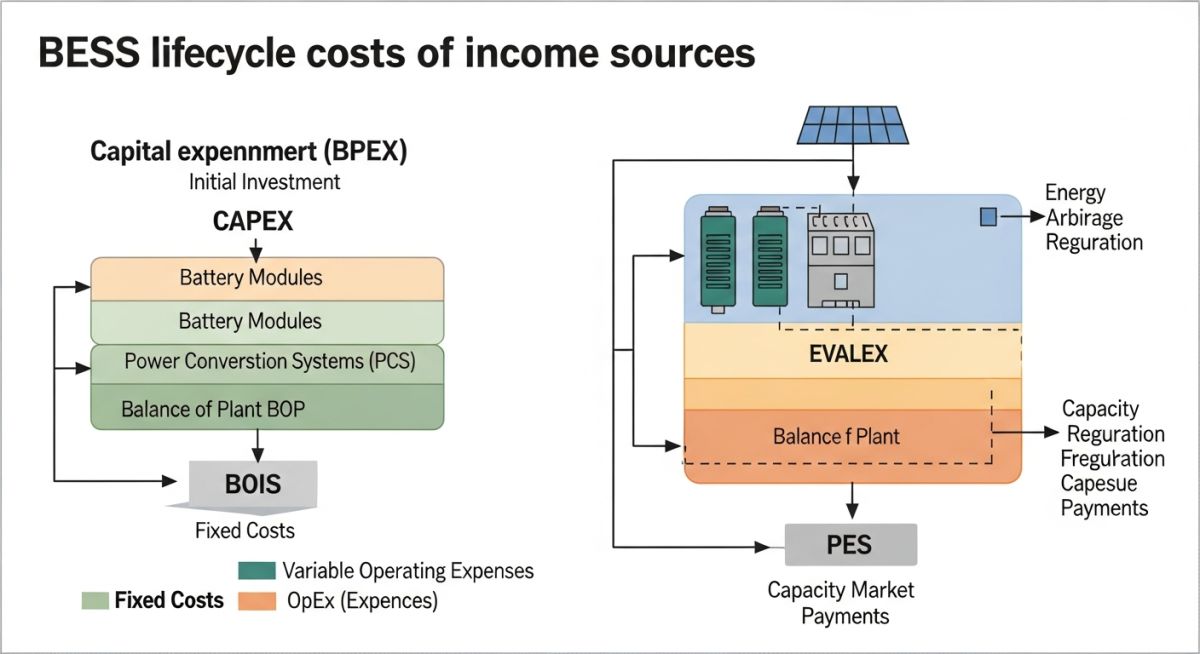
To evaluate the economics of Battery Energy Storage Systems, we must first define the CAPEX boundary. This includes the battery modules, the Power Conversion System (PCS), the Balance of Plant (BoP), and the grid interconnection infrastructure. In my experience, the PCS often represents 15-20% of the total installed cost, while the battery modules themselves account for 50-60%.
The calculation of the Levelized Cost of Storage (LCOS) is the standard metric for comparing different storage technologies. The formula is defined as the sum of discounted costs over the project lifetime divided by the sum of discounted energy throughput. Unlike LCOE for generation, LCOS must account for round-trip efficiency (RTE) losses, which typically range from 85% to 92% for lithium-ion systems.
Field Warning: Degradation and Augmentation
Engineers often overlook the “augmentation” cost in initial CAPEX estimates. Because battery capacity fades over time, you must plan for periodic replacement of modules to maintain the contracted capacity. Failing to model this in the OPEX section will lead to a significant overestimation of project IRR.
When calculating revenue, we look at “revenue stacking.” This involves participating in multiple markets simultaneously. For instance, a system might provide frequency regulation (a high-value, fast-response service) while also engaging in energy arbitrage (buying low, selling high). The technical constraint here is the State of Charge (SoC) management; you cannot sell energy you do not have, and you cannot provide regulation if the battery is fully discharged.
Standardizing these calculations requires adherence to ASME guidelines for equipment reliability. We must also consider the impact of ambient temperature on battery performance. High temperatures increase degradation rates, which directly impacts the OPEX by requiring more frequent cooling system maintenance and earlier module replacement. Every 5-degree Celsius increase above the optimal operating range can reduce battery life by up to 15%.
BESS Economic Trade-offs: A comparative analysis of the financial and operational benefits versus the inherent risks and limitations of deploying large-scale battery storage assets.
Advantages
- Rapid response times for frequency regulation markets.
- Modular scalability allows for phased capital investment.
- High round-trip efficiency compared to pumped hydro.
- Minimal site footprint compared to traditional generation.
- Ability to provide black-start capabilities for grid resilience.
Disadvantages
- High initial CAPEX for lithium-ion chemistry.
- Capacity degradation necessitates long-term augmentation costs.
- Complexity in managing thermal runaway risks and safety.
- Limited cycle life compared to mechanical storage systems.
- Dependency on rare-earth mineral supply chain stability.
BESS Industry Integration: The deployment of battery storage across diverse sectors to optimize energy usage, enhance grid stability, and improve the financial performance of industrial and utility assets.
Grid Frequency Regulation
Utility-scale BESS units are deployed to provide sub-second response to grid frequency deviations. By injecting or absorbing power rapidly, these systems earn high-value payments in ancillary service markets, significantly improving the project’s payback period.
Renewable Energy Time-Shifting
Solar and wind farms utilize BESS to store excess generation during peak production hours. This energy is then discharged during periods of high demand, preventing curtailment and maximizing the revenue generated from intermittent renewable sources.
Industrial Peak Shaving
Large manufacturing facilities install BESS to reduce their peak demand charges from utility providers. By discharging the battery during peak load hours, the facility lowers its monthly demand-based electricity costs, providing a direct and predictable ROI.
Microgrid Resilience
Remote industrial sites and islanded communities use BESS to maintain power quality and reliability. These systems act as a buffer against grid instability, ensuring critical infrastructure remains operational during outages or supply fluctuations.
Evaluating the economic viability of a Battery Energy Storage System (BESS) requires a granular understanding of the cost-to-performance ratio. In my experience, the primary challenge lies in normalizing disparate data points—such as cycle life, depth of discharge (DoD), and round-trip efficiency (RTE)—into a unified financial model. The following table outlines the critical technical parameters that dictate the Net Present Value (NPV) of a utility-scale installation, referencing IEA and NREL benchmarks for current market conditions.
When reviewing these figures, note that “Levelized Cost of Storage” (LCOS) is highly sensitive to the degradation profile of the lithium-ion chemistry. A system designed for high-frequency ancillary services will experience a different decay curve than one optimized for long-duration energy arbitrage. Always ensure your financial model accounts for the “Augmentation Strategy”—the periodic addition of battery modules to maintain nameplate capacity over the project’s 20-year lifespan.
| Parameter | Typical Range | Economic Impact |
|---|---|---|
| Round-Trip Efficiency | 85% – 92% | Directly affects energy arbitrage margins |
| Cycle Life (at 80% DoD) | 4,000 – 8,000 | Determines replacement/augmentation frequency |
| Annual Degradation Rate | 1.5% – 2.5% | Impacts long-term revenue capacity |
| O&M Cost (% of CAPEX) | 1.0% – 2.5% | Influences annual OPEX burden |
The complexity of BESS integration necessitates a clear mapping between physical hardware components and their corresponding financial classifications. This matrix serves as a bridge for project engineers and financial analysts to ensure that every technical asset is correctly accounted for in the ASME-compliant cost estimation process. By aligning these entities, we reduce the risk of “hidden costs” that often plague early-stage feasibility studies.
In my practice, I have observed that misclassifying “Balance of System” (BoS) components—such as thermal management systems or fire suppression infrastructure—is a leading cause of budget overruns. These items are not merely auxiliary; they are critical to the safety and longevity of the battery cells. The matrix below categorizes these elements to ensure that your CAPEX breakdown is comprehensive and audit-ready for project financing.
Before finalizing the financial model for a Battery Energy Storage System, you must conduct a rigorous site verification process. This checklist ensures that the physical constraints of your project site do not introduce unforeseen costs that could jeopardize the project’s internal rate of return (IRR). In my experience, failing to account for grid interconnection requirements or local fire safety mandates is the most common reason for project delays.
-
Grid Interconnection Study: Verify that the point of interconnection (POI) capacity matches the BESS output requirements per IEEE 1547 standards. -
Thermal Management Infrastructure: Confirm that the site layout allows for adequate airflow and cooling, as per NFPA 855 fire safety requirements. -
Environmental Permitting: Ensure all local zoning and environmental impact assessments are completed to avoid costly litigation or site redesigns. -
Augmentation Logistics: Confirm that the site has sufficient physical space to accommodate future battery module additions for capacity maintenance. -
Communication Latency: Validate that the site’s fiber-optic or cellular infrastructure meets the millisecond-level response times required for frequency regulation markets.
Each of these checkpoints serves as a risk-mitigation tool. By validating these parameters early, you provide the financial team with a realistic view of the project’s risk profile, which is essential for securing favorable debt financing terms. Remember, a BESS project is not just a battery; it is a complex integration of power electronics, software, and civil infrastructure that must function in harmony for decades.
The Challenge: Unexpected Thermal Management Costs
A 50MW/200MWh BESS project in a high-ambient-temperature region faced significant budget overruns due to inadequate cooling system design.
- Underestimation of peak cooling load during summer months.
- Failure to account for auxiliary power consumption of HVAC units.
- Regulatory changes requiring additional fire suppression measures post-permitting.
- Supply chain delays for specialized heat exchangers.
The Outcome: Optimized Thermal Strategy
By implementing a liquid-cooling system and integrating the HVAC control into the main Energy Management System (EMS), the project achieved:
- 15% reduction in auxiliary power consumption.
- Improved battery cycle life by maintaining a tighter temperature variance.
- Successful compliance with updated NFPA 855 safety standards.
- Increased project IRR by 1.2% through optimized operational efficiency.
My recommendation for future projects is to prioritize thermal design early in the FEED (Front-End Engineering Design) phase. Do not treat cooling as a secondary system; it is a primary driver of both CAPEX and long-term OPEX. Always conduct a sensitivity analysis on ambient temperature fluctuations to ensure your cooling infrastructure is robust enough to handle extreme weather events without triggering derating protocols.
How does BESS degradation impact financial modeling?
Degradation is the most critical variable in long-term BESS financial modeling. It directly dictates the “Augmentation Strategy,” which is the planned replacement of battery modules to maintain the system’s nameplate capacity over its 20-year life. If you fail to model this, you will significantly overestimate your revenue potential in later years.
- Model the degradation curve based on specific cycle depth and temperature profiles.
- Account for the cost of replacement modules, which may differ from initial CAPEX due to technology shifts.
- Factor in the downtime required for augmentation, which impacts revenue availability.
What is the role of Round-Trip Efficiency in arbitrage?
Round-Trip Efficiency (RTE) represents the percentage of energy recovered from the battery compared to the energy used to charge it. In energy arbitrage, where you buy low and sell high, RTE acts as a “tax” on every transaction. A lower RTE means you must capture a wider price spread to remain profitable.
- RTE includes losses from the battery cells, the power conversion system, and the thermal management system.
- High-efficiency systems (above 90%) are essential for markets with narrow price spreads.
- Always use the “end-of-life” RTE in your financial model, as efficiency typically drops as the battery ages.
How do ancillary services differ from arbitrage?
Ancillary services involve providing grid stability, such as frequency regulation or voltage support, rather than simply moving energy in time. These services often require high-frequency, shallow-depth cycling, which is fundamentally different from the deep-discharge cycles used in energy arbitrage.
- Ancillary services often pay for “availability” rather than just energy throughput.
- The wear-and-tear profile for frequency regulation is different and must be modeled accordingly.
- Stacking revenue—combining arbitrage and ancillary services—is the gold standard for maximizing BESS project returns.
Why is NFPA 855 critical for BESS economics?
The NFPA 855 standard for the installation of stationary energy storage systems is the primary regulatory driver for safety-related CAPEX. Compliance is not optional; it dictates the spacing between battery racks, the fire suppression requirements, and the ventilation systems needed for safe operation.
- Non-compliance can lead to project shutdown or massive, unplanned retrofitting costs.
- Safety systems required by NFPA 855 can account for 5-10% of total project CAPEX.
- Early integration of these requirements into the site design is essential for budget control.
What are the main drivers of future BESS cost trends?
Future cost trends are driven by three primary factors: economies of scale in manufacturing, advancements in cell chemistry, and the standardization of balance-of-system components. As the industry matures, we are seeing a shift toward “LFP” (Lithium Iron Phosphate) chemistries, which offer better safety and cycle life at a lower cost than traditional NMC (Nickel Manganese Cobalt) cells.
- Manufacturing scale is driving down the cost per kilowatt-hour of battery modules.
- Standardization of containerized BESS solutions is reducing site-specific engineering and installation labor.
- Supply chain diversification is helping to stabilize the price of critical raw materials like lithium and cobalt.
How do I calculate the LCOS for a BESS project?
The Levelized Cost of Storage (LCOS) is calculated by dividing the total lifetime costs of the system—including CAPEX, OPEX, and augmentation—by the total energy throughput over the project’s life. It is the most accurate metric for comparing different storage technologies on an “apples-to-apples” basis.
- Include all capital costs, financing costs, and annual operating expenses.
- Account for the time value of money using an appropriate discount rate.
- Ensure the energy throughput calculation accounts for round-trip efficiency and annual degradation.
Complete Course on
Piping Engineering
Check Now
Key Features
- 125+ Hours Content
- 500+ Recorded Lectures
- 20+ Years Exp.
- Lifetime Access
Coverage
- Codes & Standards
- Layouts & Design
- Material Eng.
- Stress Analysis

📚 Recommended Resources: Battery Energy Storage Systems
Read these Guides
- 📄 Grid Applications of Battery Energy Storage Systems: A Technical Guide
- 📄 Battery Energy Storage Systems: Engineering Design and Operational Fundamentals
- 📄 Battery Energy Storage Systems: A Comprehensive Engineering Design Guide
- 📄 Battery Energy Storage Systems for Wind Projects: Design and Integration