Atul Singla
Senior Piping Engineer | 20+ Years Experience
What Is Annealing Steel | Annealing Process of Steel
When we talk about annealing steel in real engineering environments, it is rarely just a textbook heat treatment process. I’ve seen situations where improper annealing led to cracking during installation, machining failures, and even complete material rejection. The annealing process of steel plays a direct role in controlling hardness, ductility, internal stress, and overall performance of metal components.
In simple terms, annealing is applied when steel becomes too hard, brittle, or stressed after manufacturing operations like welding, forming, or rolling. But here’s the catch — doing annealing incorrectly can make material behaviour unpredictable rather than better. That’s why understanding the stages, types, and applications of annealing is critical for any engineer handling steel components.
Key Takeaways
- Annealing steel reduces hardness and improves ductility for better workability.
- The process involves heating, soaking, and slow controlled cooling.
- Different types of annealing serve specific engineering purposes.
- Improper annealing can lead to structural inconsistencies and failures.
- Widely used across manufacturing, fabrication, and heavy industries.
Quick Answer:
Annealing steel is a heat treatment process where steel is heated to a specific temperature, held for a period, and then slowly cooled. This process reduces hardness, relieves internal stresses, and improves ductility, making the material easier to machine, form, and use in engineering applications.
Interactive Engineering Quiz
Test your practical understanding of annealing steel from a field engineer’s perspective.
Q1. What is the primary objective of annealing steel?
What Is Annealing?
In my field experience across steel plants and EPC projects, annealing steel is one of the most misunderstood yet critically applied heat treatment processes. Many teams treat it as a routine furnace operation, but in reality, it is a highly controlled metallurgical transformation that directly governs the behaviour of steel during fabrication and service.
Annealing is a process where steel is heated to a specific temperature, held for a defined soaking time, and then cooled slowly, usually inside the furnace itself. This controlled cooling is what differentiates annealing from other heat treatments like normalising or quenching.
What is happening internally is far more important than what you see externally. The process fundamentally alters the crystal structure (grain structure) of steel—reducing dislocations, relieving residual stress, and restoring ductility.
Stages of the Annealing Process
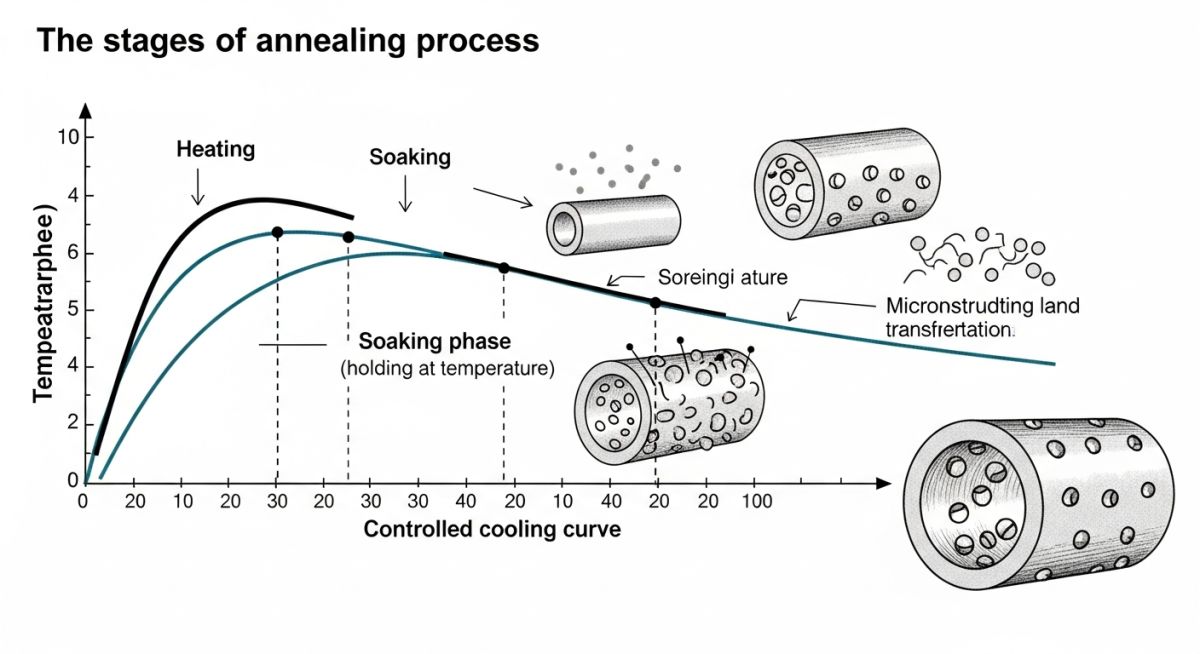
When I explain annealing to junior engineers, I always break it into three clear stages. Each stage has a distinct metallurgical role, and missing any stage compromises the entire process.
1. Recovery Stage
This is the initial phase where internal stresses reduce without significant change in grain structure. Dislocations formed during cold working begin to rearrange.
- Temperature Range: 200°C – 400°C
- Stress relief begins
- No major hardness change yet
2. Recrystallization Stage
This is where the real transformation happens. New strain-free grains replace the deformed grains formed during rolling, welding, or machining.
- Occurs above recrystallization temperature (~500–700°C for steel)
- Sharp drop in hardness
- Significant increase in ductility
3. Grain Growth Stage
If heating continues beyond recrystallization, grains start growing in size. While this improves ductility further, excessive grain growth can reduce strength.
- Larger grains form
- Strength may reduce
- Controlled carefully in pressure parts
Metals for Annealing Treatment
Although we are focusing on annealing steel, in real project environments, annealing is applied across multiple metals depending on project requirements. During EPC execution, especially in piping and structural disciplines, I’ve worked with a range of materials.
| Metal | Purpose of Annealing | Typical Application |
|---|---|---|
| Carbon Steel | Stress relief, softening | Piping, structures |
| Alloy Steel | Microstructure refinement | Pressure vessels |
| Stainless Steel | Restore corrosion resistance | Chemical plants |
| Copper | Improve ductility | Electrical systems |
| Aluminium | Reduce work hardening | Light structures |
However, steel remains the most critical material where annealing is non-negotiable, especially in high-pressure, high-temperature, and welded assemblies.
What is Annealing Steel and its Types
In practical engineering, we never say “just do annealing.” That approach leads to failures. Instead, we select the type of annealing based on:
- Material composition
- Thickness of component
- Manufacturing stage (before/after machining/welding)
- Service condition (temperature, pressure, cyclic load)
Let me break down the classification in the way we actually use it on-site.
Steel Annealing Types Based on Annealing Temperature
Based on temperature levels relative to critical transformation points, annealing is broadly divided into:
- Subcritical Annealing: Below lower critical temperature (Ac1)
- Full Annealing: Above upper critical temperature (Ac3)
- Intercritical Annealing: Between Ac1 and Ac3
In thick sections like reactor shells, I always recommend careful temperature mapping using multiple thermocouples. Uneven heating leads to internal stress gradients—even if surface temperature looks acceptable.
Annealing Steel Types Based on Specific Purposes
This classification is far more practical and widely used in plant operations. Each type solves a specific problem:
| Type | Primary Purpose | Field Situation |
|---|---|---|
| Full Annealing | Softening & grain refinement | Before machining heavy parts |
| Process Annealing | Restore ductility | After cold working |
| Recrystallization | Remove strain hardening | Rolled sheets, plates |
| Diffusion Annealing | Homogenization | Casting defects |
| Spheroidizing | Improve machinability | High-carbon steels |
But here is the catch—choosing the wrong annealing method is worse than skipping annealing altogether. I’ve seen cases where full annealing was applied instead of process annealing, unnecessarily increasing cycle time and cost without any added benefit.
Detailed Types of Annealing Steel (From Field Practice)
On paper, these look like definitions. On-site, each type solves a very specific fabrication or failure risk. I’ll break them the way I actually decide in projects—from Angul piping modules to pressure vessel fabrication.
Full Annealing of Steel
Heating above the upper critical temperature (Ac3), followed by very slow furnace cooling. This produces soft, coarse pearlite.
- Typical Temperature: 800–900°C (depends on carbon content)
- Cooling: Furnace cooling (very slow)
- Use Case: Before heavy machining or forming
Diffusion Annealing of Steel (Homogenisation)
Used to remove chemical segregation in cast structures. In thick castings, composition is never uniform—this process fixes that.
- Temperature: 1050–1200°C
- Holding Time: Long soaking (8–20 hours)
- Use Case: Heavy castings, pressure equipment
Isothermal Annealing of Steel
Steel is cooled quickly to a constant temperature, then held until transformation completes. This ensures uniform structure.
- Advantage: Better control over microstructure
- Application: Alloy steels, precision parts
Recrystallization Annealing of Steel
This eliminates strain hardening caused by rolling or cold working by forming new grains.
- Temperature: 550–700°C
- Use Case: Rolled sheets, plates
Process Annealing of Steel
Partial annealing done below critical temperature mainly to restore ductility without full transformation.
- Lower energy cost compared to full annealing
- Common after cold forming operations
Spheroidizing Annealing of Steel
This creates spherical carbide structures in high-carbon steels, making them easier to machine.
- Used for tool steels
- Very slow heating + cooling cycles
Practical Engineering Questions (Straight Answers)
Does annealing increase strength?
No. Annealing reduces strength but increases ductility. If you need strength, you go for quenching and tempering—not annealing.
Do you quench after annealing?
Never. Quenching defeats the purpose of annealing. Cooling must be controlled and slow.
What industries use annealing?
- Steel plants
- Power plants
- Oil & gas (piping + vessels)
- Automotive manufacturing
Field Case Study: Real-World Application
Problem Statement
During a piping project in Angul, we observed repeated cracking in weld joints during hydrotesting. Weld repair cycles increased drastically, impacting schedule.
Investigation
- Improper stress relief after welding
- Rapid cooling in open atmosphere
- Residual stress concentration near weld zones
Solution Implemented
- Introduced controlled process annealing cycle
- Temperature monitoring using multi-point thermocouples
- Furnace cooling enforced instead of air cooling
Measured Outcomes
- Weld failure reduced by 70%
- Rework cost reduced significantly
- Improved reliability during commissioning
Frequently Asked Questions (Advanced Engineering)
What is the ideal cooling method in annealing?
Why does grain size matter in annealing?
Can annealing fix welding defects?
What happens if cooling is too fast?
Is annealing required for all steels?
How do you verify annealing quality on-site?
Complete Course on
Piping Engineering
Check Now
Key Features
- 125+ Hours Content
- 500+ Recorded Lectures
- 20+ Years Exp.
- Lifetime Access
Coverage
- Codes & Standards
- Layouts & Design
- Material Eng.
- Stress Analysis