
What is Front End Engineering Design or FEED Engineering?
In my 20-plus years of managing piping and layout engineering for multi-billion dollar oil, gas, and petrochemical projects, I have seen many projects fail before the first shovel hits the dirt. The root cause is almost always a poorly executed Front End Engineering Design (FEED) phase. When owners try to rush through FEED to get to detailed engineering, they inherit a legacy of design changes, schedule delays, and massive cost overruns.
FEED is not just a preliminary step; it is the blueprint of your entire project. It is where we freeze the design basis, establish the process flow, size major equipment, and perform the initial hazard assessments. In this guide, I will share my hands-on experience on how to execute a flawless FEED phase, how it differs from detailed engineering, and how to avoid the common pitfalls that derail major capital projects.
Key Takeaways for Project Managers
- Scope Freezing: Freezing the design basis during FEED prevents costly late-stage changes during detailed engineering.
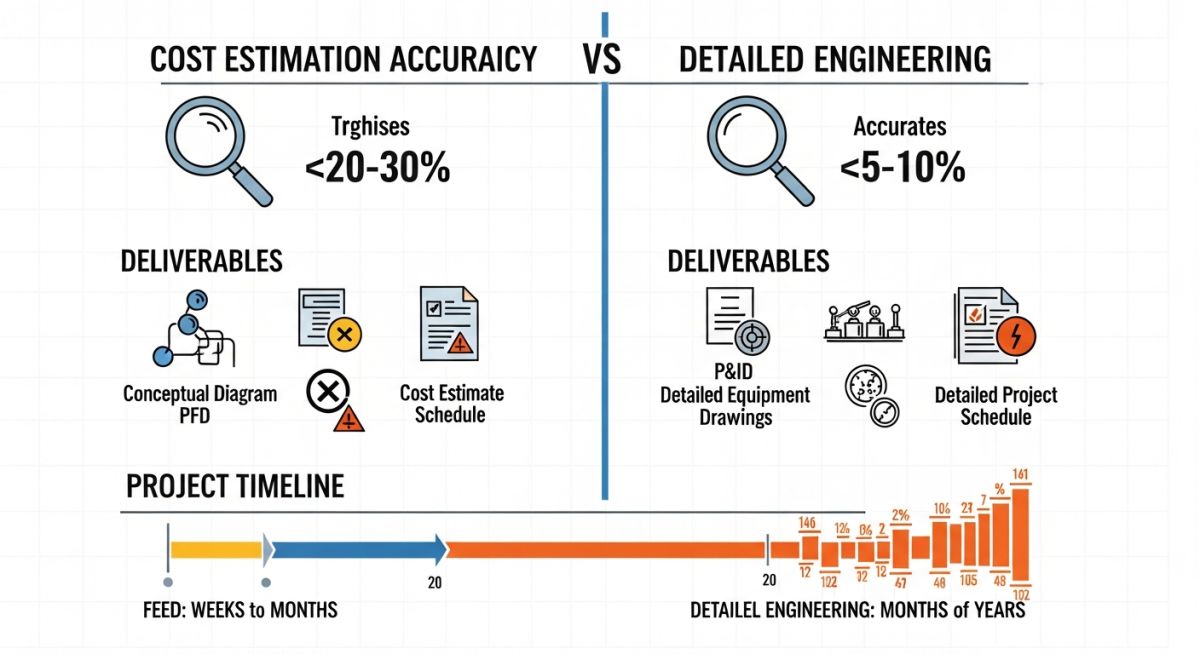
- Cost Accuracy: A successful FEED phase refines the Total Installed Cost (TIC) estimate to a Class 3 level (+/- 10% to 15% accuracy).
- Risk Mitigation: Early identification of long-lead items (LLIs) and safety hazards via HAZOP studies protects the project schedule.
Mastering Front End Engineering Design Principles
FEED Engineering Execution: This phase establishes the design basis, process flow diagrams, and piping and instrumentation diagrams to freeze the project scope. It ensures subsequent detailed engineering proceeds without costly design changes or schedule delays.
During the FEED phase, we translate the conceptual design into a solid technical package. This involves rigorous process simulation, equipment sizing, and the development of Piping and Instrumentation Diagrams (P&IDs) to an “Issued for Design” (IFD) status. We also establish the overall plot plan, which dictates the physical layout of the plant.
Process Design and Hydraulic Calculations
Process engineers use simulation software to model the plant’s behavior under various operating scenarios. We calculate line sizes, pressure drops, and fluid velocities to ensure safe and efficient transport. For example, hydraulic line sizing for liquid lines typically limits velocity to prevent erosion and water hammer, using the classical relation:
Where “v” is the fluid velocity, “Q” is the volumetric flow rate, and “d” is the internal pipe diameter. We cross-reference these velocities against industry standards such as API RP 14E for erosive velocities in gas and two-phase systems.
Piping Stress and Layout Considerations
As a piping specialist, my focus during FEED is to identify critical piping systems that require formal stress analysis under ASME B31.3. We establish the preliminary piping routing, locate major pipe racks, and define the space requirements for expansion loops. This prevents structural interference issues later when the detailed design team takes over.
Safety and Hazard Studies (HAZOP)
A core component of the FEED phase is the Hazard and Operability (HAZOP) study. We assemble a multidisciplinary team to systematically review the P&IDs, identifying potential hazards and operational problems. By addressing these issues during FEED, we can modify the design at a fraction of the cost compared to making changes during construction or operation.
Comparing Front End Engineering Design Deliverables
FEED Deliverables Matrix: This structured comparison outlines the specific engineering documents, drawings, and data sheets produced during the FEED phase versus the detailed design phase. It establishes clear boundaries of responsibility for EPC contractors and project owners.
| Parameter / Deliverable | FEED Phase (Front End) | Detailed Engineering Phase |
|---|---|---|
| Cost Estimate Accuracy | Class 3 (+/- 10% to 15%) | Class 1 (+/- 5%) |
| P&IDs Status | Issued for Design (IFD) – Frozen | Issued for Construction (IFC) |
| Piping Deliverables | Key Plot Plans, Critical Line Routing | Isometrics, Support Drawings, MTOs |
| Equipment Procurement | Long-Lead Items (LLIs) Specified | All Purchase Orders Placed |
| Civil & Structural | Design Basis, Soil Investigation | Foundation Details, Rebar Drawings |
| Entity / Acronym | Technical Definition | Physical Parameter / Scope | Standard Reference |
|---|---|---|---|
| TIC | Total Installed Cost | Overall project capital expenditure | AACE RP 18R-97 |
| HAZOP | Hazard and Operability Study | Systematic process safety review | IEC 61882 |
| LLI | Long-Lead Items | Equipment with long manufacturing times | Project Specific Procurement |
| MTO | Material Take-Off | Quantified list of materials required | ASME B31.3 / B31.1 |
Key Steps for FEED Gate Approval
FEED Gate Review: This verification process ensures all engineering deliverables meet the required quality, safety, and cost accuracy standards before transitioning to detailed design. It serves as the final check to prevent scope creep and budget overruns.
Before transitioning from the FEED phase to detailed engineering, a formal gate review must be conducted. This checklist represents the minimum criteria I enforce on my projects to ensure the design is sufficiently mature to proceed.
FEED Phase Gate Review Checklist
-
Process Design Package (PDP) Validation: Ensure all heat and material balances (HMB) are finalized and process flow diagrams (PFDs) are approved.
-
P&ID Freeze: Verify that all Piping and Instrumentation Diagrams are issued for design (IFD) with zero major “Hold” items on critical process lines.
-
Major Equipment Datasheets: Confirm that datasheets for long-lead items (such as compressors, reactors, and large columns) are finalized and ready for inquiry.
-
HAZOP Action Closure: Ensure all recommendations from the HAZOP study are either incorporated into the design or formally tracked with an owner-approved action plan.
-
Plot Plan Approval: Verify that the overall plant layout and equipment spacing comply with safety distances specified in NFPA guidelines and owner insurance requirements.
-
Cost Estimate Refinement: Confirm that the Class 3 cost estimate has been compiled and verified against the frozen scope of work.
Field Case Study: Real-World Application
The Problem: Rushing to Detailed Design
On a major offshore gas processing platform project, the owner decided to bypass a rigorous FEED phase to meet an aggressive first-gas schedule. Detailed engineering was kicked off with conceptual P&IDs that contained over 45 “Hold” items on major equipment nozzles and operating pressures.
As the detailed design progressed, the process group changed the operating pressure of the main separator. This change altered the piping wall thickness requirements and nozzle ratings, rendering the already-purchased piping materials and preliminary stress analysis completely obsolete.
The Outcome: Rework and Schedule Slippage
The lack of a frozen design basis led to massive rework. Piping stress analysis had to be redone three times for the main steam header. The project suffered a 14-month schedule delay and a 35% cost overrun, equating to over 120 million in losses.
On the subsequent phase of the project, we implemented a strict FEED gate review. We refused to kick off detailed engineering until all P&IDs were frozen and major equipment nozzles were locked. This disciplined approach saved over 40 million in engineering rework and the project was delivered two weeks ahead of schedule.
My recommendation is simple: never compromise on the quality of your FEED phase. The money you think you are saving by rushing into detailed design will be spent tenfold on field modifications and engineering rework.
Frequently Asked Engineering Questions
What is the main difference between FEED and detailed engineering?
What is the typical cost accuracy of a FEED study?
Can we purchase equipment during the FEED phase?
How does HAZOP fit into the FEED process?
What standards govern the FEED phase in piping design?
Why do projects fail when transitioning from FEED to detailed design?
===FAQ_BLOCK===
Complete Course on
Piping Engineering
Check Now
Key Features
- 125+ Hours Content
- 500+ Recorded Lectures
- 20+ Years Exp.
- Lifetime Access
Coverage
- Codes & Standards
- Layouts & Design
- Material Eng.
- Stress Analysis