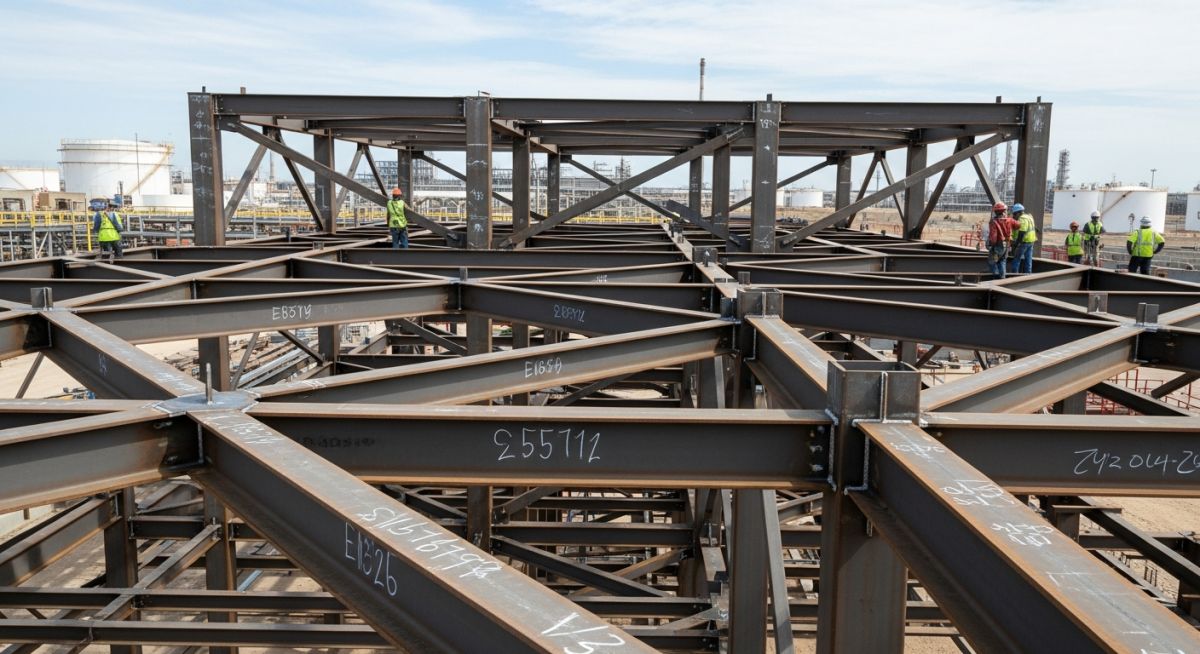
A36 Steel: Composition, Properties, and Real-World Engineering Applications
I still remember a refinery project where a contractor casually swapped a higher-grade structural steel with A36 steel to cut costs. On paper, it looked fine. But once loads started acting on the pipe rack, deflection issues began appearing. That’s where textbook knowledge fails—and field engineering saves you.
If you’re working in fabrication, EPC, or procurement like many teams I’ve collaborated with in Gurugram setups, you’ve seen how often A36 steel becomes the default choice. But here is the catch—knowing when it works and when it will fail silently is what separates good engineers from great ones.
- A36 steel is a low-carbon structural steel widely used in construction and fabrication.
- Yield strength (~250 MPa) makes it suitable for moderate load conditions.
- Highly weldable and machinable, but not ideal for high-stress or dynamic systems.
- Cost-effective choice when correctly applied in non-critical structures.
- Misuse in load-bearing or cyclic applications can lead to failure risks.
A36 steel is a low-carbon structural steel defined under ASTM standards, known for its good weldability, moderate strength, and cost-effectiveness. It typically offers a minimum yield strength of 250 MPa and is widely used in structural components like beams, plates, and frames where extreme strength is not required.
Interactive Engineering Quiz
1. What is the minimum yield strength of ASTM A36 steel?
Chemical Composition of A36 Steel
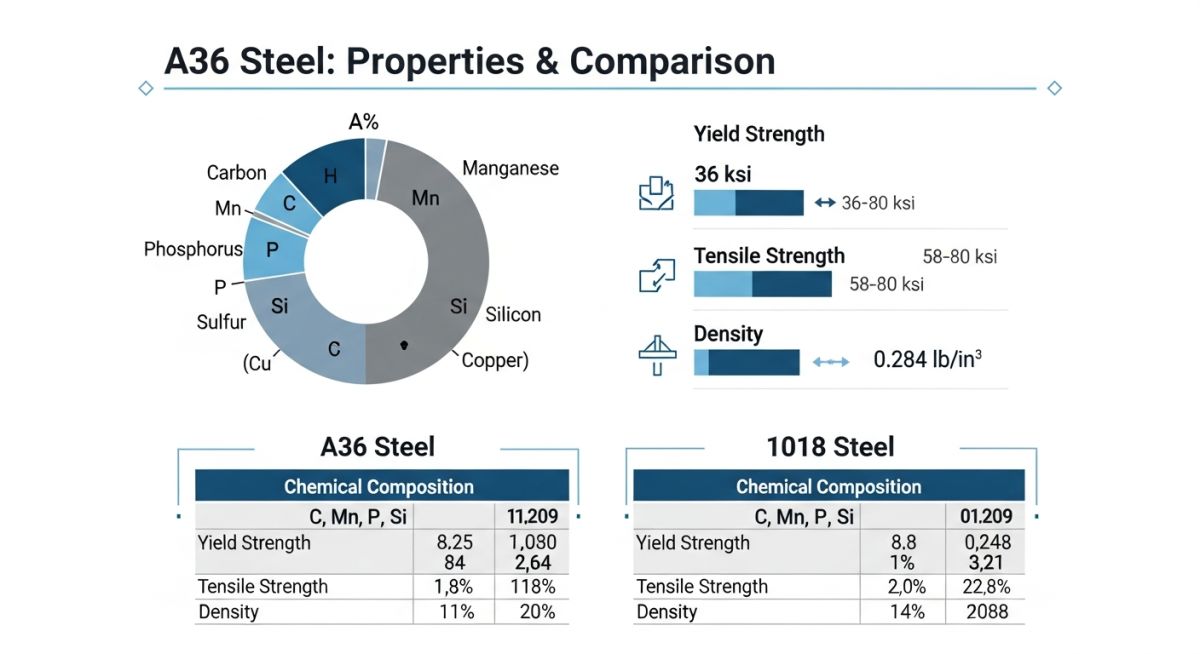
In my experience on fabrication yards and EPC sites, A36 steel works because of its simple, low-carbon chemistry. It is not a tightly controlled alloy like 1018—what matters is staying within ASTM limits. As per ASTM A36/A36M, the composition remains flexible but typically falls in this range:
- Carbon (C): ≤ 0.26%
- Manganese (Mn): 0.60–1.20%
- Phosphorus (P): ≤ 0.04%
- Sulfur (S): ≤ 0.05%
- Silicon (Si): ~0.40% max
Mechanical and Physical Properties of A36 Steel
On real jobs, I don’t just look at datasheets—I focus on how A36 behaves under load, weld, and fabrication constraints.
- Yield Strength: ~250 MPa (minimum)
- Tensile Strength: 400–550 MPa
- Elongation: ~20%
- Density: 7850 kg/m³
- Modulus of Elasticity: ~200 GPa
But here is the catch—ductility is where A36 shines. In structural misalignment cases, A36 absorbs stress instead of cracking instantly. That’s why fabricators love it.
Advantages of A36 Steel in Fabrication
- Excellent weldability with standard electrodes
- High availability in plates, beams, and sections
- Cost-effective for large projects
- Good machinability for general fabrication
In Gurgaon-based EPC supply chains, I’ve seen procurement teams default to A36 simply because it balances availability + cost + ease of handling.
Industrial Applications of A36 Steel
From my field exposure, these are the most reliable use cases:
- Pipe racks and platform structures
- Building frames and columns
- Base plates and support brackets
- Storage tank structures
A36 Steel Equivalent Grades and Standards
| Standard | Equivalent Grade |
|---|---|
| ASTM | A36 |
| EN | S235JR |
| IS | IS 2062 E250 |
| JIS | SS400 |
A36 Steel vs 1018 Steel
| Property | A36 Steel | 1018 Steel |
|---|---|---|
| Type | Structural | Carbon Steel |
| Yield Strength | 250 MPa | ~370 MPa |
| Machinability | Moderate | Excellent |
| Weldability | Excellent | Good |
Field Case Study: Real-World Application
On a refinery pipe rack project, a contractor substituted A572 Grade 50 with A36 steel to reduce cost without design recalculation.
I was called in when abnormal deflection appeared in beam spans. The issue was simple: design load exceeded A36 yield capacity. The original structure required higher strength steel for dynamic loading due to piping loads and thermal expansion.
We carried out stress verification. Using actual load inputs, calculated stress exceeded allowable limits by 18–22%. That’s not a rounding error—that’s a failure waiting to happen.
– Reinforcement plates added
– Critical beams replaced with higher grade steel
– Structural integrity restored
– Project delay: 3 weeks
– Cost overrun: ~14%
Field Lesson Learned:
Never substitute structural steel based on cost alone. Always verify load cases, fatigue conditions, and design intent before approving A36.
A36 Steel FAQs for Engineers
What is A36 grade steel?
What is A36 steel used for?
Is A36 steel strong?
Is A36 stainless steel?
What is A36 steel density?
What is A36 steel yield strength?
Welding Behavior and Fabrication Practices for A36 Steel
In my field experience, A36 steel earns its reputation mainly due to its forgiving welding nature. But here is the catch—engineers often underestimate how poor welding procedure can still ruin a perfectly good A36 structure.
- Weldability Index: Excellent due to low carbon content
- Recommended Electrodes: E6013, E7018 (for structural integrity)
- Preheat Requirement: Typically not required for thin sections
- Heat-Affected Zone (HAZ): Minimal hardening risk
On heavy plates, especially above 25 mm thickness, I always recommend controlled preheating (50–100°C). It reduces residual stress and prevents micro-cracking during cooling.
Design Considerations for A36 Steel in Structural Engineering
In engineering design, I never select A36 based only on strength tables. Real-world applications demand consideration of load types, environment, and fabrication constraints.
- Static Loads: A36 performs reliably under steady loads
- Dynamic Loads: Not ideal for vibration-heavy systems
- Fatigue Resistance: Limited — not suitable for cyclic stress
- Temperature Limits: Avoid in high-temperature creep conditions
For pipe rack designs, I cross-check not just yield stress but also deflection limits (L/360 or L/240 depending on code). That’s where A36 often becomes borderline.
| Design Factor | A36 Suitability | Engineering Note |
|---|---|---|
| Static Load | Good | Common in building frames |
| Dynamic Load | Moderate | Check fatigue stress cycles |
| Seismic Zones | Conditional | Use with proper detailing |
| Corrosive Environment | Poor | Requires coating/galvanizing |
Corrosion Protection Strategies for A36 Steel
One mistake I constantly see on-site—assuming A36 steel can survive outdoors without protection. It cannot. Being low-carbon steel, it is highly prone to rusting.
- Hot-dip galvanizing for long-term atmospheric protection
- Epoxy coating systems for industrial exposure
- Polyurethane topcoats for UV resistance
- Cathodic protection in underground applications
Heat Treatment and Thermal Behavior of A36 Steel
Unlike alloy steels, A36 is not typically heat-treated to enhance strength. Its mechanical properties come from rolling processes rather than thermal treatment.
- Annealing: Improves ductility
- Normalizing: Refines grain structure
- Hardening: Limited due to low carbon content
In fabrication shops, I’ve used normalizing only in cases where material showed excessive residual stress after forming.
Procurement and Inspection Checklist for A36 Steel
From a sourcing and screening perspective—especially relevant to EPC workflows like yours—this is where quality control makes or breaks the project.
- Mill Test Certificate (MTC): Verify yield and tensile strength
- Chemical Analysis: Ensure compliance within ASTM limits
- Ultrasonic Testing: Detect internal defects in plates
- Dimensional Tolerance: Confirm as per design drawings
- Surface Inspection: Check for lamination or scaling
I always insist on third-party inspection for critical structural components. Trusting supplier data blindly has cost projects millions.
Complete Course on
Piping Engineering
Check Now
Key Features
- 125+ Hours Content
- 500+ Recorded Lectures
- 20+ Years Exp.
- Lifetime Access
Coverage
- Codes & Standards
- Layouts & Design
- Material Eng.
- Stress Analysis

📚 Recommended Resources: A36 Steel
Read these Guides
- 📄 How to Calculate Weight of a Steel Plate? Steel Plate Weight Calculator (2026)
- 📄 Types of Structural Steel Shapes: The 2026 Engineering Guide to AISC Sections
- 📄 What is Chromoly Steel? AISI 4130 Characteristics & Engineering Applications
- 📄 Stainless Steel vs Galvanized Steel: Key Differences & Engineering Guide 2026