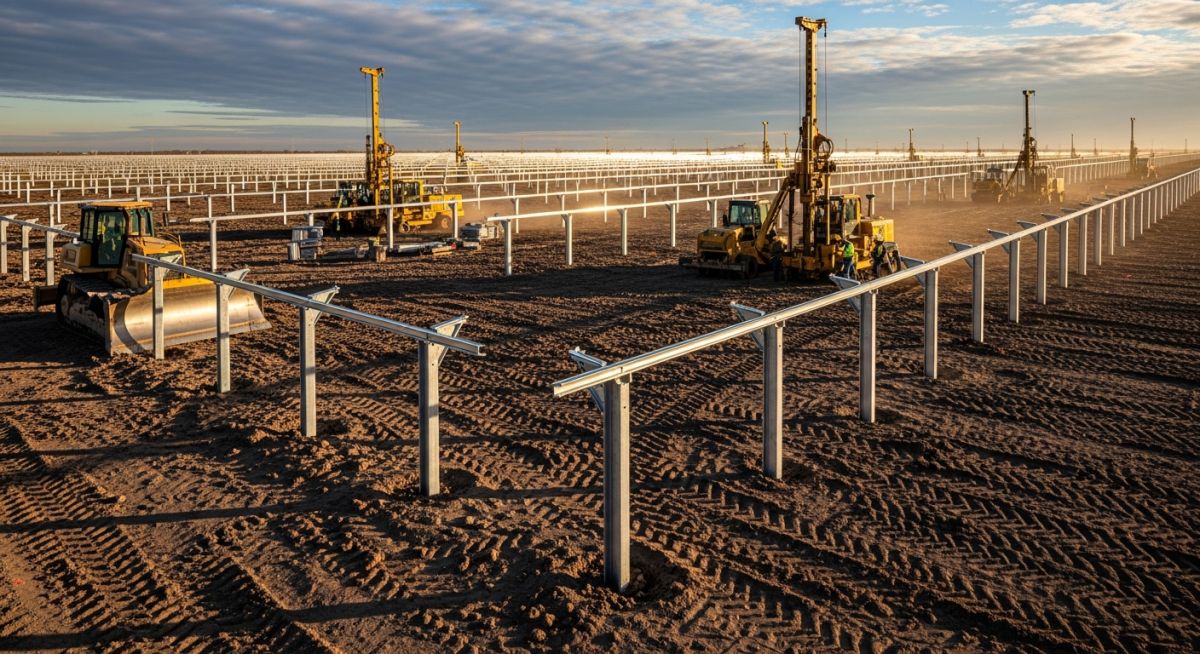
Ground Improvement Techniques for Renewable Energy Projects
In my two decades of experience navigating complex site conditions, I have learned that the success of any renewable energy project hinges on what lies beneath the surface. Whether we are installing thousands of solar piles or heavy BESS containers, the soil must provide a stable, predictable foundation. Often, the ideal site is not available, and we are forced to work with soft clays, loose sands, or expansive soils that threaten structural integrity.
Ground improvement is no longer an optional luxury; it is a technical necessity to mitigate differential settlement and ensure the longevity of high-value assets. This guide explores the critical methodologies I use to transform marginal land into robust, bankable energy sites.
Key Takeaways
- Understanding the correlation between soil shear strength and foundation pile refusal.
- Selecting the right stabilization method based on site-specific geotechnical reports.
- Mitigating long-term settlement risks for sensitive BESS and hydrogen infrastructure.
- Adhering to ASTM and ASCE standards for soil modification.
Ground Improvement Techniques for Renewable Energy Projects
Ground Improvement Techniques: Systematic engineering interventions designed to enhance the mechanical properties of soil, ensuring compliance with ASCE 7 load requirements for renewable energy structures.
When I approach a new site, the first step is always a rigorous geotechnical investigation. We look for the “critical failure plane” where soil shear strength (tau) is insufficient to support the lateral and vertical loads of solar racking or BESS skids. The fundamental equation we rely on is the Mohr-Coulomb failure criterion: tau = c + sigma * tan(phi), where ‘c’ is cohesion and ‘phi’ is the angle of internal friction.
For loose granular soils, I frequently specify vibro-compaction. This process uses a vibrating probe to rearrange soil particles into a denser configuration, significantly increasing the relative density (Dr). In my experience, achieving a Dr of 75% or higher is the threshold for preventing liquefaction during seismic events, a critical concern for BESS installations.
Field Warning: Moisture Sensitivity
Never attempt mechanical compaction on cohesive soils when the moisture content exceeds the optimum moisture content (OMC) by more than 2%. The soil will behave as a viscous fluid, leading to “pumping” and total loss of bearing capacity. Always perform a Proctor test (ASTM D698) before mobilizing heavy equipment.
For sites with high clay content, chemical stabilization is often the only viable path. By introducing lime or cement, we trigger a pozzolanic reaction that permanently alters the soil structure. This increases the Unconfined Compressive Strength (UCS) of the soil, often by a factor of 5 to 10. I typically aim for a target UCS of 200-300 kPa for standard solar pile foundations.
Deep Soil Mixing (DSM) is another tool in my arsenal for deeper, more problematic layers. By injecting a binder slurry through hollow-stem augers, we create soil-cement columns that act as rigid inclusions. This effectively transfers the structural load to deeper, more competent strata, bypassing the soft surface layers entirely.
Design calculations for these columns must account for the “stress concentration ratio” (n), which is the ratio of the stress in the column to the stress in the surrounding soil. A typical value for ‘n’ ranges from 5 to 20, depending on the stiffness of the soil-cement mix. If we fail to account for this, we risk over-designing the foundation and inflating project costs unnecessarily.
Ground Improvement Evaluation: A comparative analysis of mechanical and chemical stabilization methods to determine project feasibility and long-term structural performance.
Advantages
- Significant reduction in total and differential settlement.
- Increased lateral load capacity for solar pile foundations.
- Lower carbon footprint compared to deep foundation piling.
- Faster construction timelines by avoiding soil replacement.
- Enhanced seismic stability for sensitive BESS equipment.
Disadvantages
- High sensitivity to initial geotechnical site variability.
- Requirement for specialized equipment and skilled operators.
- Potential for chemical leaching if binders are improperly mixed.
- Difficulty in verifying uniformity across large-scale sites.
- Increased upfront engineering and testing costs.
Renewable Infrastructure Stabilization: Targeted ground improvement strategies tailored to the unique load-bearing and environmental requirements of modern energy facilities.
Utility-Scale Solar Arrays
Solar projects require uniform soil stiffness to maintain precise racking alignment over thousands of meters. I utilize shallow soil stabilization to ensure that pile pull-out resistance remains consistent across the entire site, preventing panel misalignment due to localized soil creep.
Battery Energy Storage Systems (BESS)
BESS containers impose high concentrated loads on small footprints, making them highly susceptible to differential settlement. We implement deep soil mixing or stone columns to create a rigid platform that prevents the tilting of battery skids, which could otherwise trigger internal safety shutdowns.
Green Hydrogen Electrolyzer Plants
Electrolyzer skids and high-pressure storage tanks require extreme foundation stability to maintain piping integrity. I specify cement-stabilized soil rafts to mitigate vibration-induced settlement, ensuring that critical process piping connections remain within the strict tolerances defined by ASME B31.3.
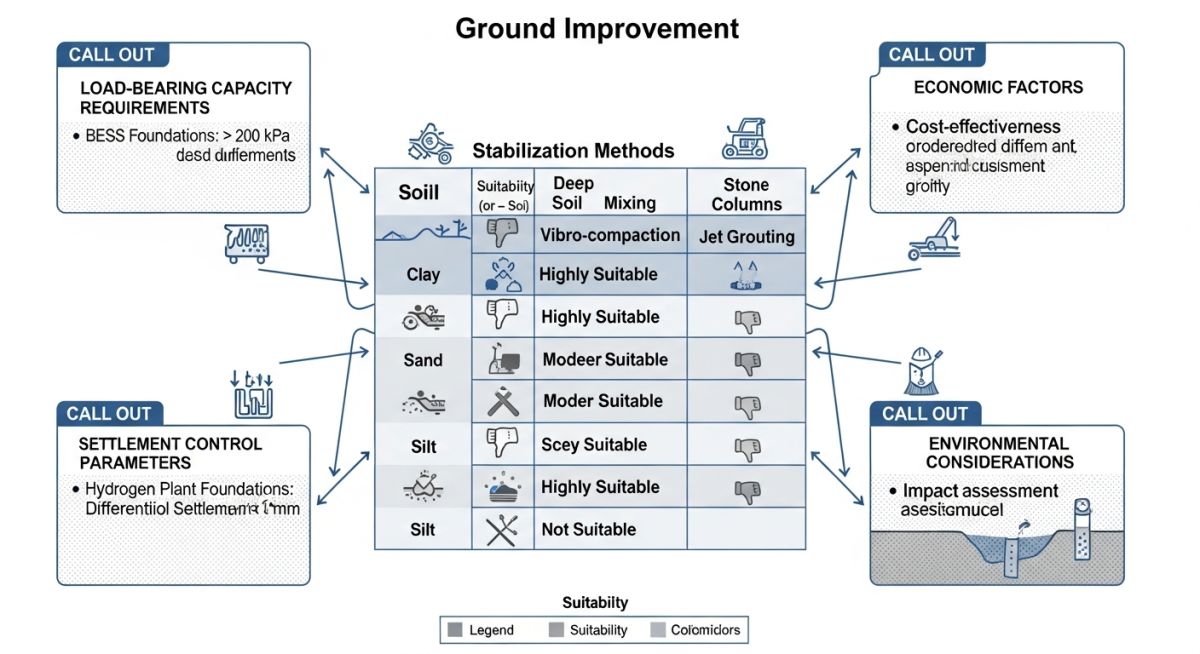
Selecting the appropriate ground improvement technique requires a rigorous evaluation of soil mechanics, project-specific load requirements, and environmental constraints. In my experience, the primary challenge in renewable energy projects—such as large-scale solar farms or Battery Energy Storage Systems (BESS)—is balancing cost-efficiency with the long-term settlement criteria required for sensitive electrical infrastructure.
The following table outlines the performance characteristics of common stabilization methods. These parameters are derived from ASCE guidelines and standard geotechnical practices. Engineers must verify these values against site-specific ASTM D-series testing protocols to ensure the design meets the required bearing capacity and settlement limits for the specific renewable energy technology being deployed.
| Method | Primary Soil Type | Improvement Mechanism | Typical Application |
|---|---|---|---|
| Vibro-Compaction | Granular/Sands | Densification | Solar Array Foundations |
| Deep Soil Mixing | Clays/Silts | Cementitious Bonding | BESS Containment Areas |
| Stone Columns | Soft Cohesive Soils | Reinforcement/Drainage | Hydrogen Plant Infrastructure |
Always remember that these methods are not universally applicable. A site with high organic content or excessive groundwater levels may require a hybrid approach, combining mechanical stabilization with chemical additives to achieve the necessary shear strength for heavy BESS equipment pads.
The successful execution of ground improvement projects relies on the precise alignment of geotechnical entities with international engineering standards. This matrix serves as a technical reference for project managers and design engineers to map specific soil parameters to the relevant regulatory frameworks and structural requirements.
By standardizing the nomenclature and the associated ISO or ASTM references, we reduce the risk of miscommunication during the procurement and construction phases. Each entity listed below represents a critical variable in the stability analysis of renewable energy sites, particularly where high-precision tracking systems or heavy battery modules are installed.
| Entity | Acronym | Standard Reference |
|---|---|---|
| Standard Penetration Test | SPT | ASTM D1586 |
| Cone Penetration Test | CPT | ASTM D5778 |
| California Bearing Ratio | CBR | ASTM D1883 |
Maintaining strict adherence to these standards ensures that the ground improvement design is defensible during third-party audits and insurance reviews. Always document the specific test method used, as variations in equipment or procedure can lead to significant discrepancies in the reported soil strength values.
Ground Improvement Verification Protocol: Before commencing any ground improvement works, a comprehensive site verification process is mandatory. This ensures that the design assumptions—often based on limited borehole data—align with the actual subsurface conditions encountered during the mobilization phase. In my experience, failing to verify these parameters leads to costly change orders and potential structural failure of sensitive renewable energy assets.
-
Geotechnical Baseline Review: Confirm that the ASCE geotechnical report covers the entire footprint, including access roads and BESS pad locations. -
Groundwater Table Assessment: Verify current water table levels against seasonal highs to prevent liquefaction risks during construction. -
Utility Clearance: Ensure all underground electrical and fiber-optic lines are mapped and protected before heavy vibratory equipment enters the site. -
Load-Bearing Validation: Perform post-improvement ASTM D1194 plate load tests to confirm the design bearing capacity is achieved. -
Settlement Monitoring: Install settlement plates at critical infrastructure points to track long-term performance under operational loads.
Each checkpoint must be signed off by the lead geotechnical engineer. If the site conditions deviate from the initial model, stop work immediately and re-evaluate the stabilization method. Renewable energy projects often have tight schedules, but the integrity of the foundation is the single most important factor in the project’s 25-year lifecycle.
Problem: Differential Settlement in BESS Facility
A 50MW BESS project encountered severe differential settlement during the initial site grading phase due to unexpected pockets of soft, compressible organic clay.
- Inadequate initial borehole density failing to identify localized soft lenses.
- High moisture content leading to rapid loss of shear strength under heavy battery container loads.
- Risk of structural misalignment for high-voltage interconnections.
Outcome: Successful Stabilization via Deep Soil Mixing
The project team implemented a targeted deep soil mixing program to create rigid soil-cement columns, effectively bridging the soft clay layers.
- Achieved a 40% increase in allowable bearing pressure across the BESS pad.
- Reduced predicted long-term settlement to within the 25mm tolerance limit.
- Maintained project schedule by utilizing rapid-set cement binders.
Recommendation: Always conduct a supplemental geotechnical investigation if the site topography suggests historical water accumulation. Early detection of soft soil pockets allows for cost-effective, localized ground improvement rather than expensive, site-wide foundation redesigns.
How does soil moisture affect ground improvement?
- High moisture requires pre-drainage or the use of lime-based additives to reduce plasticity.
- ASTM D698 testing is required to determine the optimum moisture content for compaction.
- Failure to control moisture leads to significant long-term settlement in BESS pads.
What are the risks of ignoring ground improvement?
- Differential settlement causing structural cracking in concrete pads.
- Tilt in solar trackers, leading to mechanical binding and motor failure.
- Liquefaction during seismic events, which can destroy BESS containment systems.
- Increased maintenance costs due to constant re-leveling of equipment.
When is vibro-compaction the best choice?
- Ideal for large-scale solar farms where rapid site preparation is required.
- Not effective in soils with more than 15% fines, as these dampen the vibrations.
- Requires careful monitoring of the vibration zone to avoid damaging adjacent structures.
How do I validate bearing capacity post-improvement?
- Plate Load Tests (ASTM D1194) to measure the modulus of subgrade reaction.
- Cone Penetration Testing (CPT) to verify the depth and consistency of the improved zone.
- Standard Penetration Testing (SPT) for correlation with historical site data.
Are there environmental impacts to soil stabilization?
- Use environmentally friendly binders where possible to minimize leaching.
- Monitor local water tables for changes in alkalinity or chemical composition.
- Ensure all stabilization materials comply with local environmental protection agency regulations.
What is the role of geosynthetics in improvement?
- Geogrids provide lateral confinement, increasing the bearing capacity of the base layer.
- Geotextiles prevent the migration of fines into the aggregate base, maintaining drainage.
- They are often used in conjunction with mechanical stabilization to reduce the total volume of imported fill.
Complete Course on
Piping Engineering
Check Now
Key Features
- 125+ Hours Content
- 500+ Recorded Lectures
- 20+ Years Exp.
- Lifetime Access
Coverage
- Codes & Standards
- Layouts & Design
- Material Eng.
- Stress Analysis

📚 Recommended Resources: Ground Improvement Techniques
Read these Guides
- 📄 Ground Improvement for Data Centres: Engineering Stability and Settlement Control
- 📄 Earthwork Considerations for Data Centres: Site Grading and Foundation Design
- 📄 Managing Geotechnical Risks in Green Hydrogen Infrastructure Projects
- 📄 Essential Foundation Design Inputs for Hydrogen Plant Geotechnical Reports