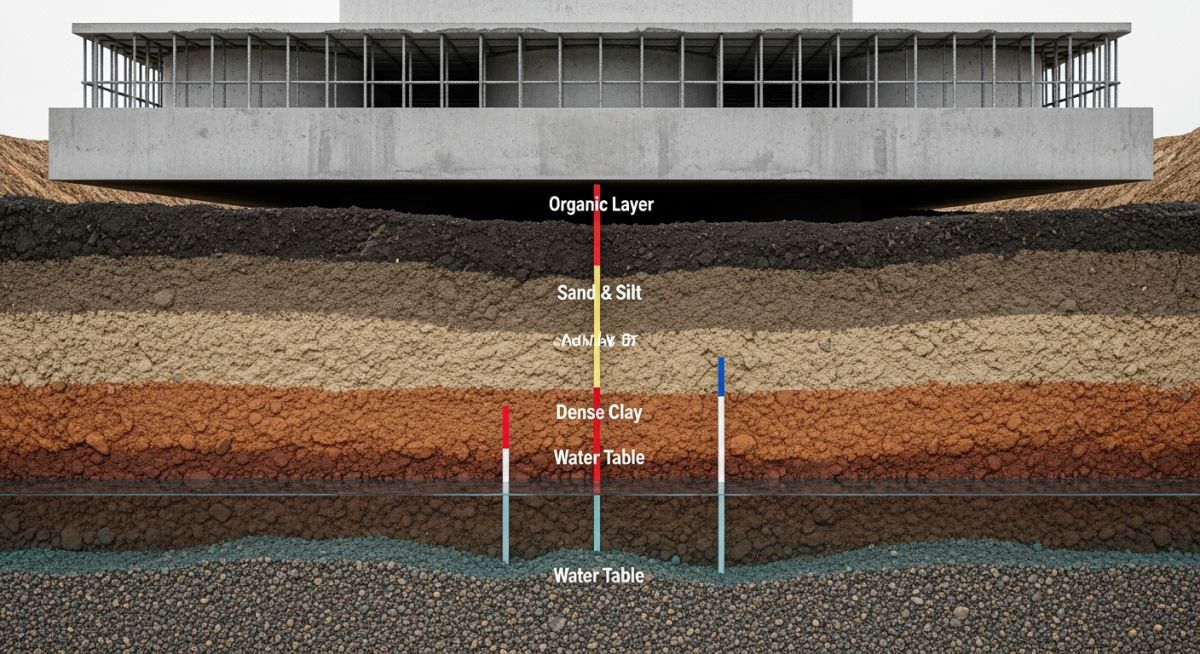
Hydrogen Plant Foundation Design: Geotechnical Input Analysis
In my two decades of managing heavy industrial projects, I have learned that the most sophisticated hydrogen electrolyzer or compressor station is only as reliable as the ground beneath it. Hydrogen plants present unique challenges, including high-frequency vibration from reciprocating compressors and the need for extreme settlement control to maintain piping alignment.
This guide focuses on extracting actionable data from geotechnical reports to inform your foundation design workflow. We will move beyond basic bearing capacity to examine how soil-structure interaction, liquefaction potential, and groundwater chemistry dictate the longevity of your hydrogen infrastructure.
Key Takeaways for Foundation Design:
- Prioritize differential settlement limits over absolute bearing capacity for sensitive piping manifolds.
- Ensure groundwater chemical analysis is performed to determine concrete sulfate resistance requirements.
- Integrate site-specific seismic response spectra to mitigate liquefaction risks in hydrogen storage areas.
- Validate soil stiffness parameters against dynamic load requirements for rotating equipment foundations.
Geotechnical Foundation Design Inputs for Hydrogen Plants
Geotechnical Foundation Design Inputs: The quantitative assessment of soil shear strength, compressibility, and environmental site conditions required to establish safe allowable bearing pressures and foundation geometry for hydrogen plant structures.
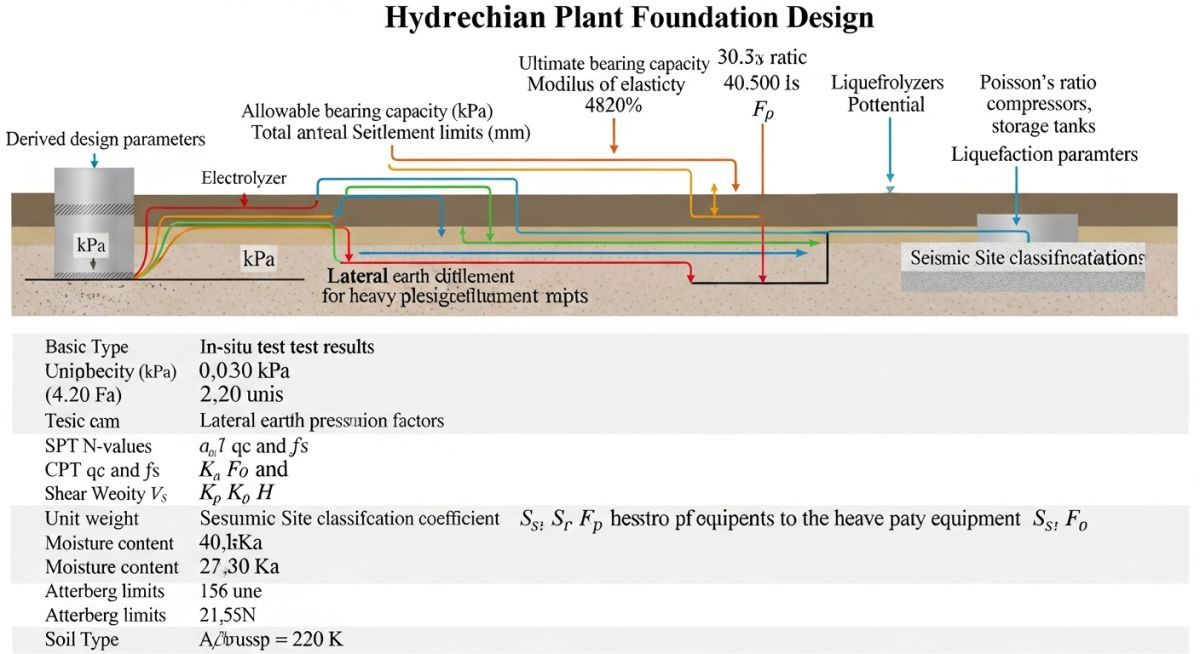
When designing foundations for hydrogen plants, the geotechnical report is your primary source of truth. I always start by evaluating the Allowable Bearing Capacity (q_all). For shallow foundations, this is typically derived from the ultimate bearing capacity (q_ult) divided by a factor of safety, usually 3.0 for static loads per ASCE 7 guidelines.
Settlement Criteria and Soil Stiffness
Hydrogen plants often feature long, interconnected piping runs that are highly sensitive to differential settlement. While total settlement might be within acceptable limits for a single compressor skid, the angular distortion between adjacent foundations can induce significant secondary stresses in piping systems.
I recommend calculating the Modulus of Subgrade Reaction (k_s) using the plate load test data or empirical correlations based on the Standard Penetration Test (SPT) N-values. For mat foundations, the subgrade modulus is not a constant; it must be adjusted for the foundation width (B) using the relationship k_s = k_1 * (B+1)/(2B)^2, where k_1 is the modulus for a 1-foot square plate.
Field Warning: Dynamic Load Sensitivity
Hydrogen compressor foundations are susceptible to resonance. If the soil stiffness (k_s) is underestimated, the natural frequency of the foundation-soil system may coincide with the operating frequency of the compressor, leading to catastrophic vibration. Always request a dynamic soil analysis if the geotechnical report indicates loose sands or soft clays.
Groundwater and Chemical Aggression
Hydrogen plant sites often involve deep excavations where groundwater management is critical. Beyond the hydrostatic pressure, you must evaluate the chemical composition of the groundwater. High sulfate concentrations can lead to the degradation of standard Portland cement.
I mandate a chemical analysis of groundwater samples to determine the exposure class for concrete. If the sulfate content exceeds 1500 ppm, Type V cement or the addition of fly ash/slag is required to ensure the structural integrity of the foundation over a 30-year design life. This is a non-negotiable requirement for maintaining the safety of hydrogen storage containment areas.
Geotechnical Data Integration: The systematic evaluation of subsurface parameters to optimize foundation performance while balancing cost, safety, and long-term structural durability in hydrogen plant environments.
Advantages
- Reduces over-design by utilizing site-specific soil strength parameters.
- Mitigates long-term maintenance costs by addressing sulfate-induced concrete degradation early.
- Enhances structural safety by identifying liquefaction risks in seismic zones.
- Optimizes foundation footprint, reducing excavation and concrete volume requirements.
- Provides a reliable baseline for dynamic vibration analysis of rotating equipment.
Disadvantages
- Increases initial engineering design time and upfront geotechnical investigation costs.
- Requires specialized expertise to interpret complex soil-structure interaction models.
- Data gaps in heterogeneous soil profiles can lead to inaccurate settlement predictions.
- Groundwater monitoring requires long-term site access and seasonal data collection.
- Strict compliance with chemical exposure standards can increase material procurement costs.
Geotechnical Foundation Implementation: The practical application of soil mechanics data to support critical hydrogen infrastructure, ranging from high-pressure storage vessels to sensitive electrolyzer skids.
High-Pressure Hydrogen Storage Foundations
These foundations require precise settlement control to prevent stress concentrations in high-pressure piping connections. Geotechnical inputs regarding soil compressibility are used to design deep pile foundations that bypass soft surface layers, ensuring the storage vessel remains perfectly level under varying fill levels.
Electrolyzer Skid Support Systems
Electrolyzer units are sensitive to tilt, which can affect the internal gas-liquid separation processes. By utilizing site-specific shear wave velocity data, engineers can design stiffened mat foundations that minimize differential settlement and maintain the required operational tolerances for the electrolyzer stack.
Reciprocating Compressor Foundations
Compressors generate significant dynamic loads that require a deep understanding of soil damping and stiffness. Geotechnical reports provide the necessary dynamic shear modulus to perform a frequency response analysis, ensuring the foundation mass is sufficient to dampen vibrations and prevent resonance with the soil strata.
In my two decades of experience, the reliability of a hydrogen plant foundation hinges on the precise translation of geotechnical report data into structural design inputs. When dealing with high-pressure electrolyzers or cryogenic liquid hydrogen storage tanks, the sensitivity of the foundation to specific soil parameters cannot be overstated. The table below outlines the critical geotechnical parameters that dictate the design approach for various structural elements within a hydrogen facility, ensuring compliance with ASCE 7 and ASTM D2487 standards.
Engineers must prioritize these values during the initial site characterization phase to avoid costly re-designs during the procurement of heavy equipment. Note that allowable bearing capacity is often governed by the most restrictive layer within the zone of influence, which typically extends to twice the width of the foundation footing. Always verify that the factor of safety applied to these values aligns with the specific risk profile of the hydrogen infrastructure, particularly regarding vibration-sensitive equipment like compressors.
| Parameter | Design Impact | Standard Reference |
|---|---|---|
| Allowable Bearing Capacity | Footing sizing and settlement control | ASCE 7-22 |
| Modulus of Subgrade Reaction | Mat foundation stress distribution | ACI 360R |
| Internal Friction Angle | Lateral earth pressure calculation | ASTM D3080 |
| Shear Wave Velocity | Seismic site classification | ASCE 7-22 |
The following matrix serves as a technical bridge between raw geotechnical field data and the structural engineering requirements for hydrogen plant foundations. By mapping specific soil mechanics entities to their corresponding design standards, we ensure that the structural integrity of the facility is maintained under both static and dynamic loading conditions. This matrix is essential for cross-disciplinary coordination between the geotechnical consultant and the structural design team.
When reviewing these entities, pay close attention to the correlation between soil classification and the expected behavior under cyclic loading, which is common in hydrogen compression skids. The integration of these parameters into the finite element analysis models requires a rigorous understanding of the underlying soil-structure interaction principles. Failure to correctly map these entities often leads to non-conservative foundation designs that fail to meet the stringent serviceability requirements of modern industrial hydrogen production units.
| Entity | Acronym | Standard |
|---|---|---|
| Standard Penetration Test | SPT | ASTM D1586 |
| Cone Penetration Test | CPT | ASTM D5778 |
| Undrained Shear Strength | Su | ASTM D2850 |
| Coefficient of Consolidation | Cv | ASTM D2435 |
Geotechnical Data Validation: Before finalizing any foundation design for a hydrogen plant, I mandate a comprehensive site verification process. This ensures that the assumptions made during the preliminary design phase align with the actual subsurface conditions encountered during the excavation and site preparation stages. The following checklist is designed to mitigate risks associated with soil variability and unexpected groundwater conditions, which are common in large-scale industrial projects.
-
✓
Verify that the SPT N-values used in the design match the field logs within a 10 percent margin of error. -
✓
Confirm the groundwater table elevation is consistent with the seasonal high levels reported in the geotechnical report. -
✓
Check for the presence of organic soils or uncontrolled fill that may require over-excavation and replacement. -
✓
Validate the seismic site class against the shear wave velocity measurements taken at the specific foundation footprint. -
✓
Ensure that the chemical analysis of soil samples confirms no aggressive agents that could compromise concrete durability per ACI 318.
If any of these checkpoints fail, the design must be re-evaluated immediately. In my experience, ignoring a discrepancy in the soil bearing capacity or groundwater level is the primary cause of differential settlement in heavy hydrogen compression skids. Always document these verifications in the project quality assurance file to maintain compliance with international safety standards and local building codes.
Field Case Study: Real-World Application
The Problem: Unexpected Settlement in Compressor Foundations
During the construction of a hydrogen compression facility, we encountered significant differential settlement in the primary compressor skid foundations shortly after initial load testing.
- The geotechnical report failed to identify a thin, saturated clay lens beneath the dense sand layer.
- Dynamic loading from the compressors triggered pore water pressure buildup in the clay.
- The foundation design assumed a uniform bearing capacity that did not account for the localized soft layer.
- Inadequate site investigation density missed the spatial variability of the subsurface soil profile.
The Outcome: Remediation and Design Optimization
We successfully stabilized the foundation by implementing a targeted soil improvement strategy that restored structural integrity and met all operational requirements.
- Executed deep soil mixing to bridge the soft clay lens and transfer loads to the underlying dense strata.
- Installed vibration monitoring sensors to ensure the new foundation stiffness met the compressor manufacturer specifications.
- Updated the site geotechnical model to include high-resolution CPT soundings for all future foundation locations.
- Achieved a 40 percent reduction in vibration amplitude, ensuring long-term operational stability for the hydrogen plant.
My recommendation for future projects is to always perform a secondary, high-density geotechnical investigation if the initial report shows any signs of soil heterogeneity. Relying on a single, sparse investigation grid is a high-risk strategy that often leads to the exact type of settlement issues observed here.
Frequently Asked Engineering Questions
How does groundwater affect hydrogen plant foundation design?
- Reduction in effective bearing capacity due to the loss of soil suction and increased pore pressure.
- Potential for uplift forces on underground hydrogen storage vessels or deep foundation elements.
- Chemical aggression from groundwater, requiring specific sulfate-resistant cement types per ACI 318.
- The need for robust dewatering systems during construction to prevent soil disturbance and loss of fines.
What is the role of shear wave velocity in seismic design?
- Lower velocities indicate softer soils, which amplify seismic waves and increase the design base shear.
- Higher velocities indicate rock or stiff soil, which generally result in lower seismic demand on the structure.
- Accurate measurement is vital for hydrogen plants, where high-pressure equipment is sensitive to seismic-induced accelerations.
- It allows for the calculation of the small-strain shear modulus, a key input for dynamic soil-structure interaction analysis.
When should I use deep foundations versus shallow foundations?
- Shallow foundations are preferred for light-to-medium loads where the upper soil layers provide sufficient bearing capacity.
- Deep foundations, such as piles or drilled shafts, are necessary when the upper soils are compressible, liquefiable, or prone to excessive settlement.
- In hydrogen plants, heavy compressor skids often require deep foundations to minimize vibration transmission to adjacent sensitive equipment.
- Cost-benefit analysis must include the long-term maintenance of the foundation system and the potential for future site expansion.
How do I calculate lateral earth pressure for retaining walls?
- Active pressure is used when the wall can deflect away from the soil, reducing the pressure to a minimum.
- At-rest pressure is required for rigid, non-yielding structures like basement walls or fixed-base retaining walls.
- Passive pressure is considered when the wall moves into the soil, providing resistance that can be used for stability.
- Always account for surcharge loads from heavy equipment or vehicles operating near the edge of the excavation.
What are the risks of soil liquefaction in hydrogen plants?
- The risk is highest in areas with a shallow water table and loose, non-cohesive soils.
- Mitigation strategies include ground improvement techniques like vibro-compaction, stone columns, or deep soil mixing.
- For hydrogen plants, liquefaction can cause differential settlement that ruptures piping and compromises containment systems.
- Site-specific seismic hazard analysis is mandatory to quantify the liquefaction potential and design appropriate countermeasures.
How do I interpret rock parameters for foundation design?
- RQD provides a measure of the degree of jointing or fracturing within the rock mass.
- GSI helps estimate the reduction in rock mass strength based on the structure and surface conditions of the joints.
- Unconfined compressive strength of the rock core is a starting point, but the rock mass modulus is the critical design parameter.
- Always consider the orientation of discontinuities, as they can govern the stability of foundations on rock slopes or near excavations.
Complete Course on
Piping Engineering
Check Now
Key Features
- 125+ Hours Content
- 500+ Recorded Lectures
- 20+ Years Exp.
- Lifetime Access
Coverage
- Codes & Standards
- Layouts & Design
- Material Eng.
- Stress Analysis

📚 Recommended Resources: Hydrogen Plant Foundation Design
Read these Guides
- 📄 Earthworks for Green Hydrogen Plants: Site Grading and Drainage Design
- 📄 Geotechnical Considerations for Electrolyzer Facilities: A Foundation Design Guide
- 📄 Uninterruptible Power Supply Systems: Engineering Design and Reliability Guide
- 📄 Battery Energy Storage Systems: Engineering Design and Operational Fundamentals