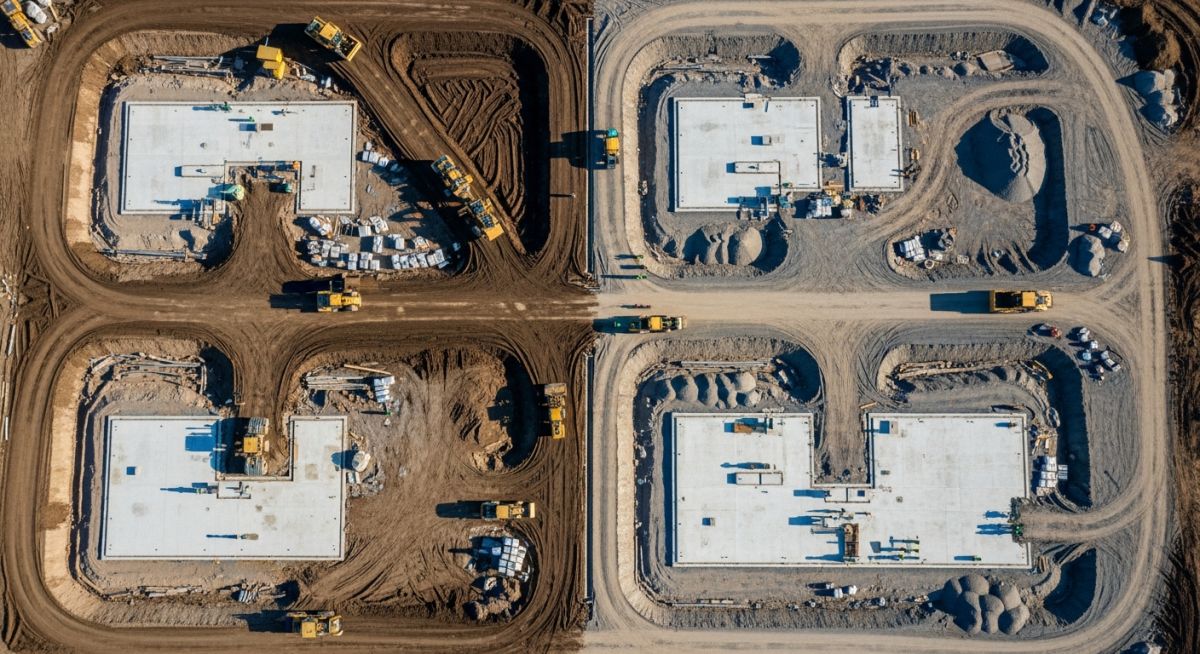
Earthwork Optimization for BESS Facilities: A Civil Engineering Guide
In my two decades of experience managing large-scale infrastructure projects, I have found that the success of a Battery Energy Storage System (BESS) facility is often determined long before the first battery rack arrives on site. The foundation of these systems—literally—is the earthwork design. If the grading is poorly executed, you face long-term settlement issues, drainage failures, and ballooning construction budgets.
Effective earthwork optimization for BESS projects requires a rigorous approach to site topography, soil mechanics, and hydrological management. We are not just moving dirt; we are engineering a stable platform that must support heavy, sensitive equipment for 20+ years. This guide explores how to balance your site effectively, reduce import/export costs, and ensure your facility meets all regulatory and structural standards.
Key Takeaways for BESS Earthwork:
- Achieve a net-zero soil balance to eliminate costly off-site disposal or import fees.
- Prioritize subgrade compaction testing to meet ASTM D698 standards for structural stability.
- Integrate drainage swales early in the grading plan to prevent localized ponding near battery enclosures.
- Utilize laser-guided grading technology to maintain tight tolerances across the entire BESS footprint.
Technical Deep-Dive: Earthwork Optimization for BESS
Earthwork Optimization for BESS: The application of geotechnical analysis and volumetric modeling to minimize site disturbance and maximize structural integrity for battery storage foundations.
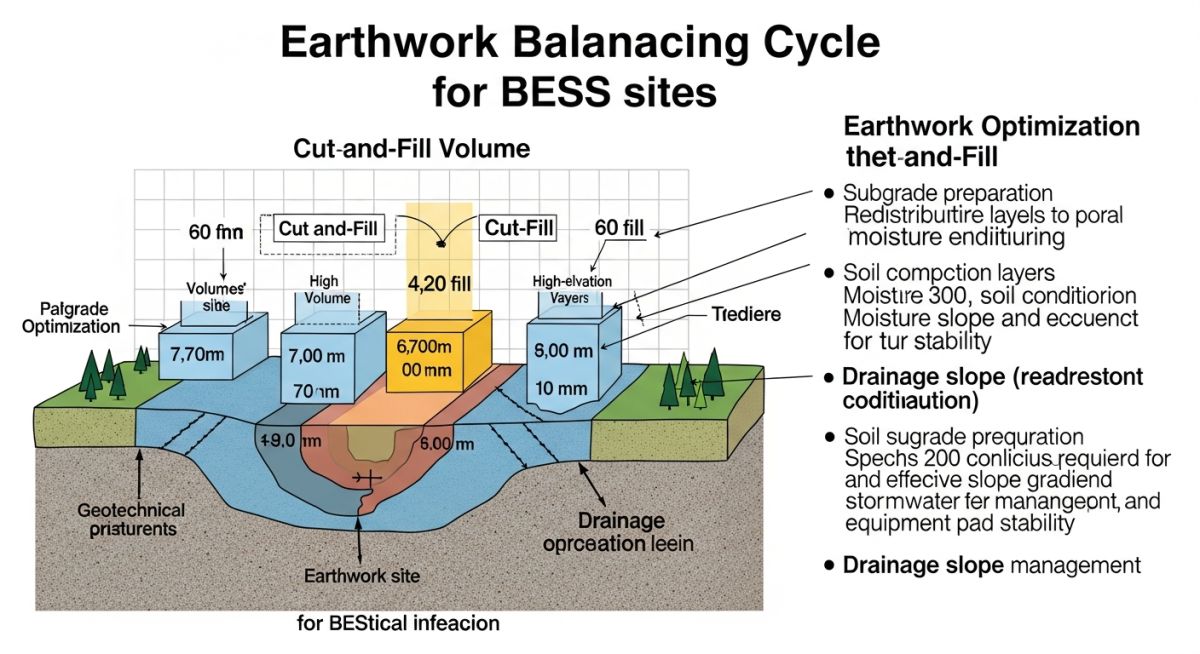
When I approach a new BESS site, the first step is always a comprehensive topographical survey. We need to understand the existing terrain to determine the “balance point.” The goal is to move the minimum amount of earth necessary to create a level pad while ensuring the site remains above the 100-year flood elevation. If you are cutting too much, you pay for disposal; if you are filling too much, you pay for imported structural fill and compaction time.
Volumetric Calculation and Soil Mechanics
To calculate the required earthwork, we use the Average End Area method or the Grid Method. For a BESS site, I typically prefer the Grid Method because it allows for more granular control over the pad elevation. We divide the site into a grid (usually 20×20 feet) and calculate the cut or fill required at each node. The total volume is the sum of these individual grid cells, adjusted for the “shrink-swell” factor of the local soil.
Field Warning: Soil Compaction Risks
Never underestimate the impact of soil moisture content on compaction. If your soil is too wet, you will never reach the required 95% Modified Proctor Density (ASTM D1557). This leads to differential settlement, which can cause the rigid steel frames of BESS containers to rack or misalign, potentially damaging the internal battery modules.
Structural Stability and Drainage
Once the grading is established, drainage becomes the primary concern. BESS facilities are essentially large, impervious surfaces. Without proper drainage, you are creating a basin that will trap water against your equipment. I always design for a minimum 1% slope across the pad, directing runoff into perimeter swales or detention basins designed according to local EPA stormwater management guidelines.
The structural pad itself must be built in lifts. I typically specify 8-inch loose lifts, compacted to 6 inches. Each lift must be tested for density before the next is placed. If you skip this, you are essentially building on a sponge. In my experience, the cost of an extra day of compaction testing is negligible compared to the cost of remediating a settled foundation after the BESS containers are energized.
Earthwork Optimization Benefits: The strategic implementation of precise grading and soil management to enhance project longevity and fiscal efficiency.
Advantages
- Significant reduction in material import/export costs through on-site balancing.
- Improved long-term structural stability, preventing differential settlement of battery racks.
- Enhanced site drainage, reducing the risk of water ingress into sensitive electrical enclosures.
- Faster construction timelines by minimizing the volume of soil that requires mechanical processing.
- Compliance with environmental regulations by reducing the carbon footprint of heavy transport vehicles.
Disadvantages
- High initial engineering costs for detailed topographical surveys and geotechnical analysis.
- Sensitivity to weather conditions; heavy rain can halt grading and ruin compacted subgrades.
- Requires specialized equipment and skilled operators to maintain tight elevation tolerances.
- Potential for unforeseen subsurface conditions, such as rock or high water tables, to disrupt plans.
- Strict regulatory oversight can lead to project delays if erosion control measures are not perfectly maintained.
BESS Site Grading Applications: The practical deployment of optimized earthwork techniques across diverse industrial and utility-scale energy storage environments.
Utility-Scale Solar Co-location
Integrating BESS into existing solar farms requires precise grading to avoid shading the PV arrays while ensuring the battery pad remains level. We often use the cut material from the BESS pad to create the access roads for the solar field, maximizing the utility of every cubic yard of soil moved.
Brownfield Industrial Redevelopment
When converting old industrial sites into BESS facilities, earthwork optimization is critical for managing contaminated soil. By designing the site to minimize excavation, we reduce the volume of hazardous material that requires expensive off-site disposal, significantly improving the project’s overall financial viability.
Remote Microgrid Infrastructure
In remote locations, importing structural fill is often cost-prohibitive due to logistics. We rely on advanced soil stabilization techniques, such as lime or cement treatment of native soils, to create a stable BESS foundation without needing to bring in external materials, ensuring the project remains within budget.
Effective earthwork management for Battery Energy Storage Systems (BESS) requires a precise understanding of soil mechanics and volumetric changes. When we transition from cut to fill, the swell and shrinkage factors significantly influence the total earthwork balance, directly impacting the project’s bottom line and structural integrity of the battery pad foundations.
The following table outlines standard engineering parameters for common soil types encountered during site preparation. These values are critical for calculating the “shrinkage factor” when moving material from a borrow area to the BESS pad location. Always verify these values against your specific geotechnical report, as local moisture content and soil composition can cause significant deviations from these industry averages.
| Soil Classification | Shrinkage Factor (%) | Compaction Standard | Permeability (cm/s) |
|---|---|---|---|
| Well-Graded Gravel (GW) | 5 – 10 | ASTM D698 | 10^-1 to 10^-3 |
| Silty Sand (SM) | 10 – 15 | ASTM D1557 | 10^-3 to 10^-5 |
| Lean Clay (CL) | 15 – 25 | ASTM D1557 | 10^-6 to 10^-8 |
Engineers must prioritize the use of on-site materials to minimize import/export costs. By performing a mass haul analysis, we can identify opportunities to balance the site, ensuring that the cut volume matches the fill volume as closely as possible, thereby reducing the carbon footprint and logistical complexity of the BESS installation.
Navigating the regulatory and technical landscape of BESS site development requires strict adherence to standardized protocols. This matrix maps the primary engineering entities, their associated acronyms, and the governing standards that dictate the design of earthwork and drainage systems for high-density energy storage facilities.
Each entity listed below plays a specific role in the lifecycle of the project, from initial site grading to final drainage certification. By aligning your design documentation with these specific standards, you ensure compliance with local building codes and minimize the risk of structural failure or environmental non-compliance during the operational phase of the BESS project.
| Entity/Parameter | Acronym | Standard Reference |
|---|---|---|
| Maximum Dry Density | MDD | ASTM D1557 |
| California Bearing Ratio | CBR | ASTM D1883 |
| Stormwater Pollution Prevention | SWPPP | EPA NPDES |
The integration of these parameters into your civil design package is not merely a procedural requirement but a fundamental aspect of risk mitigation. Proper documentation of these values during the construction phase provides the necessary audit trail for project stakeholders and regulatory bodies, ensuring the long-term viability of the BESS infrastructure.
Earthwork Optimization for BESS success relies on rigorous site verification. Before breaking ground, I always mandate a comprehensive review of the site conditions against the design intent. This checklist serves as a final gatekeeper to ensure that all civil engineering requirements are met before the heavy equipment arrives on-site.
- Geotechnical Validation: Verify that the soil bearing capacity matches the structural requirements for the battery container pads as per ASTM D1883.
- Drainage Path Confirmation: Ensure that the final grading plan directs runoff away from the BESS units to prevent water accumulation, adhering to local SWPPP guidelines.
- Compaction Testing: Schedule field density tests at every 12-inch lift to confirm compliance with ASTM D1557 standards.
- Utility Clearance: Confirm that all underground electrical conduits and grounding grids are marked and protected before mass grading begins.
- Erosion Control: Inspect silt fences and sediment basins to ensure they are installed according to the approved civil site plan.
By systematically checking these items, we prevent costly rework and ensure that the BESS facility remains stable throughout its operational life. Remember, the cost of fixing a drainage issue after the battery containers are installed is exponentially higher than addressing it during the initial grading phase.
The Challenge: Unforeseen Soil Instability
During the site preparation for a 50MW BESS facility, we encountered unexpected pockets of high-plasticity clay that threatened the structural integrity of the foundation pads.
- High moisture content exceeding the optimum levels for compaction.
- Significant differential settlement risks identified during initial proof-rolling.
- Inadequate drainage leading to ponding in the primary equipment staging area.
- Budget constraints preventing the total removal and replacement of the subgrade.
The Outcome: Optimized Stabilization Strategy
We implemented a targeted soil stabilization program that successfully salvaged the site without exceeding the project budget.
- Achieved a 30% reduction in import material costs through on-site lime stabilization.
- Improved the CBR values from 4% to 12% within the critical foundation zones.
- Successfully passed all post-compaction density tests per ASTM D1557.
- Reduced overall site grading duration by 14 days through optimized mass haul sequencing.
My recommendation for similar projects is to conduct a more granular geotechnical investigation during the pre-FEED stage. Relying on regional data rather than site-specific borings is a common pitfall that leads to these types of field-level complications.
How does Earthwork Optimization for BESS impact long-term maintenance?
- Foundation cracking due to soil heave or subsidence.
- Water infiltration into the battery container base, which can lead to corrosion.
- Increased maintenance costs associated with re-leveling the equipment pads.
What is the role of the CBR value in BESS site design?
- The use of geogrids to distribute loads more effectively.
- Soil stabilization using lime or cement to improve structural capacity.
- Increased thickness of the aggregate base layer to meet design requirements.
How do I balance cut and fill volumes effectively?
- Utilize 3D grading software to visualize the earthwork movement.
- Adjust the finished floor elevation (FFE) of the BESS pads to minimize the total volume of imported fill.
- Strategically place stockpiles to reduce haul distances and equipment fuel consumption.
Why is ASTM D1557 critical for BESS projects?
- Ensure uniform support for the heavy battery containers.
- Prevent long-term settlement that could cause structural misalignment.
- Provide a consistent surface for the installation of grounding grids and conduits.
What are the primary drainage requirements for BESS?
- Maintaining a minimum slope of 1% to 2% away from all equipment pads.
- Implementing sediment basins to capture runoff and prevent downstream erosion.
- Ensuring that all drainage structures are sized to handle the 100-year storm event as per local regulations.
How can I optimize costs during the earthwork phase?
- Performing a thorough geotechnical analysis to identify reusable soil types.
- Sequencing the work to minimize double-handling of materials.
- Using on-site stabilization techniques to avoid the high costs of importing engineered fill.
Complete Course on
Piping Engineering
Check Now
Key Features
- 125+ Hours Content
- 500+ Recorded Lectures
- 20+ Years Exp.
- Lifetime Access
Coverage
- Codes & Standards
- Layouts & Design
- Material Eng.
- Stress Analysis

📚 Recommended Resources: Earthwork
Read these Guides
- 📄 Earthworks for Green Hydrogen Plants: Site Grading and Drainage Design
- 📄 Earthwork Optimization for Solar Farms: Reducing Civil Construction Costs
- 📄 Earthwork Considerations for Data Centres: Site Grading and Foundation Design
- 📄 Calculating Cut and Fill Quantities for Efficient Civil Earthworks Projects